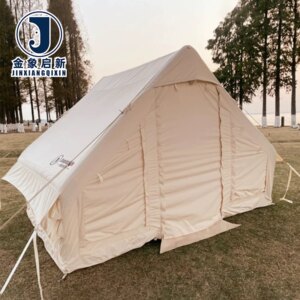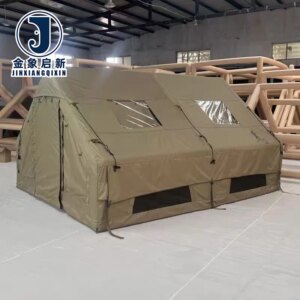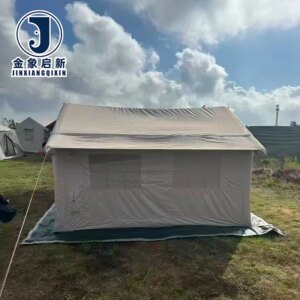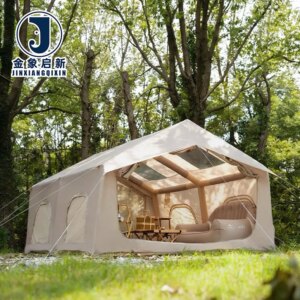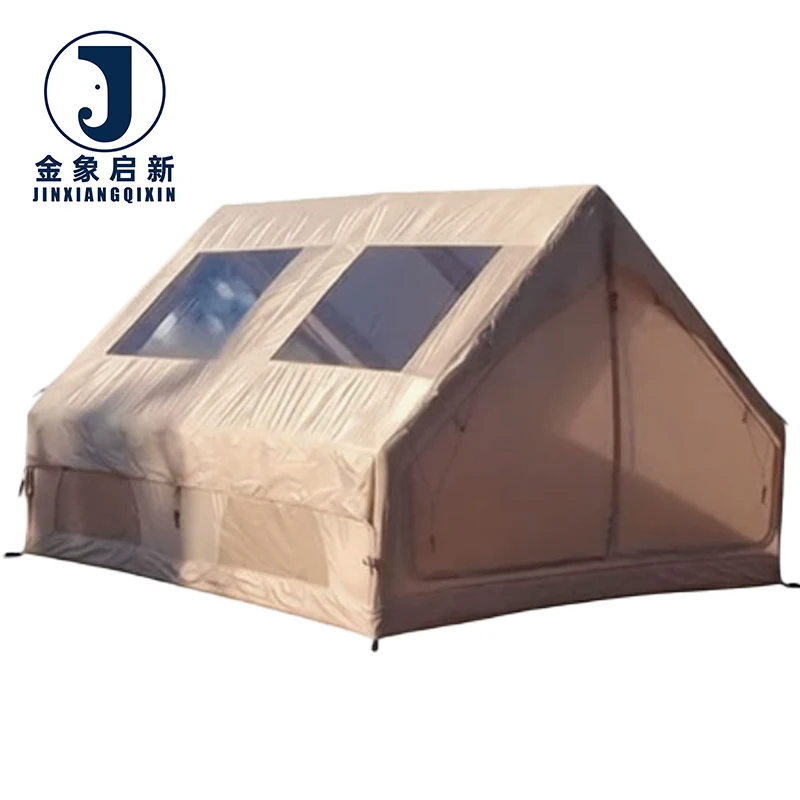
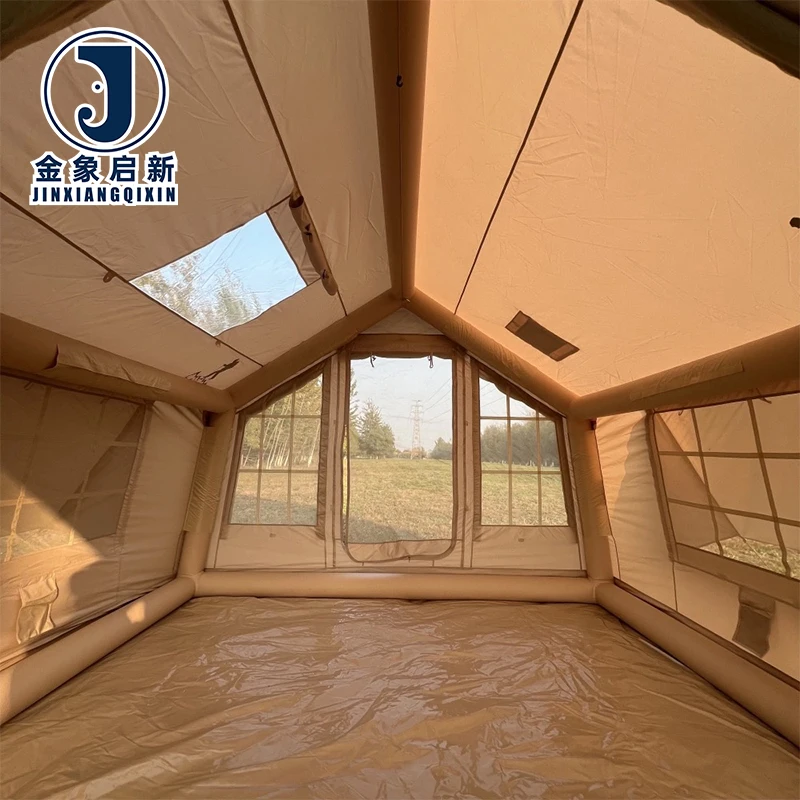
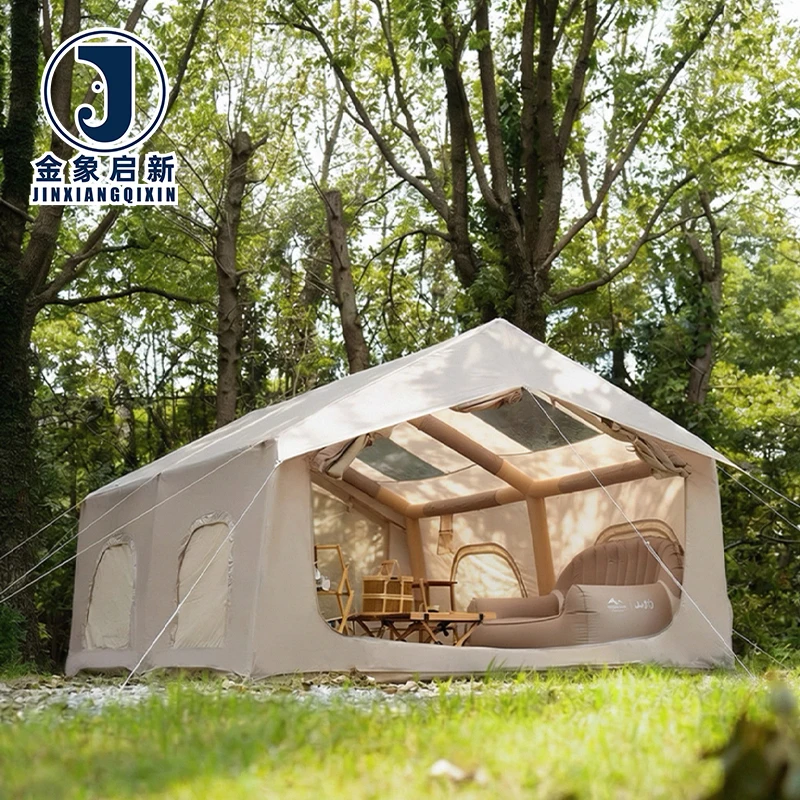
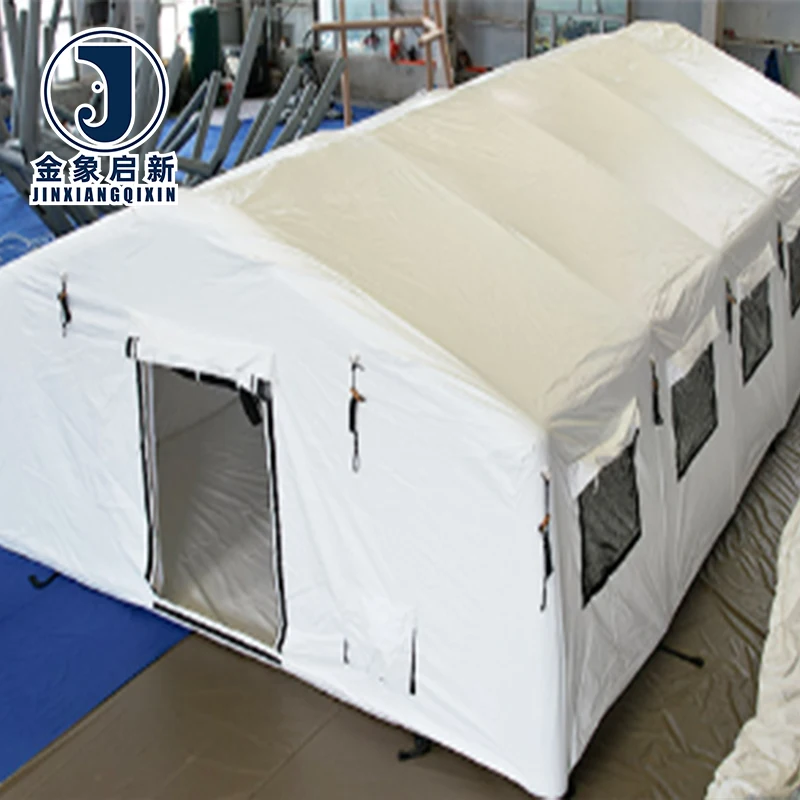
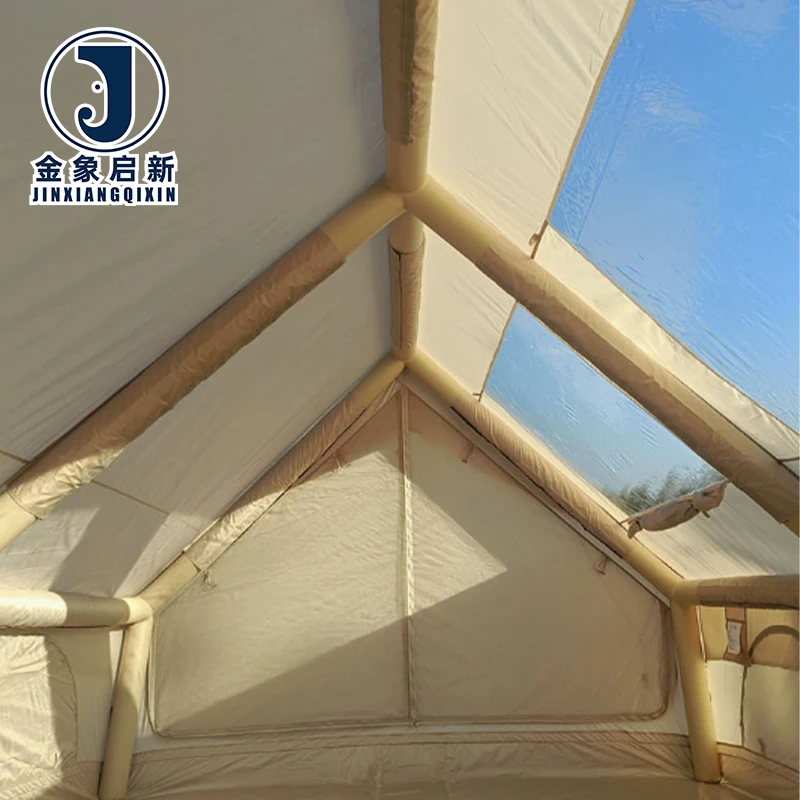
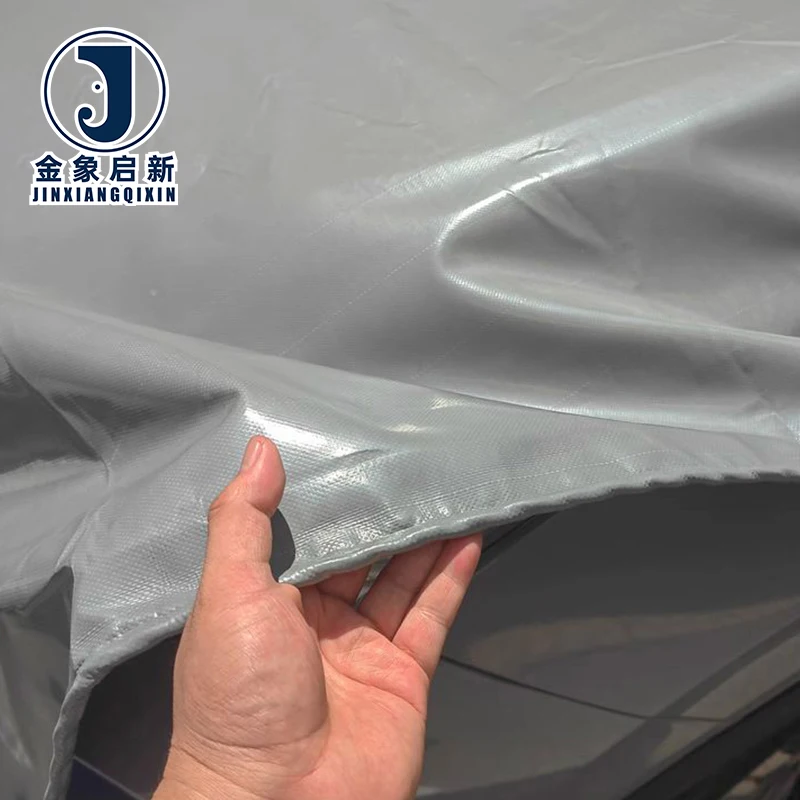
Luxury Inflatable Camping Tent With Skylight for 6-8 Person — PVC tarpaulin construction with waterproof, UV-resistant and fire-retardant treatment for commercial glamping applications.
- Designed for inflatable and membrane structure fabric projects, from material selection through finished tent delivery with pattern printing and branding options
- Knife coating process ensures uniform thickness and consistent tear resistance across every panel, while heat-welded seams eliminate leakage at stress points
Backed by 3 full production lines, 36 sets of professional equipment and a 10-person R&D team handling custom sizing, samples developed within days.
Description
Full-Catalogue Custom Range — Every roll undergoes stage-by-stage QA before leaving the 9,180 m² facility, ensuring colour and coating consistency across multi-unit inflatable glamping deployments.
Technical Specifications
| Parameter | Value |
|---|---|
| Product Type | Inflatable Tent |
| Core Material | PVC tarpaulin |
| Coating Method | Knife coated (刀刮涂层工艺) |
| Capacity | 6-8 person |
| Key Feature | Skylight |
| Waterproof Rating | Waterproof (grade not stated in source) |
| UV Treatment | UV-resistant (test basis not stated in source) |
| Flame Retardant | Fire-retardant (grade not stated in source) |
| Anti-Static | Anti-static (standard not stated in source) |
| Tear Resistance | Tear-resistant (test standard not stated in source) |
| Seam Construction | Waterproof seam welding |
| Customization | OEM & ODM available |
| Standards | ISO9001, ISO14001, ISO45001, CE |
Application Suitability
| Application | Exposure & Requirement |
|---|---|
| Commercial glamping resorts | Seasonal weather cycling, repeated inflation cycles, guest-facing aesthetics with consistent colour across units |
| Outdoor festival accommodation | Rapid deployment and breakdown, high foot traffic abrasion, short-interval re-use across multiple events |
| Corporate retreat pop-ups | Branded exterior printing, frequent transport and storage between bookings, UV exposure during extended setups |
| Tourism glamping operations | Continuous outdoor exposure through variable climates, waterproof integrity under wind-driven rain, fire-retardant compliance for hospitality zoning |
Why Coating Consistency Decides Glamping Tent Longevity
Batch-to-batch colour drift and uneven coating weight are the two most frequent complaints from glamping operators buying multiple inflatable tent units at once.
When a resort deploys ten or more custom inflatable glamping tents across a site, even slight shade variation between rolls becomes immediately visible once the units stand side by side. Guests notice it, and so do event photographers. Beyond aesthetics, uneven coating thickness means some panels carry more structural load than others under wind pressure, shifting failure risk to the thinnest sections [NEED_CITE: tensile and tear test methods for coated fabrics per ISO 1421]. Our QA protocol checks coating weight at multiple points across each production run, keeping deviation within controlled limits so that every Inflatable Tent Fabric manufacturer order arrives uniform from first roll to last.
Matching Material Grade to Deployment Cycle
Selecting the right PVC tarpaulin grade for inflatable tent applications depends on how often the structure is inflated, deflated, and relocated. Commercial festival operators who redeploy tents weekly subject the fabric to repeated fold-line stress that static resort installations never encounter. The knife-coated construction used here produces a uniform coating-to-substrate bond that resists delamination at fold points, an area where cheaper laminated fabrics often separate after limited use cycles. Our 10-person R&D team reviews each client’s deployment frequency and recommends the appropriate coating weight and base fabric density accordingly, ensuring the material specification matches the actual operational demand rather than a generic catalogue default.
Seam Welding and Air Retention Under Real Conditions
Inflatable tents rely on continuous air pressure to maintain structural shape, which means every welded seam operates under constant stress. Unlike stitched construction where needle holes create potential leakage paths, waterproof seam welding fuses the PVC layers into a continuous barrier. The critical variable is weld temperature control: too cool and the bond is superficial, too hot and the base fabric weakens at the join [NEED_CITE: thermal welding parameters for PVC coated fabrics]. Our 36 sets of professional processing equipment include dedicated welding stations calibrated to the specific coating formulation, producing seams that hold pressure through the flex and movement that inflated structures experience under wind load. This matters especially at the junctions where air beams meet the base panel, the zones where most inflatable structures lose pressure first.
What the Specification Sheet Actually Tells You
Understanding how PVC tarpaulin specifications translate into real-world tent performance requires looking beyond single numbers. Coating weight alone does not determine strength; it is the combination of base fabric denier, weave density, and coating penetration that defines tear propagation resistance. Knife coating pushes PVC paste into the textile substrate under controlled blade pressure, creating mechanical interlock that determines how well the coating stays bonded during inflation cycles. Fire-retardant additives integrated at the coating stage are available in flame retardant grades — confirm the grade required for your market before specifying, because hospitality and event venue codes vary significantly by jurisdiction. UV-resistant formulation protects the polymer chains from photo-degradation during extended outdoor deployment, though the actual service life depends on latitude, orientation, and seasonal use patterns [NEED_CITE: UV degradation testing standards for PVC tarpaulin]. The skylight feature requires a separate material zone with different light transmission properties, which must be welded in without creating a weak point in the air beam structure.
The Hidden Cost of Under-Specifying Event Fabric
When procurement focuses on unit price rather than coating verification, the savings evaporate quickly once tents reach the site. Fabric delivered lighter than the quoted GSM will inflate correctly at first but shows stress whitening at beam junctions far sooner than expected. Flame-retardant claims without supporting test documentation create compliance risk at the venue inspection stage, where authorities can shut down an event if the tent material lacks the correct certification [NEED_CITE: DIN 4102 fire classification for building materials]. Colour mismatch between production batches forces operators to either accept a visually inconsistent site or delay opening while replacement panels are manufactured. Weld failures at peak inflation pressure mean not just repair cost but lost revenue from cancelled bookings during the downtime.
What Sets This Supply Chain Apart
Our three full production lines run dedicated coating, welding, and finishing stages rather than batching multiple products through shared equipment, which keeps contamination risk low and colour consistency high. The 10-person R&D team handles custom inflatable glamping tent development from initial material selection through sample fabrication, typically producing validation samples within days rather than weeks. Every roll passes through in-process quality checks at coating, curing, and winding stages, with a full pre-shipment inspection covering visual, dimensional, and air-retention criteria before dispatch. Custom sizing, skylight integration, pattern printing, and structural modifications are handled in-house rather than outsourced to secondary converters, maintaining single-point accountability from fibre to finished tent. Documentation accompanies every shipment, giving buyers traceable records that satisfy venue compliance audits and resort procurement requirements.
Documentation & Verification
- Material specification sheet stating base fabric denier, coating method, and treatment details per order
- Test report for UV and flame-retardant grades provided with shipment documentation where applicable
- Pre-shipment inspection record with air pressure leakage verification on completed tent units
- Colour reference standard documented per batch to enable cross-order consistency checks
- Certificate of origin and customs documentation included for international glamping project shipments
Fabrication, Handling & Storage
- Weld temperature profiles are set to the specific knife-coated PVC formulation to prevent base fabric weakening at seam junctions
- Store rolls upright on pallets to avoid compression creases that become permanent fold marks in the PVC coating
- Clean skylight panels with neutral pH solutions only; solvent-based cleaners attack the plasticiser in the coating layer
- Allow fabric to reach ambient temperature before unfolding in cold conditions to prevent coating crack at fold lines
- Repair minor punctures with compatible PVC welding patches, matching the knife-coated formulation for proper adhesion
What to Include in Your Enquiry
Provide your intended deployment environment, expected inflation cycles per season, and the fire-retardant grade your local venue authority requires. Specify whether you need finished tent units with skylight integration or fabric rolls for your own manufacturing, along with target colour references and any pattern printing requirements. Confirm your required lead time and whether sample approval is needed before bulk production begins.
Frequently Asked Questions
Q: How is PVC coating weight verified on arrival?
A: We provide a material specification sheet with each shipment stating the base fabric and coating weight. Buyers can verify by cutting a measured sample from the delivered roll and weighing it against the documented value. Our pre-shipment inspection records include coating weight measurements taken at multiple points across each production batch.
Q: What fire-retardant grade does the tent fabric carry, and does it meet my local event venue code?
A: The fabric is available in fire-retardant grades, but the specific classification depends on your market requirements. Confirm the standard your local authority enforces, such as DIN 4102 or NFPA 701, and we will match the formulation accordingly. Test reports for the applicable grade accompany the shipment documentation.
Q: What UV test data supports the anti-UV claim for multi-season glamping use?
A: UV-resistant additives are integrated into the coating formulation to slow polymer degradation during outdoor exposure. The specific test basis is documented upon request. Actual service life depends on installation latitude, seasonal deployment duration, and orientation. Request the test report to evaluate suitability for your specific climate zone.
Q: What custom sizing, skylight, and ventilation options are available, and what is the MOQ?
A: Custom sizing, skylight integration, ventilation panel placement, and structural modifications are all handled by our R&D team. Minimum quantities depend on the complexity of the customisation and the colour or print specification. Provide your dimensional drawings and we will confirm MOQ and lead time within our standard quotation process.
Q: How is pattern printing and color matching handled across multiple tent units in one order?
A: Colour references are locked per batch using standardised reference systems, and our QA protocol checks shade consistency at multiple points during production. Pattern printing is applied in-house using equipment calibrated to the PVC coating surface. Pre-production samples are available for approval before the full order runs, ensuring all units match when deployed side by side.
Related products
-
Inflatable Tent Four-Season Quick Automatic Opening PVC 3000mm Waterproof Foldable Eco-Friendly 2-3/3-4/6-8 Person Outdoor Use
Read more -
Outdoor Waterproof Inflatable Tent for Camping Portable Air Camping Tent Shelter
Read more -
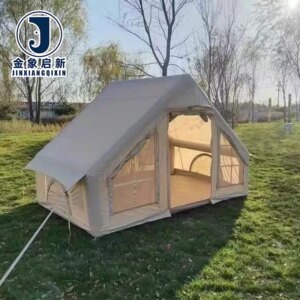
Outdoor Portable Camping Inflatable Tent Luxury All-Season Use Overnight Large Space Rainproof Insulated Quick Automatic Opening
Read more -
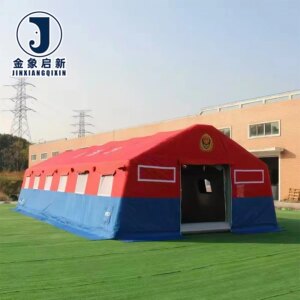
خيمة فاخرة قابلة للنفخ من PVC للتخييم الفاخر في الهواء الطلق مقاومة للماء مع تصميم سريع الفتح التلقائي قابل للطي لجميع الفصول ومضخة
Read more