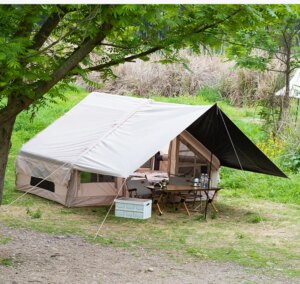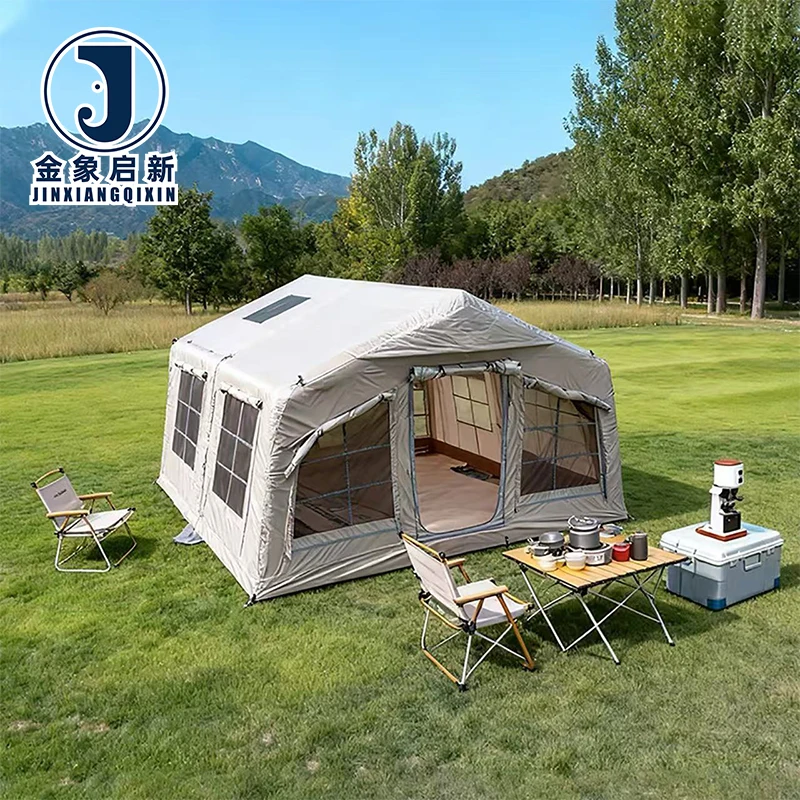
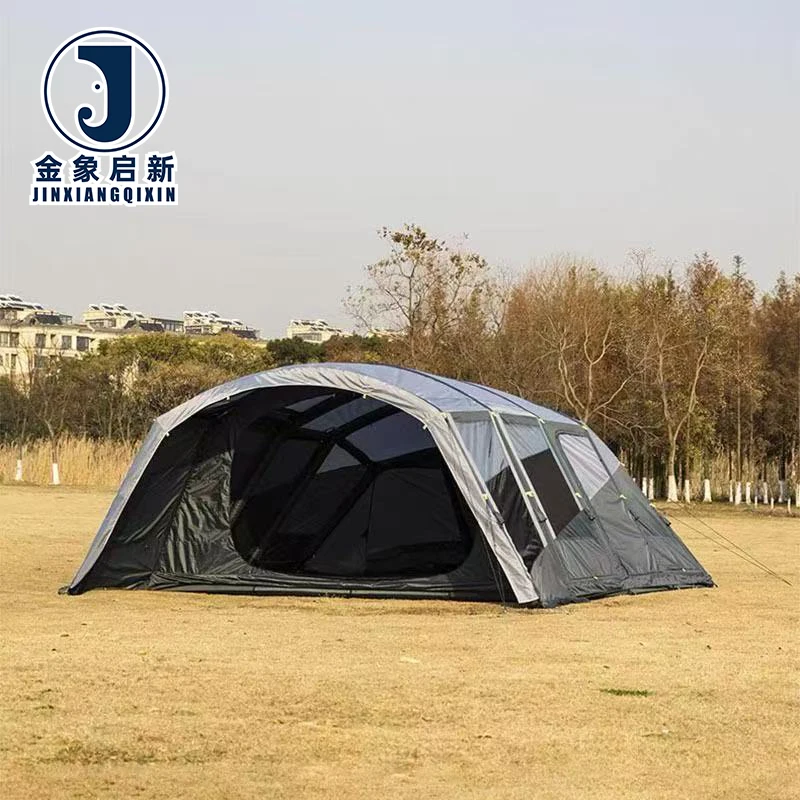
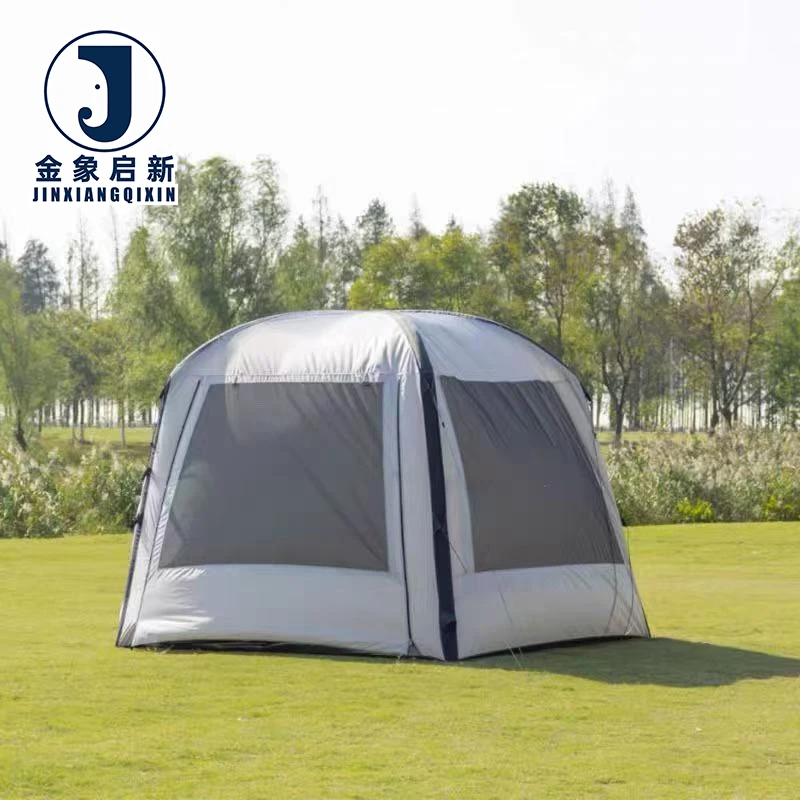
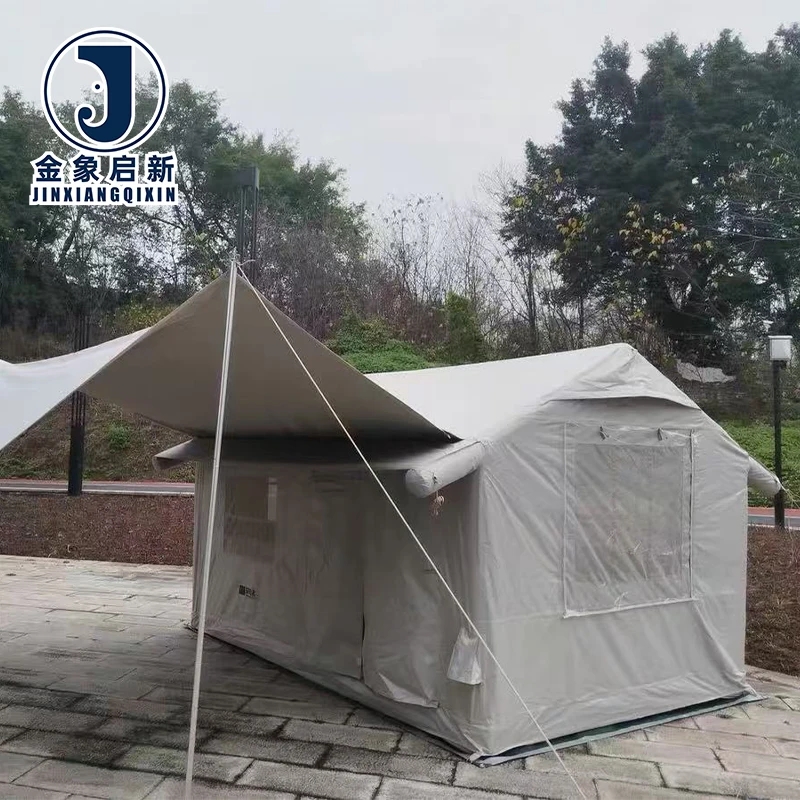
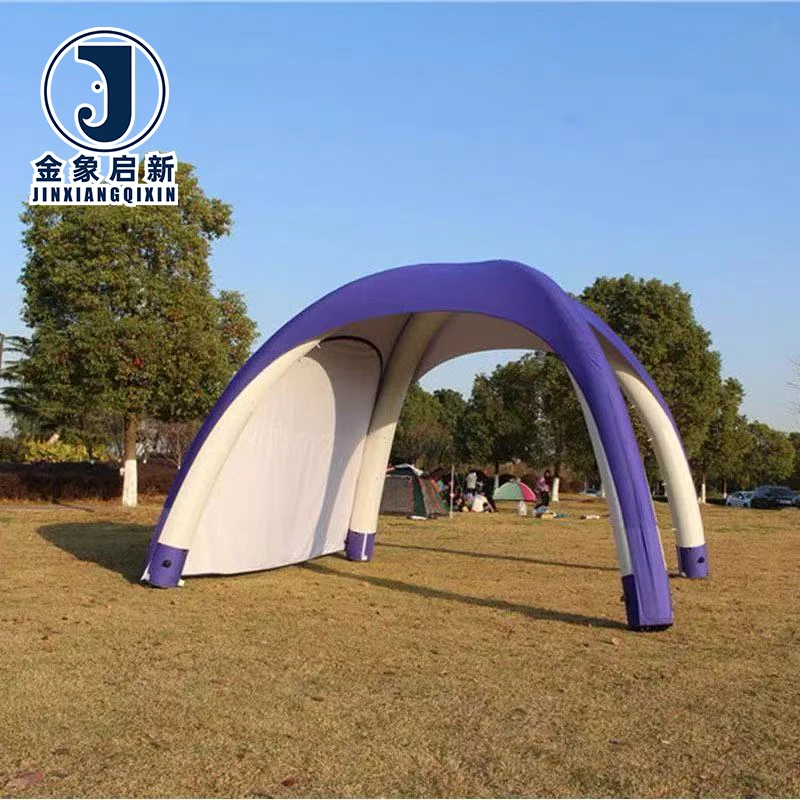
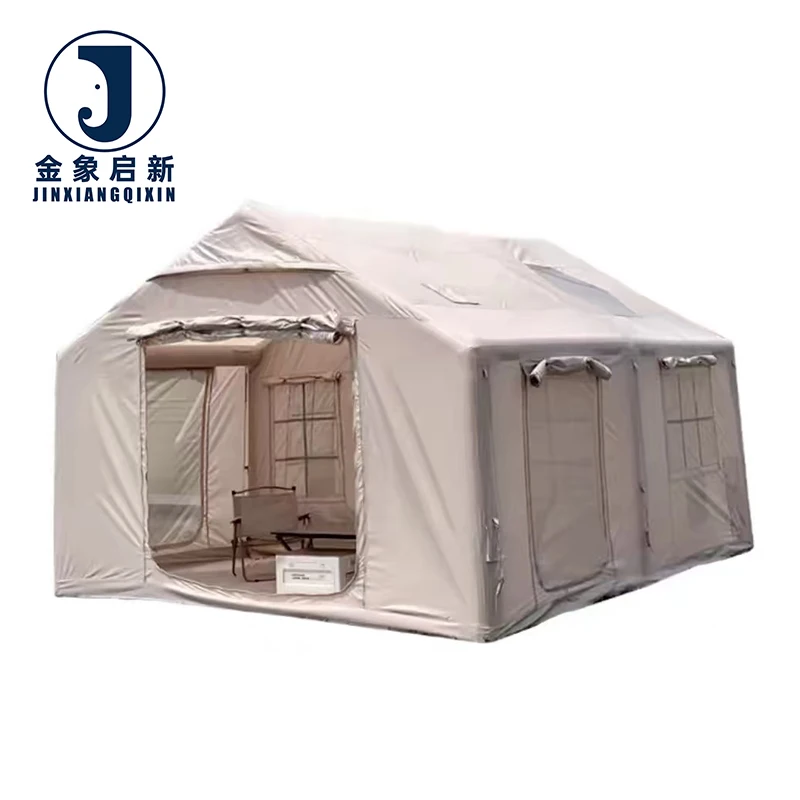
Inflatable Tent, PVC Tarpaulin Core, Waterproof & Windproof, Quick Automatic Opening — engineered for commercial glamping, event hosting, and temporary shelter applications.
- 4-season design with reinforced seams at high-stress flex points for extended service life
- Full customization on size, colour, and pattern printing with sample development before production
- Material specification sheet confirming PVC tarpaulin GSM, coating weight, and treatment details provided
- ISO9001, ISO14001, ISO45001, and CE certified production with 100% pre-shipment inspection
Nearly 30 years focused on coated fabric with deep process control, 10-person R&D team handling material selection and sample development, dedicated QA/QC at every production stage ensuring batch consistency.
Description
Proven Process Control — Three production lines and 36 sets of processing equipment maintain consistent coating weight and adhesion across every roll of inflatable tent fabric we ship.
Technical Specifications
| Parameter | Value |
|---|---|
| Product Type | Inflatable Tent Fabric |
| Core Material | PVC tarpaulin |
| Product Form | Inflatable structure |
| Design Season | 4-season |
| Key Performance | Waterproof, windproof, quick automatic opening |
| Flame Retardant Grade | Available in flame retardant grades — confirm the grade required for your market |
| UV Treatment | Treatment available — test basis to be confirmed at inquiry |
| Anti-Static | Not stated in source |
| Weight (GSM) | Not stated in source |
| Base Fabric Denier | Not stated in source |
| Tensile Strength | Not stated in source |
| Tear Strength | Not stated in source |
| Customization Service | OEM & ODM (sample customization, pattern printing) |
| Standards | ISO9001, ISO14001, ISO45001, CE |
Application Suitability
| Application | Exposure & Requirement |
|---|---|
| Commercial glamping sites | Extended outdoor exposure to rain, wind, and UV; requires airtight inflatable chambers and long-term colour consistency across multiple units |
| Outdoor exhibition and event hosting | Rapid deployment, frequent assembly and disassembly, crowd contact abrasion, and short-notice weather exposure |
| Industrial temporary shelter | Wind loading, dust ingress prevention, and compliance with site safety regulations for temporary structures |
| Emergency response staging | Fast inflation, waterproof integrity under continuous rain, and transportability between deployment locations |
| Seasonal tourism installations | Repeated seasonal inflation cycles, storage between seasons, and resistance to ground moisture at base contact zones |
Why Coating Adhesion Matters More Than GSM When Specifying Inflatable Tent Fabric
A 650 GSM roll with poor coating adhesion will delaminate at the heat-welded seams before a lighter roll with strong bond integrity shows any failure.
Buyers frequently specify inflatable tent fabric by weight alone, assuming a higher number guarantees durability. Yet inflatable structures place unique demands on the material — the sealed air chambers create constant internal pressure against every welded seam, and the fabric must hold that pressure through temperature swings that cause expansion and contraction. [NEED_CITE: relationship between coating adhesion strength and seam integrity in inflatable fabric structures] I have seen heavy-grade coated rolls fail at the weld line while lighter materials with properly controlled coating adhesion held firm through multiple deployment seasons. The coating must bond to the base fabric strongly enough that the heat from welding does not create a separation zone precisely where the structure needs it most.
How We Build Custom Inflatable Tent Solutions From the Fabric Up
Our approach to inflatable tent fabric starts with understanding how your commercial deployment will operate — whether units are inflated once for a full glamping season or cycled weekly for events. The PVC tarpaulin we supply forms the airtight envelope that makes rapid automatic opening possible, and the material must perform consistently from the first unit to the last across a multi-unit order. Each custom inflatable tent project moves through sample development where the R&D team confirms sizing, colour, and any pattern printing before production begins.
What Sets Commercial-Grade Inflatable Tent Fabric Apart
Commercial operators cannot accept the batch-to-batch variation that consumer-grade materials often carry. When ten inflatable tents stand side by side at a glamping site, any colour drift between rolls becomes immediately visible to guests. [NEED_CITE: colour consistency standards for PVC coated fabrics in batch production] Our production process addresses this through controlled coating application across 3 full production lines, where QA checks run at every stage rather than only at final inspection. The material must also tolerate the fabrication process — cutting, heat welding, and the stress concentration at inflation valve mounting points — without the coating cracking or the base fabric fraying at cut edges.
Reading the Specifications That Actually Affect Inflatable Performance
Understanding how base fabric construction interacts with coating weight helps you evaluate quotations beyond the headline GSM figure. The denier of the yarn and the density of the weave determine how well the fabric resists tear propagation when a puncture occurs, which matters for ground-contact zones and high-wind scenarios. Coating method influences how the material behaves during heat welding — knife-coated fabrics generally offer stronger adhesion at welded seams compared to laminated alternatives, which is critical for maintaining airtight chambers under pressure. Surface finish selection between glossy and matte affects both cleanability in commercial hospitality settings and the adhesion quality of any printed branding or pattern work applied to the outer surface.
The Real Cost of Getting the Specification Wrong
When inflatable tent fabric arrives with a GSM lighter than what was quoted, the shortfall often goes unnoticed until the structure fails to hold pressure in wind or shows premature wear at stress points. [NEED_CITE: common failure modes in PVC tarpaulin inflatable structures due to specification drift] Batch colour inconsistency forces operators to either accept a mismatched installation or return entire rolls, delaying project handover. Welded seams that fail before the fabric body indicate a mismatch between the heat welding parameters and the actual coating composition received — a problem that surfaces only after the structure is inflated and pressurized on site.
Why Fabricators and Operators Source Inflatable Tent Fabric Here
Our dedicated R&D team of technicians handles material selection, sample development, and pattern printing within a structured OEM and ODM workflow, so custom inflatable tent projects move from concept to confirmed sample before bulk production starts. Three full production lines and 36 sets of processing equipment provide the capacity to supply consistent material across large commercial orders without the extended lead times that smaller operations require. Every roll passes through 100% pre-shipment inspection with documented QA records, giving procurement teams traceable quality evidence rather than verbal assurances. The facility operates under ISO9001, ISO14001, and ISO45001 management systems with CE certification, supporting compliance documentation for markets that require verified standards. Sample development within days allows buyers to validate coating adhesion, colour accuracy, and weldability before committing to production volume.
Documentation & Verification
- Material specification sheet confirming PVC tarpaulin GSM, base fabric construction, and coating parameters for each roll
- Test reports for UV and flame retardant grades supplied where applicable to your market requirements
- Pre-shipment inspection record with coating adhesion and airtightness verification data per batch
- Roll packing list with individual roll identification for traceability across multi-unit inflatable tent orders
- Certificate of origin and customs documentation supporting international freight clearance
Fabrication, Handling & Storage
- Heat weld temperature and dwell time must match the specific PVC tarpaulin coating composition — request our recommended parameters before fabrication
- Store rolls horizontally on padded supports to prevent permanent creasing in the coated surface that affects inflatable chamber integrity
- Cut edges should be sealed or hemmed to prevent base fabric fraying that compromises weld strength at panel joins
- Cold-weather transport requires allowing the PVC tarpaulin to reach ambient temperature before unrolling to avoid coating micro-cracking
- Clean with pH-neutral detergent only — solvent-based cleaners can degrade the coating surface and reduce airtightness over time
What We Need to Prepare Your Quotation
Provide your intended deployment scenario — whether the inflatable tents will serve as permanent seasonal glamping accommodation, rotating event structures, or emergency shelter stock — along with the environmental exposure conditions your market requires. Let us know the unit dimensions, quantity, and whether you need finished panels or full rolls for your own fabrication. If your jurisdiction mandates a specific flame retardant grade or if branding and pattern printing are part of the project, include those requirements so we can develop a matched sample for your approval before production.
Frequently Asked Questions
Q: How do you ensure GSM consistency across a multi-roll inflatable tent fabric order?
A: Every roll undergoes weight verification against the quoted GSM during our pre-shipment inspection. The QA team records actual measurements per roll, and we provide this data with your shipment documentation. If your project requires a specific coating weight for pressure retention, confirm the target value at inquiry so we can match production parameters accordingly.
Q: Can you control colour consistency when supplying fabric for multiple inflatable tents?
A: Our production process manages colour across batches using controlled coating formulation and in-line QA checks. For orders spanning multiple rolls destined for side-by-side installation, we group production runs to minimize variation. We recommend requesting a production sample from your specific batch for visual approval before we complete the full order.
Q: What is the process for custom sizing and pattern printing on inflatable tent fabric?
A: Our R&D team develops a sample based on your dimensional drawings, colour references, and print artwork. Once you approve the sample for sizing, material feel, and print accuracy, we proceed to full production. Pattern printing is handled in-house, allowing us to confirm colour matching and registration before coating and finishing.
Q: What should fabricators know about heat welding this PVC tarpaulin?
A: Welding parameters depend on the specific coating composition and weight of the material you receive. We supply recommended temperature, pressure, and dwell time settings with each batch. Test welds on sample pieces before full production are essential — this confirms that the seam strength meets your airtightness requirements for the inflatable chamber design.
Q: Which certifications accompany each shipment of inflatable tent fabric?
A: Shipments include ISO9001, ISO14001, ISO45001, and CE certification documentation relevant to the material supplied. Where flame retardant or UV treatment has been specified, corresponding test reports are included. Pre-shipment inspection records and roll-level traceability data are provided as standard with every order.
Related products
-
Inflatable Tent Family Size Four-Season Quick Automatic Opening Waterproof 2-8 Person Factory Direct Sale
Read more -
High Quality Four-Season Inflatable Tent for Camping Durable PVC Waterproof All-Weather Resistance Quick Automatic Opening
Read more -
Inflatable Camping Tent PVC Four-Season Waterproof Outdoor Air Tent with Quick Automatic Opening for 2-3 Person
Read more -
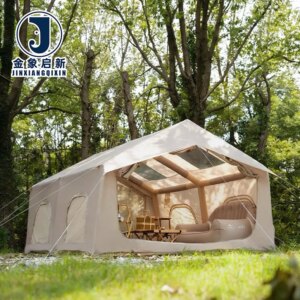
Inflatable Camping Tent Waterproof PVC Outdoor Air Tent Easy Setup Family Camping Shelter
Read more