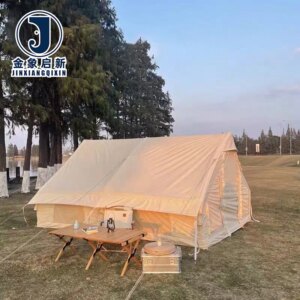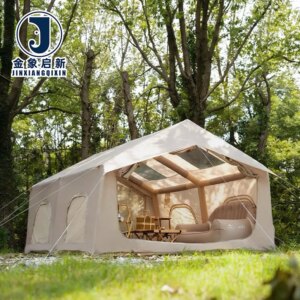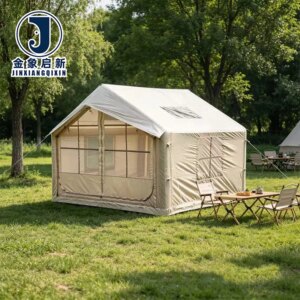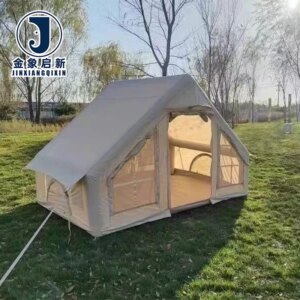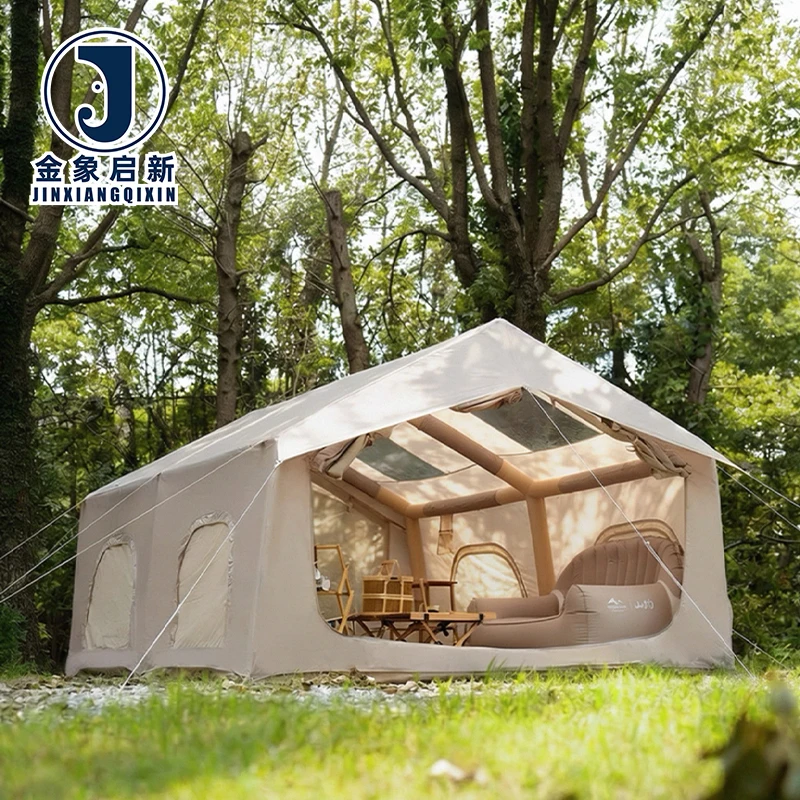
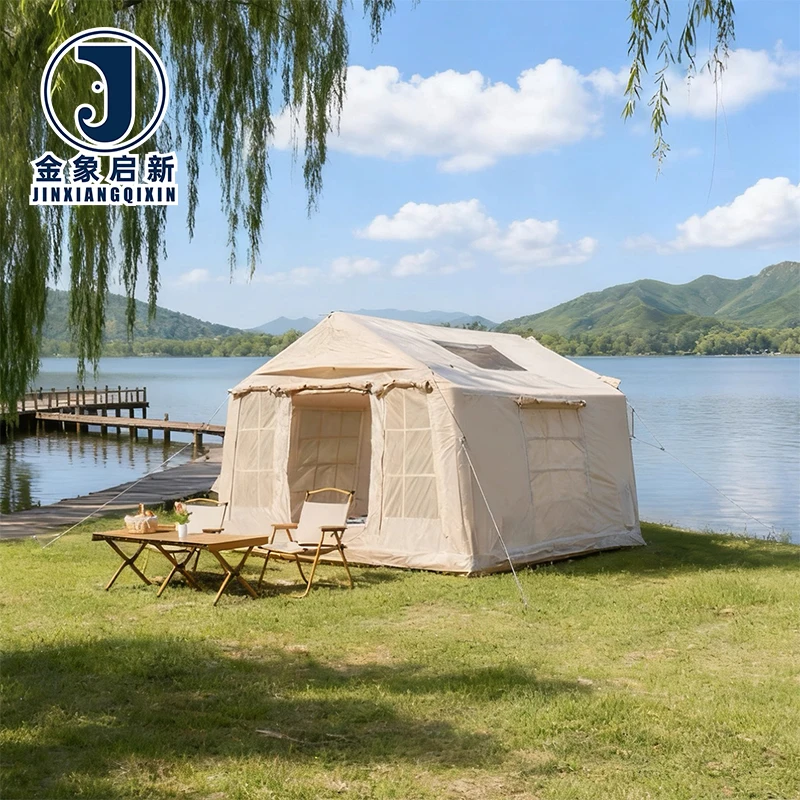
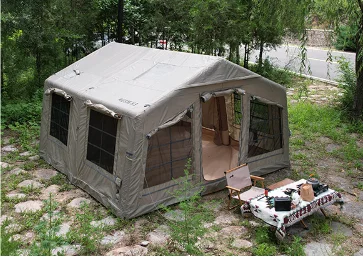
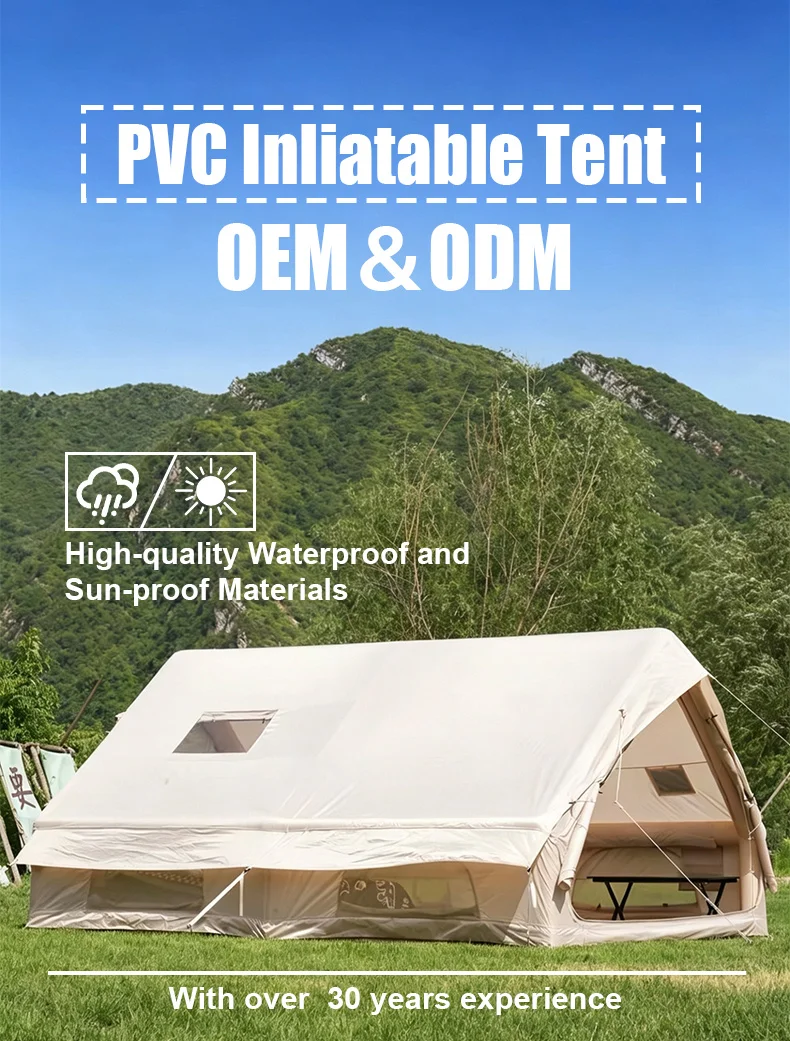
PVC Inflatable Tent with quick automatic opening and four-season all-weather design, featuring durable PVC material for rapid deployment in demanding environments. Engineered for construction sites, remote workspaces, and equipment storage where reliable temporary shelter is critical. Single-layer construction balances portability with weather resistance across varying conditions.
- Anti-UV resistant PVC extends outdoor service life
- Stable waterproof performance protects stored equipment
- OEM & ODM customization for specific dimensional requirements
- 9,180 m² facility with 3 production lines and 36 processing equipment sets
Sample development within days and 100% pre-shipment inspection ensure specifications match your project requirements before dispatch.
Description
Process-Controlled Coated Fabric — we maintain strict coating weight and adhesion consistency across every roll of PVC inflatable tent material, ensuring your fabrication starts with predictable hot-air welding results.
Technical Specifications
| Parameter | Value |
|---|---|
| Product Type | Inflatable Tent |
| Core Material | Durable PVC material |
| Key Performance | Quick automatic opening, all-weather suitability, four-season design, single layer construction |
| Anti-UV Treatment | Anti-UV resistant PVC (confirm grade required for your market) |
| Waterproof Performance | Stable waterproof coated construction |
| Production Facility Area | 9180 square meters |
| Production Lines | 3 full production lines |
| Processing Equipment | 36 sets of professional processing equipment |
| R&D Team Scale | 10 technicians |
| Customization Service | OEM & ODM customization support |
| Certifications | ISO9001, ISO14001, ISO45001, CE |
Application Suitability
| Application | Exposure & Requirement |
|---|---|
| Construction site temporary shelters | Continuous UV exposure, wind loading on inflated air beams, abrasion from ground contact and site debris |
| Remote location workspaces | Rapid deployment under variable weather, temperature fluctuation across seasons, limited crew for manual assembly |
| Outdoor equipment storage | Prolonged water exposure from rain and condensation, protection against dust ingress, structural stability under snow or wind load |
| Year-round industrial operations | Four-season thermal cycling, sustained internal air pressure on seams, repeated inflation and deflation cycles |
When the Seam Fails Before the Fabric Does
Hot-air welding parameters must track ambient temperature and material batch — otherwise the weld line cracks at the first air-beam bend.
Most inflatable tent failures I have seen on site were not fabric tears. The PVC membrane held fine, but the welded seam along the air column split open where the beam flexed most under wind load. The tent lost pressure and collapsed within hours. When you source a PVC inflatable tent aftermarket supplier, the question is never just about the base fabric — it is whether the supplier understands how coating adhesion behaves under thermal welding at different seasonal temperatures. [NEED_CITE: weld strength testing methods for PVC coated fabrics]
Coating Adhesion and Air-Beam Integrity
Inflatable structures depend entirely on the bond between coating and base fabric holding under sustained internal pressure. A PVC inflatable tent aftermarket supplier must control coating weight precisely because uneven adhesion creates weak zones along the weld line. When an air beam inflates, the fabric stretches microscopically at every seam — if the coating has peeled even slightly during welding, that micro-gap propagates under cyclic pressure changes throughout the day.
Four-Season Thermal Behaviour
The single-layer PVC construction faces a wide temperature envelope across four seasons. In summer, direct solar gain softens the coating and reduces its dimensional stability; in winter, low temperatures push the material toward its brittleness threshold. The quick automatic opening feature means the fabric must tolerate rapid inflation pressure without the stiffness that cold conditions impose. This is where material formulation — not just thickness — determines whether an inflatable shelter survives its first winter storm. [NEED_CITE: low-temperature flexibility thresholds for plasticised PVC]
Reading the Specification Sheet Beyond GSM
Buyers often anchor on weight as a proxy for strength, but GSM alone tells you nothing about how the fabric will behave in an inflatable structure. The base fabric denier and weave density determine how tear forces propagate once a puncture occurs. The coating method — whether knife-over-roll, lamination, or calendering — directly affects peel strength at welded seams, which is the single most critical property for air-beam construction. Surface finish influences both field cleanliness and how well repair patches bond in service. For inflatable tents, a lighter fabric with superior coating adhesion will outperform a heavier one with poor weld integrity every time.
The Hidden Cost of Batch Inconsistency
Colour variation between rolls is visible once panels are welded side by side on a large tent — but the less obvious problem is coating-weight variation. When one roll carries slightly less coating than the next, your hot-air welding temperature that produced perfect seams on Monday will burn through or under-weld on Tuesday. Fabricators then spend time recalibrating machines between rolls instead of running production. For inflatable tents, this inconsistency shows up as air-beam sections that lose pressure faster than others, forcing the blower to work harder and masking the real problem until the tent is deployed on site. [NEED_CITE: coating weight tolerance standards for technical textiles]
What We Bring to Inflatable Tent Fabrication
Our three full production lines run dedicated coating schedules, so your PVC inflatable tent material is produced in controlled batches rather than squeezed between unrelated orders. The 36 sets of professional processing equipment include hot-air and high-frequency welding stations used during sample development, meaning we validate weld parameters before your roll ships. Our 10-person R&D team develops sample panels within days when you need to test a new air-beam geometry or custom colour. We run 100 percent inspection before dispatch, checking coating adhesion and surface consistency across every roll. ISO9001, ISO14001, ISO45001, and CE certifications are maintained and available for audit, giving your procurement team the compliance documentation needed for project submissions.
Documentation & Verification
- Material specification sheet stating base fabric, coating type, and weight for your inflatable tent order
- Test reports for UV and flame-retardant grades where applicable to your market requirements
- Pre-shipment inspection record covering coating adhesion and surface consistency per roll
- ISO9001, ISO14001, ISO45001, and CE certificates current and available for compliance review
- Roll packing list with batch traceability for multi-roll inflatable tent orders
- Certificate of origin and customs documentation for cross-border shipment
Fabrication, Handling & Storage
- Hot-air welding temperature must be adjusted to the specific PVC coating formulation and ambient conditions at your shop
- High-frequency welding suits single-layer PVC construction for clean air-beam seams without surface marking
- Store rolls upright on pallets in a temperature-controlled area to prevent flat spots that affect welding
- Avoid dragging PVC material across unprotected floors — the coating surface can pick up abrasion that weakens weld zones
- Field repairs on inflatable tent panels require compatible PVC patch material and solvent cement matched to the coating type
- Allow cold-stored rolls to acclimatise to workshop temperature before unrolling to prevent coating crack at the bend
How to Scope Your Inquiry
Tell us the deployment environment — whether the inflatable tent will sit on a construction site through winter or serve as seasonal remote workspace — along with the air-beam diameter and operating pressure your design requires. Share your target market so we can confirm which fire-safety or compliance grades apply. Let us know the dimensions, colour requirements, and whether you need sample panels for weld testing before committing to full production volume.
Frequently Asked Questions
Q: What customization options are available for specific inflatable tent dimensions?
A: We support OEM and ODM customization, including panel dimensions, colour selection, and air-beam geometry. Our R&D team develops sample panels so you can validate weld parameters and inflation performance before full production. Confirm your required dimensions and we will advise on material width and seam layout.
Q: How do you verify product certifications for compliance submissions?
A: ISO9001, ISO14001, ISO45001, and CE certificates are current and issued to our production facility. We provide copies with your shipment documentation. If your project requires specific fire-safety or UV-resistance test reports, confirm the standard your market demands and we will supply applicable documentation.
Q: Can we receive sample panels before placing a full order?
A: Yes. Our 10-person R&D team produces sample panels within days of receiving your specification. We recommend testing hot-air weld parameters on these samples under your actual workshop conditions to confirm seam integrity before committing to bulk production of inflatable tent material.
Q: What is the typical lead time for custom inflatable tent orders?
A: Standard specifications ship faster since material may already be in production. Custom colours, widths, or treatments require dedicated production scheduling across our three lines. Share your required delivery date and volume so we can confirm a realistic lead time tied to current line capacity.
Q: How do you ensure batch consistency across multiple roll orders?
A: Each production run follows controlled coating schedules with in-process quality checks on coating weight and adhesion. Our 100 percent pre-shipment inspection verifies surface consistency and weld-zone integrity across every roll, so fabricators receive material that behaves predictably on their welding equipment.
Related products
-
Waterproof Inflatable Camping Tent Outdoor Easy Setup Air Tent for Camping
Read more -
Premium Four-season Inflatable Tents for Camping Easy-to-Use Spacious Portable Waterproof Outdoor Tent Quick
Read more -
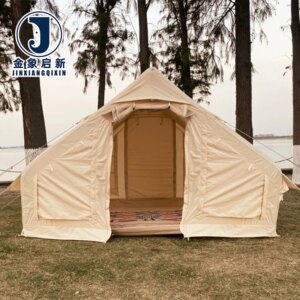
خيمة قابلة للنفخ لأربعة مواسم طبقة واحدة >3000 مم مقاومة للماء ومقاومة للرياح فتح تلقائي سريع قماش PVC صديق للبيئة
Read more -
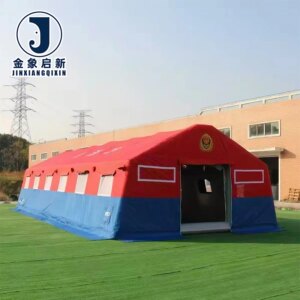
خيمة فاخرة قابلة للنفخ من PVC للتخييم الفاخر في الهواء الطلق مقاومة للماء مع تصميم سريع الفتح التلقائي قابل للطي لجميع الفصول ومضخة
Read more