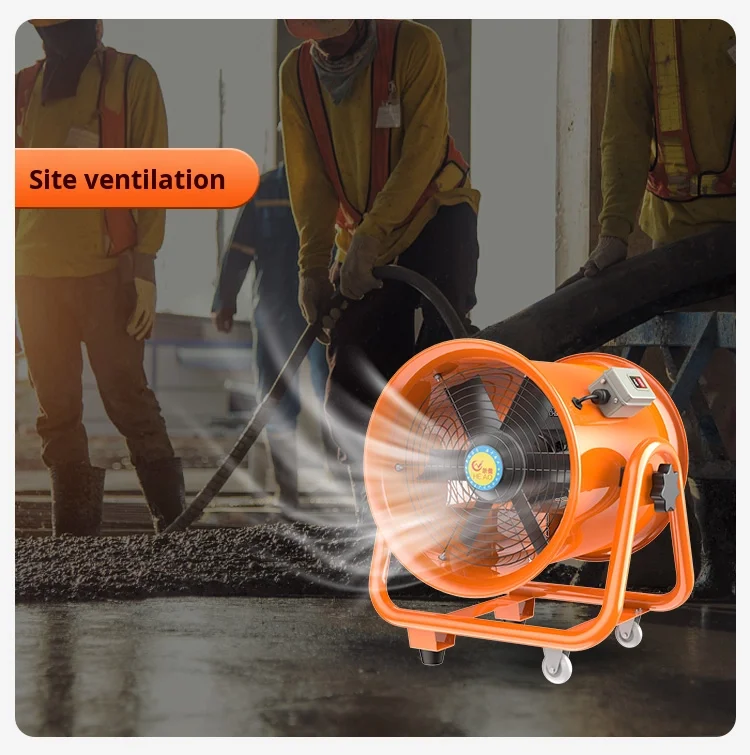
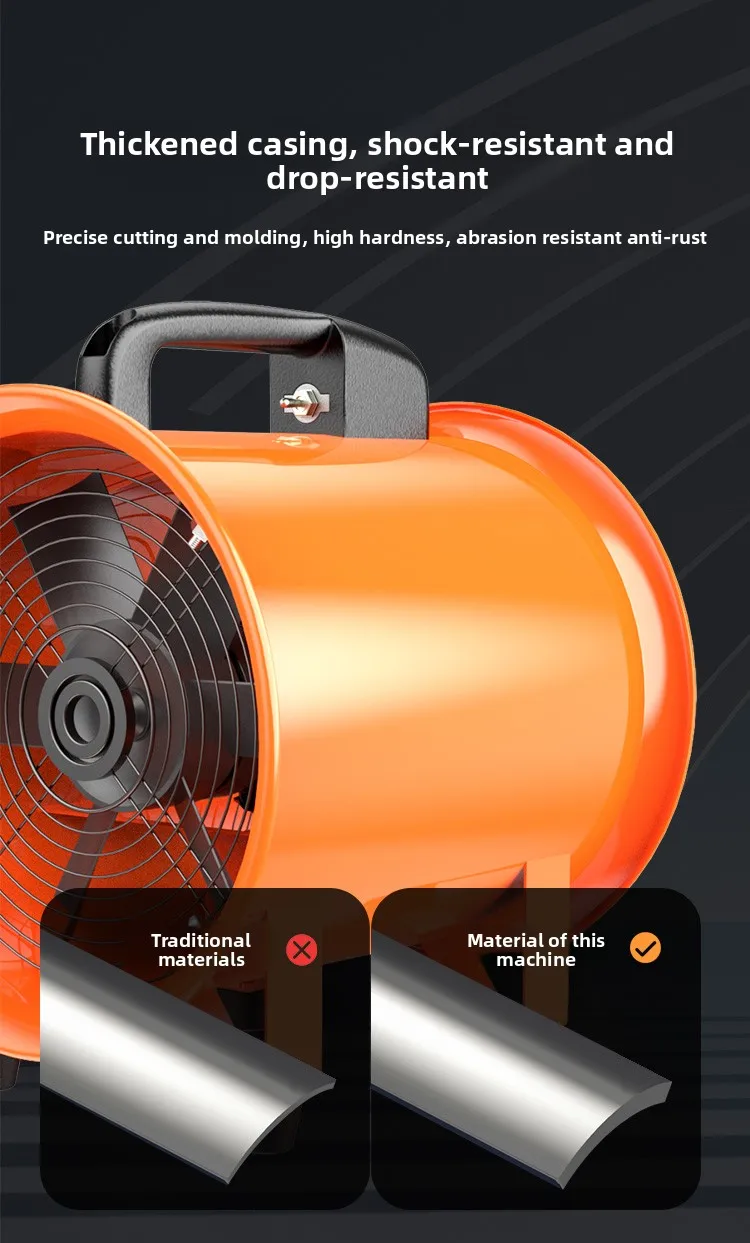
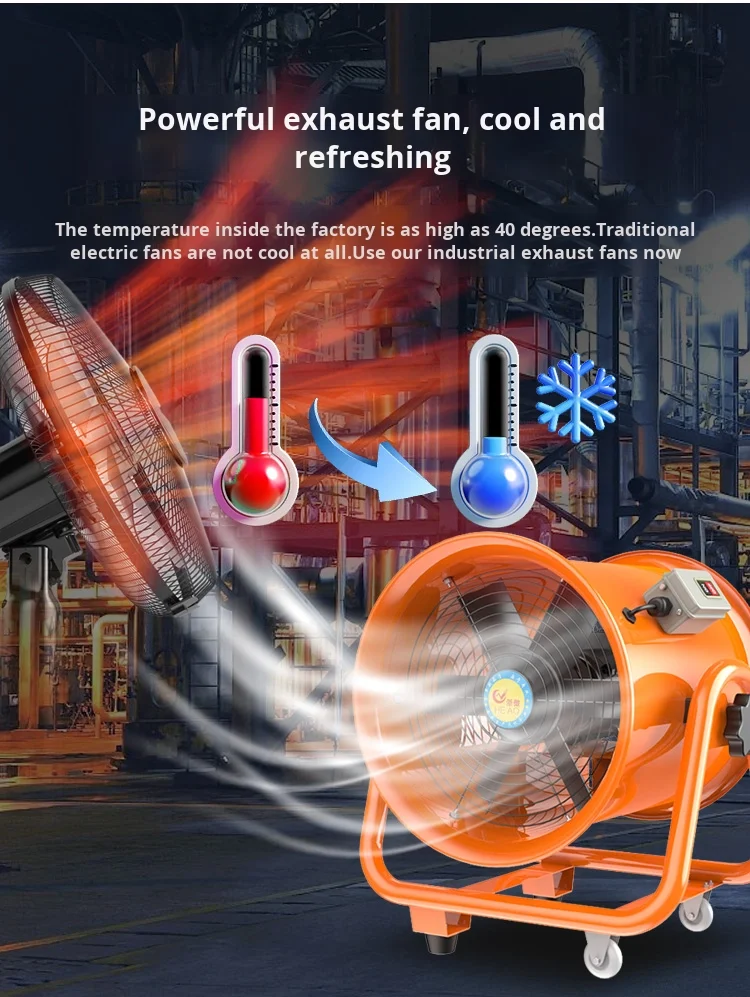
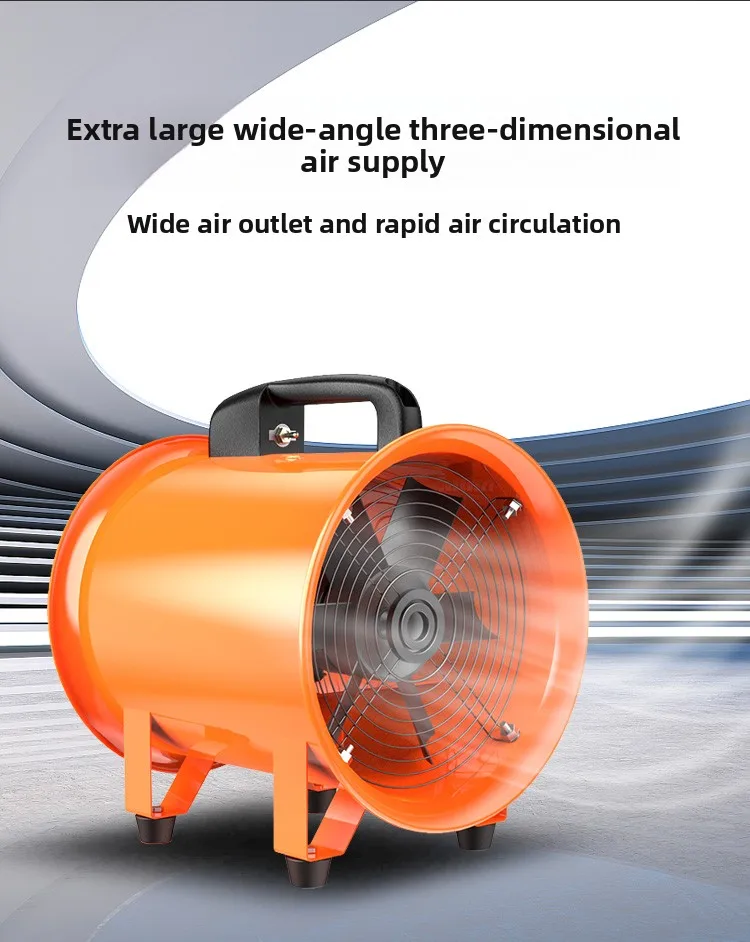
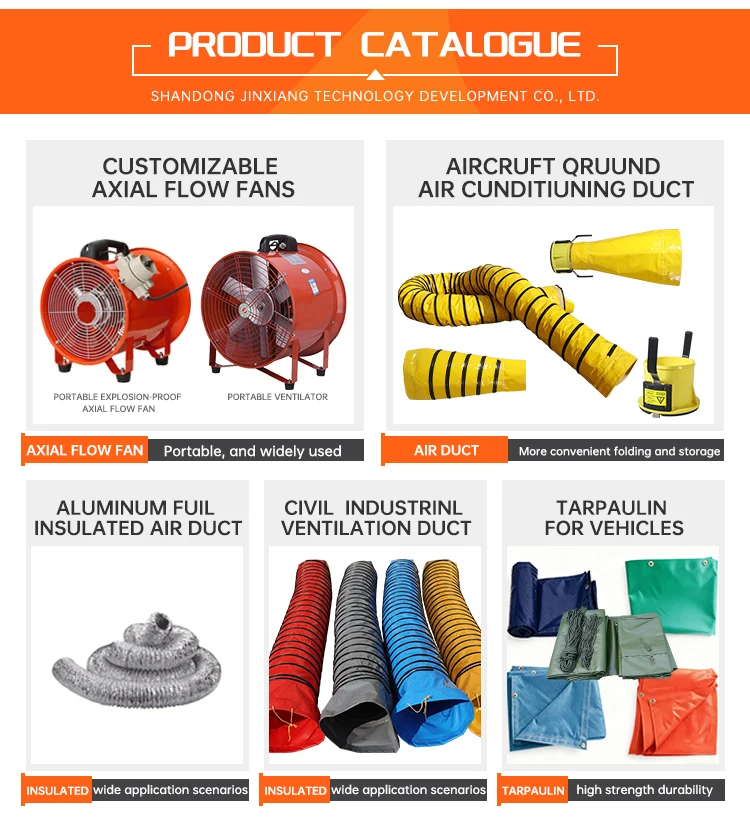

Portable Axial Flow Fan with Flexible Duct Hose — available in 200mm to 900mm diameters, 3000RPM, 220V/380V dual voltage.
- Air volume 1300–28000 m³/h, total pressure 140–320 Pa across sizes
- Flexible duct routes around obstacles into confined workspaces
- Matches exhaust requirements for welding fumes, grinding dust, and tunnel ventilation
Backed by 3 full production lines, 100% pre-shipment inspection, and samples developed within days for custom configurations.
Description
Custom capability from design to delivery — Our 10-person R&D team develops matched fan and duct configurations within days, supporting full custom sizing and site-specific documentation for industrial ventilation projects.
Technical Specifications
| Parameter | Value |
|---|---|
| Product Type | Axial Flow Fan |
| Size Options | 200mm / 250mm / 300mm / 350mm / 400mm / 450mm / 550mm / 650mm / 750mm / 850mm / 900mm |
| Power Range | 250W to 5500W (varies by size) |
| Air Volume | 1300 m³/h to 28000 m³/h (varies by size) |
| Total Pressure | 140 Pa to 320 Pa (varies by size) |
| Voltage | 220V / 380V |
| Noise Level | 57 dB(A) to 88 dB(A) (varies by size) |
| Speed | 3000 RPM |
| Fan Type | Handheld axial flow fan |
| Duct Type | Flexible duct hose |
| Flame Retardant Grade | (grade not stated in source) |
| Anti-Static | (test basis not stated in source) |
| Certifications | ISO, CE |
Application Suitability
| Application | Exposure & Requirement |
|---|---|
| Mining and tunnelling ventilation | Continuous dust and fume extraction in confined underground passages, flexible routing around equipment and shifting work faces |
| Construction site exhaust ventilation | Removal of welding fumes, grinding dust and solvent vapours from enclosed work areas, temporary setup and teardown cycles |
| Factory floor exhaust | Capture and routing of airborne particulates and hot gases from welding, grinding or chemical process zones to external discharge points |
| Demolition and renovation projects | Dust suppression airflow in partially enclosed structures, portability requirement for repositioning as work progresses |
Why Ventilation Duct Without Certification Creates Site Risk
A portable axial flow fan with flexible duct for industrial ventilation only meets site compliance when the duct material itself carries verified fire-retardant or anti-static documentation — not just the fan unit.
Many procurement teams receive ventilation duct on site only to discover the fire-retardant or anti-static certification the project safety plan demands was never supplied. This gap forces work stoppages, re-inspection requests and sometimes full material replacement after installation. [NEED_CITE: fire-retardant and anti-static compliance requirements for underground ventilation per regional mining regulations]
The portable axial flow fan with flexible duct for industrial ventilation must be specified as a matched system, where the duct material grade is confirmed against the site safety standard before the order is placed, not after delivery.
Matching Airflow Capacity to Duct Run Length
Selecting the correct diameter from the 200mm to 900mm range depends on both the volume of contaminated air that must be moved and the resistance created by duct length and bends. A 200mm fan at 1300 m³/h suits short, straight exhaust runs from a single welding bay. A 900mm unit at 28000 m³/h addresses large tunnel faces where duct runs extend considerable distances with multiple directional changes. Total pressure ratings from 140 Pa to 320 Pa indicate how effectively each size pushes air through resistance, making this figure as important as air volume when planning the portable axial flow fan with flexible duct for industrial ventilation layout.
Dual Voltage Configuration for Site Compatibility
Every size in this portable axial flow fan with flexible duct for industrial ventilation range supports both 220V and 380V supply, eliminating the mismatch that delays site startup when electrical infrastructure differs from the original specification. Confirming voltage and plug type at the inquiry stage ensures the motor winding and connector arrive configured for the local supply. [NEED_CITE: industrial voltage and plug configuration standards across regional markets] This dual-voltage capability means the same fan model can be redeployed across project sites in different countries without rewinding or replacing the motor.
Interpreting Pressure, Volume and Noise for Real Conditions
Air volume measured in m³/h describes the quantity of air moved, while total pressure in Pa determines how far and through how many bends that air can travel before velocity drops below effective levels. In tunnel ventilation, long duct runs with multiple joints absorb pressure steadily — a fan rated at 320 Pa sustains usable airflow further than one at 140 Pa, even if both quote the same volume at zero resistance. Noise levels range from 57 dB(A) at the smallest models to 88 dB(A) at the largest, which matters in occupied factory environments where hearing protection policies are triggered above certain thresholds. Selecting the right balance between volume, pressure and noise prevents over-specification on open sites and under-performance in extended duct runs.
The Cost of Underspecifying Your Ventilation System
Choosing a fan diameter too small for the required duct length causes airflow to stall before reaching the discharge point, leaving contaminants trapped at the work face. Duct material supplied without the fire-retardant grade required by the site safety plan results in failed inspections and mandatory removal — a cost that multiplies once the duct is already hung and connected. Mismatched voltage configuration causes motor burnout or breaker trips on the first day of operation. These failures share a common cause: specifying the fan and duct as separate items rather than as a verified system. [NEED_CITE: common causes of ventilation system failure in construction and tunnelling projects]
Why Procurement Teams Source This Equipment Here
Three full production lines and 36 sets of professional equipment support bulk orders of matched fan and duct systems with reliable on-time delivery, even when multiple diameter sizes are required across a single project.
The 10-person R&D team handles diameter pairing, duct length customisation and site-specific documentation packages, developing samples within days rather than weeks.
Dedicated QA/QC at every production stage with 100% inspection before shipment means each fan motor, impeller balance and duct coupling is verified against the order specification before packing.
Nearly 30 years of focused production experience in coated fabric and ventilation products underpins the process control that keeps duct material quality consistent across rolls and batches.
ISO and CE certification supports compliance documentation for international project tenders, with full test reports provided for fire-retardant and anti-static grades where applicable.
Documentation & Verification
- Material specification sheet stating duct diameter, material grade and fire-retardant classification where applicable
- Test report for flame retardant and anti-static properties matched to the specific duct batch supplied
- ISO and CE certificates covering the ventilation system components shipped
- Pre-shipment inspection record covering fan motor, impeller balance and duct coupling integrity
- Packing list with roll count, diameter breakdown and weight per item for customs clearance
- Certificate of origin and customs documentation support for international shipments
Fabrication, Handling & Storage
- Flexible duct hose couplings must be secured with the specified band clamps at each joint to prevent air leakage under pressure
- Store duct rolls horizontally on pallets away from direct sunlight to prevent material degradation before installation
- Verify fan motor winding matches site voltage supply (220V or 380V) before first energisation
- Inspect duct coupling flanges for damage after transport before connecting to the portable axial flow fan with flexible duct for industrial ventilation unit
- Clean external duct surfaces with mild detergent only — solvent-based cleaners may degrade the hose material coating
- When extending duct runs, maintain consistent diameter throughout to avoid pressure loss at transition points
What We Need From Your Inquiry
Provide the duct diameter range, total run length and number of directional bends in your ventilation plan so we can match fan size and power to your actual airflow requirement. Specify any fire-retardant or anti-static grade your site safety plan demands, along with the certification standard name, so the correct duct material is allocated. Confirm local voltage supply and plug type to ensure the motor arrives site-ready without modification.
Frequently Asked Questions
Q: What fire-retardant and anti-static documentation is provided with the duct?
A: Fire-retardant and anti-static grades are available — confirm the specific grade required for your market and site safety plan at the inquiry stage. Where applicable, test certificates matched to the duct material batch are included with the shipment documentation package. Request the standard name your project requires so we align testing accordingly.
Q: How do I match fan diameter and power to my duct length and airflow requirement?
A: Provide your required air volume, total duct run length and number of bends. Longer runs with multiple joints increase resistance, requiring higher total pressure ratings. We match fan diameter and power to your layout, confirming that the selected model delivers the necessary airflow at the discharge end, not just at the fan outlet.
Q: Can I extend the flexible duct hose on site if I need more reach?
A: Additional duct sections connect via standard couplings and band clamps. Maintain the same diameter throughout the entire run — stepping down in diameter at any point creates a pressure bottleneck that reduces airflow at the work face. Confirm total extended length so we can verify the fan pressure rating supports the full run.
Q: What voltage and plug options are available for different regional markets?
A: All models support 220V and 380V dual voltage. Confirm your site supply voltage and required plug type at the order stage. The motor winding and connector are configured before dispatch so the fan is operational immediately upon arrival without electrical modification.
Q: What lead times apply for custom duct lengths and bulk orders?
A: Standard diameter and length configurations ship within typical production scheduling windows. Custom lengths or non-standard duct specifications require sample development and approval first. Provide your project timeline and total quantity at the inquiry stage so we confirm a delivery schedule aligned to your site mobilisation date.
Related products
-
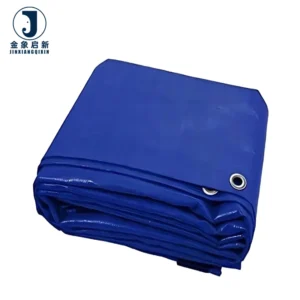
Custom Made PVC Tarpaulin Truck Cover 650 Gsm 630 Gsm
Read more -
PVC Tarpaulin 650 Gsm 630 Gsm for Truck Cover – Custom Made
Read more -

PVC Coated Tarpaulin Fabric for Awning and Tents – Custom Made
Read more -
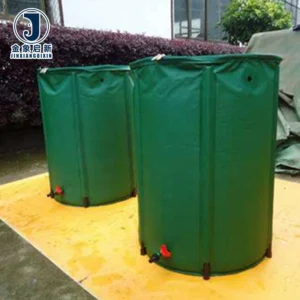
Garden Flexible 750L PVC Waterproof Fabric Rain Tank Irrigation Rainwater Harvesting Industrial Fabric Large Water Storage Tank
¥15.70 Add to cart