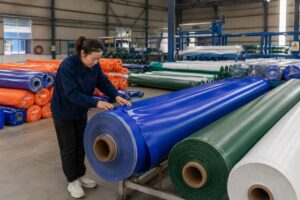
PVC Tarpaulin Manufacturer for Outdoor Retailers: OEM & Bulk Wholesale
Most buyers think a "waterproof" label is enough; in reality, UV stabilization determines lifespan in outdoor retail.
Successful sourcing of PVC Tarpaulin Sourcing Strategy hinges not just on price, but on rigorous verification of technical certifications and precise specification matching to avoid costly customs detentions and product failure. Without original fire-retardant certificates and accurate GSM documentation, shipments to high-risk markets like Africa or the Middle East face severe clearance delays, often exceeding several weeks.
I still remember the silence on the phone line when a client in Lagos called me. A full container of heavy-duty covers was stuck at the port. The local customs authority demanded the original stamped fire-retardant certificate, not a digital copy, not a scanned PDF. We had sent the documents via courier, but they arrived two days after the vessel. The cargo sat under the hot sun for over twenty days. The demurrage charges ate up the entire profit margin, and the client nearly rejected the goods due to perceived negligence. That incident changed how I handle every single export file. Now, for any shipment heading to regions with strict compliance checks, I prepare three sets of original certificates, cross-checking every digit on the bill of lading against the packing list before the truck even leaves the factory gate.
This guide breaks down the technical and logistical pitfalls that trap inexperienced buyers. It moves beyond basic price comparisons to focus on the verifiable data points that actually protect your inventory and reputation.
Why Do Standard Sourcing Strategies Fail for PVC Tarps?
Lack of specific certification prep leads to customs seizures, not just minor delays.
Many retailers assume that a standard commercial invoice and a generic quality certificate are sufficient for global trade. This is a dangerous misconception, particularly for technical fabrics. In many African and Middle Eastern countries, customs officials do not accept digital copies of safety certifications. They require original, stamped documents that match the batch number on the cargo exactly.
The failure usually stems from a disconnect between the sales team and the logistics documentation process. Salespeople might promise "fire-retardant compliant" material based on a general test report from months ago. However, customs authorities often require a certificate linked to the specific production batch or a recent validation from an accredited third-party lab. If the document is missing, outdated, or lacks the original wet ink stamp, the cargo is flagged for inspection.
Consider the difference between a standard PE cover and a certified PVC Tarpaulin Sourcing Strategy product. The former might pass through loose inspections, but the latter, being a higher-value industrial good, attracts stricter scrutiny. A buyer in Dubai once faced a situation where their entire shipment of advertising banners was held because the fire-retardancy standard listed on the certificate did not match the specific code required by local municipal regulations. The delay lasted nearly a month, causing them to miss a major seasonal event.
To mitigate this, buyers must request the exact certification standards required by their target market before placing the order. Common standards include DIN 4102 for European markets or NFPA for certain US applications. Verifying these details early prevents the nightmare of having goods stranded at a foreign port. [NEED_CITE: common customs documentation requirements for textile imports in MENA region]
How to Verify Technical Specifications Beyond the Quote?
Match GSM and coating type to specific end-use rather than prioritizing the lowest weight.
Buyers often fixate on GSM (grams per square meter) as the sole indicator of quality. While important, GSM alone does not guarantee durability. A high GSM fabric with poor coating adhesion will delaminate faster than a slightly lighter fabric with a robust, chemically bonded coating. The key is understanding the correlation between thickness, tensile strength, and the specific environmental stresses the product will face.
For trucking fleets, the requirement is different from event tents. Truck covers need high tear strength to withstand wind flapping and friction against cargo. Event materials need printability and flexibility. Using a generic spec sheet for both leads to premature failure.
| Specification Factor | Low-Cost Generic Option | Premium Technical Grade | Impact on Performance |
|---|---|---|---|
| Coating Adhesion | Basic mechanical bond | Chemical fusion process | Prevents peeling in extreme heat/cold |
| UV Stabilization | Minimal additive | High-concentration stabilizers | Extends outdoor lifespan significantly |
| Tear Strength | Standard weave | Reinforced high-tenacity yarn | Resists ripping during high-wind events |
| Fire Retardancy | Self-extinguishing (basic) | Certified non-flammable (DIN/NFPA) | Meets strict legal safety codes |
A construction contractor in Southeast Asia learned this the hard way. They ordered what they thought was a heavy-duty cover based on GSM alone. However, the coating was not optimized for high humidity. Within months, the fabric began to stick together and tear when unfolded. Switching to a supplier who provided detailed coating adhesion test reports solved the issue. The new material, while similar in weight, had a superior chemical bond that resisted moisture ingress.
When evaluating suppliers, ask for test reports on tear strength and color fastness, not just weight. A reliable PVC Tarpaulin Sourcing Strategy involves requesting samples that undergo real-world stress tests, such as prolonged exposure to sunlight or repeated folding, rather than just reviewing paper specs. [NEED_CITE: industry standards for PVC coated fabric tear strength testing]
What Documentation Prevents Customs Delays in High-Risk Markets?
Original fire-retardant and quality certs are non-negotiable for Africa and MENA regions.
The paperwork accompanying your cargo is as critical as the cargo itself. In high-risk import markets, the absence of a single original document can halt the entire clearance process. This is not a matter of bureaucracy; it is a matter of legal compliance and safety verification.
The essential document checklist includes the Certificate of Origin (CO), Bill of Lading (BL), Packing List (PL), and most importantly, the original Quality and Fire-Retardant Certificates. These certificates must be issued by recognized testing bodies and must bear original stamps and signatures. Digital copies are often rejected because they can be easily altered.
A distributor in Nigeria shared their experience of switching suppliers. Their previous partner sent scanned copies of certificates, leading to consistent delays of over two weeks per shipment. After switching to a manufacturer who prioritized document accuracy and sent originals via express courier ahead of the vessel, their clearance time dropped to just a few days. The cost of couriering documents was negligible compared to the savings in demurrage and storage fees.
Buyers should establish a protocol with their supplier where all documents are reviewed and approved before shipment. This includes verifying that the batch numbers on the certificates match the production run. Any discrepancy, no matter how small, can be used by customs officials to justify a hold. Implementing a PVC Tarpaulin Sourcing Strategy that includes a pre-shipment document audit ensures smooth entry into even the most stringent markets. [NEED_CITE: best practices for export documentation compliance in international trade]
Which Supplier Capabilities Ensure Consistent Quality?
Look for in-house coating lines and flexible MOQ for mixed containers.
Consistency is the hallmark of a professional manufacturer. Suppliers who outsource their coating process often struggle with quality control variations between batches. In-house production allows for tighter monitoring of temperature, speed, and chemical mixture during the coating phase. This results in uniform thickness and adhesion across every roll.
Flexibility in Minimum Order Quantity (MOQ) is another critical factor. Retailers often need to test new colors or weights without committing to a full container. A supplier that offers flexibility from single rolls to container loads enables businesses to manage inventory risk effectively. This is particularly useful for seasonal peaks or custom advertising projects where demand fluctuates.
Jinxiang, for instance, operates with full in-house coating capabilities, allowing for precise control over GSM ranges from 440 to 1000gsm. This vertical integration means they can adjust specifications quickly to meet custom requirements without relying on external partners. For a retailer launching a new line of heavy-duty truck covers, this capability meant they could start with a smaller trial order to verify quality before scaling up to bulk volumes.
Moreover, the ability to provide complete export documentation packages directly from the factory reduces the administrative burden on the buyer. When the manufacturer handles the certification and documentation internally, the risk of mismatched data is minimized. This integrated approach supports a robust PVC Tarpaulin Sourcing Strategy, ensuring that both the physical product and its accompanying paperwork meet international standards. [NEED_CITE: benefits of vertical integration in textile manufacturing quality control]
Conclusion
Sourcing success depends on verifying certifications and matching specs to use cases.
Avoiding customs delays and product failure requires more than just finding the lowest price. It demands a disciplined approach to documentation and a deep understanding of technical specifications. By prioritizing original certificates, validating coating quality, and choosing suppliers with in-house production capabilities, retailers can secure reliable supply chains. A well-executed PVC Tarpaulin Sourcing Strategy protects your margins and your reputation in the global market.