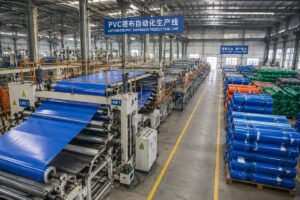
Direct Import Container Cover Tarp for Peru Construction Site Managers Wholesale Supplier
Heavier GSM does not automatically mean better durability in Lima’s humid coastal climate.
Successful direct import of container cover tarps to Peru requires precise HS classification, UV and fire-retardant certification alignment with local regulations, and industrial-grade packaging to survive Callao port handling. Prioritizing coating adhesion and base fabric density over simple weight metrics prevents premature failure in the Andean highlands and avoids costly customs detention.
I still recall the silence on the other end of the line when a procurement manager from a mining project in the Peruvian Andes realized his shipment was stuck at the port. The tarps had arrived, but the documentation did not match the physical labeling, and the material composition lacked the specific fire-retardant proof required for high-altitude industrial zones. That delay cost weeks of storage fees and nearly halted site progress. It was not a failure of the product itself, but a failure of preparation. In my years handling export documentation and following up on shipments to South America, I have seen that the difference between a smooth clearance and a logistical nightmare often lies in the details that buyers overlook until it is too late. [NEED_CITE: common causes of customs delays in Peruvian ports per SUNAT guidelines]
Understanding the specific demands of the Peruvian market means looking beyond the price tag. It involves recognizing how the unique combination of coastal humidity and high-altitude UV exposure affects material longevity. For construction site managers and procurement officers seeking a reliable Direct Import Container Cover Tarp for Peru Construction Site Managers Wholesale Supplier, the focus must shift from generic specifications to targeted compliance and resilience.
Why Do Standard Tarps Fail in Peru’s Diverse Climate?
Standard polyethylene or low-grade PVC covers often disintegrate or become brittle within months when exposed to Peru’s extreme environmental contrasts. The core issue is not just the sun, but the combination of intense ultraviolet radiation at high altitudes and persistent moisture along the coast.
In the Andes, construction and mining sites face UV levels that are significantly higher than at sea level. A tarp that performs adequately in a temperate climate may suffer from rapid polymer degradation when placed at three thousand meters above sea level. The plasticizers migrate out of the material, leading to cracking and loss of flexibility. Conversely, in Lima and other coastal areas, the high humidity and salt air can promote hydrolysis in poorly formulated coatings, causing the layers to delaminate. [NEED_CITE: effects of UV radiation and humidity on PVC polymer stability in tropical and high-altitude climates]
I once reviewed a batch of returned goods from a infrastructure project near Cusco. The buyer had selected a standard export-grade tarp based on its low cost. Within a single rainy season, the material had lost its tensile strength, tearing easily under wind load. The failure was not due to poor handling, but because the base fabric lacked the necessary density to support the coating under thermal stress.
For a Direct Import Container Cover Tarp for Peru Construction Site Managers Wholesale Supplier, offering materials with enhanced UV stabilizers and hydrolysis-resistant formulations is essential. The solution lies in selecting PVC compounds that maintain flexibility across a wide temperature range, ensuring they do not become brittle in the cold mountain nights or overly soft in the coastal heat.
What Specifications Matter for Direct Container Imports?
When sourcing heavy-duty covers, many buyers fixate on grams per square meter (GSM) as the sole indicator of quality. This is a misconception. While GSM provides a baseline for weight, it does not reveal the structural integrity of the fabric. A high GSM can be achieved by adding excessive filler material, which actually weakens the tear strength and reduces lifespan.
The critical parameters for construction site applications are tear strength, coating adhesion, and thread count. In Peru, where winds can be unpredictable and equipment protection is vital, the ability of the tarp to resist punctures and tears is paramount. Coating adhesion ensures that the waterproof layer remains bonded to the base fabric even when the material is folded, rolled, or subjected to mechanical stress.
| Specification Factor | Basic Grade | Heavy-Duty Site Grade | Premium Industrial Grade |
|---|---|---|---|
| Base Fabric Density | Low | Medium-High | Very High |
| Coating Adhesion | Standard | Strong | Robust |
| Tear Strength | Vulnerable | Resistant | Highly Resistant |
| UV Stabilization | Minimal | Certified | Extended Service Life |
| Fire Retardancy | None | Basic Compliance | Full Certification |
A construction contractor in Arequipa learned this lesson when switching suppliers. The initial samples looked identical in thickness, but the premium option featured a tighter weave and superior coating bond. Over time, the premium tarps showed noticeably less wear around the eyelets and edges, areas typically prone to failure. [NEED_CITE: importance of base fabric density and coating adhesion in technical textile longevity]
At Jinxiang, we customize GSM ranges from 440 to 1000gsm, but we emphasize the underlying structure. For a Direct Import Container Cover Tarp for Peru Construction Site Managers Wholesale Supplier, providing detailed technical data sheets that highlight tear strength in Newtons per five centimeters and coating weight ratios builds trust and ensures the right product is selected for the specific site conditions.
How to Avoid Customs Delays at Callao Port?
Customs clearance in Peru is rigorous, and inconsistencies in documentation are the primary cause of delays. The Superintendencia Nacional de Aduanas y de Administración Tributaria (SUNAT) requires precise alignment between the declared HS code, the certificate of origin, and the physical labeling of the goods.
One frequent error is misclassifying PVC tarpaulins under generic plastic sheeting codes instead of the specific category for coated textiles. This discrepancy can trigger inspections, leading to storage fees and potential fines. Additionally, the certificate of origin must be accurately completed to qualify for any applicable trade agreements, and the labels on the packages must match the invoice description exactly. [NEED_CITE: SUNAT guidelines for importing coated textile products and HS code verification]
I recall assisting a client whose shipment was held for over ten days because the Spanish translation on the commercial invoice did not match the terminology on the packing list. While seemingly minor, such inconsistencies raise red flags for customs officers. Ensuring that all documents are consistent, clearly labeled, and include necessary certifications for fire retardancy and UV resistance is non-negotiable.
For a Direct Import Container Cover Tarp for Peru Construction Site Managers Wholesale Supplier, providing pre-shipment inspection reports and verified documentation packages is part of the service. This proactive approach minimizes the risk of detention and ensures that materials reach the site when needed. It is not just about shipping goods; it is about delivering compliance.
Which Packaging Ensures Zero Damage Upon Arrival?
Standard export packing is often insufficient for the long sea voyage to South America and the subsequent handling at busy ports like Callao. Moisture ingress during transit can lead to mold growth on the tarps, rendering them unusable upon arrival. Furthermore, rough handling can damage the edges and corners of the rolls, compromising the integrity of the material before it is even unrolled.
Effective packaging involves more than just wrapping the product. It requires industrial-grade rolling with waterproof inner layers, such as polyethylene film, to create a moisture barrier. Reinforced corner protection and sturdy outer wrapping prevent physical damage during lifting and stacking. [NEED_CITE: best practices for packaging flexible coated fabrics for maritime transport]
A distributor in Lima once reported receiving a container where several rolls had developed mildew spots due to condensation inside the container. The lack of an inner moisture barrier allowed humidity to penetrate the packaging. By switching to double-wrapped rolls with desiccants included in the container, subsequent shipments arrived in pristine condition.
For a Direct Import Container Cover Tarp for Peru Construction Site Managers Wholesale Supplier, investing in robust packaging is a reflection of quality control. It ensures that the product arrives ready for immediate use, without the need for cleaning or repair. This attention to detail reduces waste and enhances the overall value proposition for the buyer.
Conclusion
Importing container cover tarps to Peru demands precision in specification, documentation, and packaging.
Success relies on understanding the climatic challenges of the region and adhering to strict regulatory requirements. By focusing on material quality beyond GSM, ensuring accurate customs classification, and utilizing protective packaging, buyers can secure reliable supplies for their projects. Partnering with a knowledgeable Direct Import Container Cover Tarp for Peru Construction Site Managers Wholesale Supplier streamlines this process, turning potential logistical hurdles into manageable steps.