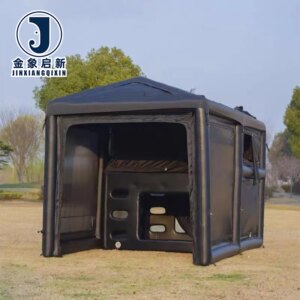
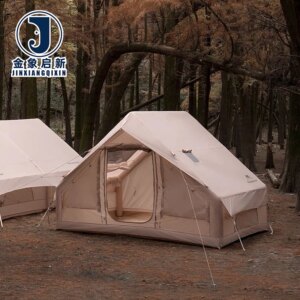
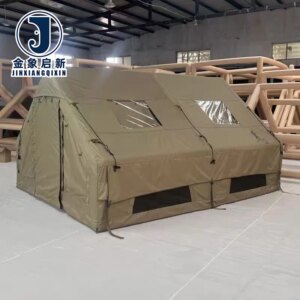
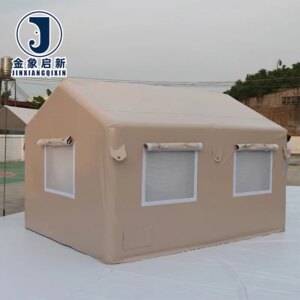
Portable Inflatable Camping Tent Large Waterproof Family Outdoor Air Tent With Great for 8-10 Person Group Trip — PVC tarpaulin construction engineered for commercial outdoor accommodation and rapid-deploy event shelters.
Full catalogue and custom capability from design to delivery, with material selection, pattern printing, and sizing tailored to your project specifications. Each unit undergoes 100% inflation testing for 24 hours before dispatch to verify pressure retention.
- OEM & ODM supported with sample development within days
- Waterproof and UV-resistant treatment for extended field service
- Produced in 9,180 m² facility with 3 full lines and 10-person R&D team
Backed by nearly 30 years of coated fabric process control and dedicated QA at every production stage.
Description
Verified Test Data Per Shipment — every roll of inflatable tent fabric ships with documented results for waterproof rating, UV exposure, and tensile performance against ISO standards.
Technical Specifications
Product Type | PVC Tent
| Parameter | Value |
|---|---|
| Core Material | PVC tarpaulin |
| Product Form | Inflatable structure |
| Waterproof Rating | IPX6 per ISO 20811 |
| UV Resistance | 4000 hours accelerated testing per ISO 4892 |
| Tear Strength | 200N per ISO 13934-1 |
| Airtightness | ≤5% pressure loss in 12 hours |
| Capacity | 8–10 Person |
| Design | Single-layer |
| Customization | OEM & ODM, pattern printing, sample development |
| Certifications | ISO 9001, ISO 14001, ISO 45001, CE |
Application Suitability
| Application | Exposure & Requirement |
|---|---|
| Temporary site accommodation for construction crews | Repeated inflation cycles, ground moisture, UV exposure, wind load on air beams |
| Base camp facilities for industrial field projects | Extended outdoor deployment, temperature variation, abrasion from sand and debris |
| Mobile event shelters requiring quick setup | Rapid inflation and deflation, flex fatigue at seam junctions, transport vibration |
| Commercial outdoor accommodation | Guest-facing appearance, weather sealing, long-term UV and rain resistance |
| Wholesale distribution to outdoor equipment suppliers | Batch-to-batch colour and weight consistency, branded printing, roll-to-roll uniformity |
Why Test Reports Matter More Than Quotation Claims for Inflatable Structures
Claimed performance without documentation is the single most common reason inflatable structures fail site inspection. [NEED_CITE: ISO 4892 accelerated UV testing methodology for coated fabrics]
Buyers sourcing inflatable tent fabric for commercial use frequently discover that the material arriving on site does not match the performance stated on the quotation — UV resistance claimed but untested, waterproof ratings asserted without ISO 20811 validation, and tear strength figures that disappear when independent labs run the numbers. For inflatable structures that must hold air pressure over extended periods, these gaps are not cosmetic; they determine whether the structure passes commissioning or collapses under its first storm. Every batch of our inflatable tent fabric manufacturer custom output includes batch-specific test data, so your procurement team can verify before the first inflation cycle begins.
Full-Catalogue Custom Capability for Air Structure Manufacturers
Tent and inflatable structure manufacturers need more than a stock roll — they need a supplier that can match material selection to the structural demands of each air beam, wall panel, and roof membrane. As an Inflatable Tent Fabric manufacturer custom partner, we support OEM and ODM requirements from sample development through mass production, including pattern printing, bespoke sizing, and colour matching across production runs. The 10-person R&D team handles material specification alignment, ensuring that the PVC tarpaulin selected for your inflatable structure meets both the pressure retention and surface durability requirements of the end application.
Batch Consistency Across Production Runs for Branded Product Lines
Outdoor equipment distributors specifying certified PVC inflatable fabric for branded product lines face a recurring challenge: colour and weight variation between rolls becomes visible once panels are assembled side by side. [NEED_CITE: batch consistency requirements for coated fabric in visual applications] Our three full production lines and 36 sets of professional processing equipment are calibrated to maintain uniform coating weight and colour across every roll in a production batch. Dedicated QA/QC at each production stage, combined with 100% pre-shipment inspection, ensures that the inflatable tent fabric you receive matches the approved sample in both appearance and performance.
Reading the Specification Sheet for Inflatable Tent Fabric
The IPX6 waterproof rating confirmed per ISO 20811 indicates that the PVC tarpaulin core resists water penetration under high-pressure spray conditions — critical for inflatable structures deployed in sustained rain or ground-level moisture environments. The 4000-hour accelerated UV testing per ISO 4892 provides a documented baseline for how the coating resists degradation under prolonged solar exposure, though actual field performance depends on installation altitude, latitude, and maintenance practices. Tear strength validated at 200N per ISO 13934-1 reflects the fabric’s resistance to propagation of cuts or punctures during repeated inflation and deflation cycles — a key factor for air structures that are packed, transported, and redeployed regularly. The airtightness threshold of ≤5% pressure loss in 12 hours confirms that the coated seams and material body maintain structural integrity under sustained internal pressure. [NEED_CITE: ISO 13934-1 strip method for tensile and tear testing of coated fabrics]
The Hidden Cost of Unverified Material Claims in Inflatable Structures
When inflatable tent fabric is specified without documented test results, the consequences extend well beyond the fabric itself. Structures that fail airtightness testing after assembly require complete seam re-welding — labour costs that far exceed the original material savings from choosing an unverified supplier. Flame-retardant claims without a supporting grade or standard can result in failed site safety inspections, forcing full material replacement after the structure is already erected. Colour variation between rolls becomes apparent only after panels are welded together, making partial corrections impossible without visible patch lines. [NEED_CITE: consequences of unverified flame retardant certification in temporary structures]
Procurement Confidence Backed by Process Control
Nearly 30 years of focused coated fabric production means deep process control over coating weight, adhesion, and finishing — the variables that directly determine whether inflatable tent fabric holds pressure, resists UV degradation, and maintains appearance across production batches. The 9,180 m² facility with three full production lines supports bulk capacity with reliable delivery timelines for custom specifications. Sample development within days allows your engineering team to validate material performance before committing to mass production. Dedicated QA/QC at every stage, culminating in 100% pre-shipment airtightness inspection, ensures that each roll meets the documented specification before it leaves the facility.
Documentation & Verification
- Material specification sheet stating PVC coating type, waterproof rating (IPX6), and UV test basis (ISO 4892, 4000 hours)
- Batch-specific test reports per ISO 20811, ISO 4892, and ISO 13934-1 with actual measured values
- Pre-shipment airtightness inspection record documenting pressure retention results per roll
- ISO 9001, ISO 14001, ISO 45001, and CE certificates for import compliance verification
- Roll packing list with individual roll identification and weight confirmation
- Certificate of origin and customs documentation support for destination market clearance
Fabrication, Handling & Storage
- Weld seams on PVC tarpaulin inflatable structures require controlled heat and pressure settings matched to the coating thickness to prevent delamination
- Store fabric rolls upright on flat surfaces to avoid permanent creasing that compromises airtightness at fold lines
- Allow fabric to acclimate to site temperature before inflation — cold PVC becomes less flexible and more prone to stress cracking at seam junctions
- Clean surfaces with mild non-solvent cleaners only; abrasive or solvent-based products degrade the UV-resistant coating layer
- Inspect all seam welds visually before each deployment cycle; early detection of micro-separation prevents pressure loss during use
Preparing Your Inquiry for Inflatable Tent Fabric
To receive an accurate specification recommendation and sample, provide the intended application environment, required dimensions and panel configuration, target market compliance requirements (including any flame-retardant or fire-safety standards), and annual volume estimate. Indicate whether you require fabric by the roll or finished panel cutting, along with any pattern printing or branding specifications. Sample development is available for performance validation before mass production commitment.
Frequently Asked Questions
Q: How is UV resistance tested and what documentation accompanies each shipment?
A: UV resistance is validated through 4000 hours of accelerated testing per ISO 4892. Each shipment includes a batch-specific test report documenting the actual measured performance, along with a material specification sheet confirming the coating type and treatment applied to the PVC tarpaulin.
Q: What customization options are available for inflatable tent fabric?
A: Customization includes OEM and ODM support with bespoke sizing, pattern printing, colour matching, and sample development. The 10-person R&D team handles material selection and specification alignment to match your inflatable structure design requirements.
Q: How is airtightness verified before dispatch?
A: Each inflatable structure undergoes 24-hour inflation testing, with airtightness confirmed at ≤5% pressure loss over 12 hours. Pre-shipment inspection records documenting pressure retention results are included with every dispatch.
Q: What is the sample development lead time for custom specifications?
A: Samples are developed within days for custom requirements, including pattern printing and bespoke sizing. This allows your engineering team to validate material performance and appearance before committing to mass production.
Q: Which certifications are provided for import compliance?
A: Shipments include ISO 9001, ISO 14001, ISO 45001, and CE certificates, along with a certificate of origin and customs documentation support. Test reports per ISO 20811, ISO 4892, and ISO 13934-1 are provided for performance verification in destination markets.
Related products
-
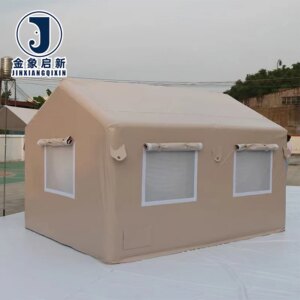
Inflatable Camping Tent PVC Waterproof Four-Season Outdoor Air Tent with Quick Automatic Opening for 3-4 Person
Read more -
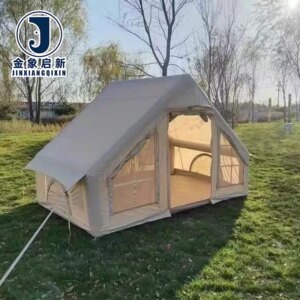
Outdoor Portable Camping Inflatable Tent Luxury All-Season Use Overnight Large Space Rainproof Insulated Quick Automatic Opening
Read more -
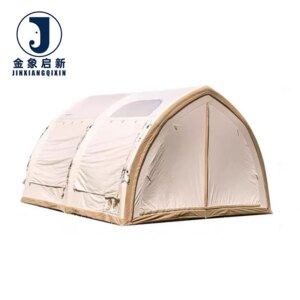
Premium Four-season PVC Inflatable Tents for Camping Easy-to-Use Spacious Portable Waterproof Outdoor Tent with Pump
Read more -
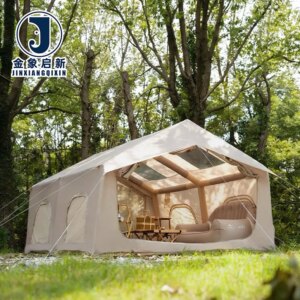
High Quality Four-Season Inflatable Tent for Camping Durable PVC Waterproof All-Weather Resistance Quick Automatic Opening
Read more