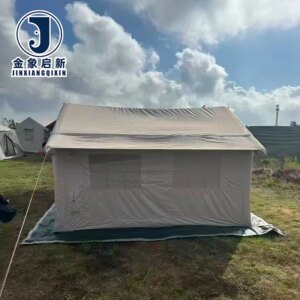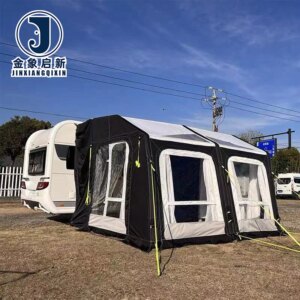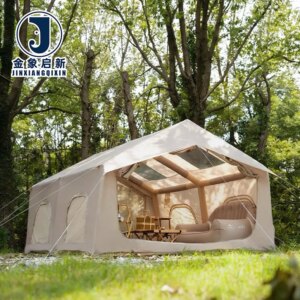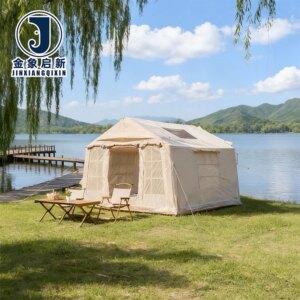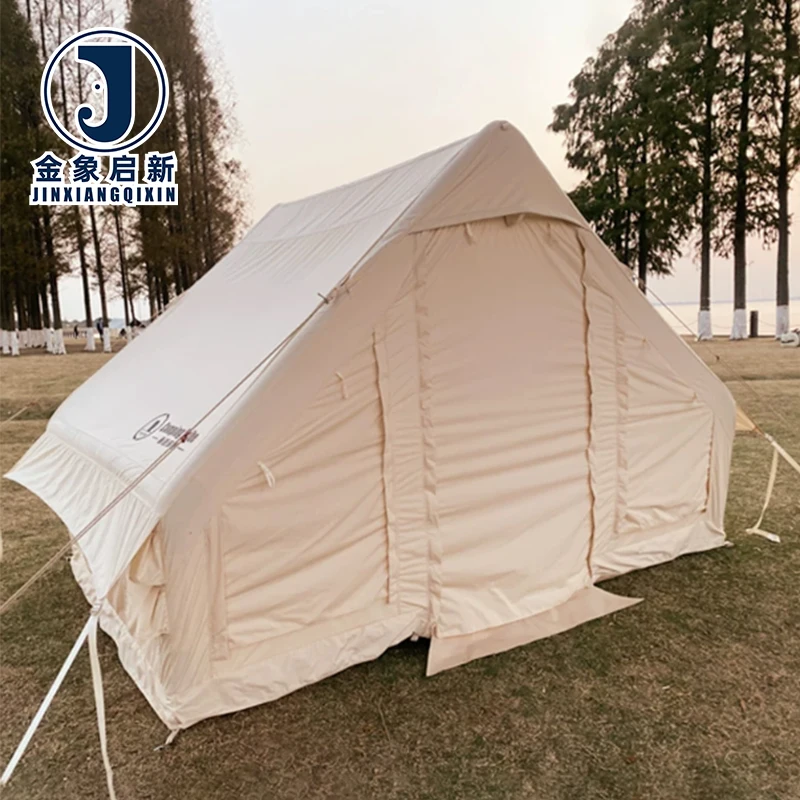
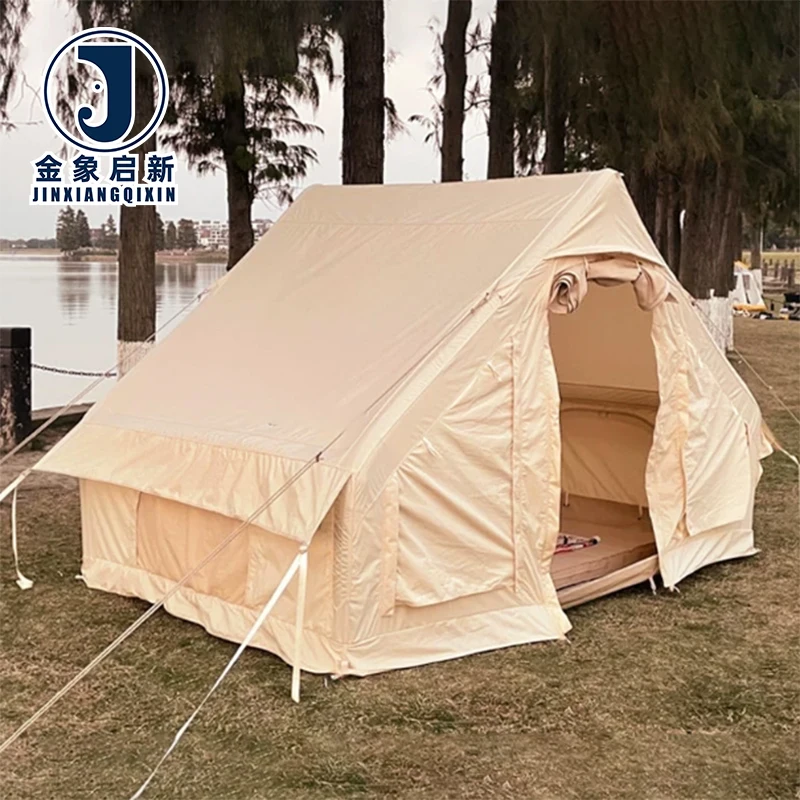
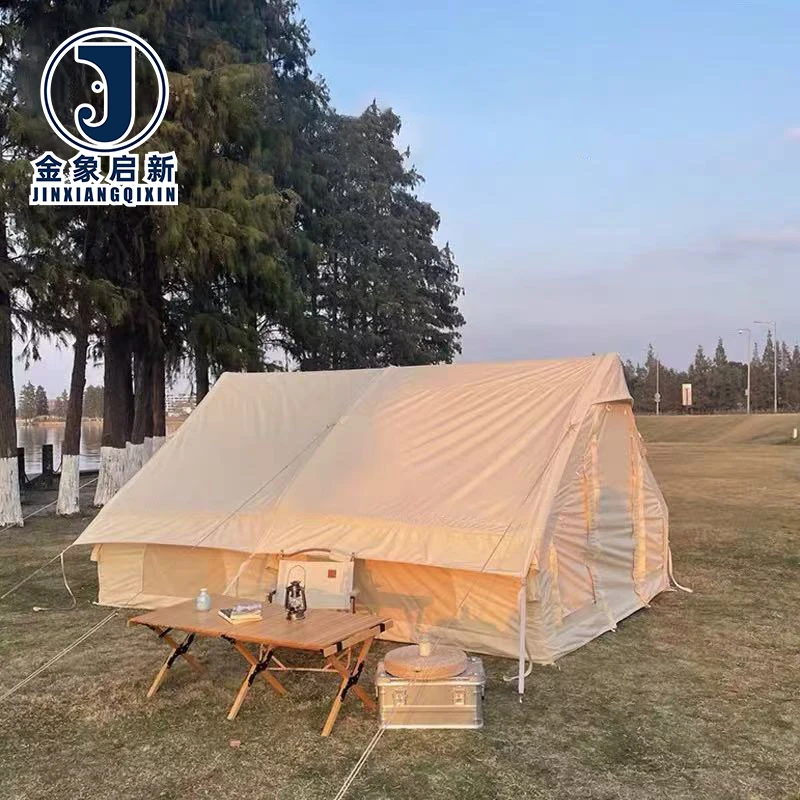
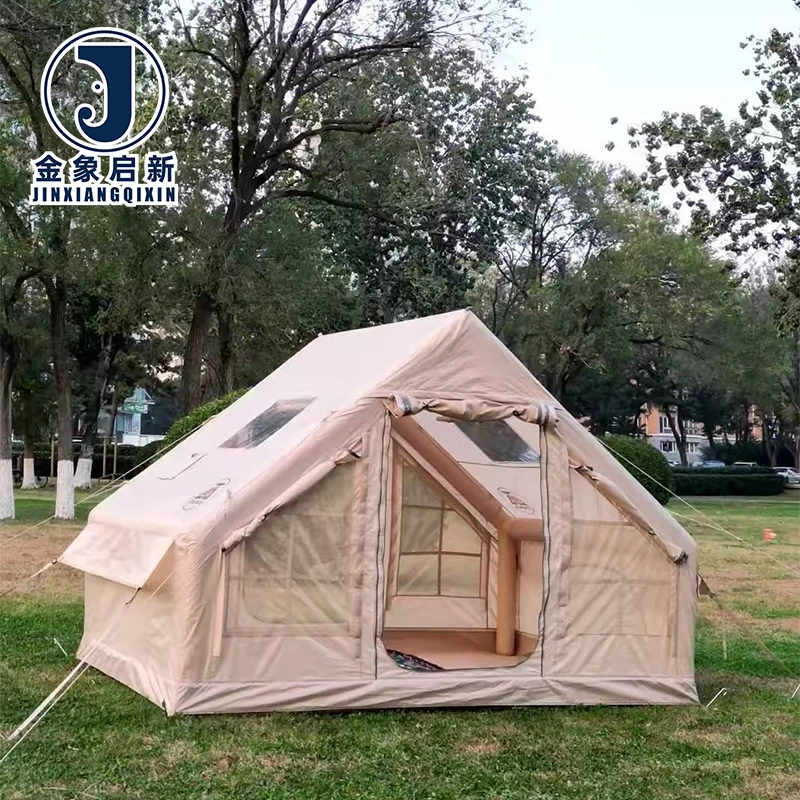
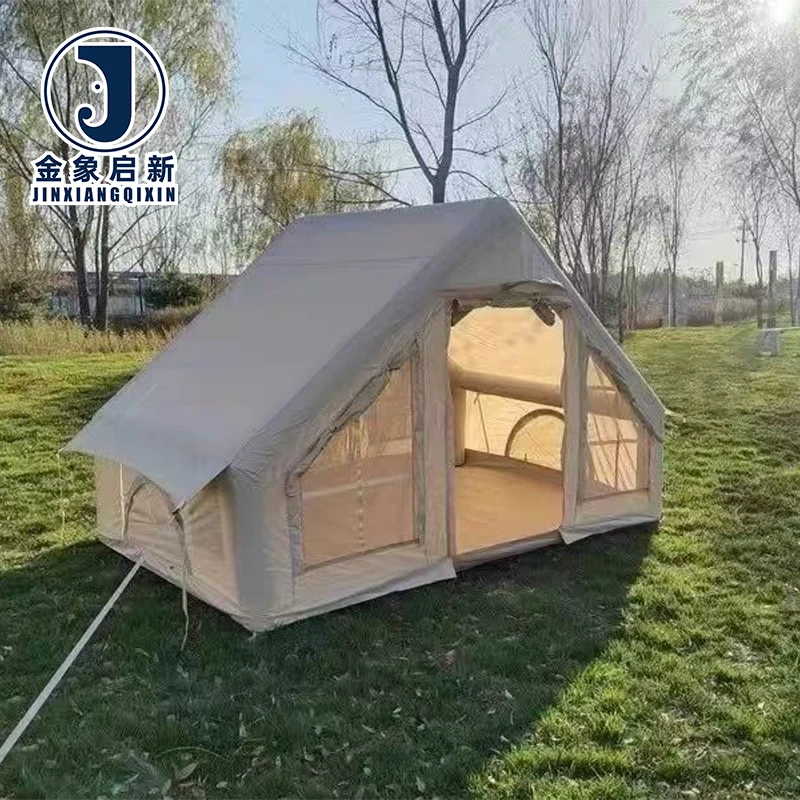
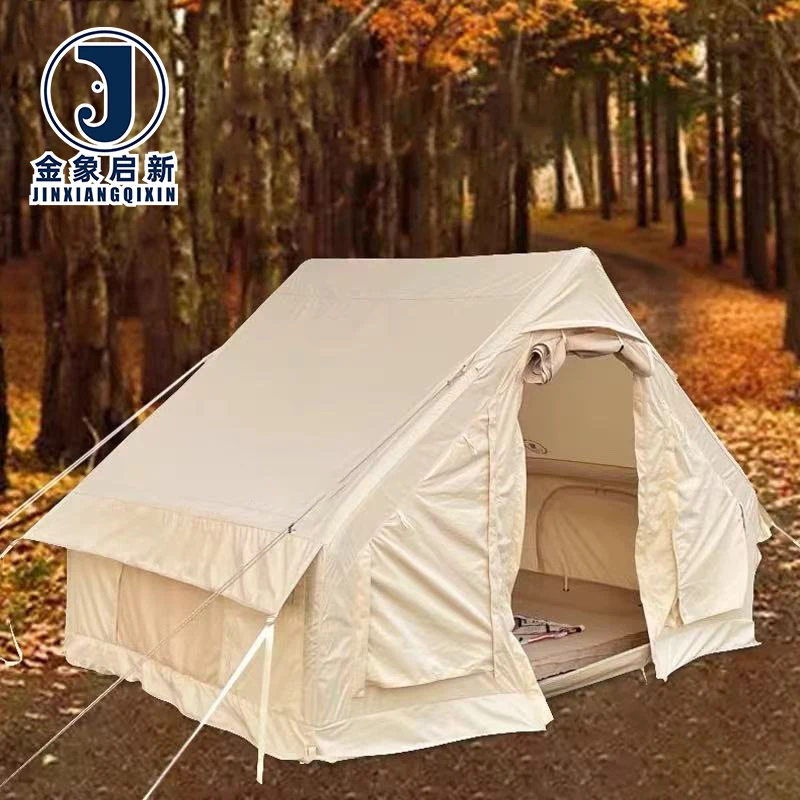
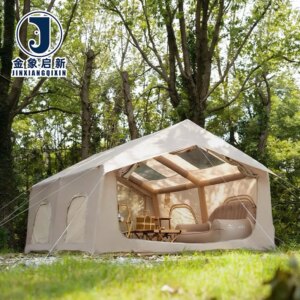
Inflatable Camping Tent Portable Anti-UV Water-resistance Khaki — single-layer 4-person design with integrated air pump system and reinforced stress points. Engineered using industrial-grade PVC coated fabric with proprietary coating formulation, delivering verified tear strength of 300N/5cm in both warp and weft directions under wind load. Full custom sizing, color matching, and logo printing supported.
- Hydrostatic head exceeding 5000mm with batch-specific inspection data
- UV and water resistance validated for continuous outdoor exposure
- 16-point QA covering raw material, seam strength, and 24-hour pressure retention
- Pre-production sample approval required before bulk commitment
Description
Coating Weight Control — Nearly three decades of PVC coating formulation applied to inflatable tent fabric, with every roll verified against stated GSM before dispatch.
Technical Specifications
| Parameter | Value |
|---|---|
| Product Type | Inflatable Tent Fabric |
| Core Material | UV Water-resistant PVC Fabric |
| Waterproof Rating | Hydrostatic head exceeding 5000mm per ISO 5912 |
| UV Resistance | Minimum 5000 hours exposure per ISO 4892-3 |
| Tear Strength | 300N/5cm warp and weft per EN 13725 |
| Wind Load Resistance | Beaufort scale 6 |
| Material Thickness Range | 0.3mm to 0.8mm |
| Product Forms | Extended type with 1 bedroom & 1 living room |
| Capacity | 4 Person |
| Design | Single layer with integrated air pump system |
| Key Features | UV protection, water resistance, tear resistance |
| Certifications | ISO9001, ISO14001, ISO45001, CE |
Application Suitability
| Application | Exposure & Requirement |
|---|---|
| Construction site crew accommodation | Continuous UV exposure, dust ingress, daily inflation-deflation cycles, mechanical abrasion from tools and equipment |
| Mobile field stations for research teams | Remote deployment in variable climates, rapid setup under wind load, waterproof integrity over extended occupation |
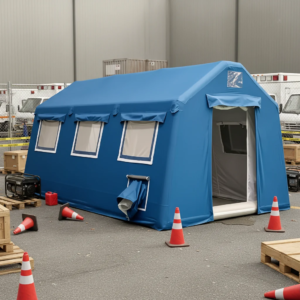
| Emergency response temporary facilities | Immediate deployment under adverse weather, repeated transport and storage, high-visibility color requirements |
| Outdoor equipment storage shelters | Long-term moisture exposure, UV degradation on stored assets, puncture risk from sharp-edged inventory |
Why Test Reports Matter More Than "Waterproof" Labels on Inflatable Tent Fabric
Specifying inflatable tent fabric without verified test documentation invites structural failure at the worst possible moment.
Buyers routinely see inflatable tent materials marketed as waterproof or UV-resistant with no independent verification behind the claim. The fabric arrives, performs acceptably through the first season, then delaminates at the seams or loses tensile integrity after sustained sun exposure. For commercial operations — construction sites, research expeditions, emergency deployments — that failure window is unacceptable. [NEED_CITE: ISO 5912 hydrostatic head test methods for coated tent fabrics]
When a 4-person inflatable camping tent deflates mid-storm because the welded seam could not hold pressure, the root cause often traces back to coating adhesion that was never tested against the stated specification. This is where material procurement diverges sharply from consumer-grade purchasing decisions.
What the PVC Coating Layer Actually Does for Inflatable Structures
The PVC coating on inflatable tent fabric serves a dual structural function: it creates the airtight envelope necessary for pneumatic rigidity while shielding the base fabric from moisture, UV radiation, and mechanical wear. An Inflatable Tent manufacturer custom formulation controls coating weight per square meter with precision, ensuring the air beams maintain pressure without excessive material stiffness that would compromise pack-down dimensions.
The relationship between coating thickness and air retention is not linear. Thicker coatings add weight and reduce flexibility, which matters when a 4-person camping tent must be transported and deployed rapidly in field conditions.
How Base Fabric Construction Governs Long-Term Inflation Integrity
The warp and weft yarn structure beneath the PVC layer determines how the inflatable tent responds to sustained internal pressure. A tear strength of 300N/5cm in both directions, verified per EN 13725, means the base fabric resists propagating tears at stress concentration points — particularly around valve penetrations and beam junctions where inflation forces create multi-directional load paths. [NEED_CITE: EN 13725 tear resistance testing protocol for coated fabrics]
Denier count and weave density work together to distribute inflation pressure across the fabric plane. If the base fabric is under-specified, the coating layer alone cannot compensate, and micro-tears develop at flex points during inflation and deflation cycles.
Reading the Specification Sheet: Thickness, Hydrostatic Head, and Tear Data
The 0.3mm to 0.8mm material thickness range exists because different inflatable tent applications demand different structural compromises. Thinner material at 0.3mm suits lightweight portable camping tents where pack weight governs the specification. Thicker 0.8mm construction handles industrial applications — construction crew shelters, equipment covers — where abrasion resistance and long-term air retention take priority over portability.
A hydrostatic head exceeding 5000mm per ISO 5912 indicates the PVC coating maintains waterproof integrity under sustained water column pressure far beyond typical rainfall intensity. This rating matters most for ground-contact panels where standing water or driving rain creates localized pressure against the fabric surface.
Tear strength at 300N/5cm in both warp and weft directions reflects balanced base fabric construction. Unbalanced weave — strong in one direction, weak in the other — causes asymmetric tear propagation that compromises an inflated beam more rapidly than uniform tearing. [NEED_CITE: ISO 1421 tensile and tear testing for coated textiles]
The Hidden Cost of Specifying Inflatable Fabric on Marketing Claims Alone
When UV resistance is stated without a test standard, the buyer has no basis for comparing two suppliers’ materials or for setting warranty expectations. Fabric that survives one summer in northern Europe may degrade within months under equatorial sun exposure. The cost is not just replacement material — it includes downtime for the construction crew or research team that depended on the shelter, plus reputational damage for the tent manufacturer who specified it.
Batch-to-batch color variation across fabric rolls becomes visible the moment two panels are seamed together on a production floor. If the inflatable tent manufacturer has not locked color references at the sample approval stage, an entire production run can be visually inconsistent, forcing rework or customer rejection. [NEED_CITE: color fastness and batch consistency standards for PVC coated fabrics]
Welded seam failure before fabric failure is the most common structural complaint in inflatable tent assemblies. This typically indicates that welding parameters were not matched to the specific coating formulation and thickness, causing the heat-affected zone to become the weakest link rather than the seam itself.
Why Buyers Source Inflatable Tent Fabric Through This Facility
Ten dedicated R&D technicians handle material selection, pattern printing, and custom sizing from initial inquiry through sample approval, ensuring the inflatable tent fabric matches the buyer’s engineering requirements before production commits.
Three full production lines and 36 sets of professional equipment support bulk roll output with maintained coating consistency — critical when a tent manufacturer orders multiple rolls and expects uniform thickness and color across the entire batch.
Dedicated QA/QC runs at every production stage, including 24-hour pressure retention tests and seam strength checks on finished inflatable tent assemblies, catching adhesion or weld defects before they reach the packing line.
Samples for custom requirements are developed within days, allowing buyers to validate material thickness, color, and weld behavior before committing to a production order — reducing the commercial risk of specifying an untested fabric.
Documentation & Verification
- Material specification sheet listing coating weight, base fabric denier, and color reference per roll
- UV resistance test report to ISO 4892-3 documenting exposure hours and retention percentage
- Waterproofness test certificate per ISO 5912 with hydrostatic head measurement for each production batch
- Tear strength test data per EN 13725 showing warp and weft values from in-line sampling
- Pre-shipment inspection record covering coating adhesion, dimensional tolerance, and visual defects
- Certificate of origin and customs documentation package for export shipment
Fabrication, Handling & Storage
- Heat-weld PVC seams at temperatures matched to the specific 0.3mm–0.8mm thickness to avoid coating burn-through at beam junctions
- Reinforce valve penetration points with additional PVC patches bonded to the base fabric layer before inflation testing
- Store fabric rolls horizontally on padded racks to prevent permanent creasing that weakens the coating at fold lines
- Allow cold-stored rolls to reach ambient temperature before unrolling to prevent low-temperature coating crack damage
- Use PVC-compatible adhesives only for field repairs — solvent-based cleaners can dissolve the coating surface layer
- Plan cutting layout to minimize transverse seams across inflatable beam panels where internal pressure concentrates
What We Need to Quote Your Inflatable Tent Fabric Requirement
Provide the intended application environment — whether the tent will face continuous UV in arid climates, salt-air coastal exposure, or industrial dust and abrasion — so we can recommend the appropriate coating formulation and thickness within the 0.3mm to 0.8mm range.
Share your target market compliance requirements, particularly any fire-retardant grades your end-users mandate, along with annual volume estimates and preferred roll widths so we can confirm production capacity and lead times against your delivery schedule.
Frequently Asked Questions
Q: How is UV resistance tested and documented for inflatable tent fabric?
A: UV resistance is evaluated per ISO 4892-3 accelerated aging protocols, documenting minimum 5000 hours of simulated sunlight exposure with measured retention of tensile and color properties. Test reports accompany each batch shipment, showing actual measured values rather than pass-fail statements, giving buyers verifiable data for their product warranty calculations.
Q: What customization options are available for color, thickness, and dimensions?
A: OEM and ODM customization covers material thickness from 0.3mm to 0.8mm, custom color matching against buyer-supplied references, logo printing, and dimensional modifications to panel sizes. Pre-production samples are developed for engineering validation, allowing buyers to confirm weld behavior, color accuracy, and inflation performance before mass production authorization.
Q: How do you ensure batch-to-batch color consistency across rolls?
A: Color references are locked at the sample approval stage using standardized color measurement against the buyer’s specified reference. In-process QC checks coating color at multiple points during each production run, and rolls from different batches destined for the same order are compared side-by-side before packing to flag any visible variation.
Q: What is the sample development lead time for custom inflatable tent fabric?
A: Sample development typically requires 7–10 working days for custom specifications including color matching, thickness adjustment, and pattern printing. Samples ship with full material documentation so buyers can conduct their own inflation testing and weld parameter development before committing to bulk order quantities.
Q: How are welded seams tested for structural integrity under inflation pressure?
A: Finished inflatable assemblies undergo 24-hour pressure retention testing as part of the 16-point inspection protocol, verifying that welded seams hold rated inflation pressure without measurable leakage. Seam peel strength is tested destructively on production samples per EN 13725 methodology, ensuring the weld zone meets or exceeds the base fabric tear specification.
Related products
-
Aufblasbares Campingzelt Wasserdicht PVC Outdoor Luftzelt Einfacher Aufbau Familiencamping Schutz Vier-Jahreszeiten >3000mm Wasserdicht Schnell
Read more -
High Quality Four-Season Inflatable Tent for Camping Durable PVC Material All-Weather Resistance Quick Automatic Opening
Read more -
Camping Tent Inflatable UV Resistant Customizable Four-season Waterproof PVC Eco-Friendly Windproof Foldable Quick Automatic
Read more -
Outdoor Waterproof Inflatable Tent for Camping Portable Air Camping Tent Shelter
Read more