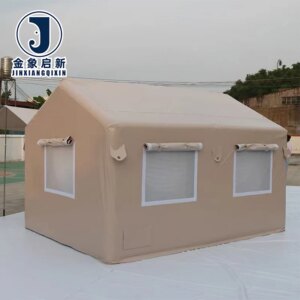
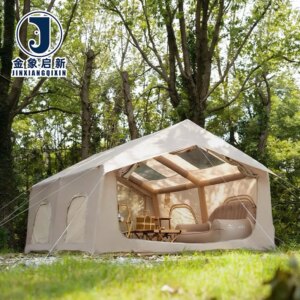
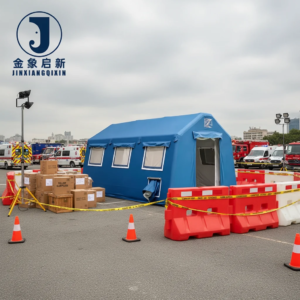
Automatic Inflatable Four-season PVC Tent 3-5 Person — waterproof PVC construction with UV protection, TPU viewing door, and tear-resistant fabric for reliable outdoor performance.
- Automatic inflatable design for rapid single-operator setup
- Four-season rated for varied climate conditions
- Full OEM/ODM customization including sample development and pattern printing
Purpose-built for commercial and industrial temporary shelters, this inflatable tent delivers consistent material quality verified through batch-specific testing and detailed specification documentation.
Description
Deep process control over coating weight and adhesion — Our Automatic Inflatable Four-season PVC Tent 3-5 Person production runs through three dedicated lines where coating consistency is monitored at every stage, not just at final inspection.
Technical Specifications
| Parameter | Value |
|---|---|
| Product Type | Automatic Inflatable Four-season PVC Tent 3-5 Person |
| Core Material | Waterproof PVC |
| Capacity | 3-5 Person |
| Season Rating | Four-season |
| Viewing Door | TPU |
| Key Features | Waterproof, Tear-Resistant, Automatic Inflatable |
| UV Protection | Available — test basis not stated, confirm grade required for your market |
| Customization | OEM & ODM (sample customization, pattern printing) |
| Production Facility | 9,180 square meters |
| Production Lines | 3 full production lines |
| R&D Team | 10 technicians |
| Standards | ISO9001, ISO14001, ISO45001, CE |
Application Suitability
| Application | Exposure & Requirement |
|---|---|
| Temporary site shelters for construction projects | Prolonged sun exposure, wind loading, repeated inflation-deflation cycles, ground moisture contact |
| Mobile equipment storage for logistics operations | Abrasion from loading and unloading, UV exposure in open yards, waterproofing against rainfall ingress |
| Temporary workspace covers for outdoor events | Rapid single-operator deployment, crowd safety compliance, variable weather across seasons |
| Industrial outdoor sheltering | Structural integrity under wind load, long-duration waterproof seal, frequent relocation between sites |
Why "UV Protected" Means Nothing Without a Test Report Behind It
Commercial buyers who sourced inflatable tents with UV claims often discover after deployment that the fabric degrades faster than expected, showing brittleness and colour shift within a single season. Verified UV performance requires a documented test basis, not just a line on a quotation.
When a supplier states UV protection without referencing a specific test standard or grade, the claim cannot be evaluated against the environmental conditions your site actually faces. [NEED_CITE: UV degradation testing for PVC coated fabrics per ISO 4892] The gap between a treated fabric and a verified treated fabric is where premature failures originate — and where buyers absorb the replacement cost mid-project.
Design-to-Delivery Custom Capability for Project-Specific Tents
Every commercial outdoor project presents different dimensional, branding, and performance requirements. An Inflatable Tent manufacturer custom approach means material selection, tent geometry, and surface finishing are all adjustable before production begins. Our 10-person R&D team develops samples within days, allowing buyers to validate construction details and pattern printing accuracy before committing to bulk quantities. This eliminates the common scenario where a generic product is forced into an application it was never designed to serve.
How Automatic Inflation Changes the Deployment Equation on Active Sites
The automatic inflatable design removes the need for manual pole assembly, enabling a single operator to deploy a full shelter in minutes rather than hours. On construction sites where weather windows are unpredictable, this speed difference determines whether equipment stays protected or exposed. The PVC-coated frame structure maintains air retention under temperature fluctuation, which is where cheaper inflatable systems typically lose pressure and collapse during overnight temperature drops. [NEED_CITE: inflatable structure pressure retention standards for temporary shelters]
Material Decisions That Determine Real-World Tent Performance
Waterproof PVC construction provides continuous moisture barrier performance across the entire tent envelope, including seams that are thermally welded rather than stitched. The four-season rating reflects material behaviour across a broad temperature range — remaining flexible in cold conditions without becoming brittle, and retaining structural rigidity when ambient temperatures rise. The TPU viewing door introduces a secondary material interface that must bond reliably to the PVC body; delamination at this junction is a frequent failure point in tents that treat the window as an afterthought. Tear resistance depends on both the base fabric weave density and the coating adhesion strength working together — neither parameter alone predicts field performance.
The Cost of Selecting the Wrong Specification Package
A tent specified without adequate tear resistance will develop propagating tears at stress concentration points — typically where the inflatable frame connects to the ground anchor system or where the door panel meets the main body. [NEED_CITE: tear propagation testing methods for coated fabrics per ISO 1421] When UV treatment is claimed but unverified, the PVC surface chalks and loses flexibility, making the entire structure vulnerable to wind damage that a properly treated fabric would withstand. Buyers who skip sample evaluation before bulk production sometimes discover colour variation between batches only after multiple tents are deployed side by side at an event site, creating an inconsistent appearance that reflects poorly on the operator.
Why Production Control Matters More Than Spec Sheet Claims
Three full production lines running simultaneously mean your order is not queued behind unrelated product categories — tent production stays on dedicated equipment with operators trained on inflatable structure welding parameters. Every roll of PVC-coated fabric passes through full-process QA/QC inspection with 100% pre-shipment checking, catching coating inconsistencies and weld defects before they leave the facility. The 10-technician R&D team handles material selection and pattern printing customisation directly, rather than routing your requirements through a generic sales intermediary. ISO9001, ISO14001, and ISO45001 certification frameworks structure how production decisions are documented and traceable. Sample development runs use the same production lines as bulk orders, so the sample you approve is genuinely representative of what ships.
Documentation & Verification
- Material specification sheet confirming PVC grade and coating weight per shipment
- Batch-specific quality inspection report detailing waterproof and structural integrity results
- Pre-shipment inspection record covering weld seams and inflatable frame pressure tests
- ISO9001, ISO14001, ISO45001, and CE certificates available for compliance verification
- UV and flame retardant test documentation provided where applicable grades are specified
Fabrication, Handling & Storage
- Thermally weld PVC panels using temperature settings matched to the specific coating thickness to avoid burn-through or incomplete bonding
- Store rolled tent fabric vertically in climate-controlled conditions to prevent permanent creasing in the PVC coating layer
- Clean PVC surfaces with pH-neutral detergents; solvent-based cleaners degrade the coating adhesion over repeated applications
- Inspect TPU viewing door bond lines after each deployment cycle for early signs of delamination at the material interface
- Repair minor PVC punctures with compatible patching compound applied to clean, dry substrate surfaces
What We Need to Quote Your Project Accurately
Provide your deployment environment details — expected wind conditions, temperature range, and duration of continuous outdoor exposure. Specify whether you need finished tents in set quantities or if custom dimensions and pattern printing are required for branding compliance. Confirm whether your market requires specific fire classification documentation or if standard waterproof and tear-resistant specifications meet your procurement requirements.
Frequently Asked Questions
Q: What customization options are available for inflatable tents in bulk orders?
A: OEM and ODM services cover material selection, custom sizing, colour specification, and pattern printing. Our R&D team develops physical samples for approval before production begins. You can specify tent dimensions, frame configuration, and surface finish requirements. Standard and custom configurations are produced on the same three dedicated lines to maintain consistent output quality across all order volumes.
Q: How is waterproof and UV performance verified before shipment?
A: Each production batch undergoes full-process QA/QC inspection with dedicated staff on site. Waterproof performance is documented in batch-specific inspection reports. UV protection is available — however, the specific test basis should be confirmed during the inquiry stage so the correct grade is selected for your market requirements. A 100% pre-shipment inspection covers structural integrity before dispatch.
Q: Can samples be provided and approved before mass production begins?
A: Yes. Sample development is a standard step in the OEM and ODM process. Physical samples are produced using the same materials and production lines as bulk orders, allowing you to evaluate construction quality, material feel, and printing accuracy. Production only proceeds after written sample approval, preventing specification mismatches from reaching the shipping stage.
Q: What certifications and documentation accompany each shipment?
A: Shipments include a material specification sheet, batch inspection report, pre-shipment inspection record, roll packing list, and certificate of origin. ISO9001, ISO14001, ISO45001, and CE certification documentation is available for compliance verification. Customs support documentation is prepared to match destination country import requirements.
Q: What is the lead time and ordering process for custom tent orders?
A: The process follows inquiry, specification recommendation, sample development, quotation, sample approval, production with in-process QA, pre-shipment inspection, and dispatch with full documentation. Custom orders involving pattern printing or non-standard dimensions require sample approval before production scheduling. Contact us with your application details and target delivery window to receive a project-specific timeline.
Related products
-
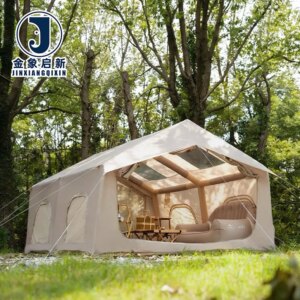
High Quality Four-Season Inflatable Tent for Camping Durable PVC Waterproof All-Weather Resistance Quick Automatic Opening
Read more -
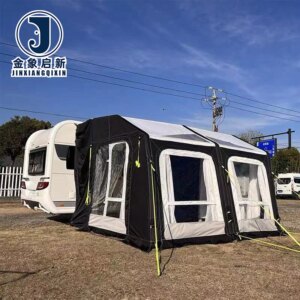
Outdoor Camping Inflatable Tent Luxury All-Season Use PVC Waterproof Quick Automatic Opening Rainproof Insulated
Read more -
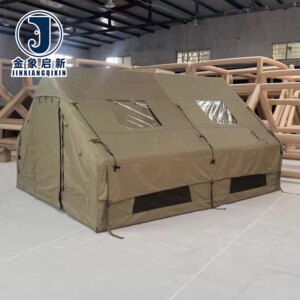
Waterproof Inflatable Camping Tent Outdoor Easy Setup Air Tent for Camping
Read more -
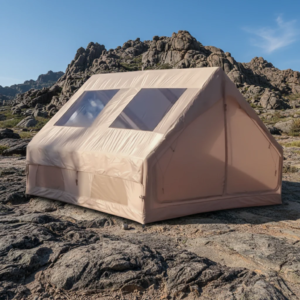
High Quality Four-Season Inflatable Tent for Camping Durable PVC Material All-Weather Resistance Quick Automatic Opening
Read more