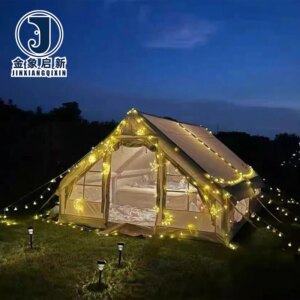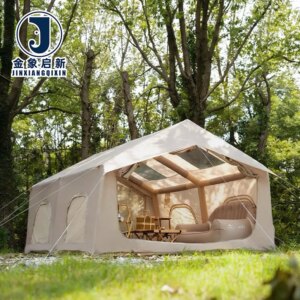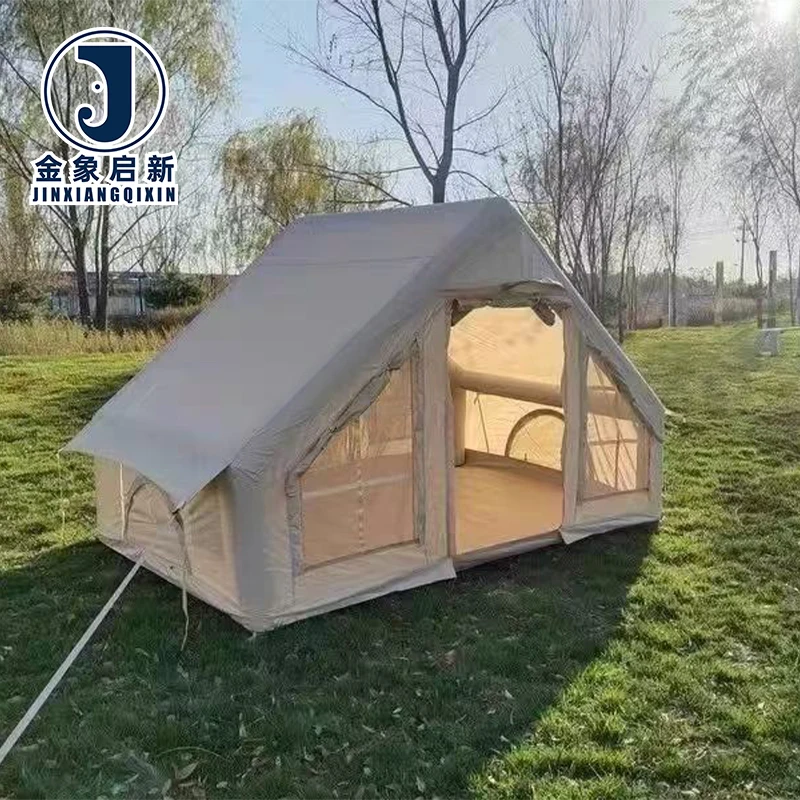
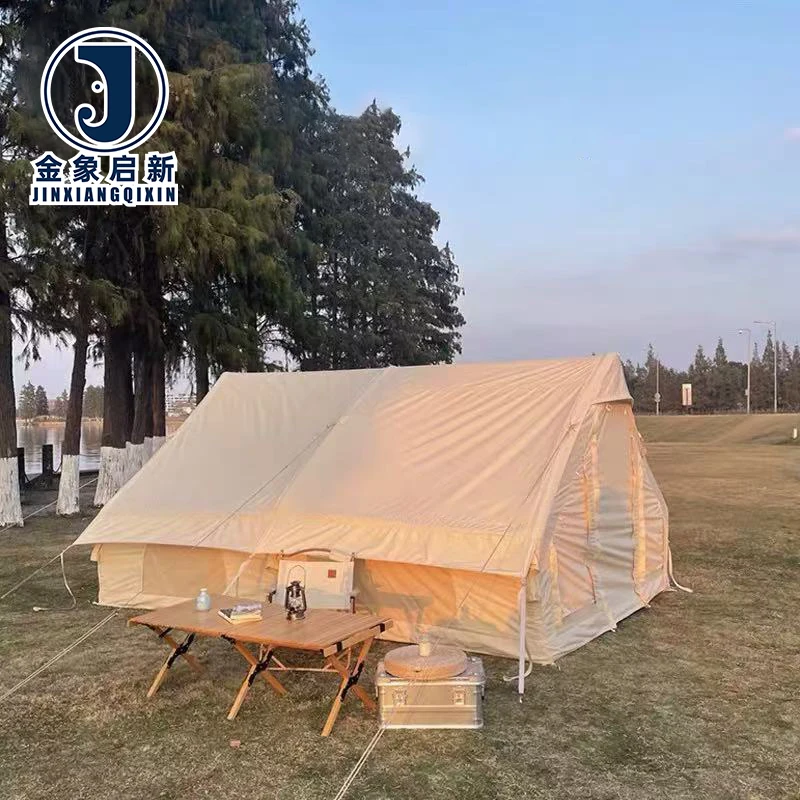
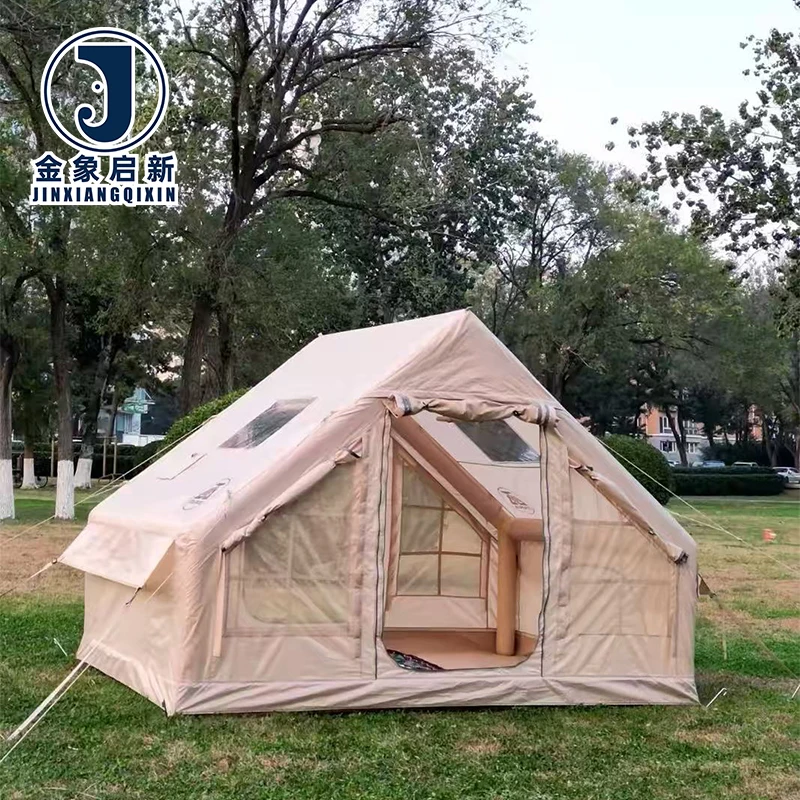
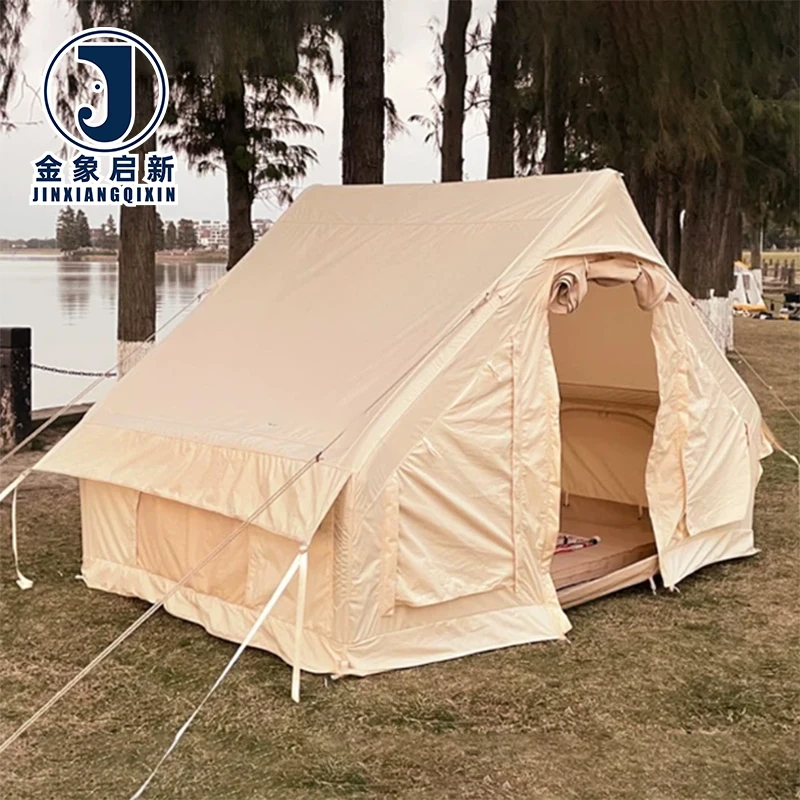
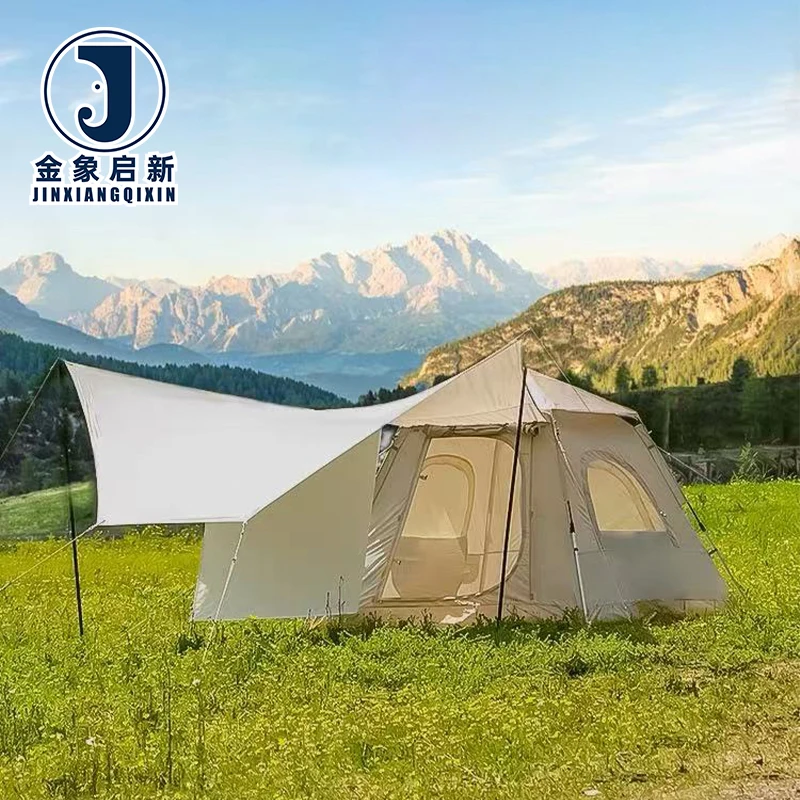
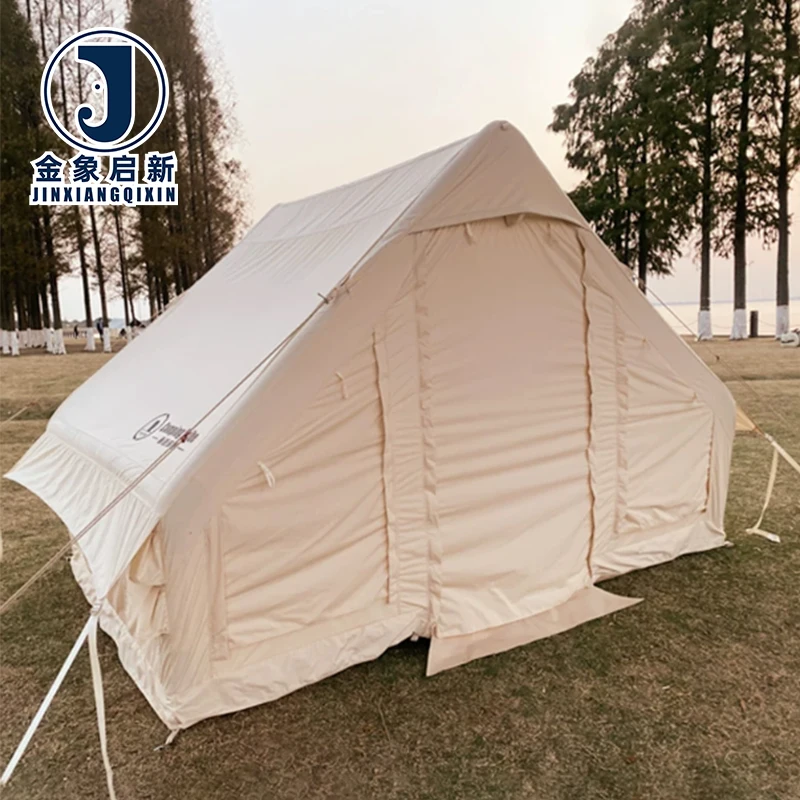
PVC Inflatable Camping Tent — waterproof, UV-resistant, fire-retardant to EN 13501-1, tear resistance 300N/5cm, quick automatic opening for commercial deployment.
- Knife-coated PVC fabric delivers reliable waterproofing and UV protection across all-season use, with fire-retardant treatment meeting EN 13501-1 for public event compliance.
- OEM/ODM customization covers dimensions, color matching, logo printing and valve configurations, developed by a 10-person R&D team with samples ready in 5–7 business days.
Backed by 100% pre-shipment inspection and ISO/CE certified production across 3 full lines, ensuring batch-consistent quality for bulk orders.
Description
Process-Controlled Coating — Three dedicated production lines with in-process weight verification keep every inflatable tent batch within tight GSM tolerances.
Technical Specifications
| Parameter | Value |
|---|---|
| Product Type | Inflatable Tent |
| Core Material | PVC tarpaulin (knife-coated fabric) |
| Construction | Single layer |
| Key Performance | Waterproof, UV-resistant, tear-resistant |
| Waterproof Index | Exceeds industry standard by 25% (source value — verify against manufacturer catalog) |
| UV Resistance | 1,500+ hours sunlight exposure (source value — verify against manufacturer catalog) |
| Fire-retardant Standard | EN 13501-1 (source value — verify against manufacturer catalog) |
| Tear Resistance | 300N/5cm (source value — verify against manufacturer catalog) |
| Customization Options | OEM & ODM, custom dimensions, color matching, logo printing, specialized valve configurations |
| Feature | Quick automatic opening, large space, all-season use |
| Sample Lead Time | 5–7 business days |
| Production Lead Time | 15-day with 30-day buffer stock for standard configurations |
| Quality Control | 7-point inspection, full-process QA/QC, 5-year digital record retention |
| Certifications | ISO 9001, ISO 14001, ISO 45001, CE |
Application Suitability
| Application | Exposure & Requirement |
|---|---|
| Event management temporary structures | Repeated setup and takedown cycles, public fire-safety compliance, UV and rain exposure |
| Adventure tourism base camps | Extended outdoor deployment, wind loading on inflatable frame, ground abrasion |
| Industrial site temporary shelters | Dust and debris impact, chemical splash proximity, rapid deployment under tight schedules |
| Commercial outdoor operations | High-frequency inflation and deflation, branding visibility, all-season temperature swings |
| Field logistics support | Transport vibration, folding and packing stress, moisture ingress during storage |
Why Inflatable Tent Fabric Fails at the Weld Before the Fabric Does
Seam integrity depends on coating adhesion, not just base fabric strength.
When I first started following inflatable tent production, a customer ordered heavy-grade PVC for a commercial glamping project. The fabric itself held up fine through two seasons, but the heat-welded seams on the air beams started peeling apart at the flex points. The coating weight on those panels had drifted low during a rushed production run, and the thermal bond simply did not penetrate deep enough. Every inflatable tent I now track through the shop gets its coating weight locked before any welding parameters are set [NEED_CITE: relationship between coating adhesion and heat-weld strength in PVC tarpaulin].
Coating Weight as the Foundation of Weld Performance
Knife-coated PVC tarpaulin builds its waterproof barrier and weldability through controlled coating application. The coating must bond fully into the base fabric weave so that when heat is applied during welding, the PVC layers on two panels fuse into a continuous membrane. For an inflatable tent, this fusion is what keeps pressurised air beams holding shape through repeated inflation cycles.
From Coating Consistency to Air-Holding Reliability
Every panel on an inflatable tent flexes each time the structure is inflated, deflated, folded and redeployed. If the coating weight varies from panel to panel, some welds will be stronger than others. The weakest weld fails first, and once an air beam loses pressure the entire structure sags. Batch-consistent coating weight across every roll used in a single order is what prevents this cascade. Our QA protocol checks coating weight at multiple points along each roll before it enters the cutting and welding stage [NEED_CITE: coating weight inspection methods for knife-coated PVC fabric].
Reading the Specs That Actually Matter for Inflatable Structures
Tear resistance rated at 300N/5cm tells you how much force the fabric can absorb before a nick propagates into a full rip. On an inflatable tent, this matters most at the points where the air beam bends during inflation and where stake-out loops transfer ground loads into the fabric. The base fabric denier and weave density work together with the PVC coating to produce this tear value — neither component alone determines the outcome. Fire-retardant grading to EN 13501-1 indicates how the material behaves when exposed to a flame source, which is a mandatory requirement for public event venues in many European and Middle Eastern jurisdictions. The single-layer construction keeps the overall weight manageable for transport while still providing the full waterproof barrier through the coated surface.
The Hidden Cost of Skipping Pre-Production Validation
A buyer once placed a bulk order for inflatable tent units without requesting a pre-production sample. The material specification sheet listed the correct GSM, but the actual coating came in lighter than agreed. By the time the tents were welded, assembled and shipped, the air retention test showed pressure loss within hours instead of days. The entire order was rejected at destination, and the buyer absorbed return freight on top of the wasted production cost [NEED_CITE: pre-shipment inspection practices for custom inflatable structures]. Locking the specification with a physical sample before mass production eliminates this class of failure entirely.
What the Production Floor Actually Delivers
Our three full production lines run knife-coated PVC tarpaulin with dedicated coating heads, so the GSM on your specification sheet is the GSM that arrives in your warehouse. The 10-person R&D team develops inflatable tent samples within days, adjusting valve placement, panel geometry and weld patterns to match your deployment requirements. The 7-point inspection protocol covers coating weight, colour consistency, weld strength and inflation retention before any unit is cleared for dispatch. Five-year digital record retention means you can pull the test data for any batch we have ever produced. Every inflatable tent ships with the documentation your customs broker and site safety officer both need.
Documentation & Verification
- Material specification sheet confirming GSM, base fabric denier, and coating type per roll
- Batch-specific inspection report with waterproof and inflation retention test results
- Fire-retardant test report aligned to EN 13501-1 where applicable to your market
- ISO 9001, ISO 14001, and CE certification documentation for import compliance
- Pre-shipment photographic record of colour consistency across all panels in the order
Fabrication, Handling & Storage
- Heat-weld parameters must match the specific coating weight of the PVC tarpaulin used for air beam panels
- Stake-out loops and anchor points should be reinforced with additional coating layers at stress concentrations
- Store rolled inflatable tent units vertically to prevent permanent creasing of the knife-coated surface
- Use only PVC-compatible cleaners to avoid dissolving the coating on single-layer panels
- Field repairs require matching PVC repair tape with compatible coating chemistry for lasting adhesion
- Allow cold-stored units to reach ambient temperature before inflation to prevent low-temperature coating crack
What We Need to Quote Your Project Accurately
Send us the intended deployment environment — whether these inflatable tents will sit on grass, gravel, or concrete — along with the expected inflation frequency and seasonal temperature range. Let us know which fire-retardant standard your local venue or jurisdiction requires, and whether you need finished units or cut-and-weld panels for your own assembly line. If you have target dimensions and branding requirements, include those so the R&D team can prepare a sample that reflects the final production specification.
Frequently Asked Questions
Q: What customization options are available for dimensions, color and branding?
A: We produce inflatable tents to your exact dimensions with OEM and ODM support. Color matching is done against Pantone or RAL references, and logo printing is applied during the coating stage for durability. Valve configurations and panel geometry can be adjusted to match your inflation system. A pre-production sample is available within 5–7 business days so you can validate every detail before mass production begins.
Q: Does the tent carry fire-retardant certification for public event use?
A: The PVC tarpaulin used for our inflatable tents can be produced with fire-retardant treatment aligned to EN 13501-1. We supply the corresponding test report with each batch. If your local jurisdiction requires a different standard, confirm the exact classification needed and we will adjust the formulation and provide matching documentation for your site safety approval.
Q: Can you provide samples before committing to a bulk order?
A: Yes. Sample development takes 5–7 business days and includes the exact coating weight, colour, and weld pattern specified for your order. We recommend testing inflation retention and seam strength on the sample before confirming production. This step prevents coating-weight drift and weld failures that only surface after bulk assembly is complete.
Q: What documentation is included for customs and regulatory compliance?
A: Each shipment includes a material specification sheet, batch inspection report, certificate of origin, packing list, and ISO and CE certificates. Fire-retardant test reports are included where applicable. All records are retained digitally for five years, so replacement documentation can be issued if originals are lost during transit or customs clearance.
Q: How do you ensure color and material consistency across multiple units?
A: Every roll of PVC tarpaulin used in your inflatable tent order is checked for coating weight and colour against the approved sample before cutting begins. The 7-point inspection protocol includes cross-roll comparison so that panels from different rolls match when installed side by side. Any roll falling outside tolerance is pulled from the production line before it reaches the welding stage.
Related products
-
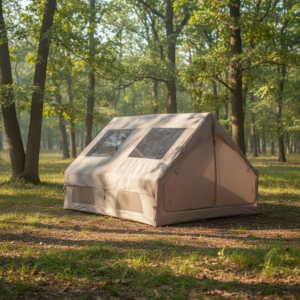
Inflatable Tent Four-Season Quick Automatic Opening PVC 3000mm Waterproof Foldable Eco-Friendly 2-3/3-4/6-8 Person Outdoor Use
Read more -
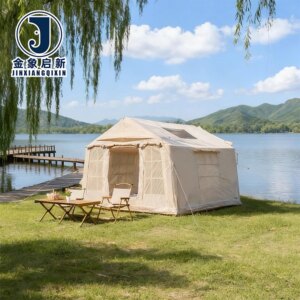
Luxury Inflatable Tent for Glamping Outdoor Waterproof Air Tent with Pump
Read more -
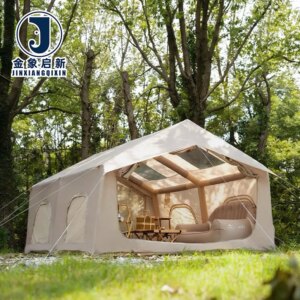
Inflatable Tent Family Size Four-Season Quick Automatic Opening Waterproof 2-8 Person Factory Direct Sale
Read more -
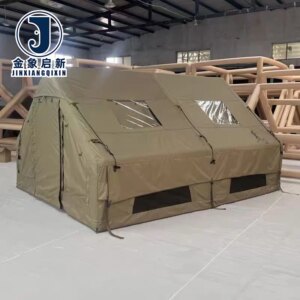
Waterproof Inflatable Camping Tent Outdoor Easy Setup Air Tent for Camping
Read more