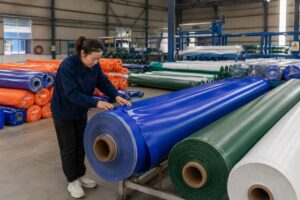
Fire Retardant Tarpaulin 440-1000GSM Wholesale Supplier Factory Direct
Heavier fabric does not mean better fire resistance. The flame retardant additive formula and target certification standard determine whether a tarpaulin passes inspection or gets an entire container rejected at the destination port.
When sourcing fire retardant tarpaulin, buyers often fixate on GSM weight as the primary cost driver. In reality, the per-square-meter price of fire retardant tarpaulin is shaped by three deeper variables: the type of flame retardant additive used in the coating compound, the certification standard required by the destination market, and the coating lamination process itself. A 680gsm PVC tarpaulin treated with halogen-based retardants for NFPA 701 compliance will cost noticeably more than the same weight treated with basic formulations meeting only domestic GB standards — even though both look identical on the surface. [NEED_CITE: flame retardant additive cost differential between halogen-based and phosphorus-based systems in PVC coating compounds]
Getting the fire retardant tarpaulin price right starts with understanding what actually drives cost at the compound level, not just the weight scale.
What Determines Fire Retardant Tarpaulin Price in 2026?
Three factors dominate the cost structure of fire retardant tarpaulin: flame retardant additive type, certification testing requirements, and coating process selection. Base fabric GSM is only the starting point.
Early in my time working near the coating lines, I watched operators adjust the doctor blade gap and compound viscosity for different orders. The base PVC paste and polyester scrim accounted for a predictable portion of cost. But the moment a buyer required fire retardancy, the compound recipe changed entirely. Halogen-based retardants like decabromodiphenyl ether are effective but carry environmental compliance scrutiny in certain markets. Phosphorus-based alternatives like triethyl phosphate offer cleaner profiles but require higher loading ratios to achieve the same oxygen index. Aluminum hydroxide systems are the most cost-effective but add significant weight to the fabric, which in turn affects shipping cost calculations. [NEED_CITE: comparative loading ratios and cost implications of halogen vs phosphorus vs aluminum hydroxide flame retardants in PVC coatings]
The coating process itself splits into two main categories: knife-over-roll coating and calendering lamination. Knife-coated fabrics generally achieve thicker, more uniform coating layers that hold higher concentrations of flame retardant additives. Calendered laminates are faster to produce and suit lighter GSM ranges well, but the bonding interface between film and scrim can behave differently under sustained flame exposure. Buyers requesting fire retardant tarpaulin price quotes should specify not just GSM but also which coating method they prefer, because the same weight produced through different processes yields different unit costs.
Then there is the certification testing cost. A single NFPA 701 test conducted by an accredited third-party laboratory like SGS or Intertek covers material cost, sample preparation, and report issuance. If a buyer needs BS 5867 Part 2 compliance for the UK market or GB/T 8624 for domestic Chinese applications, each standard requires separate testing with different specimen preparation protocols. These testing fees get amortized across the order volume. A full container order absorbs the testing cost per square meter at a negligible rate. A small trial order of a few hundred square meters makes the per-unit certification cost disproportionately high. [NEED_CITE: third-party fire testing fee structures and per-unit cost amortization for bulk vs small-batch tarpaulin orders]
How Do Certification Standards Affect Fire Retardant Tarpaulin Price?
Different destination markets require different fire testing standards, and each standard demands a distinct chemical formulation. Choosing the wrong standard means the entire shipment fails inspection at the port.
I learned this the hard way. A Middle East construction materials distributor ordered a full container of 680gsm fire retardant tarpaulin for a mining site cover application. We produced the fabric, ran the standard domestic GB/T fire test, attached the report, and shipped. When the container arrived, the buyer’s local fire safety inspector took a sample, applied a direct flame, and observed the afterglow duration. The fabric did not meet the NFPA 701 criteria that the local authority enforced. The entire container was held. The buyer faced re-testing, potential re-shipment, or total write-off.
The root issue was not fabric quality. It was specification alignment. NFPA 701 measures flame propagation through two test methods — Method 1 for lightweight fabrics and Method 2 for heavier membrane structures. The afterflame time, afterglow time, and char length thresholds differ fundamentally from GB/T 8624, which uses a different ignition source geometry and evaluates burning droplet behavior. BS 5867 Part 2, commonly required for curtains and drapes in the UK, focuses on edge ignition and flame spread across the surface. A fabric that passes one standard may fail another, not because the material is inferior, but because the test methods measure different fire behaviors. [NEED_CITE: comparative test parameters across NFPA 701, BS 5867 Part 2, and GB/T 8624 for PVC-coated polyester fabrics]
This is why fire retardant tarpaulin price discussions must begin with the destination market. A buyer in Southeast Asia purchasing for general construction site covers may only need basic self-extinguishing properties. A buyer supplying mining ventilation ducts in Australia must meet AS/NZS 1906. A buyer serving the oil and gas sector in the Gulf states may need both NFPA compliance and additional smoke density testing. Each layer of certification adds compound cost, testing cost, and documentation cost to the fire retardant tarpaulin price.
| Certification Standard | Target Market | Testing Focus | Formulation Impact | Documentation Level |
|---|---|---|---|---|
| NFPA 701 | North America, Middle East | Flame propagation, afterglow | Higher phosphorus loading | Full third-party report |
| BS 5867 Part 2 | UK, Europe | Edge ignition, flame spread | Balanced halogen-phosphorus blend | Certified test certificate |
| GB/T 8624 | China domestic | Burning droplets, char length | Standard domestic additive package | Domestic lab report |
| AS/NZS 1906 | Australia, New Zealand | Flame spread for mining textiles | Specialized mineral-based additives | Accredited lab certification |
The formulation adjustments needed to pass stricter standards do not scale linearly. Moving from basic self-extinguishing to full NFPA 701 Method 2 compliance requires noticeably higher additive concentrations, which in turn affects the coating viscosity, the doctor blade settings, and the curing temperature on the production line. All of these production adjustments translate into higher fire retardant tarpaulin price per square meter.
Fire Retardant Tarpaulin Price Matrix by GSM and Coating Type
The following matrix maps typical GSM ranges against coating processes and their relative fire retardant tarpaulin price positioning, helping buyers align specifications with budget expectations.
Buyers often request a single fire retardant tarpaulin price per square meter without specifying GSM or coating type. This produces meaningless quotes. A 440gsm knife-coated fabric and a 900gsm calendered fabric serve entirely different applications and carry different cost structures. The matrix below organizes the typical ranges we encounter in export orders.
| GSM Range | Typical Coating Process | Common Applications | Fire Retardant Price Level | Certification Compatibility |
|---|---|---|---|---|
| 440-500gsm | Calendered lamination | Light covers, temporary shelters, truck side curtains | Entry-level fire retardant tarpaulin price | Basic self-extinguishing, GB/T feasible |
| 510-680gsm | Knife-over-roll coating | Mining ventilation ducts, construction enclosures, warehouse covers | Mid-range fire retardant tarpaulin price | NFPA 701 Method 2 achievable |
| 700-800gsm | Knife-over-roll heavy coating | Long-term industrial covers, oil field containment, heavy equipment protection | Upper-mid fire retardant tarpaulin price | Full NFPA, BS 5867, multi-standard |
| 850-1000gsm | Double-side knife coating or laminated | Extreme-duty mining, chemical plant covers, permanent structures | Premium fire retardant tarpaulin price | All major standards with full additive loading |
An African mining operator once needed ventilation ducts for an underground copper extraction site. The initial specification called for 500gsm fabric with basic fire retardancy. After a site safety review, the engineer upgraded the requirement to 750gsm with full NFPA 701 compliance and enhanced UV resistance for the surface layer exposed to ambient conditions. The fire retardant tarpaulin price per square meter increased noticeably, but the service life under continuous underground operation extended substantially compared to the lighter original spec. The total cost of ownership over the projected two-year deployment period actually favored the heavier, better-certified option because replacement frequency dropped significantly. [NEED_CITE: service life comparison of different GSM fire retardant tarpaulins in underground mining ventilation applications]
A Southeast Asian construction distributor faced a different calculation. They had been importing 500gsm fire retardant tarpaulin for general site protection. When a major high-rise project required documented NFPA compliance for all temporary enclosures, the distributor needed to upgrade their entire stock. The jump from 500gsm to 800gsm with full certification documentation increased the per-square-meter cost, but the distributor could now serve a higher-value project segment and command better margins from their local construction clients.
The key takeaway from the matrix is that fire retardant tarpaulin price should be evaluated against total project requirements, not isolated per-unit cost. A cheaper fabric that fails inspection or degrades prematurely costs far more than a properly specified product from the outset.
How to Avoid Hidden Costs When Ordering Fire Retardant Tarpaulins?
Three verification steps before order confirmation prevent the majority of costly disputes: validate the factory’s existing test reports against your target standard, request pre-production samples for independent testing, and confirm the additive package in writing.
Hidden costs in fire retardant tarpaulin procurement rarely come from the invoice price. They emerge from mismatches between what was ordered and what the destination authority actually requires. I have seen buyers receive fabric with a fire retardant certificate that looked official, only to discover the certificate covered a different product category or an outdated test method revision.
The first defense is requesting the factory’s current third-party test reports and cross-checking them against your target standard. NFPA 701 was revised in recent years, and test reports issued under older editions may not be accepted by current inspectors. The report should clearly state the product tested, the GSM, the coating type, and the specific test method used. If the factory cannot produce a report matching your exact specification, that is a signal that the fire retardant tarpaulin price they quoted may not include the formulation needed for your market. [NEED_CITE: common discrepancies in fire retardant tarpaulin test reports and how buyers can verify report validity]
The second defense is ordering pre-production samples and sending them to an independent laboratory in your country or region. This step costs a modest amount relative to the total order value but provides confirmation that the actual production compound — not just a lab-prepared specimen — meets the required standard. Some factories maintain a “golden sample” that passes testing while production batches use reduced additive loading to cut costs. Independent testing of production samples closes this gap.
The third defense is written confirmation of the additive package. Ask the factory to specify whether the coating compound uses halogen-based, phosphorus-based, or mineral-based flame retardants. This specification affects not only fire performance but also environmental compliance, recyclability, and long-term UV stability. A halogen-loaded fabric may pass fire testing but face restrictions under certain environmental regulations in European markets. A phosphorus-based system may offer better long-term color retention but require more careful storage to prevent additive migration. [NEED_CITE: environmental and regulatory implications of different flame retardant chemistries in PVC-coated tarpaulin fabrics]
A Latin American distributor learned these lessons after two separate incidents. The first involved receiving fabric with a test report that listed a different GSM than what was ordered — the factory had tested a heavier sample but shipped a lighter product. The second involved a phosphorus-based fabric that performed well on fire testing but showed noticeable surface tackiness after several months in tropical warehouse storage, caused by additive migration in high humidity. Both issues were avoidable with proper pre-order verification steps.
How to Request an Accurate Quote from a China Factory?
Provide four pieces of information in your inquiry: target GSM, destination market certification standard, coating process preference, and estimated order volume. This enables the factory to calculate fire retardant tarpaulin price accurately without back-and-forth delays.
Vague inquiries produce vague quotes. When a buyer asks for “fire retardant tarpaulin price” without specifying parameters, the factory can only provide a broad range that may not reflect the actual product needed. This wastes time on both sides and often leads to orders being placed on incorrect assumptions.
The most effective inquiry format specifies the application context. For example: “We need 680gsm knife-coated PVC fire retardant tarpaulin for mining ventilation ducts, NFPA 701 Method 2 compliance required, estimated order volume is two 40-foot containers per quarter.” This single paragraph gives the factory enough information to calculate the compound recipe, confirm testing feasibility, factor in certification cost amortization, and provide a fire retardant tarpaulin price per square meter that reflects the actual product.
If the buyer is unsure about GSM or certification, the inquiry should state the end use and destination country. A factory experienced in export orders can recommend appropriate specifications based on the application. Mining ventilation in Australia requires different standards than construction site covers in Saudi Arabia. The factory’s role is to translate the application requirement into a technical specification and then price it accurately.
Order volume matters because it directly affects the per-unit cost of certification testing and compound preparation. A factory preparing a custom phosphorus-based compound for a single container order absorbs the compound development and testing cost across that one shipment. If the same buyer commits to quarterly orders, the factory can amortize setup costs across multiple shipments and offer a more competitive fire retardant tarpaulin price. [NEED_CITE: volume-based cost amortization effects on custom flame retardant compound pricing in PVC tarpaulin manufacturing]
Color and width specifications also influence pricing. Standard widths produced on regular calendering or coating line setups carry lower cost than non-standard widths that require line reconfiguration. Stock colors like blue, silver, and green are produced in larger batches and benefit from economies of scale. Custom colors require minimum batch quantities and may carry a surcharge.
Conclusion
Fire retardant tarpaulin price is determined by additive chemistry, certification standards, and coating process — not GSM alone. Align your specification with the destination market’s fire safety requirements before requesting quotes, verify test reports against current standard revisions, and provide complete application details to factories to receive accurate pricing that reflects the actual product you need.