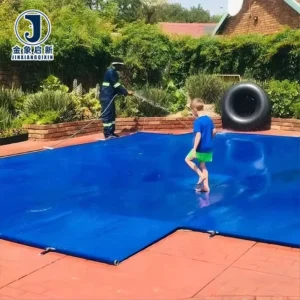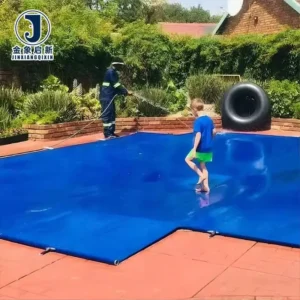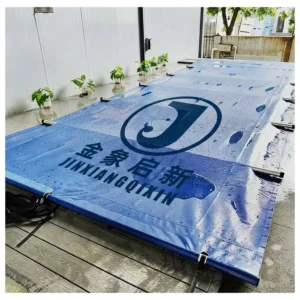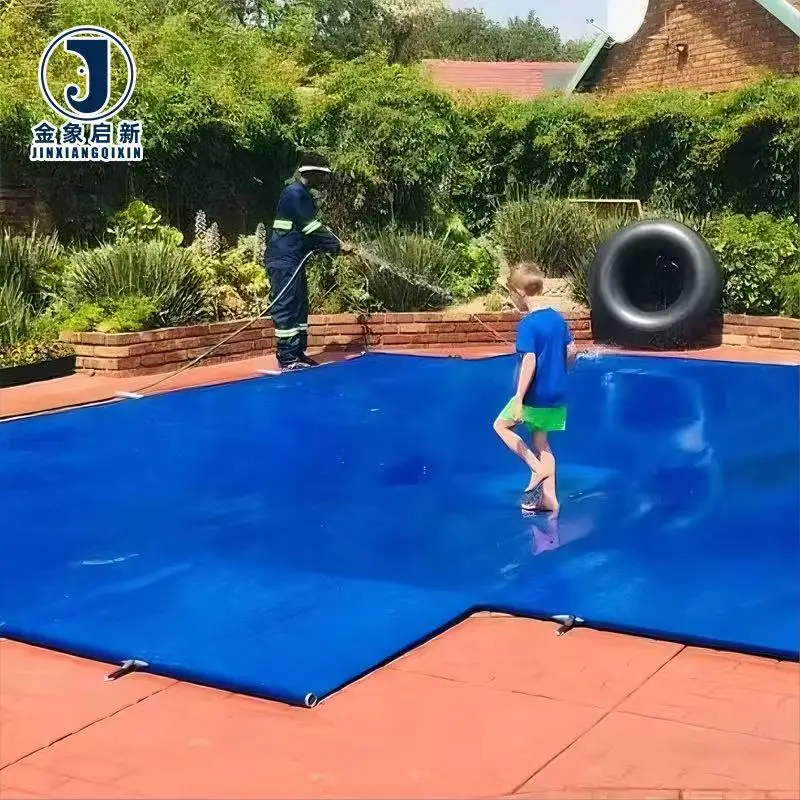
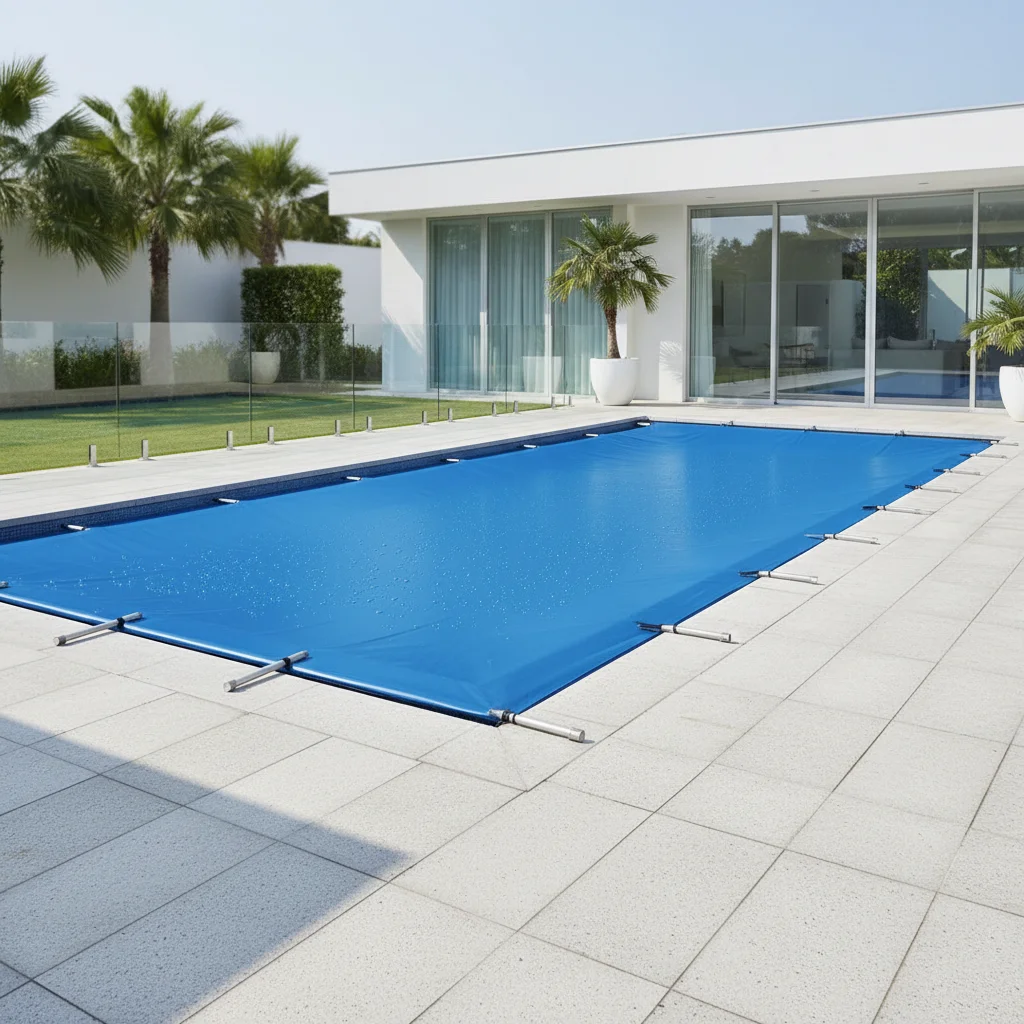
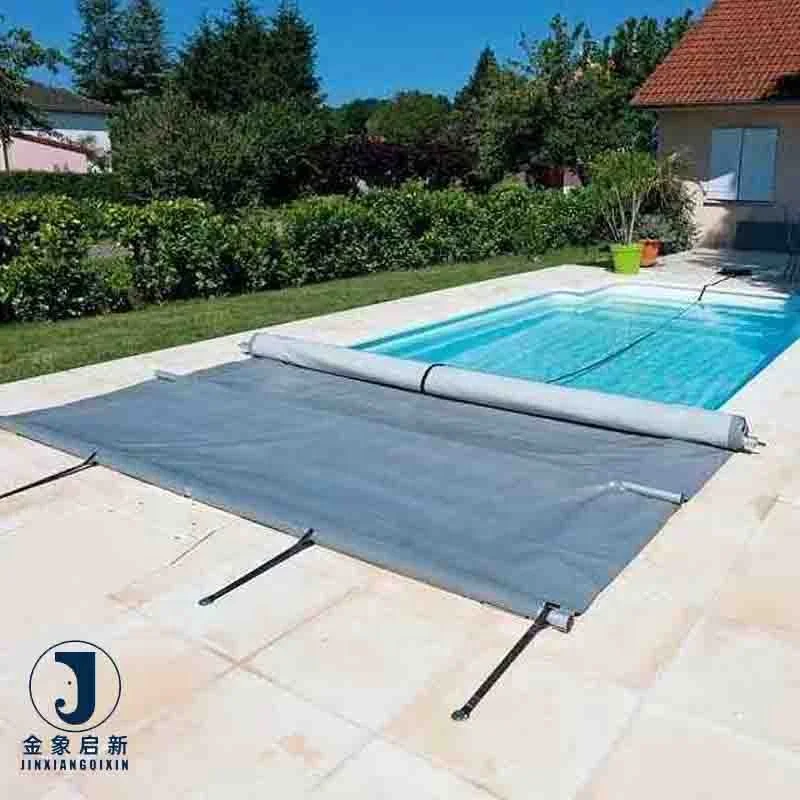
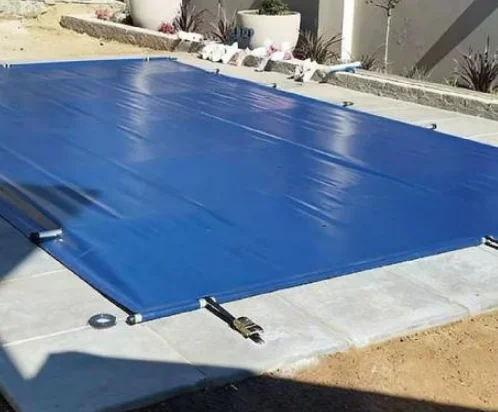
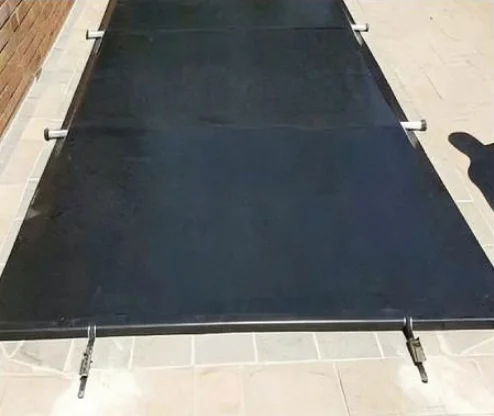
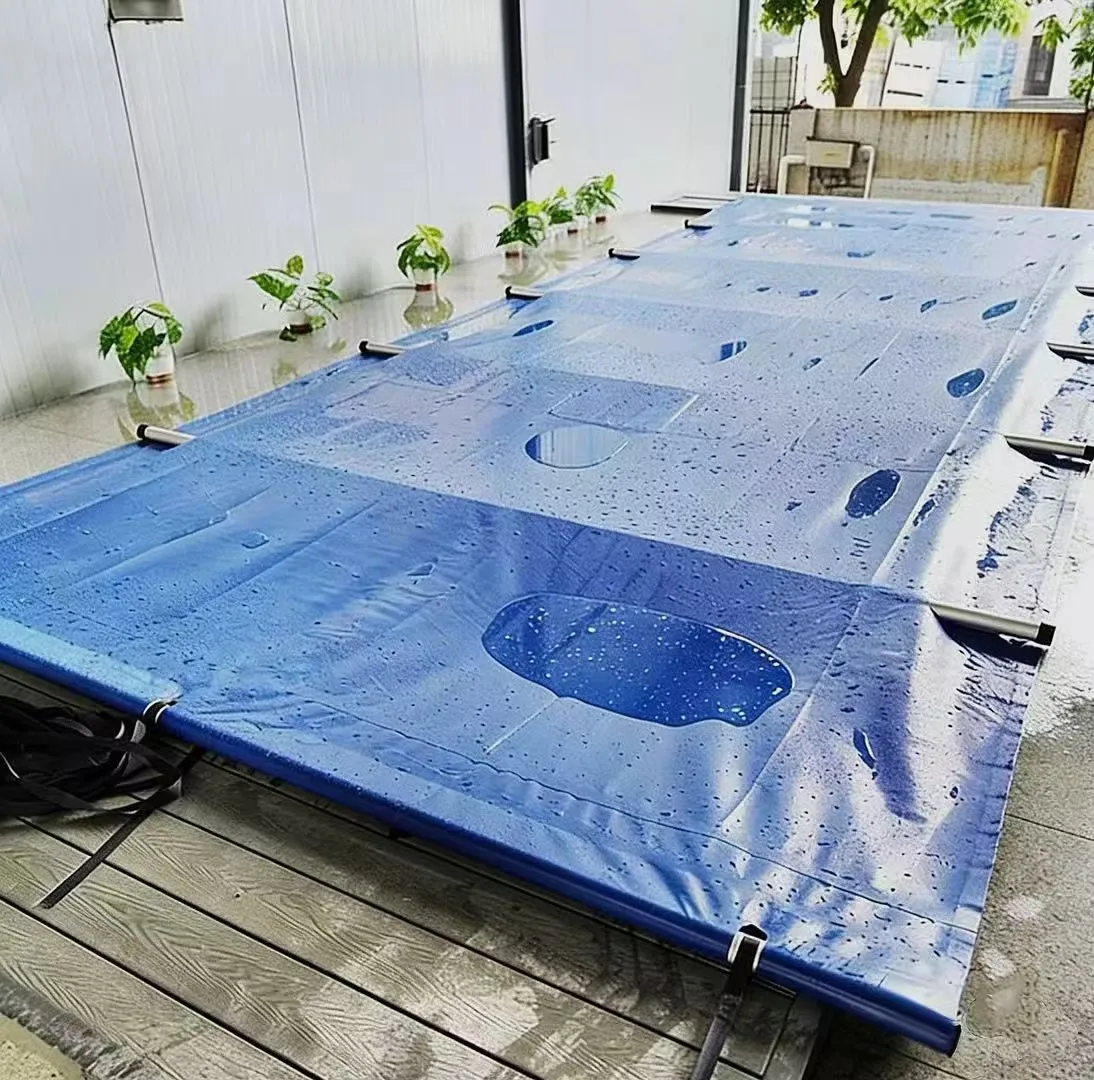
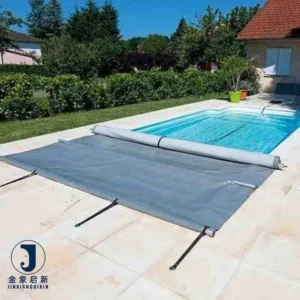
PVC Swimming Pool Cover — PVC laminated, high-strength polyester mesh base, available in 350gsm to 750gsm.
- Laminated and hot-melt coating technology ensures consistent PVC adhesion across the polyester mesh, preventing delamination under UV and thermal cycling.
- Multiple weight grades (350gsm, 420gsm, 500gsm, 550gsm, 600gsm, 750gsm) allow buyers to match cover specification to pool size and climate exposure.
- Backed by a 10-person R&D team handling custom sizing and 100% pre-shipment inspection for verified GSM and colour consistency across rolls.
Description
Process Control — Hot-melt lamination lines hold coating adhesion within tight tolerances across every roll of PVC Pool Cover Tarpaulin, verified by in-process QA before dispatch.
Technical Specifications
| Parameter | Value |
|---|---|
| Product Type | PVC Swimming Pool Cover |
| Material | PVC + High-strength polyester mesh fabric |
| Coating Method | Laminated technology & Hot-melt Coating technology |
| Weight (GSM) | 350gsm / 420gsm / 500gsm / 550gsm / 600gsm / 750gsm |
| Total Thickness | 0.32mm / 0.35mm / 0.4mm / 0.45mm / 0.5mm / 0.65mm |
| Roll Size | 2m width × 75m length / 2.1m width × 50m length |
| Finish Product Size | Custom items as per customer’s needs, or sold by inventory |
| Color | Blue / Red / Yellow / Light blue / Grey (Customized) |
| Key Features | Cold crack resistance, anti-mildew, anti-static treatment, waterproof, sunproof, best color fastness |
| Special Treatments Available | Flame retardant (grade not stated), anti-cold, 3P |
| Standards | ISO, CE |
Application Suitability
| Application | Exposure & Requirement |
|---|---|
| Residential swimming pool cover | Continuous UV, seasonal temperature swing, debris load, tension system flex points |
| Commercial leisure pool cover | High foot-traffic adjacent exposure, chemical splash, wind uplift on large spans |
| Fish tank and aquaculture pond liner | Permanent water contact, anti-mildew demand, aquatic chemical tolerance |
| Tent and awning fabrication | Outdoor weathering, repeated roll-up stress, weld seam integrity |
| Cargo ship and truck awning | Salt spray, road vibration, abrasion at tie-down contact zones |
Why Welds Fail Before the Fabric — and What That Means for Your PVC Pool Cover Tarpaulin
The seam is always the weakest point unless coating adhesion is controlled at the lamination stage.
When a pool cover splits, the tear almost always starts at a welded joint rather than across the fabric body. I have seen coated fabric rolls that passed tensile tests but failed at the weld line during the first cold snap [NEED_CITE: tensile and tear test methods for coated fabrics per ISO 1421]. The reason is inconsistent plasticizer migration between the coating layers during hot-melt lamination. If the bond between PVC film and polyester mesh is uneven, heat welding cannot produce a uniform melt zone, and the seam peels under load. This is why coating method matters more than raw GSM when specifying PVC Pool Cover Tarpaulin for long-span pools where tension forces concentrate at attachment points.
Laminated Coating and Hot-Melt Bond Integrity
Hot-melt lamination fuses the PVC film to the high-strength polyester mesh under controlled temperature and pressure, creating a bond that survives repeated thermal cycling. Unlike simple adhesive bonding, this process ensures the coating penetrates the mesh interstices, which is critical for pool covers that experience constant expansion and contraction between day and night temperatures. The result is a PVC Pool Cover Tarpaulin that holds together at the weld when fabricators use standard high-frequency or hot-air welding equipment.
Multiple Weight Grades for Different Pool Spans and Load Conditions
The range from 350gsm through 750gsm, with corresponding thickness from 0.32mm to 0.65mm, allows specifiers to match cover weight to the actual mechanical demand. A small residential splash pool with a hook-system perimeter needs a lighter, more flexible grade that drapes and folds easily. A large rectangular commercial pool tensioned with aluminium bars and ratchets requires a heavier grade that resists sag and wind uplift without excessive stretch. Selecting the correct PVC Pool Cover Tarpaulin weight at the inquiry stage prevents both overspecification costs and underspecification failures [NEED_CITE: coating weight and adhesion standards for laminated PVC fabrics].
Specifying Thickness and Weave for Tear Propagation Resistance
GSM alone does not predict how far a puncture will spread once it starts. The high-tenacity polyester yarns in the base fabric determine tear propagation resistance, and the total thickness influences how well the coating bridges any local damage. A 0.65mm cover at 750gsm will resist tear spread better than a 0.32mm cover at 350gsm under identical debris impact, but both grades remain weldable on standard fabrication tables. Matching thickness to expected point-load exposure — branches, ice edges, maintenance tools — is a more reliable selection method than choosing by weight alone.
What Happens When Colour Consistency Is Not Verified Across Rolls
When a pool installation requires multiple panels welded together, even a slight shade difference between rolls becomes visible once the cover is tensioned and sunlight hits the surface at an angle. Buyers who do not request pre-shipment colour swatches sometimes discover the variation only after fabrication is complete, forcing rework or acceptance of a visibly mismatched cover [NEED_CITE: colour fastness test methods for PVC coated textiles]. This is particularly costly on commercial projects where the pool cover is part of a visible amenity package. Specifying colour reference codes at the quotation stage and verifying against production samples before shipment eliminates this risk entirely.
Why Procurement Teams Choose This Supply Chain
Three full production lines and 36 sets of professional equipment mean that roll stock in standard widths of 2m and 2.1m is produced in continuous runs, maintaining batch consistency that smaller operations cannot guarantee for PVC Pool Cover Tarpaulin orders. The 10-person R&D team develops samples within days for custom pool shapes, non-standard colours, or branded printing, allowing fabricators to confirm fit and appearance before committing to production volume. A dedicated QA/QC checkpoint at every production stage, with 100% inspection before shipment, catches weight deviations and coating defects before they leave the factory. Export documentation — including roll packing lists, certificates of origin, and customs support — is prepared in-house, reducing clearance delays at destination ports.
Documentation & Verification
- Material specification sheet stating exact GSM, base fabric denier, and coating method for each roll
- Pre-shipment inspection record verifying weight and colour consistency across the full order
- Test report for UV and flame-retardant treatments where applicable grades are specified
- Roll packing list with individual roll weights and dimensions for container loading verification
- Certificate of origin and customs documentation package for destination port clearance
Fabrication, Handling & Storage
- Hot-air welding at temperatures matched to the laminated coating grade ensures seam adhesion without scorching the polyester mesh base
- Store rolls upright on pallets in shaded, ventilated areas to prevent flat-spot deformation on the 2m and 2.1m widths
- Allow cold-stored rolls to reach ambient temperature before unrolling to avoid creasing in cold-crack resistant grades
- Use PVC-compatible cleaners only; solvents can degrade the hot-melt coating bond on the anti-mildew treated surface
- Plan cut layouts across the 75m roll length to minimise off-cuts and reduce the number of field-welded panel joints
What to Include in Your Inquiry
Provide the pool dimensions or contour drawing, the tension system type — hook perimeter or aluminium bar with ratchet — and the target GSM or thickness range for your climate zone. If your market requires flame-retardant certification, specify the grade so the correct treatment is applied and documented. Confirm whether you need finished cut-to-size covers or roll stock for your own fabrication line, and state any colour reference or branding print requirements at the inquiry stage.
Frequently Asked Questions
Q: How is the stated GSM verified before my PVC pool cover order ships?
A: Every roll undergoes weight verification at the pre-shipment inspection stage, checked against the GSM stated on the material specification sheet. The inspection record is included in your documentation pack so you can cross-reference on arrival. If any roll tests outside tolerance, it is replaced before dispatch.
Q: Can you supply finished pool covers cut to my exact pool dimensions, and what information do you need?
A: Yes, finished covers are produced to custom dimensions. Provide the pool outline drawing or measurements, the tension system type — hook or aluminium bar — and any hem reinforcement or eyelet spacing requirements. The R&D team prepares a sample for approval before full production begins.
Q: What UV and anti-mildew treatments are available, and is test evidence provided?
A: Sunproof and anti-mildew treatments are standard features of the laminated coating. Where specific test standards are required for your market compliance, confirm the grade at the inquiry stage so the appropriate treatment is applied and the relevant documentation ships with your order.
Q: How do you control colour consistency when my order requires multiple rolls?
A: Colour reference codes are locked at the quotation stage, and production runs are scheduled to keep your rolls within a single batch where possible. Pre-shipment colour swatches can be sent for your approval, and the inspection record notes shade consistency across the full order.
Q: What flame-retardant grades are available for commercial pool installations?
A: Flame-retardant treatment is available as a special option. The specific grade depends on your local fire code requirements — confirm the standard needed for your market at the inquiry stage so the correct formulation is applied and documented in the shipment paperwork.
Related products
-
Custom PVC Pool Cover for Inground Pools – Full Range
Read more -
Cubiertas de piscina de PVC laminado impermeables, transpirables, anti-UV, opacas, de tejido orgánico, recubiertas de lona.
¥1.78 Select options This product has multiple variants. The options may be chosen on the product page -
Cubiertas de piscina de tela de tarpaulin recubierta JX PVC laminada, impermeable, transpirable, anti-UV, blackout, orgánica, de trama lisa.
¥1.78 Select options This product has multiple variants. The options may be chosen on the product page -
Material de cubierta de piscina de lona de PVC JX recubierto de cuchillo, tela impermeable, resistente a los UV y a prueba de viento.
¥13.00 Select options This product has multiple variants. The options may be chosen on the product page