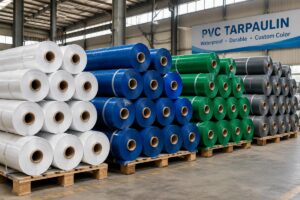
PVC Tarpaulin Price in Philippines: 2026 Wholesale Supplier Guide
The per-square-meter quote you see online is rarely what you actually pay at the port.
The real PVC tarpaulin price Philippines buyers face is shaped by three invisible levers: GSM weight range, coating formulation, and the Incoterms hidden in the fine print. A Manila wholesaler importing 500gsm rolls learned this the hard way when landing costs ballooned far beyond the initial factory quote, turning a margin-positive order into a mid-six-figure peso loss.
I still remember standing at Qingdao port years ago, watching a container of 500gsm PVC tarpaulin get loaded for Manila. The buyer had locked in what looked like a rock-bottom rate, only to discover weeks later that the quote was FOB, not CIF. By the time the cargo cleared, customs duties, terminal handling, and inland haulage had eaten the entire margin—and then some. That single shipment reshaped how I talk to Philippine buyers about pricing. The PVC tarpaulin price Philippines market quotes is never just a number on a spreadsheet; it is a layered structure, and peeling back each layer is the only way to budget accurately. [NEED_CITE: Philippine Bureau of Customs tariff classification for coated woven fabrics]
Let us walk through exactly what drives the PVC tarpaulin price Philippines buyers should expect in 2026, how to calculate the true landed cost, which specifications match real-world applications, and where suppliers quietly shift risk onto importers.
What Factors Actually Determine PVC Tarpaulin Price in the Philippines?
Raw material weight, coating chemistry, and trade terms form the pricing triangle; ignore one and your budget collapses.
Most first-time importers fixate on the per-meter rate. That is like buying a car based on the sticker price while ignoring fuel, insurance, and registration. The PVC tarpaulin price Philippines distributors negotiate is fundamentally anchored to three variables:
- GSM weight class: Heavier fabric costs more per square meter, but the relationship is not linear. Moving from a light-duty grade to a mid-range grade adds proportionally less than moving from mid-range to heavy-duty, because the base woven scrim remains similar while coating thickness scales.
- Coating type: Standard PVC coating is the baseline. Adding anti-UV stabilizers, fire-retardant additives, or anti-fungal treatments shifts the PVC tarpaulin price Philippines buyers pay upward, sometimes substantially, depending on certification requirements.
- Incoterms structure: FOB quotes exclude ocean freight and destination charges. CIF quotes bundle them but often carry a markup that exceeds actual logistics cost. The gap between the two can dwarf the fabric cost itself.
| Pricing Factor | Light-Duty Range | Mid-Range Standard | Heavy-Duty Premium |
|---|---|---|---|
| GSM Category | Entry-level weight | Mid-tier weight | Maximum weight class |
| Coating Complexity | Basic PVC | PVC with UV stabilizer | PVC with FR and UV |
| Typical Use Case | Temporary cover | Truck tarp, farm liner | Mining, long-term outdoor |
| Certification Need | None | Self-reported | Third-party verified |
| Price Sensitivity | High volume, thin margin | Balanced | Performance-driven |
[NEED_CITE: ISO 1421 standard test methods for PVC coated fabrics]
A construction supply distributor in Cebu once ordered what they thought was standard 500gsm material for site protection. The supplier delivered a product that met the weight spec on paper but used a recycled-fill coating that cracked within one rainy season. The PVC tarpaulin price Philippines market offers at the lowest tier looked attractive until replacement costs doubled the original spend. Weight alone tells you nothing about coating quality.
How Do You Calculate the Real Landed Cost from China to Manila?
The factory invoice is only the opening chapter; freight, duties, and clearance write the rest of the story.
Here is where most Philippine buyers get blindsided. A CIF quote feels convenient because it bundles everything, but convenience carries a cost. Conversely, an FOB quote looks cheap until you add ocean freight, marine insurance, Philippine customs duty, VAT, arrastre, wharfage, and inland trucking to your warehouse.
The landed cost breakdown typically follows this structure:
- Fabric cost (FOB): The base manufacturing price, usually quoted per square meter or per roll.
- Ocean freight: Varies by container size and shipping season. Peak season surcharges can add noticeably during the months preceding Christmas and Chinese New Year.
- Marine insurance: A small percentage of cargo value, but non-negotiable for high-GSM rolls where moisture damage risk exists.
- Customs duty and VAT: The Philippines applies specific tariff headings for coated woven fabrics. Getting the HS code wrong can mean overpaying or facing penalties. [NEED_CITE: Philippine tariff commission classification for PVC coated woven textile fabrics]
- Port charges and clearance: Arrastre, wharfage, broker fees, and x-ray scanning add fixed and variable costs at Manila North Harbor or South Harbor.
- Inland delivery: Trucking from port to warehouse, especially if your facility is outside Metro Manila.
We once structured a shipment for a Davao-based aquaculture buyer who needed pond liner material. They insisted on FOB pricing because they had their own freight forwarder. We provided complete export documentation, packing lists, and commercial invoices formatted to Philippine customs requirements. Their forwarder handled the ocean leg, and because every document was pre-verified, clearance at the port took days instead of weeks. The PVC tarpaulin price Philippines buyers pay in total landed terms ended up lower than competing CIF quotes from other suppliers, precisely because no hidden markup was buried in the freight line.
| FOB Structure | CIF Structure | |
|---|---|---|
| Fabric Price | Included | Included |
| Ocean Freight | Buyer arranges | Supplier arranges |
| Insurance | Buyer arranges | Supplier arranges |
| Destination Port Charges | Buyer pays | Buyer pays |
| Customs Clearance | Buyer pays | Buyer pays |
| Cost Transparency | High | Moderate |
| Risk of Markup | Low | Noticeable |
[NEED_CITE: International Chamber of Commerce Incoterms 2020 FOB vs CIF obligations]
The key insight: FOB gives you visibility and control; CIF gives you simplicity at a premium. Neither is universally better. The right choice depends on whether you have a trusted freight forwarder and the bandwidth to manage logistics documentation yourself.
Which GSM and Coating Type Fits Your Application?
Over-specifying wastes money; under-specifying wastes the entire investment.
Philippine buyers often assume heavier is always better. That instinct is wrong. Every application has an optimal GSM and coating combination, and deviating from it in either direction creates problems.
Consider three common scenarios:
Truck covers and transport tarpaulins need a balance of tear resistance and flexibility. A mid-range GSM with standard PVC coating and UV stabilization handles daily folding, sun exposure, and road vibration. Going heavier adds unnecessary weight to the vehicle and increases fuel consumption over time.
Aquaculture pond liners demand chemical resistance and long-term waterproof integrity. Here, a heavier GSM with reinforced scrim and anti-fungal coating makes sense. The material sits submerged or semi-submerged for extended periods, and any coating failure means contaminated water and lost stock. A fish farm operator in Laguna province once switched from a lighter grade to a heavier, properly coated liner after two consecutive seasons of premature tearing. The PVC tarpaulin price Philippines aquaculture buyers pay for the heavier grade was higher per meter, but the replacement cycle extended substantially, making the total cost of ownership lower.
Construction site protection and scaffolding wraps require fire-retardant certification above all else. Philippine building inspectors increasingly demand verifiable test reports, not just supplier self-declarations. A lighter GSM with certified fire-retardant coating outperforms a heavier, uncertified product in any compliance audit.
| Application | Recommended GSM Range | Coating Requirement | Certification Priority |
|---|---|---|---|
| Truck and transport covers | Mid-range | PVC with UV stabilization | Moderate |
| Aquaculture pond liners | Heavy-range | PVC with anti-fungal treatment | High (chemical resistance) |
| Construction site wraps | Light to mid-range | PVC with fire-retardant additive | Critical (third-party verified) |
| Advertising banners | Light-range | PVC with print-receptive surface | Low |
[NEED_CITE: IFAI recommended specifications for flexible fabric applications]
We supply material across the full GSM spectrum, from light-duty banner fabric to heavy-duty geomembrane-grade liner. The manufacturing line handles custom widths, colors, and roll lengths, so a buyer sourcing truck cover fabric and pond liner from the same shipment does not need to split orders across multiple factories. That consolidation alone reduces the PVC tarpaulin price Philippines importers pay in logistics and coordination overhead.
How to Avoid Hidden Costs and Supplier Traps?
The cheapest quote becomes the most expensive lesson when details are left ambiguous.
Hidden costs in PVC tarpaulin importing do not come from malice; they come from vagueness. A few specific traps recur constantly in the Philippines market:
Unclear Incoterms. As discussed, FOB versus CIF confusion is the single most common source of budget overrun. Always confirm in writing which Incoterm applies, and verify what is included under that term.
MOQ misalignment. Some suppliers quote attractive per-meter rates contingent on full-container orders. If you only need a partial container, the effective cost per meter rises sharply once you factor in less-than-container-load surcharges. Others offer roll-level MOQs with slightly higher per-meter pricing but far lower total commitment. The right MOQ structure depends on your warehouse capacity and cash flow cycle, not just the unit price.
Certification gaps. A supplier may claim fire-retardant or anti-UV properties without providing test documentation. When Philippine customs or a building inspector requests proof, the buyer is left holding uncertified cargo. Always require test reports aligned with recognized standards before shipment, not after.
Roll length and width inconsistency. Some factories deliver rolls that are nominally the specified width but vary noticeably across the batch. This creates waste during cutting and fabrication. Request production samples and verify roll dimensions against purchase order specifications upon arrival.
A distributor in Quezon City once received a shipment where the roll widths were consistently narrower than specified by a small but compounding margin. Across dozens of rolls, the lost usable area translated into a noticeable shortfall against their projected coverage. The PVC tarpaulin price Philippines buyers calculate per square meter becomes meaningless when the actual square meters delivered fall short.
| Risk Area | What to Verify | Documentation Required |
|---|---|---|
| Incoterms | FOB or CIF explicitly stated | Proforma invoice with Incoterm clause |
| MOQ Structure | Full container or roll-level | Order confirmation with quantity terms |
| Certifications | Fire-retardant, UV, anti-fungal | Third-party test reports |
| Dimensional Accuracy | Roll width and length consistency | Pre-shipment sample and inspection report |
[NEED_CITE: International trade documentation standards for coated fabric imports]
We provide complete export documentation with every shipment, including detailed packing lists, commercial invoices, and test reports where applicable. This transparency lets Philippine buyers clear customs smoothly and verify that what they ordered matches what arrived. The PVC tarpaulin price Philippines importers pay should never include surprise costs born from paperwork failures.
Conclusión
Pricing transparency beats pricing promises every time. The PVC tarpaulin price Philippines buyers encounter is a composite of material specification, trade terms, and logistical reality. Understanding each component, matching GSM and coating to actual application needs, and demanding clear documentation upfront transforms importing from a gamble into a managed process. The suppliers who win long-term relationships are not those who quote the lowest number, but those who help buyers see the full cost picture clearly.