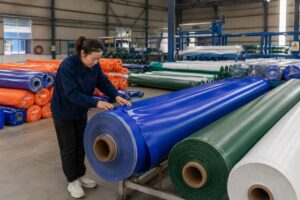
Truck Cover Supplier for France: China Factory Direct OEM Wholesale
Heavier PVC does not automatically mean longer service life—coating formulation and base fabric density matter far more than gram weight alone.
When sourcing from a truck cover supplier for the French market, fleet buyers must align GSM selection, coating工艺, and anti-UV等级 with actual route climates, parking conditions, and replacement cycles. Factory-direct sourcing from China enables custom specification matching while reducing procurement costs noticeably.
I spent years on the production floor in Shandong checking PVC coating thickness with a micrometer every shift, then moved into export coordination. The numbers on the spec sheet rarely told the full story. A few years back, a transport fleet in southern France ordered 650gsm PVC truck tarpaulins marketed as anti-UV. When the container arrived in Marseille, the fleet manager grabbed a roll, bent it by hand, and said the hand feel was wrong—he suspected recycled filler had been blended in. The whole shipment nearly got rejected. I flew over with third-party test reports, unrolled every piece in their warehouse, ran color-card comparisons and tear-strength spot checks, and only then got the cargo accepted. Since that trip, I never start a specification discussion with gram weight. The first questions are always: what route does the truck run, does it park outdoors or under shelter, and how often do you replace covers? [NEED_CITE: correlation between PVC coating formulation and service life under Mediterranean UV exposure]
That experience reshaped how I build specification proposals. Below is a field-oriented breakdown for French fleet buyers evaluating a truck cover supplier, organized around real operating scenarios rather than catalog numbers.
Why Do French Fleet Buyers Keep Making the Same Three Mistakes?
Most procurement errors trace back to treating gram weight as the sole durability indicator, ignoring coating工艺 differences, and over-specifying anti-UV additives beyond what the base fabric can handle.
The first mistake is assuming higher GSM equals longer life. A 900gsm tarpaulin with low-density base weave and soft-extract PVC coating will often fail earlier than a 650gsm product built on high-tenacity polyester scrim with knife-over-roll coating. The base fabric carries the mechanical load; the coating seals and protects. When the base weave is loose, no amount of coating thickness compensates for internal yarn abrasion. [NEED_CITE: relationship between base fabric density and PVC tarpaulin mechanical performance per EN standards]
The second mistake is misunderstanding coating工艺. Knife-over-roll coating produces a smoother, more uniform surface with better weld-seam integrity, while calender-rolled coating tends to leave micro-channel paths where moisture penetrates. For French fleets running humid northern routes or coastal Mediterranean corridors, this distinction directly affects mold resistance and seam failure rates.
The third mistake is the belief that more UV stabilizer always equals better protection. In practice, excessive anti-UV additive loading plasticizes the PVC layer and accelerates surface chalking. The optimal loading range depends on the specific resin system and plasticizer blend—something only the coating formulator can balance. [NEED_CITE: effect of excessive UV stabilizer loading on PVC coating embrittlement]
| Factor | Knife-Over-Roll Coating | Calender-Rolled Coating |
|---|---|---|
| Surface uniformity | Highly uniform | Micro-channel paths possible |
| Seam weld integrity | Robust | Noticeably reduced |
| Moisture penetration resistance | Resistant | Vulnerable |
| Suitability for humid coastal routes | Certified | Basic |
A northern European fleet operator once switched from a calender-rolled 900gsm cover to a knife-over-roll 650gsm specification after repeated seam failures during winter thaw cycles. The lighter cover actually outperformed the heavier one because the coating continuity prevented water ingress at heat-welded joints. [NEED_CITE: seam failure mode analysis in PVC tarpaulins under freeze-thaw cycling]
650gsm vs 900gsm: How Should Route Climate and Parking Environment Decide?
GSM selection must follow operating environment, not catalog habit. Southern Mediterranean routes demand high anti-UV rating with moderate GSM; northern cold-corridor routes need low-temperature flexibility formulation;露天 storage yards require anti-fungal surface treatment regardless of weight.
For fleets operating along the French Mediterranean corridor—Marseille, Montpellier, Nice—summer UV intensity is sustained and severe. The priority is a coating system rated for extended UV endurance with high tear-strength retention after accelerated weathering. A 650gsm knife-over-roll product with controlled UV stabilizer loading and high-tenacity scrim typically outlasts a heavier calender-rolled alternative in this zone, because the coating remains flexible without chalking. [NEED_CITE: QUV accelerated weathering test methodology for PVC-coated polyester fabrics]
For fleets running northern European cross-channel routes—Calais, Dunkirk, Lille—winter temperatures regularly drop below freezing. The critical property shifts from UV resistance to low-temperature flexibility. The coating must pass repeated cold-fold testing without cracking, and the plasticizer system must resist migration at sub-zero conditions. Here, a 900gsm specification with cold-flex formulation delivers reliable performance, but only if the plasticizer package is matched to the resin—not simply increased in volume.
For trucks parked permanently in open logistics yards—common around Lyon, Paris, and Lille distribution hubs—mold and fungal growth on the underside of the cover becomes the dominant failure mode. Anti-fungal surface treatment, typically a zinc-based or organic biocide incorporation into the inner coating layer, extends service life substantially. GSM matters less here than coating chemistry.
| Operating Scenario | Priority Property | Recommended GSM Range | Coating Requirement |
|---|---|---|---|
| Southern Mediterranean routes | UV endurance, tear retention | 650gsm | Knife-over-roll, controlled UV loading |
| Northern cold-corridor routes | Low-temperature flexibility | 900gsm | Cold-flex plasticizer system |
| Permanent outdoor storage yards | Anti-fungal, moisture barrier | 650–900gsm | Biocide-treated inner coating |
A fleet based near Montpellier replaced its entire 900gsm calender-rolled fleet covers with 650gsm knife-over-roll products after two consecutive summers of premature surface chalking. The lighter covers ran substantially longer and maintained color consistency through the third season. [NEED_CITE: field performance comparison of PVC tarpaulin coatings under Mediterranean UV index conditions]
How Can Buyers Verify a Chinese Factory’s Anti-UV Claims?
Require independent QUV test reports, insist on third-party pre-shipment inspection, and request production sample rolls for independent lab verification before committing to full container orders.
Many factories quote “anti-UV” as a marketing term without specifying the test standard, exposure hours, or evaluation criteria. A credible truck cover supplier for the French market should provide QUV accelerated weathering test data referencing ASTM G154 or ISO 4892-2, with clear reporting of exposure duration, UV-A wavelength, and evaluation metrics such as color change (Delta E), gloss retention, and tear-strength retention percentage. [NEED_CITE: ASTM G154 QUV test protocol for PVC-coated fabrics]
Beyond the test report, third-party pre-shipment inspection catches batch-level inconsistencies that lab reports cannot. An inspector from a recognized body can verify coating thickness uniformity across the roll width, check heat-weld seam strength at random intervals, and confirm color consistency against the approved Pantone or RAL reference. This step is non-negotiable for first-time orders.
For high-value fleet contracts, requesting a production sample roll—cut from the actual batch destined for shipment—allows the buyer’s own lab or a local French testing facility to run independent verification. This closes the loop between factory claim and delivered product.
| What It Catches | Who Performs It | |
|---|---|---|
| QUV test report review | Inadequate UV stabilizer loading, wrong test standard | Buyer’s technical team |
| Third-party pre-shipment inspection | Coating thickness variation, seam weakness, color deviation | Independent inspection body |
| Production sample roll testing | Batch-level formulation inconsistency | Buyer’s designated lab |
A French transport association once received a shipment where the factory’s QUV report showed excellent results, but random roll sampling revealed that the middle section of the production run had noticeably reduced UV stabilizer concentration. Only pre-shipment inspection caught the inconsistency before the covers were deployed across the fleet. [NEED_CITE: batch consistency verification protocols for PVC tarpaulin production]
How Much Does Factory-Direct Sourcing Actually Save?
Eliminating intermediary layers reduces procurement costs noticeably, while direct factory access enables specification customization and flexible minimum order quantities that trading companies rarely match.
When a French buyer sources through a European trading house, the price stack typically includes the Chinese factory margin, the trader’s markup, warehousing costs in Europe, and logistics coordination fees. Factory-direct sourcing collapses this structure into a single production margin plus export logistics. For fleet-scale orders running multiple container loads per year, the cumulative saving is substantial.
Beyond price, direct factory access unlocks specification flexibility. A trading company can only offer what the factory produces in standard runs. A direct relationship with a truck cover supplier allows custom width adjustments to match specific French trailer dimensions, bespoke color matching to fleet livery, and tailored coating formulations for route-specific conditions. Minimum order quantities become negotiable at the roll level rather than the container level, which matters for trial orders or partial fleet upgrades.
A mid-size French logistics operator sourcing through a European distributor paid a mid-five-figure annual premium compared to direct factory pricing on equivalent specifications. After switching to direct sourcing, the same operator added custom anti-fungal coating for its outdoor-parked vehicles—a specification the distributor had never offered—without increasing per-unit cost. [NEED_CITE: cost structure comparison of direct factory sourcing versus trading intermediary for PVC tarpaulin procurement]
| Specification Customization | MOQ Flexibility | Price Structure | |
|---|---|---|---|
| European trading house | Standard catalog only | Container-level | Factory + trader markup + warehousing |
| Direct factory sourcing | Full custom width, color, coating | Roll-level negotiable | Factory margin + export logistics |
Conclusión
Specification matching beats specification maximization. French fleet buyers achieve better cover longevity and lower total cost by aligning coating工艺, anti-UV formulation, and GSM with actual route climate and parking conditions—then verifying factory claims through independent testing rather than catalog promises.