Waterproof Tarpaulin Price in France: 2026 Wholesale Buyer Guide
The landed cost of waterproof tarpaulin in France is never just the factory invoice multiplied by freight.
In 2026, a French buyer sourcing waterproof tarpaulin should expect a DDP warehouse price ranging between mid-tier and upper-tier per-square-meter levels depending on GSM, coating type, and Incoterms alignment — with the gap between FOB and DDP often wider than the fabric cost itself.
I still remember the morning I stood on the dock at Qingdao watching a 40-foot container of blue-silver rolls get sealed, only to get an email three weeks later from a Lyon-based hardware chain saying my “tax-inclusive, freight-inclusive” quote was somehow more expensive than their local comparator in Marseille. It took me two phone calls and a spreadsheet to realize they were comparing my FOB number against a competitor’s DDP price — and the customs clearance plus last-mile trucking alone accounted for a noticeable slice of that gap. That single mismatch taught me that any conversation about waterproof tarpaulin price in France must start with Incoterms, not fabric weight. [NEED_CITE: Incoterms 2020 cost allocation rules per ICC]
Let’s walk through what actually drives the numbers you’ll see on your invoice in 2026, why the cheapest per-square-meter quote can end up the most expensive delivery, and how to match GSM specs to real French use-cases without overpaying for durability you’ll never need.
What Is the Real Waterproof Tarpaulin Price in France in 2026?
The per-square-meter landing price is a layered construct, not a single number pulled from a mill price list.
Raw material volatility, container freight oscillation, and French import duty structure all compress or expand the final figure throughout the year. In early 2026, PVC resin pricing in Asia showed noticeable fluctuation tied to energy cost shifts, and Red Sea routing disruptions kept ocean freight from North China to Fos-sur-Mer at elevated levels compared to the previous year’s calm. [NEED_CITE: PVC resin price trend and Red Sea freight impact on Europe-bound shipments in 2026]
The French import duty on PVC-coated woven fabric typically falls under a specific CN code that attracts a standard third-country tariff, and then French VAT applies on top of the CIF value plus duty. This means a buyer comparing a Chinese supplier’s per-square-meter quote against a Turkish or local European converter’s quote must normalize all figures to DDP before drawing any conclusion.
| Cost Layer | Typical Influence on Final Price |
|---|---|
| Fabric GSM and coating type | Noticeable — heavier GSM and double-coated structures cost substantially more per square meter |
| Ocean freight per CBM | Noticeable — fluctuates with routing and fuel surcharge |
| French import duty | Standard — applied on CIF value |
| French VAT | Applied on CIF plus duty |
| Last-mile trucking to warehouse | Noticeable — varies by inland distance from Fos-sur-Mer or Le Havre |
A construction distributor near Marseille once asked me why a competitor’s 440gsm blue-silver roll looked cheaper on paper but arrived at the warehouse costing nearly the same as my DDP quote. The answer was simple: the competitor’s price was CFR Le Havre, and the buyer’s warehouse was two hundred kilometers inland near Avignon. The inland haulage and customs brokerage fees closed the gap entirely.
Why Does Your Quote Always Look More Expensive Than the Competitor’s?
Because you are likely comparing an FOB number against a DDP number without realizing it.
This is the single most common pricing misunderstanding I see among European buyers sourcing waterproof tarpaulin from China. The factory in Shandong or Qingdao will quote you a clean per-square-meter figure based on the goods leaving the port. Your competitor’s supplier, meanwhile, may be quoting a DDP price that includes ocean freight, French customs clearance, duty, VAT handling, and trucking to your warehouse door. On the surface, the competitor looks cheaper per square meter. In reality, you are looking at two completely different delivery scopes.
Under Incoterms 2020, the allocation of cost and risk between seller and buyer shifts dramatically depending on whether the term is FOB, CFR, CIF, or DDP. [NEED_CITE: Incoterms 2020 rule comparison for FOB versus DDP obligations]
| Term | Seller Covers | Buyer Covers |
|---|---|---|
| FOB | Factory cost, inland transport to port, export customs | Ocean freight, insurance, import duty, VAT, last-mile trucking |
| CIF | Factory cost, ocean freight, basic insurance | Import duty, VAT, customs clearance, last-mile trucking |
| DDP | All costs including import duty, VAT, and delivery to buyer’s warehouse | Nothing beyond the quoted price |
When a French buyer receives a CIF quote and a DDP quote side by side, the CIF number will always look lower — but the buyer still needs to arrange customs brokerage, pay duty and VAT upfront, and contract a trucker from the port. Those hidden costs routinely add a meaningful percentage on top of the CIF fabric value.
A mid-sized agricultural cover distributor in central France once showed me two competing offers for a full container of 600gsm rolls. One was CIF Marseille, the other DDP their warehouse near Orléans. The CIF quote looked substantially cheaper per square meter. But once we added French duty, VAT, customs brokerage, and the inland haulage to Orléans, the two numbers converged almost completely. The buyer had been misled by the headline figure.
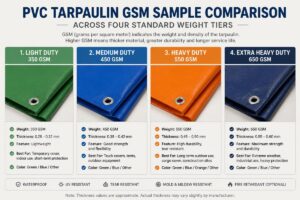
How Do 440gsm and 600gsm Waterproof Tarpaulin Compare for French Applications?
Higher GSM does not automatically mean better value — it means better suitability for a specific stress profile.
French buyers often assume that specifying a heavier fabric is the safest procurement decision. In practice, the right choice depends entirely on the end-use environment. A 440gsm PVC-coated polyester tarpaulin and a 600gsm variant serve different duty cycles, and paying for the heavier option in a light-duty application is wasted budget.
| Parameter | 440gsm Blue-Silver | 600gsm Heavy-Duty |
|---|---|---|
| Base fabric weight | Standard | Substantially heavier |
| Coating thickness | Standard | Noticeably thicker |
| Tear resistance | Adequate for seasonal cover | Robust for year-round industrial use |
| UV endurance | Standard | Substantially extended |
| Typical use-case | Temporary construction cover, hay bale protection, light transport | Truck side curtain, permanent machinery cover, mining site protection |
| Per-square-meter cost tier | Mid | Upper |
A chain of building material stores in southern France procured 440gsm blue-silver rolls for seasonal timber protection at their outdoor yards. The fabric needed to resist rain and moderate UV for roughly six months per year, then be folded and stored. Specifying 600gsm would have increased the per-square-meter cost noticeably without extending useful life in any meaningful way — the lighter fabric was already over-engineered for that rotation cycle.
Conversely, a transport operator running flatbed loads between Perpignan and the Benelux corridor needed 600gsm because the tarpaulins faced continuous wind flap, abrasion against load edges, and year-round UV exposure. Switching to 440gsm would have cut procurement cost per square meter but doubled the replacement frequency, which would have been far more expensive over a multi-year horizon. [NEED_CITE: PVC tarpaulin service life correlation with GSM and coating thickness per textile industry guidelines]
How Can You Get an Accurate DDP Warehouse Price for Waterproof Tarpaulin?
You must give the supplier your exact delivery address, unloading conditions, and expected roll weight — then ask for a full-chain DDP quote in writing.
The DDP price is the only number that matters if you want to compare suppliers on an apples-to-apples basis. But many buyers fail to provide the information needed to generate that number accurately, and then wonder why the final invoice drifts from the original quote.
The steps are straightforward but often skipped:
- Confirm the delivery address including postal code, because inland trucking rates in France vary noticeably between a warehouse near Fos-sur-Mer and one near Metz.
- Specify whether your warehouse has a loading dock or requires a tail-lift truck — this changes the last-mile cost tier.
- Confirm roll dimensions and weight per roll, because oversized or overweight rolls may trigger surcharges or require special equipment at unloading.
- Ask the supplier to break down the DDP quote into fabric cost, ocean freight, duty, VAT handling, and last-mile trucking — so you can see where the cost sits. [NEED_CITE: French customs VAT and duty calculation methodology for PVC-coated textile imports]
- Request the quote validity period, because ocean freight and PVC resin pricing can shift within weeks.
A European tent manufacturer once received a DDP quote that looked attractive, only to discover at the warehouse that the rolls had been shipped without palletization and the unloading crew needed an extra half-day to handle loose rolls. The labor cost wiped out the per-square-meter saving the buyer thought they had secured. The lesson was simple: unloading conditions must be part of the DDP conversation from day one.
Conclusion
The true waterproof tarpaulin price in France is a function of Incoterms precision, GSM-to-application matching, and transparent DDP breakdown — not the headline per-square-meter number on a factory quote.
Align your comparison basis to DDP warehouse cost, match fabric weight to actual duty cycle rather than defaulting to the heaviest option, and always share unloading conditions before finalizing the order.