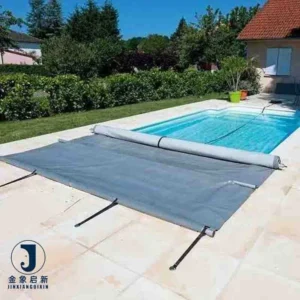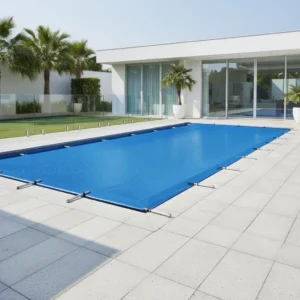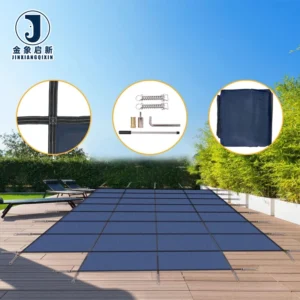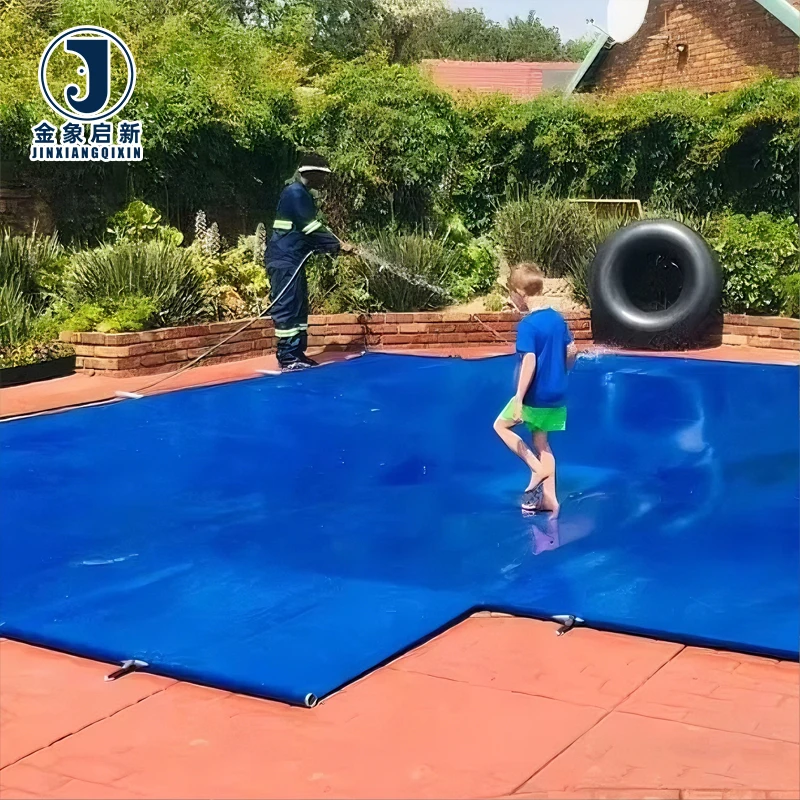
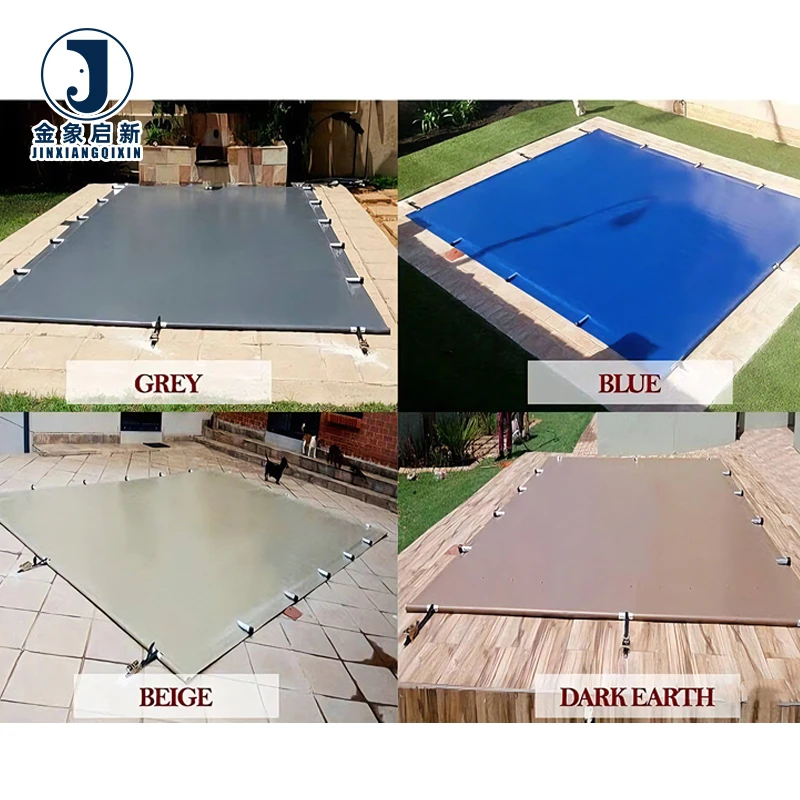
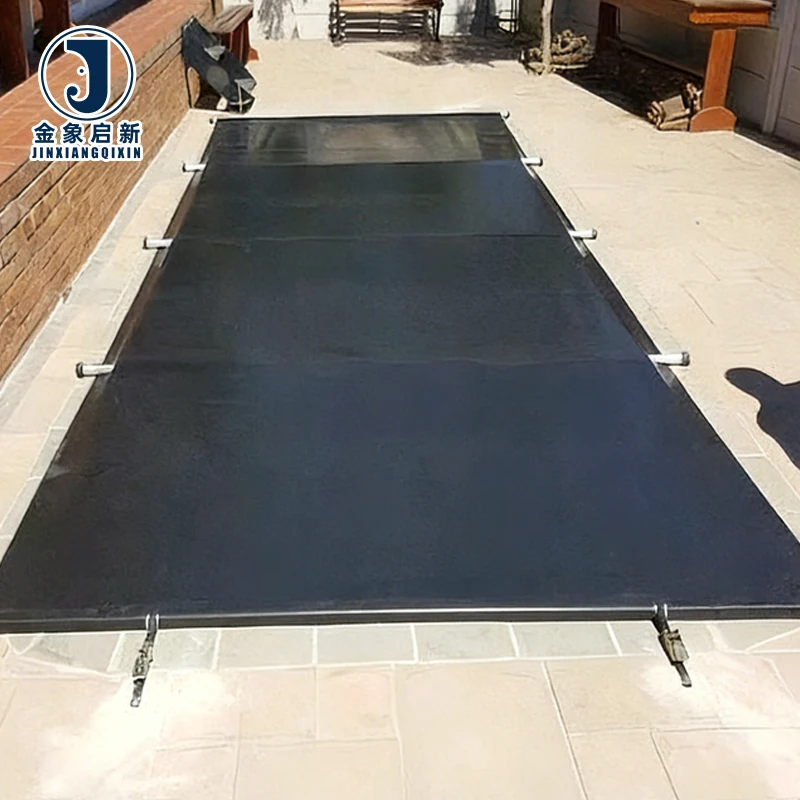
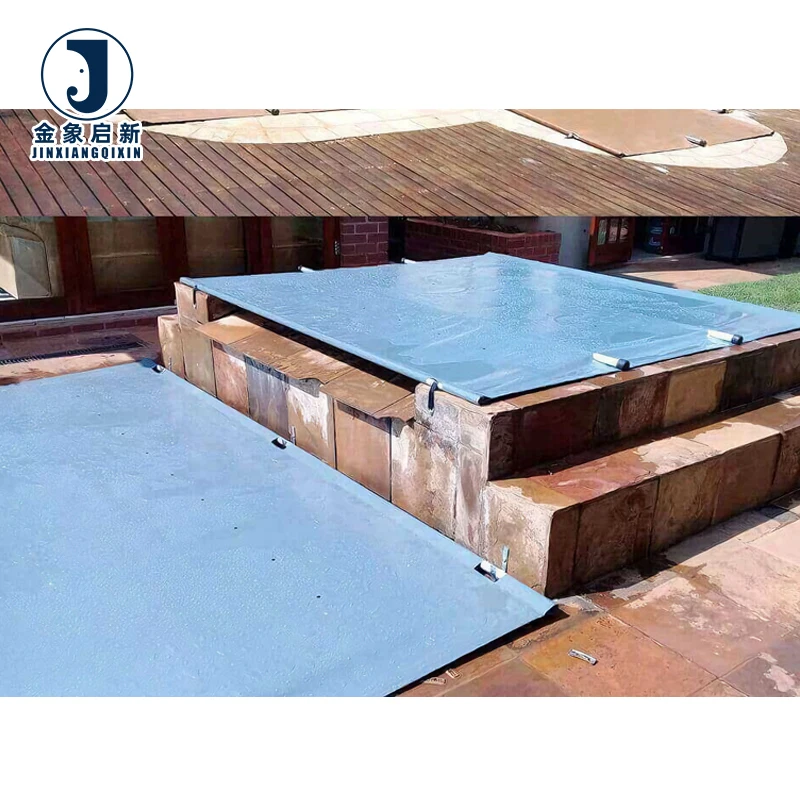
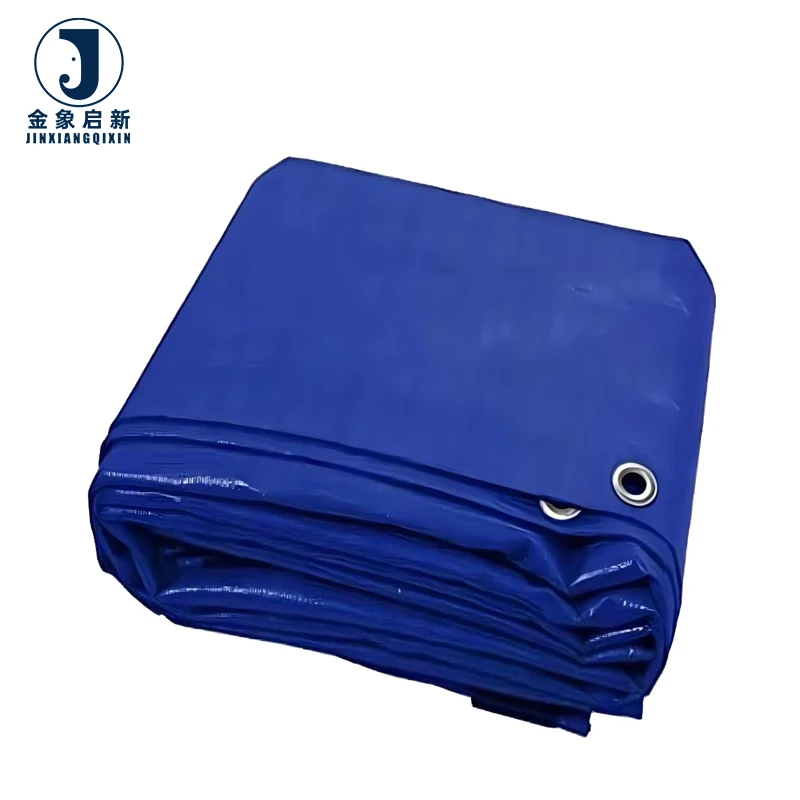
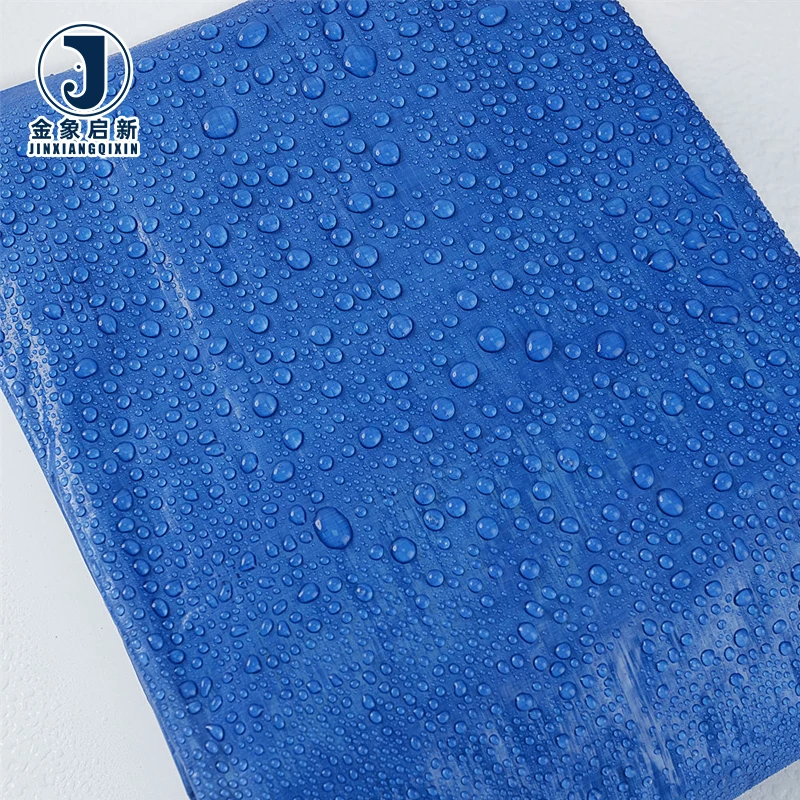
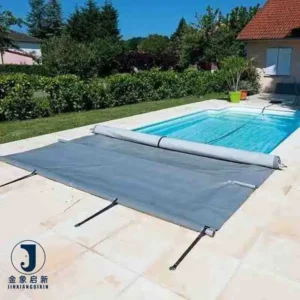
PVC Pool Cover Tarpaulin — 350gsm to 750gsm, Hot-Melt Coated, High-Tenacity Polyester Mesh — engineered for swimming pool evaporation control and water containment with custom cut-to-fit capability.
- Lamination and hot-melt coating deliver strong adhesion and tearing strength at welded seams, critical where covers flex under tension
- Treatment options include flame retardant, anti-UV, anti-mildew, and anti-static — each supported by test documentation on shipment
- Roll stock from 2m to 2.1m width with finished sizes available per pool dimensions
Three full production lines ensure reliable bulk capacity with on-time dispatch, backed by 100% pre-shipment inspection on every roll.
Description
Three full production lines — dedicated coating weight control on every roll of PVC pool cover tarpaulin, backed by 36 sets of professional equipment and 100% pre-shipment inspection.
Technical Specifications
| Parameter | Value |
|---|---|
| Product Type | PVC Coated Tarpaulin |
| Base Fabric | High-strength polyester mesh fabric |
| Coating Method | Laminated technology & Hot-melt Coating technology |
| Weight (GSM) | 350gsm / 420gsm / 500gsm / 550gsm / 600gsm / 750gsm (available grades — confirm required grade) |
| Total Thickness | 0.32mm / 0.35mm / 0.4mm / 0.45mm / 0.5mm / 0.65mm |
| Width | 2m / 2.1m |
| Roll Length | 75m (for 2m width) / 50m (for 2.1m width) |
| Color Options | Blue / Red / Yellow / Light blue / Grey (custom colors available) |
| Finish | Glossy |
| Waterproof | Yes |
| Anti-Mildew | Yes |
| Cold Crack Resistance | Yes |
| Anti-UV | Treatment available — confirm test basis for your market |
| Flame Retardant | Available in flame retardant grades — confirm the grade required for your market |
| Anti-Static | Available — surface resistance or standard to be confirmed at inquiry |
| Adhesion Strength | Good adhesion strength (no numerical value with standard provided) |
| Tearing Strength | Outstanding tearing strength for welding (no test standard provided) |
| Service Life | 3–7 years under normal circumstances |
| Standards | ISO, CE |
Application Suitability
| Application | Exposure & Requirement |
|---|---|
| Residential swimming pool covers | Daily UV exposure, chlorine-laden moisture, tension from hook or aluminium bar securement systems, debris load |
| Commercial pool enclosures | Heavy foot-traffic perimeter handling, frequent rolling and unrolling, chemical splash from pool maintenance |
| Fish tank and aquaculture pond covers | Permanent water contact, biological fouling, mildew risk in humid climates, long-term submersion resistance |
| Rectangular pool safety covers | Ratchet tensioner loads at anchor points, wind uplift stress, winter snow accumulation |
| Evaporation reduction covers in arid zones | Intense solar radiation, thermal cycling between day and night, sand abrasion at edges |
Why Stated GSM Does Not Guarantee a Reliable PVC Pool Cover Tarpaulin
Weight verification must happen roll by roll, not just on the quotation.
I have reviewed too many pool cover shipments where the label reads one number and the scale tells another. A PVC pool cover tarpaulin quoted at a given GSM often arrives lighter because the coating weight was reduced at the calender while the base fabric stayed the same. The buyer sees no visible difference until the cover is tensioned over a pool and begins to stretch unevenly under load. [NEED_CITE: weight tolerance standards for coated fabrics per ISO 2286]
The real problem surfaces months later. The lighter coating means less PVC encapsulating the polyester yarns, which means the mesh absorbs moisture at the cut edges. Mildew takes hold, the welded seams weaken, and the cover fails before the expected service window closes. Dedicated QA/QC at every production stage with documented roll-by-roll weight checks is the only way to prevent this drift.
How Coating Technology Shapes Pool Cover Durability
Laminated and hot-melt coating technology bonds the PVC layer to the high-strength polyester mesh fabric under controlled heat and pressure. This process produces a stronger interlayer adhesion than simple spread coating, which matters when a PVC pool cover tarpaulin is heat-welded at the seams. The weld line must hold at least as long as the surrounding fabric, or the first winter wind event will open a seam before the material itself shows any wear.
For pool environments specifically, the adhesion between coating and base fabric determines whether chlorinated water can penetrate the mesh structure. Once moisture reaches the yarns, tensile strength drops and mildew forms from the inside out. Hot-melt coating closes that pathway by filling the mesh interstices more completely.
Color Consistency Across Rolls in a Single Pool Cover Order
When a commercial pool operator orders multiple rolls to cover a large facility or several sites, even a slight shade difference between rolls becomes visible once the panels are installed side by side. This PVC pool cover tarpaulin is available in blue, red, yellow, light blue, grey, and custom colors, with color fastness controlled during the coating stage. [NEED_CITE: color measurement methods for coated fabrics per ISO 105 series]
Batch matching starts at the pigment dispersion stage. Each production run uses a single master batch formulation, and rolls from the same order are grouped for pre-shipment inspection so that shade variation is caught before dispatch rather than on the pool deck.
Reading the Specification Sheet Beyond Weight Numbers
GSM alone does not tell you how a PVC pool cover tarpaulin will perform under tension. The base fabric denier and weave density determine how the material resists tear propagation when a ratchet strap pulls at an anchor point. A heavier coating on a loosely woven base can produce a high GSM reading while offering less tear resistance than a lighter coating on a tighter mesh. That is why the specification sheet for this material states both the GSM and the total thickness — together they indicate how much PVC encapsulates each yarn intersection.
The coating method matters equally. Laminated technology produces a distinct film-to-fabric bond that delivers consistent peel strength across the roll width. Hot-melt coating penetrates deeper into the mesh, which improves weldability but changes the surface finish. For pool covers that are frequently rolled and unrolled, the flex life at the fold line depends on which coating method was used and at what weight.
Width selection — 2m or 2.1m — directly affects fabrication waste. A pool measuring 4m by 8m cut from 2m rolls requires a longitudinal weld seam, while the same pool from wider stock may be covered with fewer joins. Each weld seam is a potential failure point, so minimizing seams through proper width selection reduces long-term maintenance. [NEED_CITE: relationship between coating adhesion and weld strength per ISO 1421]
Thickness correlates with puncture resistance at the pool edge, where coping stones and anchor hardware concentrate load. The 0.65mm option in the heavier GSM grades provides more cushion at these high-stress contact points compared to thinner variants.
The Hidden Cost of Underspecifying Your Pool Cover Fabric
A buyer once sourced what appeared to be identical PVC pool cover tarpaulin from two suppliers at different price points. Both quotations stated the same GSM. The lighter-arriving material lasted one season before the welded seams began to delaminate at the anchor points, where wind uplift concentrates stress. The entire cover had to be replaced, and the pool was closed to members during reinstallation. [NEED_CITE: seam failure analysis methods for coated fabrics]
Color inconsistency across rolls carries its own cost. If two shades arrive in one shipment and are already cut before the difference is noticed, the buyer either installs a visibly mismatched cover or scraps the affected panels. Pre-shipment inspection records that document roll grouping and shade matching prevent this outcome before the container is sealed.
What This Manufacturer Brings to Your Pool Cover Project
Nearly 30 years focused on coated fabric means the process control behind each PVC pool cover tarpaulin roll is built on accumulated coating weight and adhesion data, not trial runs. Three full production lines and 36 sets of equipment handle bulk volume while maintaining the batch consistency that pool cover fabricators depend on.
The 10-person R&D team manages material selection, custom sizing, and sample development, producing samples within days for custom color and dimension requirements. Dedicated QA/QC at every production stage with 100% inspection before shipment means each roll is checked against the material specification sheet — not sampled from a batch.
Custom width, length, and finishing options are handled in-house, which keeps lead times predictable for buyers who need finished cut-to-size panels rather than raw roll stock alone.
Documentation & Verification
- Material specification sheet stating exact GSM, base fabric, coating method, and color reference for every order
- 100% pre-shipment inspection record documenting roll count, dimensions, and quality checks
- Test report for UV and flame-retardant grades where applicable — confirm treatment level at inquiry stage
- ISO and CE certificates included with dispatch documentation
- Certificate of origin and full customs support documentation for international shipments
Fabrication, Handling & Storage
- Heat-weld at temperatures matched to the coating method; laminated and hot-melt PVC respond differently to heat input
- Reinforce anchor points with additional PVC patches before installing eyelets or aluminium bar pockets
- Store rolls horizontally on padded racks to prevent permanent creasing across the 2m or 2.1m width
- Allow cold-stored rolls to reach ambient temperature before unrolling to avoid cracking at low-temperature grades
- Clean surfaces with mild detergent only; avoid solvent-based cleaners that attack the PVC coating layer
- Cut panels with a minimum overlap allowance to ensure weld seams land on flat fabric, not on folded hems
Share Your Project Requirements Before Quoting
To receive an accurate specification recommendation, provide the pool dimensions and shape, the tensioning system in use (hook, aluminium bar, or ratchet), and the climate conditions at the installation site. Let us know whether you need roll stock or finished cut-to-size panels, and specify any color or treatment requirements such as flame retardant grade for your local building code. Sample development is available within days for custom color and sizing confirmation.
Frequently Asked Questions
Q: How is GSM verified on arrival and what documentation supports the quoted weight?
A: Every roll undergoes weight verification during pre-shipment inspection against the stated GSM on the material specification sheet. The inspection record travels with the shipment so you can confirm weight upon receipt. If you require independent lab testing, we can arrange third-party verification before dispatch at the inquiry stage.
Q: How do you control color consistency across multiple rolls in the same pool cover order?
A: Rolls for a single order are produced from the same pigment master batch and grouped during pre-shipment inspection for visual shade matching. The inspection record documents roll grouping so that any variation is identified before the container is sealed, preventing mismatched panels on site.
Q: What custom sizing and finishing options are available for pool covers?
A: Finished products are cut to customer dimensions with options for eyelet placement, reinforced hems, aluminium bar pockets, and hook-compatible edge finishing. The 10-person R&D team develops samples within days for custom size and color confirmation before full production begins.
Q: What UV and flame-retardant treatments are available and how are they documented?
A: Anti-UV and flame-retardant treatments are available across the PVC pool cover tarpaulin range, but specific grades and test bases must be confirmed at the inquiry stage. Where applicable, a test report accompanies the shipment to verify the treatment level matches your market requirements.
Q: Can you supply finished covers or only roll stock?
A: Both options are available. Roll stock ships in standard widths of 2m and 2.1m at documented roll lengths. Finished covers are cut to your pool dimensions with edge finishing and reinforcement as specified. The sales process moves from specification recommendation through sample approval to full production with in-process QA.
Related products
-
PVC Laminated Waterproof Breathable Anti-UV Blackout Organic Plain Weft Swimming Pool Covers Tarpaulin Coated
¥1.78 Select options This product has multiple variants. The options may be chosen on the product page -
JX PVC Laminated Waterproof Breathable Anti-UV Blackout Organic Plain Weft Swimming Pool Covers Tarpaulin Coated
¥1.78 Select options This product has multiple variants. The options may be chosen on the product page -
JX PVC Laminated Waterproof Breathable Anti-UV Blackout Organic Plain Weft Swimming Pool Covers Tarpaulin Coated
¥1.78 Select options This product has multiple variants. The options may be chosen on the product page -
JX PVC Tarpaulin Swimming Pool Cover Material Knife Coated Fabric Waterproof UV-Resistant Windproof
¥13.00 Select options This product has multiple variants. The options may be chosen on the product page