PVC Tarpaulin Price in Brazil: 2026 Wholesale Supplier Guide
Higher GSM does not mean better value in Brazil’s climate — coating uniformity and UV resistance determine whether your cargo survives a single tropical summer.
The real PVC tarpaulin price Brazil buyers pay in 2026 is shaped by three variables: fabric weight range, coating process consistency, and anti-UV treatment grade. Per-square-meter FOB quotes are only the starting point. For importers clearing through Santos, the landed cost includes ocean freight, port handling, Brazilian import duties, and compliance documentation — all of which can erase the savings from choosing the cheapest roll.
Early in my time sourcing construction materials in São Paulo, I supplied PVC rolls to a regional hardware chain. One client ordered 550gsm fabric for truck side curtains. I quoted a mid-range price based on standard domestic specs. When the container arrived at Santos and they unrolled the first batch, the surface had already yellowed during transit, and the UV layer was thin enough to see light through. Within a single season under northeastern Brazil’s sun, the entire shipment became brittle and cracked. The replacement cost ran into mid-five figures, and I learned the hard way that a few cents saved per square meter turned into a loss many times that amount. Since then, I have focused exclusively on exporting PVC coated fabrics, and I can tell you that pricing in this market is never just about weight — it is about matching the spec to the environment. [NEED_CITE: UV degradation rate of PVC coated fabrics under tropical irradiance conditions]
Getting the specification right before quoting is the only way to protect your margin. Let me walk through what actually drives the cost structure in Brazil this year.
What Determines PVC Tarpaulin Price in Brazil in 2026?
Three factors dominate the final price: base fabric weight, coating method, and UV stabilization level — not the per-meter quote alone.
Many first-time buyers assume that comparing square-meter prices across suppliers is enough. In practice, the gap between a quote that looks attractive and one that delivers real performance comes down to how the PVC paste is applied and what additives go into it. [NEED_CITE: coating process types for PVC tarpaulin and their impact on durability]
The base weight of the polyester scrim combined with the PVC coating determines the total GSM. But two rolls at the same weight can behave completely differently if one uses a knife-over-roll coating with controlled paste viscosity while the other uses a simpler calendering method with uneven distribution. The first will hold up under sustained sun exposure; the second will develop micro-cracks along stress lines within months.
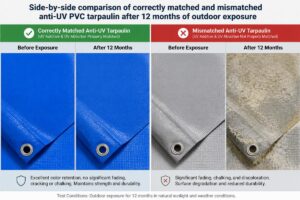
Then there is the UV package. Brazil’s solar radiation intensity varies significantly between regions — the northeast receives substantially more annual UV than the south. A tarpaulin formulated for São Paulo warehouse covers will fail quickly if deployed on a truck fleet in Bahia. The anti-UV additive concentration must match the deployment zone, and this directly affects raw material cost. [NEED_CITE: regional solar radiation intensity variation across Brazil]
| Factor | Basic Tier | Standard Tier | High-Performance Tier |
|---|---|---|---|
| Coating Uniformity | Uncontrolled | Standard | Controlled |
| UV Additive Level | None | Standard | Enhanced |
| Weldability | Vulnerable | Resistant | Robust |
| Color Retention | Noticeably reduced | Substantially extended | Substantially extended |
| Suitable Climate Zone | Sheltered / Indoor | General outdoor | High-irradiance tropical |
A distributor in Minas Gerais once switched to a cheaper supplier to save on restocking costs. The new rolls were the same GSM on paper, but the coating was noticeably thinner at the edges. Within one rainy season, water seeped through the selvedge and damaged the goods underneath. The claims from end users cost several times the original savings. [NEED_CITE: coating thickness consistency standards for PVC tarpaulin]
This is why I always tell buyers: the PVC tarpaulin price Brazil market offers is only meaningful when you know exactly what spec you are comparing.
How Does GSM and Coating Type Affect Cost for Different Applications?
Truck covers, construction tarps, and aquaculture liners each demand a different weight range and coating approach — pricing follows accordingly.
The application dictates the spec, and the spec dictates the price. Here is how the major segments break down in the Brazilian market.
Truck Covers and Transport Tarps
Fleet operators in Brazil typically need fabric in the mid-weight range. The key requirements are tear resistance, weldability for panel assembly, and UV endurance for long-haul routes that cross multiple climate zones. In the northeast, where solar exposure is intense, a double-coated construction with enhanced UV stabilization is essential — otherwise the service life drops dramatically compared to southern routes. [NEED_CITE: PVC tarpaulin performance requirements for transport applications]
Construction and Site Covers
This segment leans toward the lighter end of the PVC range. The priority here is waterproof integrity and heat-seal welding strength rather than extreme abrasion resistance. Buyers in this category should focus on peel strength of welded seams, because a cover that splits at the seam during installation is worthless regardless of how cheap it was.
Aquaculture and Pond Liners
Fish farming and water storage operations require heavier fabric with strong chemical resistance. The PVC formulation must withstand prolonged contact with treated water and organic compounds. Thickness and puncture resistance become the primary cost drivers here, and the coating must remain flexible over extended periods without plastimizer migration.
| Application | Weight Range | Key Coating Requirement | Primary Failure Mode if Underspecified |
|---|---|---|---|
| Truck Covers | Mid-weight range | Double-coated, high UV | Surface cracking, color fading |
| Construction Covers | Light-to-mid range | Uniform weldability | Seam splitting, water ingress |
| Aquaculture Liners | Heavy-weight range | Chemical-resistant formulation | Puncture, plastimizer loss |
A truck cover manufacturer in Goiás once sourced rolls at the lowest available price per square meter. The fabric met the weight spec, but the coating lacked sufficient flexibility at fold lines. After repeated folding during daily use, the creases turned white and then cracked. The entire batch had to be pulled from production. The manufacturer’s loss was not just the fabric cost — it included labor, downtime, and customer penalties. [NEED_CITE: flexible PVC coating performance under repeated mechanical stress]
When you request a PVC tarpaulin price Brazil quote, always specify the end use. A supplier who asks about your application before quoting is protecting your investment. One who quotes without asking is gambling with your reputation.
What Is the Real CIF Santos Landed Cost Breakdown?
FOB price is the beginning — ocean freight, port fees, import duties, and compliance costs form the actual landed price.
Many buyers focus entirely on the FOB number and assume the rest is predictable. In Brazil, the gap between FOB and landed cost can be substantial, and unexpected charges at Santos port have wiped out the margin on entire containers.
The cost stack looks like this:
FOB Cost — This covers the fabric, packaging, and loading at the Chinese port. It is the number suppliers quote most prominently.
Ocean Freight — Rates fluctuate based on season, vessel availability, and routing. Shipping to Santos typically involves transit through major transshipment hubs. During peak seasons, freight costs can rise noticeably. [NEED_CITE: ocean freight rate trends for China to Santos route]
Port Handling and Terminal Charges — Both the origin and destination ports levy handling fees. At Santos, terminal storage charges begin accumulating if the container is not cleared within the free-time window. Delays in documentation can push costs higher quickly.
Import Duties and Taxes — Brazil’s tariff structure on PVC coated fabrics includes import duty, IPI, PIS, COFINS, and ICMS. The combined rate is significant and must be calculated based on the correct NCM classification code. Misclassification can lead to fines or delays. [NEED_CITE: Brazilian import tariff structure for PVC coated textile fabrics]
Compliance Documentation — Brazilian customs requires specific certificates depending on the product classification. Having the correct test reports and compliance documents ready before the cargo arrives prevents demurrage charges that can run into thousands of dollars per day.
A buyer from Ceará once found that the cheapest FOB quote saved a modest amount per roll, but the supplier could not provide the required test documentation in the format Brazilian customs expected. The container sat at Santos for weeks, and the storage fees alone exceeded the original FOB savings many times over. [NEED_CITE: Santos port demurrage and storage charge structure]
| Cost Component | Predictability | Risk if Mismanaged |
|---|---|---|
| FOB Price | High | Low — transparent |
| Ocean Freight | Moderate | Moderate — seasonal spikes |
| Port Handling | Moderate | High — demurrage accumulation |
| Import Duties | High (if classified correctly) | High — misclassification penalties |
| Documentation | High (if prepared in advance) | Very high — cargo hold at port |
The lesson is straightforward: when comparing PVC tarpaulin price Brazil options, ask the supplier whether they can provide complete export documentation for Brazilian customs. A factory-direct supplier with full export capability eliminates a major risk point.
How to Avoid Quality Traps That Turn Cheap Price Into Total Loss?
Uneven coating and insufficient UV stabilization are the two silent killers — visual inspection alone cannot detect them.
The most dangerous quality failures in PVC tarpaulin are the ones you cannot see at the port. A roll can look perfect on the outside — clean surface, correct color, proper width — while the coating underneath is inconsistent or the UV package is under-dosed.
Here is what experienced buyers check:
Coating Uniformity Verification
Request cross-section samples and examine the PVC layer distribution on both sides. A well-controlled coating process produces consistent thickness across the full width. If the edges are noticeably thinner than the center, the roll will fail first at the edges — exactly where water and wind stress concentrate. [NEED_CITE: PVC coating thickness measurement methods per ISO standards]
UV Stabilization Validation
Ask for accelerated weathering test reports. These tests simulate extended sun exposure in a compressed timeframe. A supplier confident in their UV formulation will provide these reports without hesitation. One who deflects or offers only generic certificates is signaling a risk. [NEED_CITE: accelerated weathering testing standards for PVC coated fabrics]
Weldability Testing
For applications requiring heat-sealed seams, request welded sample strips and verify peel strength. A coating that looks good on the roll may not bond properly when heat-sealed, leading to seam failure in the field.
Plastimizer Migration Check
Heavy-duty applications require flexible PVC over extended periods. If the plastimizer migrates to the surface, the fabric becomes stiff and brittle. This is a formulation issue that only shows up after months of use — but the right supplier will have formulation data to confirm long-term flexibility.
| Check Point | What to Request | Red Flag |
|---|---|---|
| Coating Uniformity | Cross-section sample | Edge thickness visibly thinner |
| UV Stabilization | Accelerated weathering report | No report or generic certificate only |
| Weldability | Heat-sealed peel test strip | Seam separates under light tension |
| Flexibility Retention | Plastimizer migration data | No formulation documentation |
A mining operation in Mato Grosso ordered heavy-duty covers for equipment storage. The supplier quoted an aggressive price, and the rolls passed visual inspection. But after one dry season with intense sun, the covers lost flexibility and tore when workers tried to reposition them. The replacement order cost several times the original purchase, and the operational disruption added further losses. [NEED_CITE: PVC plastimizer migration effects on long-term flexibility]
The PVC tarpaulin price Brazil market offers will always have a floor — below that floor, something has been cut. The question is whether it is something you can afford to lose.
Which PVC Tarpaulin Specification Gives the Best Value for Your Brazilian Market?
Matching the specification to the end use — not chasing the lowest per-meter price — is how importers lock in real cost efficiency.
After years of watching buyers succeed and fail in this market, the pattern is clear: those who invest time upfront in defining their exact specification end up with the lowest total cost. Those who chase the cheapest quote end up paying again — and again.
The right approach works like this:
Define the deployment environment first. Is the fabric going on trucks crossing the northeast? Covering construction sites in the south? Lining aquaculture ponds in the interior? Each environment has different demands for UV resistance, flexibility, and chemical exposure.
Select the weight range that matches the mechanical stress. Light-duty covers do not need the heaviest fabric — and paying for weight you do not need is wasted margin. Conversely, specifying too light a fabric for a heavy-duty application guarantees premature failure.
Confirm the coating process and UV package. This is where the real differentiation lies. A controlled coating process with appropriate UV stabilization costs more per square meter but delivers a service life that is substantially longer. The cost per year of service is far lower.
Work with a supplier who covers the full weight range and can customize. Not every application needs the same spec, and a manufacturer with broad production capability can match the exact requirement rather than forcing a standard product into a non-standard use. Custom width and color options reduce waste and rework at the buyer’s end. [NEED_CITE: PVC tarpaulin customization capabilities for different end-use specifications]
A distributor in Paraná sources multiple weight ranges for different customer segments — lighter fabric for construction covers, mid-range for truck accessories, and heavy-duty for industrial applications. By consolidating orders with a single manufacturer who can produce across the full spectrum, they reduce per-container logistics cost and maintain consistent quality across their catalog. Their reorder rate reflects end-user satisfaction, not just initial price.
| Decision Factor | Wrong Approach | Right Approach |
|---|---|---|
| Spec Selection | Pick lowest GSM available | Match GSM to mechanical stress level |
| UV Package | Assume all suppliers include adequate UV | Specify UV level by deployment region |
| Coating Quality | Compare only per-meter price | Verify coating uniformity and process control |
| Supplier Choice | Choose lowest FOB blindly | Choose manufacturer with full range and export documentation capability |
The PVC tarpaulin price Brazil buyers pay in 2026 will reward those who treat specification as an investment, not an afterthought.
Conclusion
The true cost of PVC tarpaulin in Brazil is determined by specification accuracy, not quote comparison alone. Coating uniformity, UV stabilization matched to regional solar intensity, and complete export documentation for Santos customs are the factors that separate a profitable shipment from a total loss. Buyers who define their end-use environment first and work with a manufacturer capable of full-range production lock in the lowest cost per year of service — regardless of what the per-meter FOB number says.