PVC Tarpaulin Supplier for Kazakhstan: China Factory Direct OEM Wholesale
Higher GSM does not automatically mean better durability — yarn density and coating uniformity determine actual tear resistance under extreme conditions.
Sourcing a reliable Tarpaulin Supplier for Kazakhstan means prioritizing factory-direct models that compress intermediary costs, guarantee complete certification documentation, and match GSM specifications to sub-zero and mining workloads.
I remember pressing PVC film on production lines in Linyi before moving into export sales across Latin America. One shipment of 680gsm flame-retardant tarps bound for a Chilean mine got held up at San Antonio port because the NFPA 701 certification was missing — we had only completed a basic oxygen index test. Demurrage charges accumulated daily, and we ended up airfreighting samples for supplementary testing, losing nearly a month and a half before clearance. That episode drilled one truth into me: selling tarpaulins is not about selling plastic sheets; it is about selling parameters, certifications, and customs paperwork. When a buyer asks what separates 440gsm from 550gsm, you must be able to explain base fabric density, coating process, and tear strength performance — otherwise, they have no reason to hand you a full container order.
For buyers in Central Asia, choosing a Tarpaulin Supplier for Kazakhstan who operates a direct factory model unlocks structural advantages in cost control, certification integrity, and customization flexibility — and the sections below break down exactly how to evaluate those factors.
PVC vs PE Tarpaulin: Which Spec Fits Your Application?
PVC-coated tarpaulins suit heavy-duty mining, trucking, and long-term outdoor use; PE laminated tarps serve short-term agricultural and temporary coverage needs at lower cost.
The choice between PVC and PE is not about which material is universally superior — it is about matching the coating process to the workload environment. PVC tarpaulins use a knife-over-roll or calendering process where PVC paste is bonded to a polyester base fabric, producing a monolithic layer that resists abrasion, chemicals, and prolonged UV exposure. PE tarpaulins, by contrast, are produced through a blown-film lamination process where polyethylene layers are extruded onto a woven PP scrim, yielding a lighter, more economical sheet suited to seasonal or disposable applications.
| Parameter | PVC-Coated Tarpaulin | PE-Laminated Tarpaulin |
|---|---|---|
| Base Fabric | High-tenacity polyester | Woven polypropylene scrim |
| Coating Process | Knife-over-roll / calendering | Blown-film extrusion lamination |
| Tear Resistance | Robust | Moderate |
| Chemical Resistance | Resistant | Vulnerable |
| UV Endurance | Substantially extended | Noticeably reduced |
| Weight Range | 440–1000gsm | 60–300gsm |
| Weldability | High-frequency welding | Heat-seal only |
| Typical Lifespan | Years of continuous outdoor use | Seasonal to short-term |
[NEED_CITE: comparative performance of PVC-coated versus PE-laminated flexible fabrics in outdoor exposure conditions]
A construction materials distributor in Almaty once ordered a mixed container of PE tarps for grain pile covers and PVC rolls for flatbed truck covers. The PE tarps performed adequately through one harvest season, but when the same distributor tried using PE for mining equipment covers, the material degraded within months under combined UV and abrasive dust exposure. Switching those SKUs to PVC-coated rolls from the Tarpaulin Supplier for Kazakhstan eliminated repeat complaints.
The takeaway is straightforward: if your end-use involves heavy friction, chemical exposure, or multi-year outdoor deployment, PVC is the only viable option. PE remains a cost-effective choice for temporary or light-duty scenarios where replacement cycles are short.
GSM Range 440-1000: How to Match Weight to Extreme Conditions?
Sub-zero and high-wind工况 require 680gsm and above with cold-resistant additive formulations — standard compounds become brittle at minus thirty degrees Celsius.
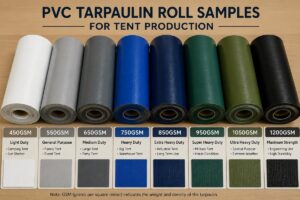
GSM — grams per square meter — is the first number buyers look at, but it tells only part of the story. The real performance driver is the relationship between GSM, base fabric yarn count, and coating compound formulation. A 680gsm PVC tarpaulin built with a high-density polyester scrim and plasticizer-rich coating will outperform a 900gsm sheet made with low-density yarn and a stiff, filler-heavy compound.
| GSM Range | Base Fabric Density | Typical Application | Cold-Weather Suitability |
|---|---|---|---|
| 440–550gsm | Standard density | Truck covers, light construction | Suitable down to moderate cold |
| 550–680gsm | Medium-high density | Mining ventilation ducts, heavy equipment covers | Requires cold-resistant formulation |
| 680–1000gsm | High density | Extreme cold zones, permanent industrial covers | Must include specialized low-temperature additives |
[NEED_CITE: effect of plasticizer type and concentration on low-temperature flexibility of PVC-coated fabrics]
A mining operation in northern Kazakhstan needed ventilation ducts rated for continuous use in sub-zero conditions. They initially specified a generic 680gsm PVC compound. During the first winter, the ducts cracked along fold lines — the standard plasticizer formulation lost flexibility well before the actual ambient temperature dropped to its seasonal low. The Tarpaulin Supplier for Kazakhstan then reformulated the compound with a cold-resistant plasticizer system, and the replacement ducts held through the entire heating season without embrittlement.
The lesson: never select GSM in isolation. Always confirm the coating formulation matches your lowest expected operating temperature. A Tarpaulin Supplier for Kazakhstan who cannot explain their cold-weather compound adjustments is not a factory — they are a middleman reselling generic stock.
Certifications & Documentation: Avoiding Customs Delays
Missing or incomplete certification documents cause port demurrage charges that far exceed any per-unit price difference between suppliers.
This is where many buyers get trapped. They compare unit prices across three or four Tarpaulin Supplier for Kazakhstan candidates, pick the cheapest, and then discover that the winning quote came without fire-retardant test reports, anti-UV certification, or certificates of origin formatted for Eurasian Economic Union customs. The resulting delays at the border or port can cost multiples of whatever was saved on the invoice.
| Document Type | Purpose | Risk if Missing |
|---|---|---|
| Fire-retardant test report (e.g., NFPA 701, EN 13501-1) | Proves flame resistance compliance | Cargo held at port; supplementary testing required |
| Anti-UV test certificate | Validates UV stabilizer performance | Buyer claims upon delivery; contract disputes |
| Certificate of Origin | Required for EAEU customs clearance | Clearance delay; potential tariff penalties |
| SGS / Intertek inspection report | Third-party quality verification | Buyer rejection risk; no independent evidence |
[NEED_CITE: Eurasian Economic Union import documentation requirements for coated textile products]
A Central Asian distributor once sourced a full container of PVC tarpaulin rolls from a supplier who quoted a noticeably lower price. The shipment arrived at the destination port without a properly formatted certificate of origin. Customs held the container for weeks while the distributor scrambled to obtain retroactive documentation from the factory. The demurrage and storage fees ended up exceeding the original price advantage by a wide margin.
Before placing an order, request sample copies of every certification document the Tarpaulin Supplier for Kazakhstan will provide. Verify that the test standards match your market requirements — NFPA 701 for North American-spec projects, EN 13501-1 for European-aligned buyers, and GOST standards for EAEU destinations. A factory that maintains a complete documentation package as standard practice is worth a modest premium over one that treats certifications as an afterthought.
Factory Direct Pricing: MOQ, Lead Time & Container Loading
Flexible MOQ and optimized container loading are the real levers for reducing landed cost — not just the quoted per-square-meter price.
Factory-direct pricing sounds simple, but the actual cost advantage depends on how well the supplier manages production scheduling, minimum order quantities, and container space utilization. A Tarpaulin Supplier for Kazakhstan who only sells full-container loads of a single SKU forces buyers to overcommit on one specification. A factory that accommodates mixed-SKU containers — combining different GSM weights, widths, and colors in one shipment — gives buyers far more inventory flexibility.
| Factor | Rigid Supplier Model | Flexible Factory-Direct Model |
|---|---|---|
| MOQ | Full container, single SKU | Roll-level to container-level |
| Container Loading | Single width, single GSM | Mixed widths and GSM optimized for space |
| Private Label | Not available or high threshold | Available with reasonable threshold |
| Lead Time | Fixed, no acceleration | Adjustable based on production scheduling |
[NEED_CITE: container loading optimization methods for mixed-width flexible fabric rolls]
A distributor in Kazakhstan regularly orders mixed containers combining 550gsm truck cover rolls, 680gsm mining-grade sheets, and 900gsm heavy-duty pond liner material. The Tarpaulin Supplier for Kazakhstan calculates the optimal width combination for each container to minimize wasted space — narrower rolls fill gaps beside wider ones, and heavier GSM rolls are loaded at the bottom to maximize weight distribution. This approach means the distributor receives exactly the SKU mix the market demands without paying to ship empty space.
When evaluating a Tarpaulin Supplier for Kazakhstan, ask specifically about their container loading methodology. A factory that can demonstrate systematic space optimization across mixed-SKU orders will deliver a lower effective landed cost than one offering a slightly cheaper per-square-meter quote but forcing single-SKU full containers.
Conclusion
Choosing the right Tarpaulin Supplier for Kazakhstan comes down to three verifiable factors: specification-to-application matching, complete certification documentation, and factory-direct operational flexibility.
GSM alone does not determine performance — base fabric density and coating formulation matter equally, especially in extreme cold. Certification gaps create hidden costs that dwarf any unit price savings. And true factory-direct value emerges from mixed-SKU container optimization and responsive MOQ policies, not merely a low quote on a spec sheet.