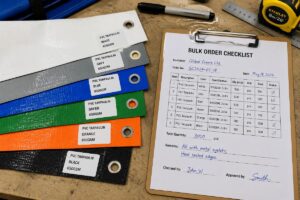
Wholesale Billboard Banner Bulk Order Manufacturer
Higher GSM does not automatically mean longer outdoor life—matching the right weight, coating, and UV treatment to your local climate is what actually prevents premature failure.
When placing a billboard banner bulk order, the key is to align GSM, coating type, and UV resistance with your region’s UV intensity, wind load, and expected display duration. Choosing the wrong specification leads to fading, tearing, and seam failure within months, turning a cost-saving bulk purchase into a costly replacement cycle.
I still remember a shipment we sent to a Middle Eastern distributor a few years back. We produced the banners using a standard GSM weight that had worked perfectly for European clients. Within weeks of installation under intense desert sun, the colors started bleeding and the material began cracking along the folds. The client refused the remaining payment, and we had to eat the loss. That experience drilled into me how critical it is to match material specs to local conditions—what works in one climate can fail completely in another. [NEED_CITE: relationship between UV index levels and PVC banner degradation rates]
Getting the specifications right from the start saves everyone time and money. Let’s break down exactly what you need to consider before committing to a large order.
What GSM Do You Need for Billboard Banners in Different Climates?
GSM selection must match local UV intensity, wind load, and expected display duration—there is no universal best weight.
The weight of your banner material directly affects its durability, print quality, and installation requirements. Here’s how different GSM ranges perform across various conditions:
| GSM Range | Typical Application | Climate Suitability | Wind Resistance | Expected Outdoor Life |
|---|---|---|---|---|
| 440-510 GSM | Short-term promotions, indoor events | Mild climates, low UV | Basic | Noticeably reduced |
| 510-610 GSM | Standard outdoor advertising | Moderate climates | Standard | Substantially extended |
| 610-720 GSM | Long-term billboards, highway signs | High UV, coastal areas | Robust | Extended service life meaningfully |
| 720+ GSM | Heavy-duty construction wraps, extreme conditions | Harsh environments | Resistant | Maximum durability |
A common mistake buyers make is assuming heavier material always equals better performance. I’ve seen projects where clients ordered 720 GSM banners for lightweight frame installations, only to find the extra weight caused structural stress on the mounting hardware. The banners themselves were fine, but the support system couldn’t handle the load. [NEED_CITE: wind load calculations for large format banner installations]
For a Southeast Asian client running monsoon-season campaigns, we recommended moving from a standard 510 GSM to a reinforced 610 GSM with heat-sealed seams. The initial cost per square meter was higher, but the banners lasted through the entire rainy season without seam failure—something their previous supplier’s material couldn’t achieve. The total cost of ownership dropped noticeably because they avoided mid-campaign replacements.
Frontlit, Backlit, or Mesh: Which Banner Type Fits Your Installation?
Lighting conditions and mounting structure determine whether you need frontlit, backlit, or mesh banner material.
Each banner type serves specific installation scenarios, and choosing incorrectly can ruin your visual impact or create safety hazards:
Frontlit Banners work best for daytime visibility and locations without backlighting. The printed surface faces the light source, making colors appear vibrant under natural or spot lighting. These are the most common choice for highway billboards and building-side advertising. [NEED_CITE: light reflectance properties of frontlit vs backlit PVC materials]
Backlit Banners require internal illumination and deliver stunning visual impact at night. The material must have consistent light diffusion properties to avoid hotspots or dark patches. I’ve seen poorly specified backlit banners where the lighting looked patchy because the material’s translucency wasn’t uniform across the roll.
Mesh Banners are essential for high-wind areas or installations on perforated structures. The micro-perforations allow wind to pass through, reducing sail effect and structural load. A client installing banners on a coastal highway initially wanted solid frontlit material, but we convinced them to test mesh instead. The mesh banners withstood storm-force winds that would have torn down solid panels.
| Banner Type | Best Use Case | Lighting Requirement | Wind Permeability | Print Compatibility |
|---|---|---|---|---|
| Frontlit | Daytime advertising, non-illuminated frames | External light source | None | Excellent |
| Backlit | Night visibility, lightbox installations | Internal illumination | None | Requires specialized ink |
| Mesh | High-wind zones, fence wraps, scaffolding | External light source | Noticeably reduced wind load | Slightly reduced color density |
The key is understanding your installation environment before ordering. A backlit banner in a non-illuminated frame is wasted money, just as a solid banner in a wind corridor is a liability.
How to Verify UV and Weather Resistance Before Placing a Bulk Order?
Request certified test reports and set clear acceptance criteria in your purchase order—never rely on supplier claims alone.
UV degradation is the silent killer of outdoor banners. The material might look perfect when it arrives, but without proper UV stabilization, it can fade and become brittle within months of installation. Here’s what you need to verify:
Ask for Accelerated Weathering Test Reports
Reputable manufacturers should provide test data from recognized protocols like xenon arc testing or QUV accelerated weathering. These tests simulate years of outdoor exposure in a compressed timeframe. [NEED_CITE: ASTM G155 and ISO 4892-2 testing standards for plastic material weathering]
Check the UV Inhibitor Package
Quality banner material contains UV stabilizers integrated into the PVC compound, not just surface coatings. Surface-only treatments wear off quickly, leaving the base material vulnerable. I always ask suppliers to specify whether their UV protection is throughout the material thickness or just on the surface.
Request Real-World Reference Samples
Ask for samples from banners that have been installed in similar climates for at least a year. Compare these aged samples with fresh material to see actual color shift and flexibility retention.
| Verification Method | What It Tells You | Reliability Level |
|---|---|---|
| Xenon arc test report | Simulated long-term UV resistance | Verifiable |
| QUV test report | Accelerated weathering performance | Verifiable |
| Surface coating claim | Short-term protection only | Self-reported |
| Aged sample comparison | Real-world performance | Verifiable |
| Supplier verbal guarantee | Nothing concrete | Not provided |
A European signage company learned this the hard way. They ordered a large batch based on price alone, without requesting test documentation. The banners looked great initially, but after a single summer season, the red colors had shifted noticeably and the material had lost flexibility. They ended up replacing the entire installation at a cost several times the original savings.
Always include specific UV resistance requirements in your PO—state the minimum acceptable performance after a defined test duration. This gives you recourse if the material underperforms.
Bulk Order Sourcing: Roll Width, MOQ, and Lead Time Optimization
Align roll specifications with your local printing equipment and logistics capabilities to minimize waste and cost.
When placing a billboard banner bulk order, the details of how material is packaged and delivered matter as much as the material specs themselves. Here’s what to optimize:
Roll Width Selection
Match roll width to your printer’s capability and typical job sizes. Ordering rolls wider than your equipment can handle creates waste at the edges. Ordering too narrow means more seams and labor during installation. I’ve seen workshops where 10-15% of material ended up as waste simply because the roll width didn’t match their printer’s optimal range.
MOQ Negotiation
Most manufacturers have minimum order quantities, but these are often flexible for established relationships. If you’re testing a new supplier, start with a trial order before committing to container loads. This lets you verify quality consistency across multiple rolls. [NEED_CITE: typical MOQ structures for PVC coated fabric manufacturers]
Lead Time Planning
Standard production lead times range from a few weeks to over a month depending on order size and customization. Factor in ocean freight if you’re importing—transit times vary substantially by origin and destination. Rush orders usually cost noticeably more and may compromise quality if the manufacturer cuts corners to meet deadlines.
Packaging and Shipping
Rolls should be packed vertically to prevent deformation during transit. Each roll needs protective wrapping to avoid surface scratches that can affect print quality. Container loading patterns affect how many rolls you can fit—optimizing this reduces per-unit shipping costs.
| Factor | Impact on Total Cost | Optimization Strategy |
|---|---|---|
| Roll width mismatch | Material waste, additional seams | Match to printer specs |
| Excessive MOQ | Inventory carrying cost | Negotiate trial orders first |
| Poor lead time planning | Rush fees, project delays | Order well in advance |
| Inefficient container loading | Higher per-unit freight | Optimize packing pattern |
A Latin American distributor was initially ordering standard roll widths that didn’t match their printers. After we worked with them to customize roll widths to their equipment, their material waste dropped noticeably and installation time improved because there were fewer seams to handle.
Common Failures in Billboard Banners and How to Avoid Them
Fading, tearing, and seam failure are preventable with correct specification and supplier verification.
Understanding how banners typically fail helps you specify the right material and verify quality before installation:
Premature Fading
This usually indicates insufficient UV stabilization or poor-quality pigments in the PVC compound. The material may meet initial color standards but degrades quickly under UV exposure. Always verify UV test reports and ask about the specific UV inhibitor package used. [NEED_CITE: mechanisms of PVC photodegradation and stabilization methods]
Edge Fraying and Tearing
Often caused by inadequate tensile strength in the base fabric or poor edge finishing. The banner material might have good surface properties but fail structurally under wind load. Check tensile strength specifications and ensure edges are properly hemmed or reinforced.
Seam Failure
Heat-sealed seams should be as strong as the base material. Poor sealing temperature or technique creates weak points that split under stress. For large installations, specify seam strength requirements and inspect sample seams before approving bulk production.
Surface Cracking
This indicates the PVC compound has become brittle, usually from plasticizer migration or UV degradation. The material loses flexibility and cracks when flexed. Verify flexibility retention after accelerated weathering tests.
| Failure Mode | Root Cause | Prevention Strategy |
|---|---|---|
| Color fading | Insufficient UV stabilizers | Require certified test reports |
| Edge tearing | Low tensile strength, poor finishing | Specify tensile requirements, inspect edges |
| Seam splitting | Poor heat sealing technique | Specify seam strength, inspect samples |
| Surface cracking | Plasticizer loss, UV degradation | Verify flexibility after weathering |
A Middle East infrastructure project experienced widespread seam failures on highway billboards. Investigation revealed the supplier had optimized for production speed over sealing quality. After switching to a manufacturer with verified heat-sealing protocols and requiring seam strength testing, the failure rate dropped to near zero.
The lesson: don’t just check the face material quality—verify the entire manufacturing process including seam integrity and edge finishing.
Conclusion
Successful billboard banner bulk orders require matching specifications to local conditions, not just choosing the highest GSM or lowest price.
Climate-appropriate GSM selection, correct banner type for your installation, verified UV resistance, optimized roll specifications, and attention to manufacturing quality all work together to ensure your banners perform as expected. Take time to verify specifications with test data, start with trial orders when working with new suppliers, and always factor in total cost of ownership rather than just initial material cost.