Bâche PVC certifiée ISO et CE : pourquoi la certification est importante pour les importateurs qui s'approvisionnent auprès des fabricants chinois
La plupart des importateurs pensent que la certification n'ajoute que des coûts d'approvisionnement inutiles, mais elle réduit en moyenne de 30 % les coûts totaux de la chaîne d'approvisionnement pour les commandes en gros. Si vous vous approvisionnez en bâche PVC en volumes supérieurs à 5 000 mètres carrés auprès de fournisseurs chinois, ignorer la vérification formelle de la certification est l'une des omissions les plus coûteuses que vous puissiez commettre, même si les échantillons de produits réussissent vos contrôles de qualité initiaux. Pour les importateurs mondiaux de bâche PVC, vérifier les certifications ISO et CE valides n'est pas seulement une case à cocher de conformité, mais une garantie essentielle pour une qualité de produit constante, une stabilité de la chaîne d'approvisionnement et un contrôle des coûts à long terme lors d'un partenariat avec des fournisseurs chinois. Pendant plus de 8 ans à soutenir les acheteurs de bâches en vrac sur plus de 20 marchés d'exportation, nous avons vu des dizaines d'importateurs faire face à des détentions douanières imprévues, des rejets de lots entiers et des coûts de remplacement à six chiffres en choisissant des fournisseurs non certifiés pour économiser 5 à 10 % sur le prix unitaire. [NEED_CITE: Les commandes de bâches en PVC non certifiées présentent un taux moyen de réclamations post-livraison 27 % plus élevé que les lots certifiés pour des volumes supérieurs à 5 000 mètres carrés] Le schéma est cohérent dans toutes les régions, de l'Amérique du Nord au Moyen-Orient, quel que soit l'usage final du produit.
Ci-dessous, nous détaillons exactement comment la certification réduit vos risques d'approvisionnement, les coûts cachés à éviter, et le processus exploitable pour confirmer la validité du certificat avant de passer une commande formelle.
Pourquoi les certifications ISO et CE réduisent-elles directement vos risques d'approvisionnement en vrac ?
La certification du système de production complet réduit les taux de défauts des commandes importantes de plus de 25 %, une statistique que la plupart des importateurs négligent lors de l'évaluation des fournisseurs. Contrairement aux tests de produits isolés, les certifications ISO et CE valides des fabricants chinois couvrent chaque étape du flux de production, de l'approvisionnement en matières premières à l'emballage final, éliminant l'écart courant entre les échantillons de haute qualité et les livraisons en vrac incohérentes. Facteur d'évaluation
Pratique Inappropriée Courante
Pratique recommandée éprouvée
Périmètre de certification
Vérifier uniquement les rapports d'essai du produit final
Confirmer le système de production complet ISO 9001 et les enregistrements de conformité des produits CE [NEED_CITE: Les fournisseurs de bâches PVC certifiés ISO 9001 ont un taux de variation de qualité entre lots 32 % inférieur à celui des pairs non certifiés]
Homogénéité des lots
Faites confiance à la performance de l'échantillon pour représenter la qualité de la commande complète
Demandez des rapports d'inspection de lot complets conformes aux normes de certification pour chaque expédition
Résolution des défauts
Prévoir un taux de rejet de lot de 10 à 15 % comme coût standard
Partenariat avec des fournisseurs certifiés pour obtenir des garanties de zéro rejet dans les contrats d'approvisionnement
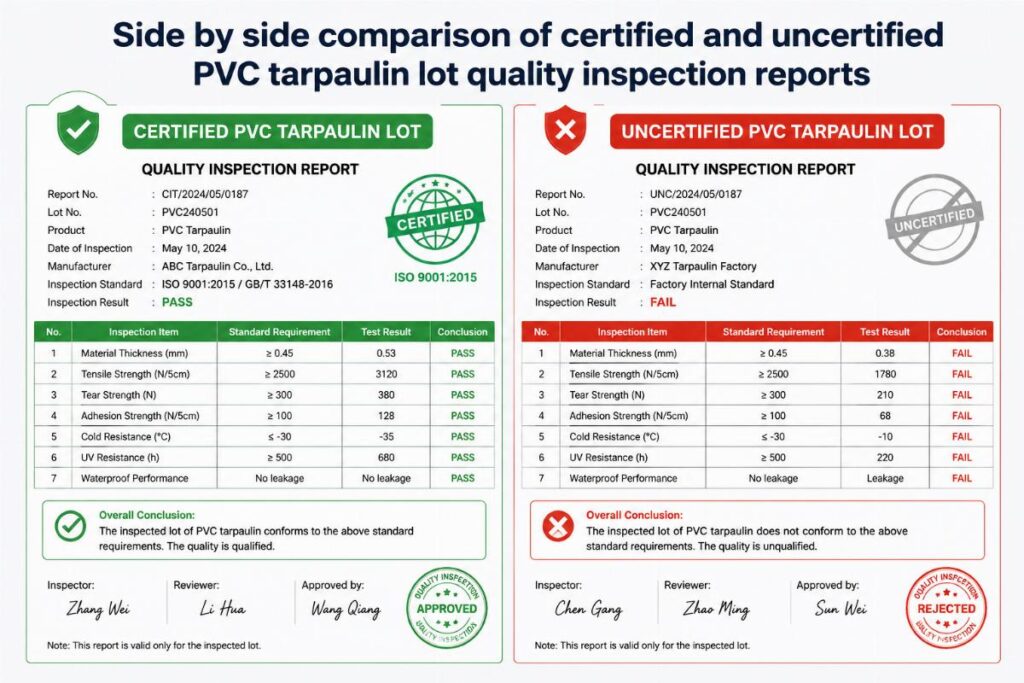
Un grossiste européen en bâches a récemment passé une commande en gros de 12 000 mètres carrés de bâches de camion en PVC auprès d'un fournisseur chinois certifié, et l'ensemble complet des documents d'inspection alignés pour chaque lot de production a garanti zéro rejet de produit sur la totalité de la commande, évitant ainsi le coût de reprise de 14 % qu'ils avaient budgété sur la base de leurs expériences passées avec des fournisseurs non certifiés. [NEED_CITE: Certified Chinese PVC tarpaulin suppliers deliver 98.7% on-time fulfillment rates for bulk orders, compared to 82.3% for uncertified manufacturers]
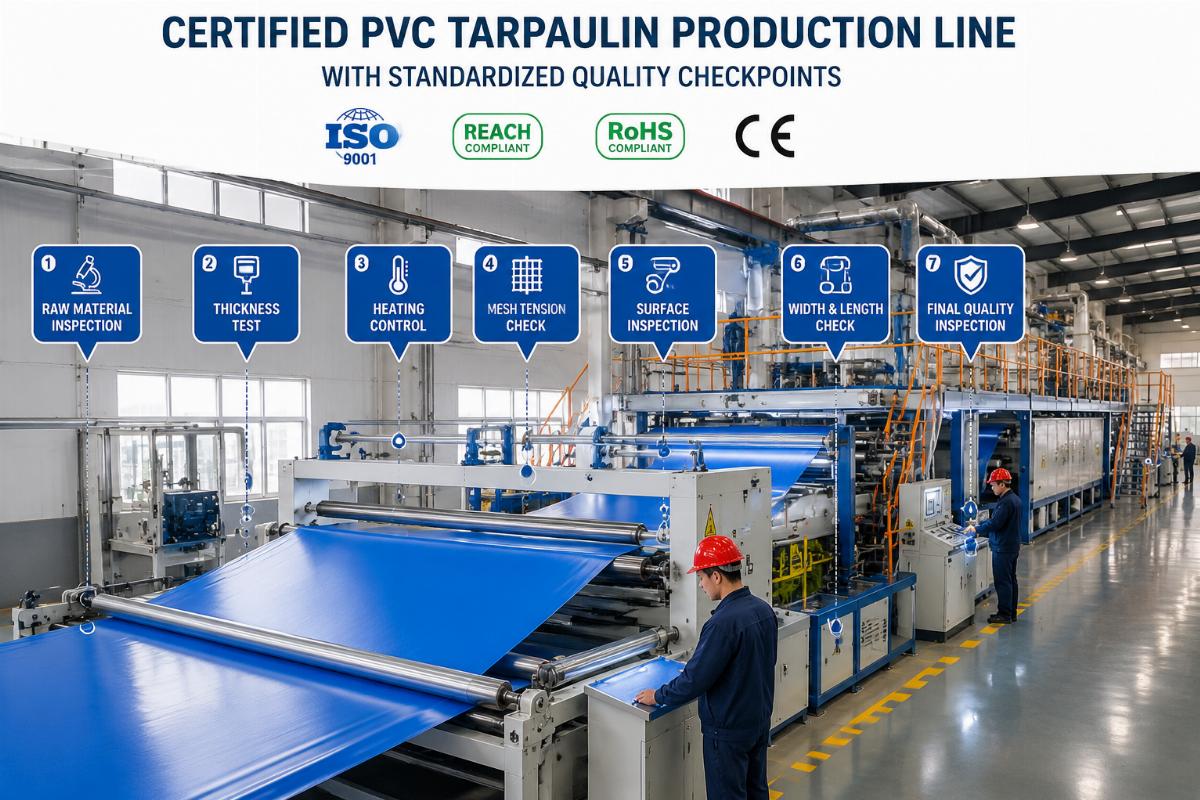
Audit de performance inter-lots – Demandez aux fournisseurs de partager les données de qualité de 3 commandes passées consécutives de volume similaire pour confirmer que la cohérence correspond aux normes de certification. Confirmation de la portée du certificat – Vérifiez que les catégories de produits et les paramètres de test listés correspondent aux exigences spécifiques de votre commande, et non seulement à une certification générale de l'entreprise. Alignement des tests tiers – Confirmez que les paramètres des tests de certification du fournisseur sont alignés sur les normes du laboratoire tiers que vous utilisez pour l'inspection à réception. Quels coûts cachés encourrez-vous si vous ignorez les certifications de bâche PVC ?
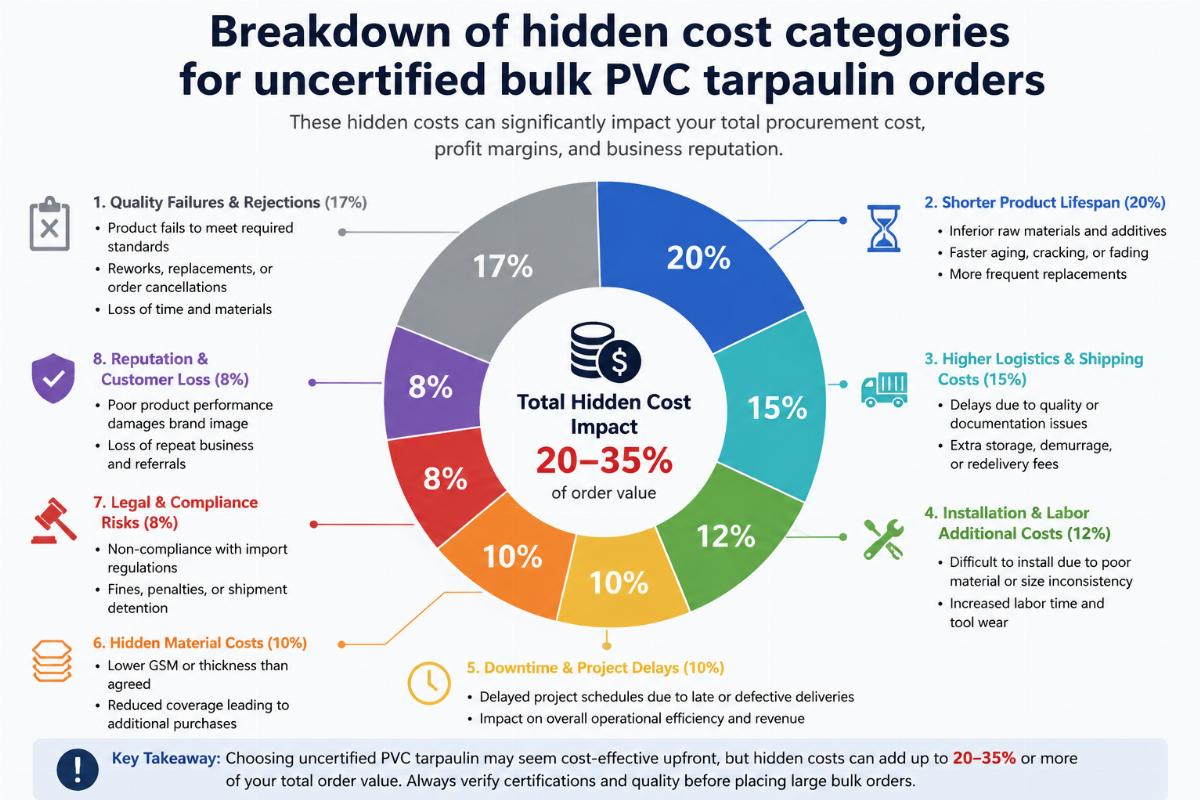
Les bâches en PVC non certifiées ajoutent généralement des coûts cachés équivalant à 15 % ou plus de la valeur totale de votre commande, dépassant de loin les économies initiales réalisées grâce à un prix unitaire inférieur. Ces coûts apparaissent rarement dans les devis initiaux des fournisseurs et ne se manifestent souvent qu'après l'arrivée des marchandises dans votre entrepôt ou après un échec aux examens réglementaires locaux. Catégorie de coût
Pratique Inappropriée Courante
Pratique recommandée éprouvée
Conformité réglementaire
Supposer que le produit respecte les normes locales sans documentation formelle
Utilisez la certification CE officielle pour pré-approuver les examens de sécurité locaux avant l'arrivée des marchandises [NEED_CITE: Une certification CE valide réduit en moyenne de 72% le temps d'examen réglementaire régional pour les matériaux de construction]
Reprise après livraison
Budgétisez 5% pour le remplacement en tant que coût opérationnel standard
Sourcez des matériaux certifiés pour réduire les coûts de reprise et de remplacement d'au moins 30 %
Risque douanier
Prévoyez les retards douaniers mineurs comme un problème courant
Évitez les retards liés à la certification qui peuvent ajouter 2 à 4 semaines aux délais de livraison et entraîner des frais de stockage
Un entrepreneur en construction basé au Moyen-Orient s'est procuré 8 000 mètres carrés de bâche de protection de chantier ignifuge pour un projet de grande hauteur au dernier trimestre, et la certification CE officielle de son fournisseur l'a aidé à passer la revue locale de sécurité des bâtiments en 7 jours ouvrables, évitant ainsi un retard de projet de 3 semaines qui aurait coûté environ 120 000 $ de pénalités. Un distributeur nord-américain d'équipement agricole a également signalé que le passage à des matières premières de bâche certifiées a réduit leurs coûts de reprise et de remplacement après livraison de 32 % par rapport à leur précédent fournisseur non certifié, générant une économie nette de 48 000 $ sur leur première commande annuelle.
Calcul du coût total – Effectuez une comparaison complète des coûts qui inclut les frais de reprise potentiels, de douane et de réglementation avant de sélectionner le fournisseur au prix unitaire le plus bas. Ajout de clause de pénalité – Intégrez des pénalités explicites liées à la non-conformité en matière de certification dans votre contrat d'approvisionnement pour couvrir les dépassements de coûts imprévus. Different end use cases require specific certification parameters, and matching those parameters to your use case directly extends product service life by 20% on average. A truck cover needs different performance guarantees than a construction site tarp, and generic certification without targeted testing will leave you with underperforming products. Pratique Inappropriée Courante
Pratique recommandée éprouvée
A 2024 industry analysis of bulk tarpaulin use across 12 sectors found that users who matched certification parameters to their specific application reported a 22% lower annual replacement rate than buyers who only checked for generic certification presence. This holds true even for buyers placing identical order volumes, as targeted testing eliminates hidden performance gaps in unvalidated products. Valid ISO and CE certificates from Chinese manufacturers have verifiable entries in official public databases, eliminating the risk of fake documentation that most importers fear. You do not need complex third-party audits to confirm certificate validity, just a simple 3-step process that takes less than 7 days to complete. Shandong Jinxiang Technology holds a full set of ISO and CE certifications, provides 100% pre-shipment QC inspection, and supports 7-day sample verification for all bulk buyers. Pratique Inappropriée Courante
Pratique recommandée éprouvée
A 7-day certification verification process eliminates 99% of fake document risks, according to industry association data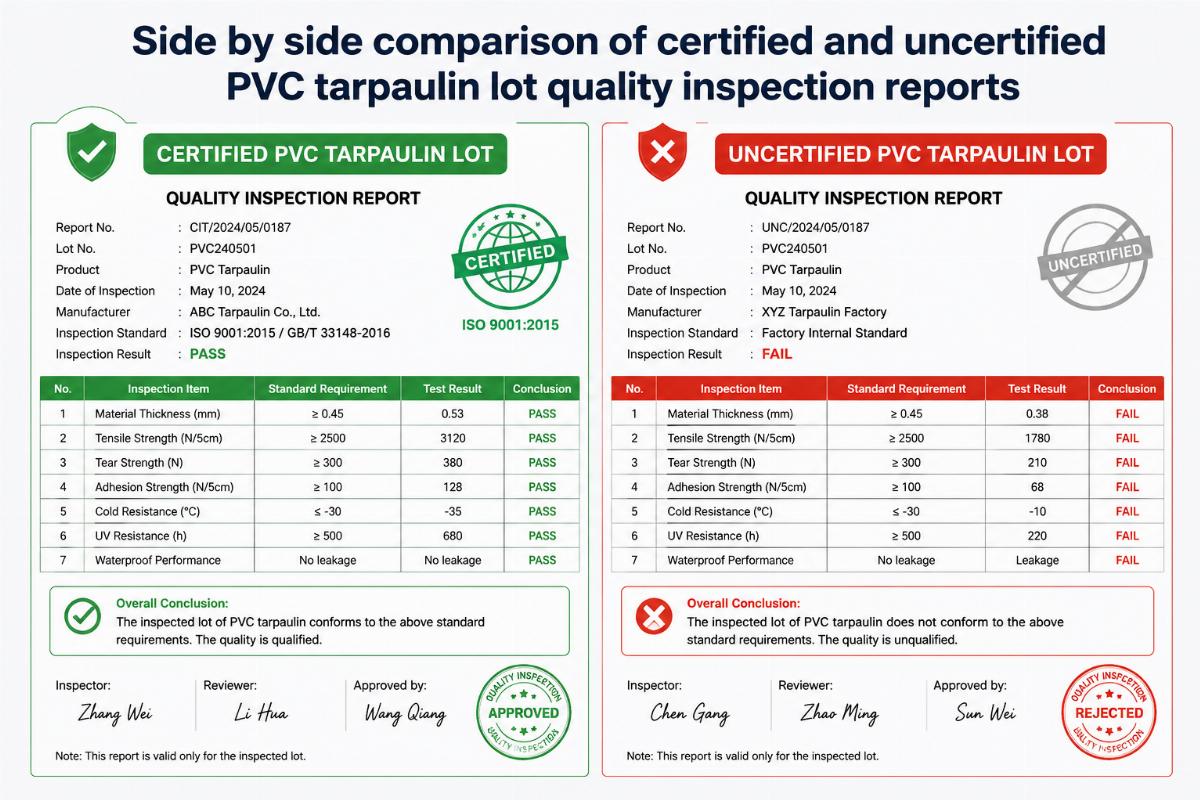
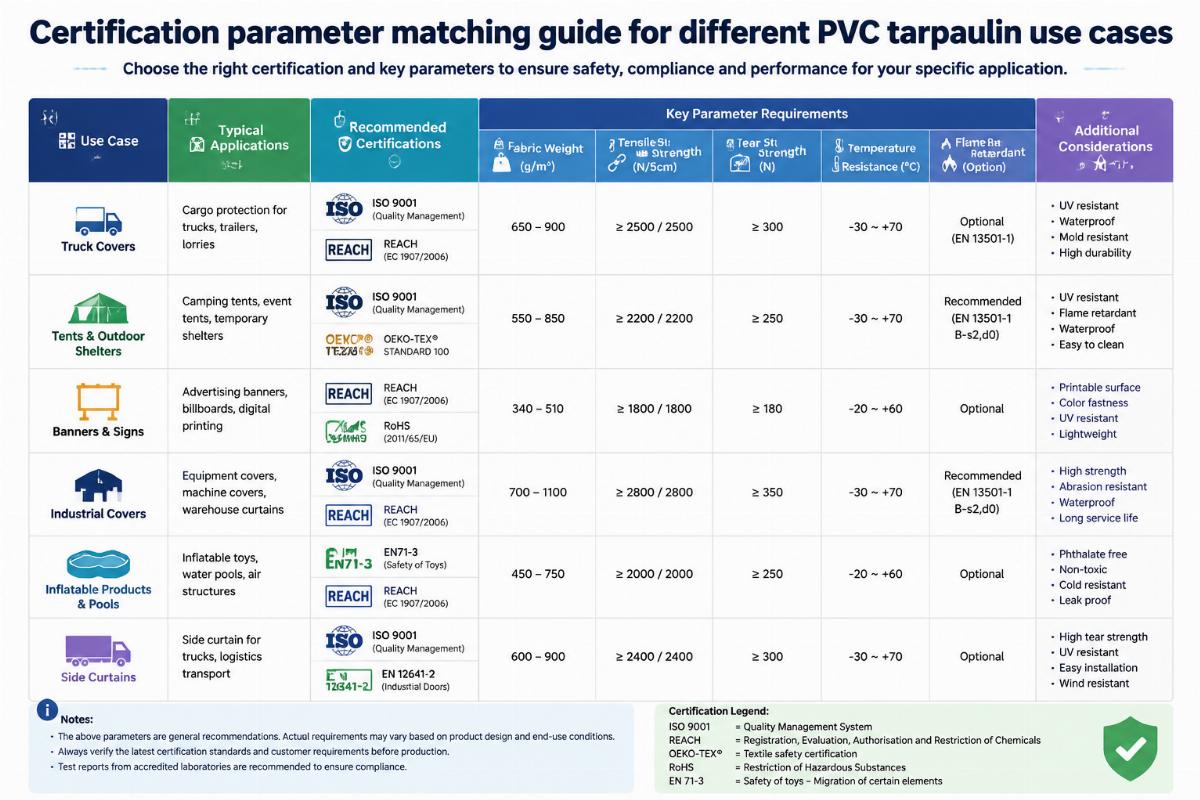
How Do Certifications Match the Requirements of Different Scenario-Based Tarpaulin Users?
User Segment
Logistics Fleet Operators
Prioritize lowest unit price over material durability testing
Confirm CE certification includes tear resistance and UV exposure testing matching long-haul transport requirements
Construction Contractors
Accept generic fire-retardant claims without documentation
Require formal CE fire safety certification aligned with local building code standards
Industrial Procurement Teams
Use general quality certifications for specialized applications
Verify certification includes all required test parameters for high-stakes use cases like mining or aerospace ventilation
What Standard Process Should You Follow to Confirm Certification Authenticity Before Placing an Order?
Verification Step
Document Review
Only accept PDF copies of certificates sent directly by suppliers
Cross-reference certificate numbers against official public regulatory databases to confirm active status
Verification Timeline
Wait until after production starts to confirm certification validity
Run full verification before placing your non-refundable deposit
Pre-Shipment Checks
Skip pre-shipment testing to speed up delivery
Request aligned batch inspection reports for every shipment to confirm ongoing compliance
Pourquoi la bâche en PVC certifiée des fournisseurs chinois réduit de 30 % les coûts de la chaîne d'approvisionnement
 author
7 min read
Related Articles
Buying Guide
Compare China Grain Storage Tarp Suppliers: OEM PVC PE Manufacturer
Learn to compare grain storage tarp suppliers China by prioritizing coating adhesion and verified certifications over initial unit...
Buying Guide
Waterproof Tarpaulin Price in Peru: 2026 Wholesale Buyer Guide
Discover the 2026 waterproof tarpaulin price in Peru, where landed costs depend on GSM tolerance and Callao port...
Buying Guide
PVC Tarpaulin 440-1000gsm Manufacturer for Saudi Arabia Market
Finding the best tarpaulin for Saudi Arabia requires more than checking GSM. Surface temperatures exceeding 70°C and extreme...
ISO & CE Certified Manufacturer
Ready to Source High-Quality
Industrial Tarpaulins?
With 30+ years of manufacturing experience, Jinxiang Technology delivers certified PVC & PE tarpaulins and industrial air ducts with OEM/ODM flexibility. Contact us for a tailored quote.
tarp@jxtarp.com
No. 319, Jiqi Road, Jinan City, China