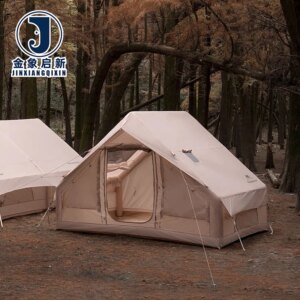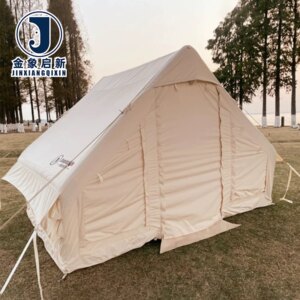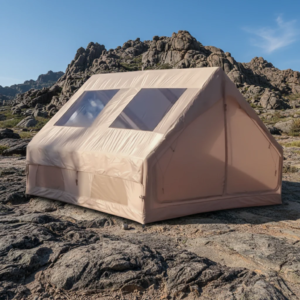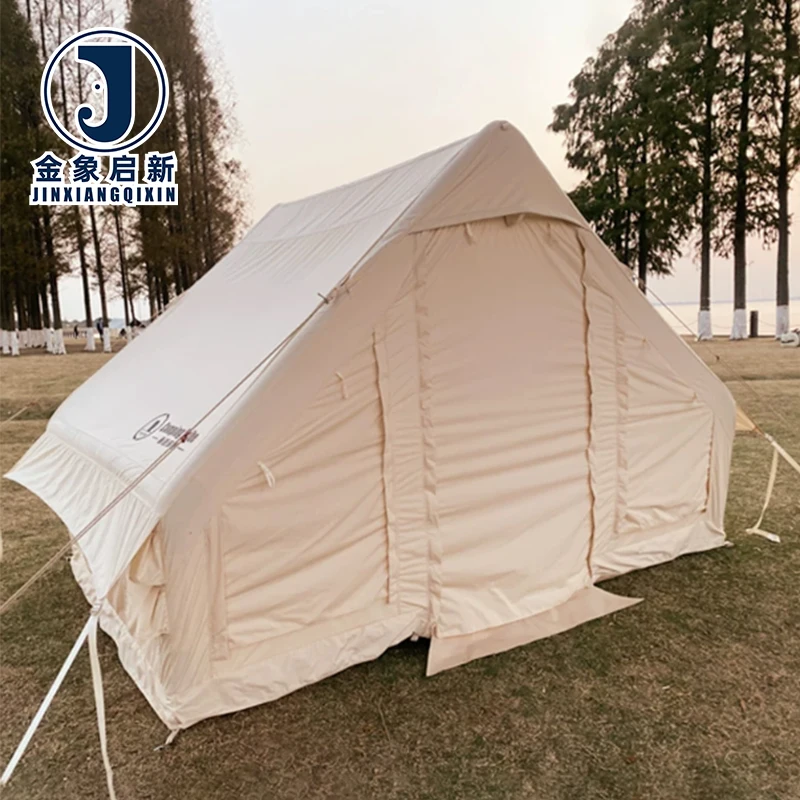
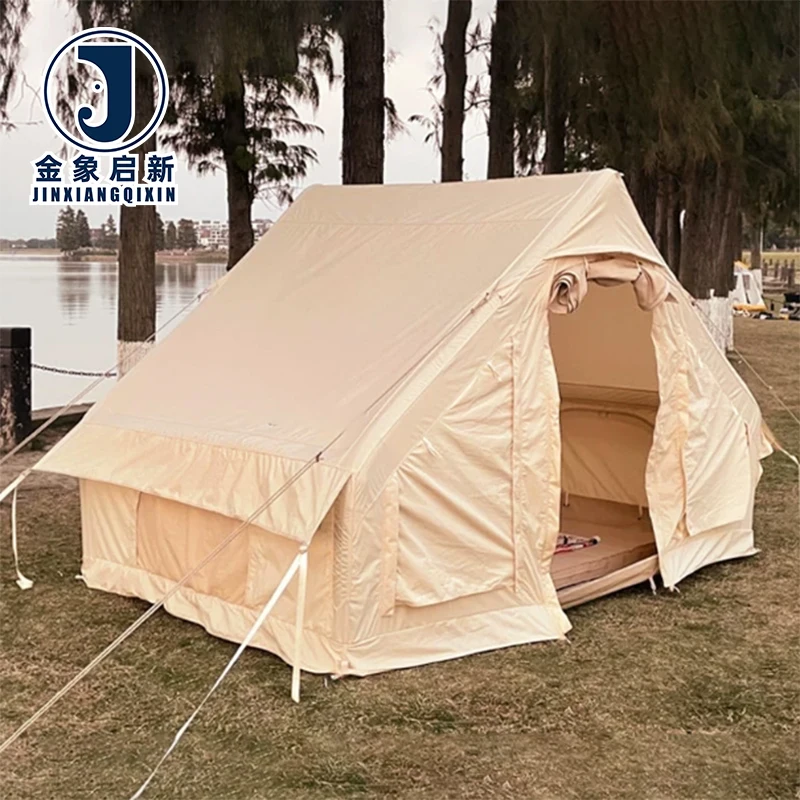
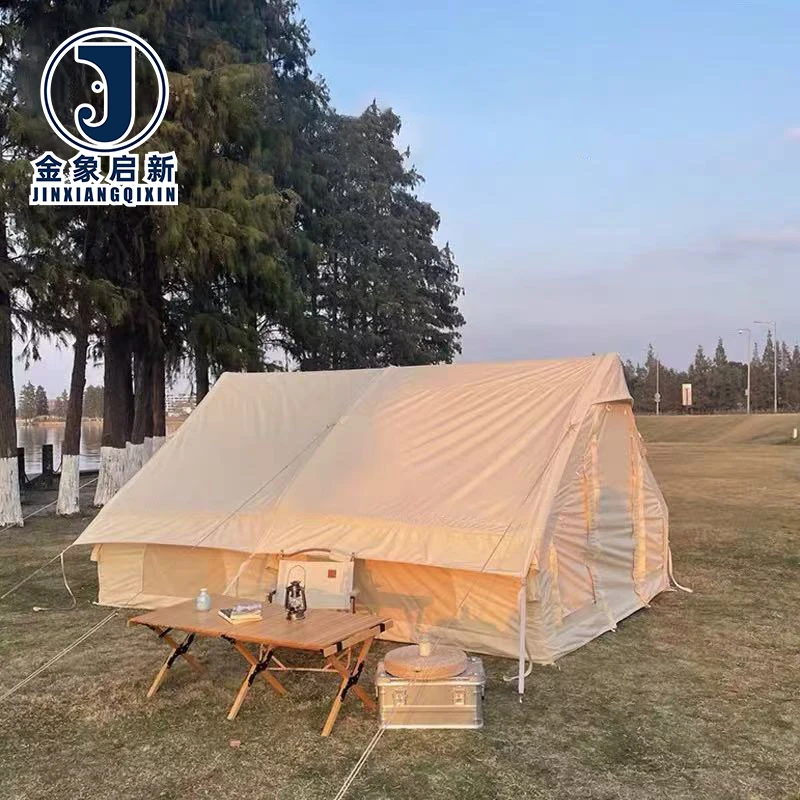
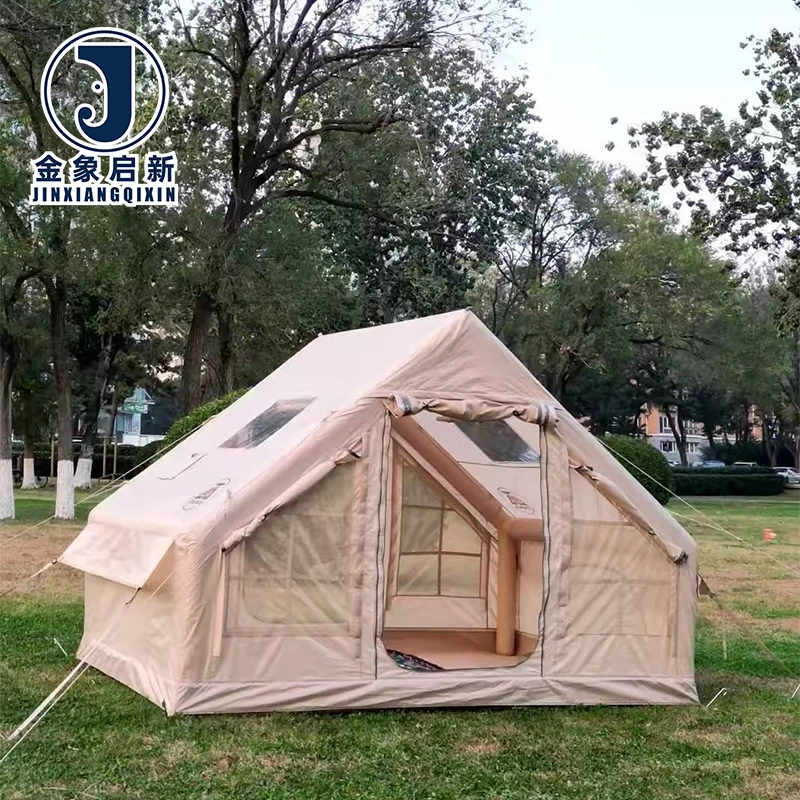
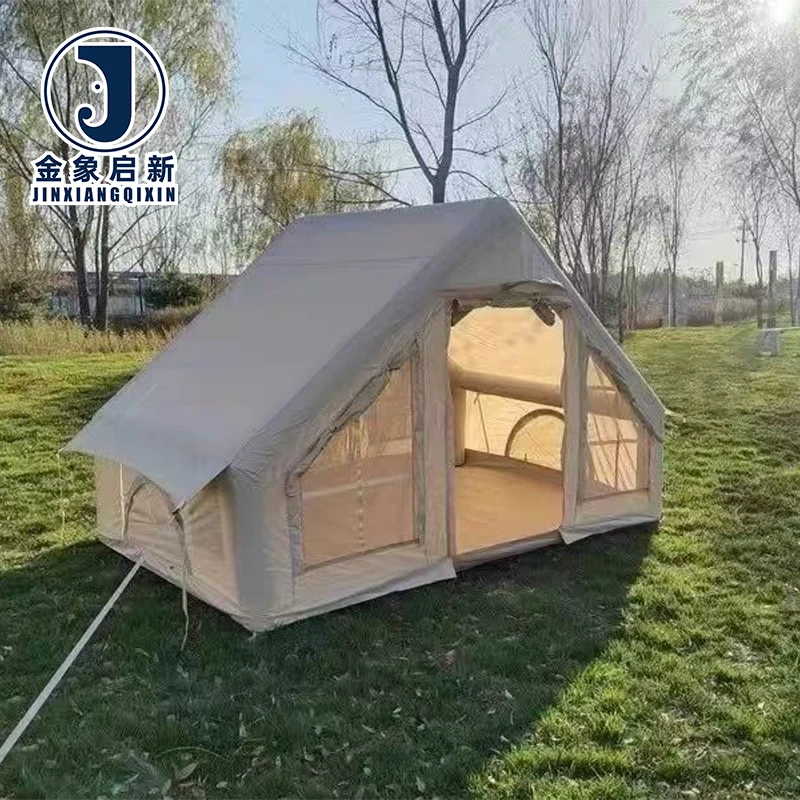
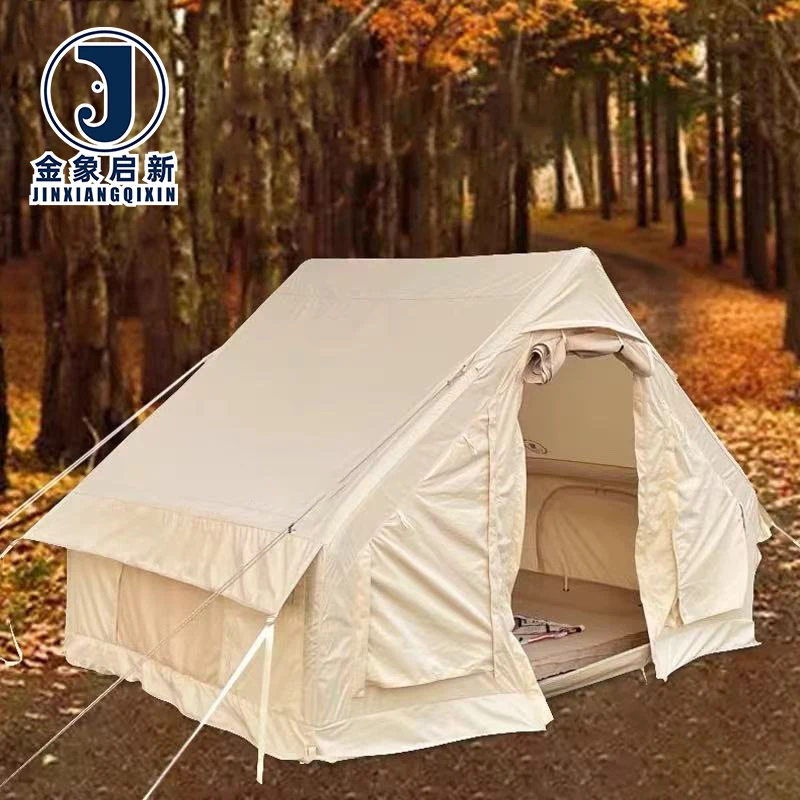
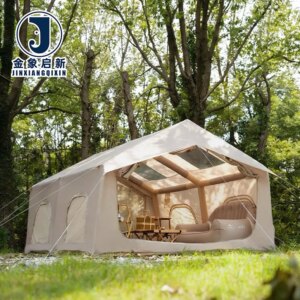
Inflatable Camping Tent UV Water-resistant PVC Fabric — 0.3mm to 0.8mm thickness range with 5000mm hydrostatic head and 300N/5cm tear strength for reliable four-season deployment.
- Extended layout with bedroom and living room configuration
- Anti-UV and water-resistant PVC coating formulation
- Customizable color matching, logo printing, and dimensional modifications
- Specialized valve systems available for OEM integration
Engineered for tent manufacturers and construction contractors sourcing fabric by the roll, with consistent coating weight control ensuring predictable heat welding performance at seam points where stress concentrates most.
Backed by 100% pre-shipment inspection with batch-specific quality documentation, dedicated R&D support for sample development within days, and complete export documentation including material specification sheets and test reports.
Description
Integrated Air-Beam Engineering — Every inflatable tent we produce undergoes single-layer air-beam pressure testing and 100% pre-shipment inspection, backed by three dedicated production lines and a 10-person R&D team that controls fabric coating weight and adhesion from the first dip to the final valve seal.
Technical Specifications
| Parameter | Value |
|---|---|
| Product Type | Inflatable Tent |
| Product Form | Extended type with 1 bedroom & 1 living room |
| Core Material | UV Water-resistant PVC Fabric |
| Material Thickness | 0.3 mm to 0.8 mm (custom range — confirm the grade for your order) |
| Waterproof Rating | Hydrostatic head exceeding 5000 mm (test basis not stated in source) |
| Tear Strength | 300 N/5 cm warp and weft (test standard not stated in source) |
| Wind Load Resistance | Up to Beaufort scale 6 (source value — verify for your deployment zone) |
| UV Aging Resistance | Minimum 5000 hours sunlight exposure (test basis not stated in source) |
| Inflation System | Integrated air pump, single layer design |
| Customization | Color matching, logo printing, material thickness adjustments, dimensional modifications, specialized valve systems, reinforced stress points |
| Certifications | ISO 9001, ISO 14001, ISO 45001, CE |
Application Suitability
| Application | Exposure & Requirement |
|---|---|
| Construction site crew accommodation | Continuous UV exposure, dust abrasion, repeated inflation/deflation cycles across project phases |
| Outdoor equipment storage shelter | Prolonged rainfall, ground moisture wicking, wind-driven debris impact on membrane surfaces |
| Mobile field research station | Multi-season deployment, temperature cycling, requirement for stable internal climate envelope |
| Emergency response temporary facility | Rapid deployment under adverse weather, high-visibility color requirements, compliance with relief procurement standards |
| Four-season camping deployment | Sustained wind loads, freeze-thaw cycling on PVC membrane, seam integrity under internal air pressure |
Why Test Reports Matter More Than Promised UV Hours
Every batch of our inflatable tent fabric ships with documented UV aging data tied to that specific production run, not a generic catalog claim.
Sourcing inflatable tents from suppliers who state "excellent UV resistance" on the quotation but cannot produce a batch-specific test report is a pattern we encounter regularly when buyers come to us for replacements. Fabric that degrades prematurely under sunlight does not fail uniformly — the roof panel facing the equator weakens first, and by the time you notice the chalking, the membrane has already lost a significant portion of its tear strength. An Inflatable Tent manufacturer that controls its own coating formulation can reference the exact accelerated aging protocol used and tie it to the roll number on your shipment. [NEED_CITE: ISO 4892-3 methods for accelerated UV exposure testing of plastics and coated fabrics]
How We Verify UV and Waterproof Claims Before Your Tent Leaves the Line
When you order a custom inflatable tent from us, the waterproof rating and UV resistance are not assumed from the material family — they are measured on the actual coated batch allocated to your order. Our QA team runs hydrostatic head tests and records the pass-or-fail result against the specification you approved at the sample stage. This matters because two rolls from the same PVC formulation can perform differently if the coating weight drifts outside the tolerance window during production.
The Role of Material Thickness in Air-Beam Structural Integrity
The air-beam walls of an inflatable tent carry the entire structural load once inflated, which means material thickness directly governs how the beam resists buckling under wind pressure and occupant movement. We offer a custom thickness range from 0.3 mm to 0.8 mm, and our R&D team selects the grade based on the tent’s footprint, expected wind zone, and inflation pressure. Thicker is not automatically better — an oversized beam wall adds weight and pack volume without proportional strength gain if the base fabric denier and weave are already matched to the load. [NEED_CITE: relationship between coated fabric thickness and inflation pressure tolerance in pneumatic structures]
Reading Beyond the Hydrostatic Head Number
A hydrostatic head figure tells you the water pressure the fabric can resist in a static column test, but real-world rain exposure involves dynamic loading — wind-driven sheets of water, pooling at low-slope roof sections, and capillary draw at stitched seams. The 300 N/5 cm tear strength in both warp and weft directions matters here because a small puncture from a falling branch or a sharp tie-down buckle will propagate differently depending on the base fabric weave density. Our coating process locks the yarn intersections, which limits tear propagation and gives field repair teams a manageable damage zone rather than a full panel split.
What Happens When Coating Adhesion Fails at the Weld Line
The most common failure point on an inflatable tent is not the fabric face — it is the heat-welded seam where air-beam sections join and where the beam connects to the ground sheet. If coating adhesion is weak, the weld peels apart under cyclic inflation pressure long before the fabric itself reaches its tensile limit. We have seen imported inflatable structures fail at the weld within a single season because the supplier used a lower-adhesion coating grade to cut cost, and the buyer never requested a peel strength test. Our 16-point production inspection includes seam peel checks at every welded junction, recorded digitally for audit. [NEED_CITE: heat-weld seam peel strength testing for PVC coated fabrics per ISO 2411]
Why Procure Your Inflatable Tent Fabric and Finished Units Here
Our 10-person R&D team handles material selection, dimensional engineering, and sample development for custom inflatable tent projects, developing pre-production samples within days so you can validate air-beam geometry and valve placement before committing to a bulk run. Three full production lines and 36 sets of professional equipment give us the capacity to fulfill volume orders without shifting your production to an overflow facility with different process controls. Dedicated QA/QC runs at every stage — incoming base fabric inspection, in-line coating weight checks, and 100% pre-shipment inspection — so the documentation you receive reflects the actual units in your container, not a generic spec sheet.
Documentation & Verification
- Material specification sheet stating PVC coating weight, base fabric denier, and color reference matched to your order
- Batch-specific UV aging and hydrostatic head test records tied to roll or unit production date
- Pre-shipment inspection report covering all 16 checkpoints with digital photographic evidence
- Certificate of origin and customs documentation prepared for your destination market
- Sample approval record linking your signed-off prototype to the bulk production specification
Fabrication, Handling & Storage
- Heat-weld air-beam seams using temperature and dwell time settings matched to the 0.3 mm–0.8 mm PVC coating thickness specified for your order
- Reinforce valve anchor points with additional PVC patches bonded to the base fabric weave to distribute inflation load
- Store rolled tent units horizontally on padded racks to prevent permanent creasing of the UV-resistant PVC membrane
- Avoid folding packed tents at the same air-beam junction repeatedly to prevent coating micro-crack propagation
- Clean membrane surfaces with neutral pH detergent only — solvent-based cleaners attack the plasticizer in the PVC coating
- Field-repair minor punctures with compatible PVC adhesive patches applied to dry, clean surfaces before re-inflation
Starting Your Inflatable Tent Specification
Tell us the intended deployment environment, expected wind and rainfall exposure, and the number of units required per shipment so we can recommend the correct material thickness and coating grade. If your market requires specific fire-safety or compliance documentation, share the target standard early so we can confirm availability during sampling. Confirm whether you need finished inflatable tents with integrated pump systems or fabric-only supply for your own assembly line.
Frequently Asked Questions
Q: What customization options are available for color, print, thickness, and dimension modifications?
A: We offer custom color matching to your Pantone or RAL reference, logo and pattern printing on the PVC membrane, material thickness selection from 0.3 mm to 0.8 mm, and dimensional adjustments to bedroom and living room layouts. Valve systems and reinforced stress points can also be engineered to your specification during the sample development phase.
Q: How are UV resistance and waterproofness verified and documented before shipment?
A: Each production batch undergoes hydrostatic head testing and UV aging assessment against the values stated in your approved specification. The test results are recorded in the batch-specific quality inspection report that ships with your order, so you receive documented evidence tied to the exact units delivered, not a generic catalog claim.
Q: What is the sample development timeline and bulk order lead time for custom inflatable tents?
A: Pre-production samples for custom specifications are typically developed within days once the design and material grade are confirmed. Bulk order lead times depend on order volume, customization complexity, and current production line scheduling — confirm timing at the quotation stage for your specific configuration.
Q: How is batch-to-batch color consistency controlled across multiple rolls or units?
A: We control color consistency through standardized pigment formulation records and in-line visual inspection against the approved color reference for every production run. Roll-to-roll and unit-to-unit comparisons are conducted under controlled lighting during the pre-shipment inspection, and any deviation outside the agreed tolerance triggers a hold and review before dispatch.
Q: What certifications and compliance documentation are provided for international market access?
A: We supply ISO 9001, ISO 14001, ISO 45001, and CE certificates as standard documentation. Additional compliance paperwork, including certificate of origin, material safety declarations, and test reports aligned to ISO 5912, ISO 4892-3, and EN 13725 where applicable, is prepared according to the import requirements of your destination market.
Related products
-
Premium Four-season PVC Inflatable Tents for Camping Easy-to-Use Spacious Portable Waterproof Outdoor Tent with Pump
Read more -
Inflatable PVC Camping Tent Four-Season Waterproof CE Certified Quick Automatic Opening 3000mm+ Factory Direct Sale
Read more -
Outdoor Portable Camping Inflatable Tent Luxury All-Season Use Overnight Large Space Rainproof Insulated Quick Automatic Opening
Read more -
High Quality Four-Season Inflatable Tent for Camping Durable PVC Waterproof All-Weather Resistance Quick Automatic Opening
Read more