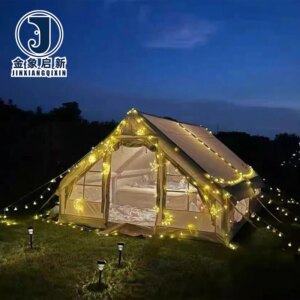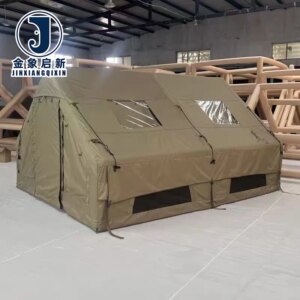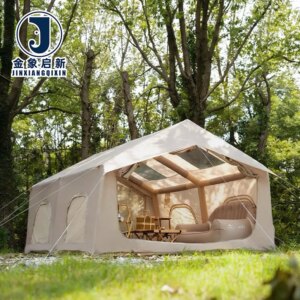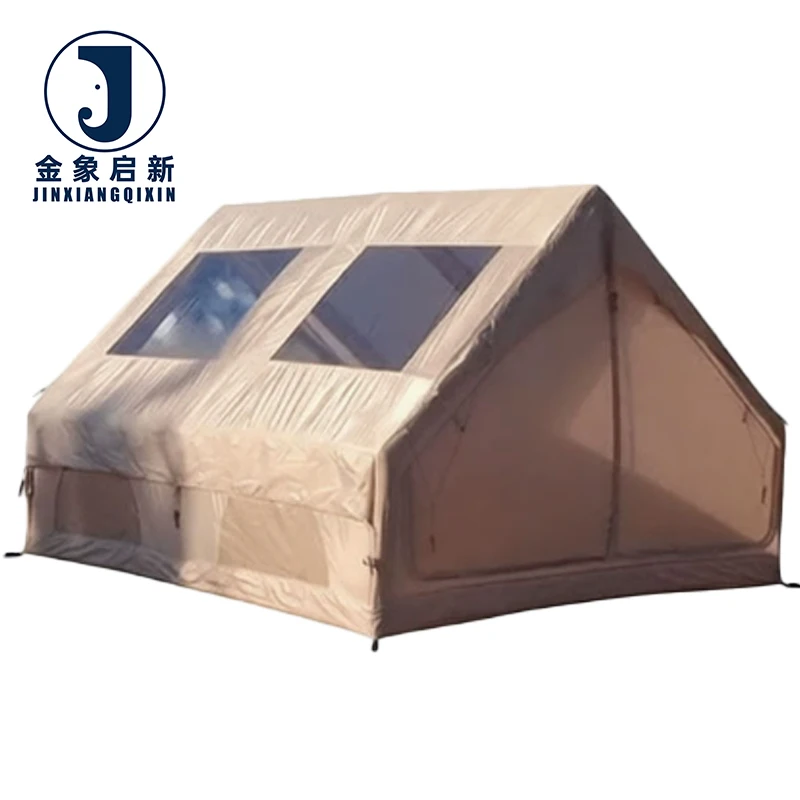
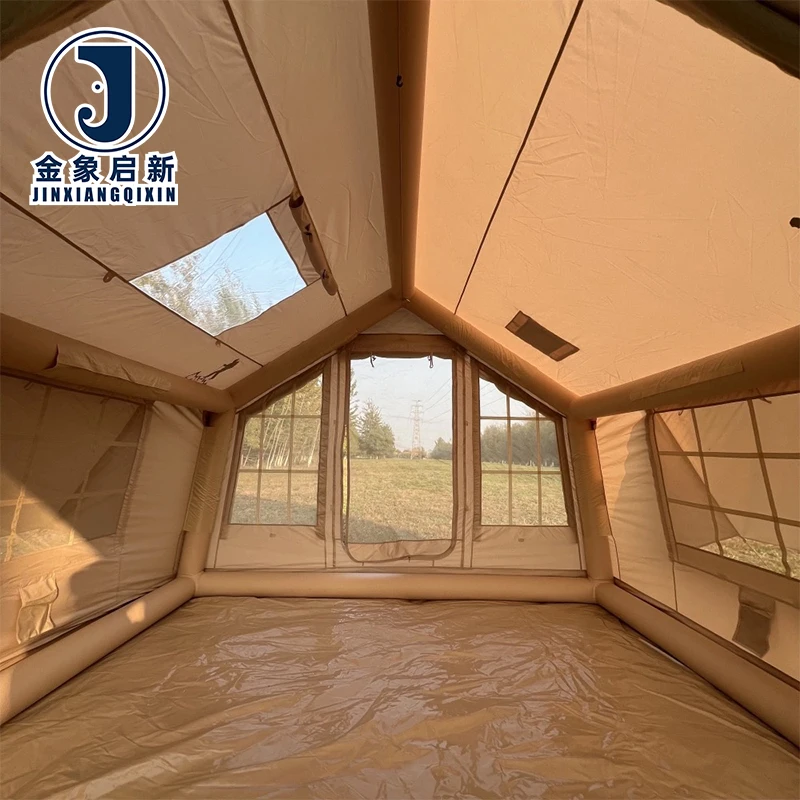
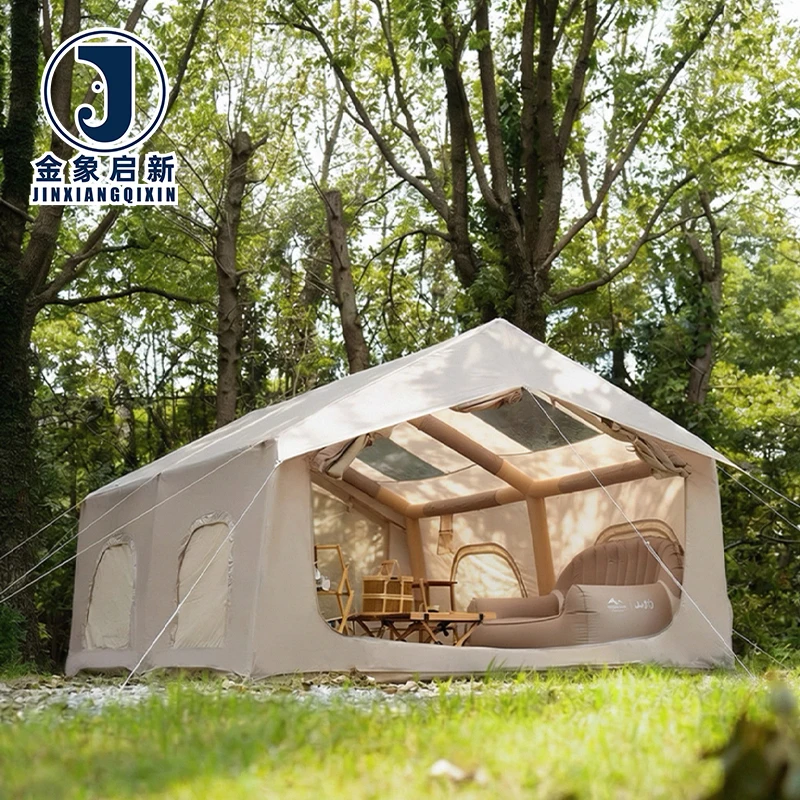
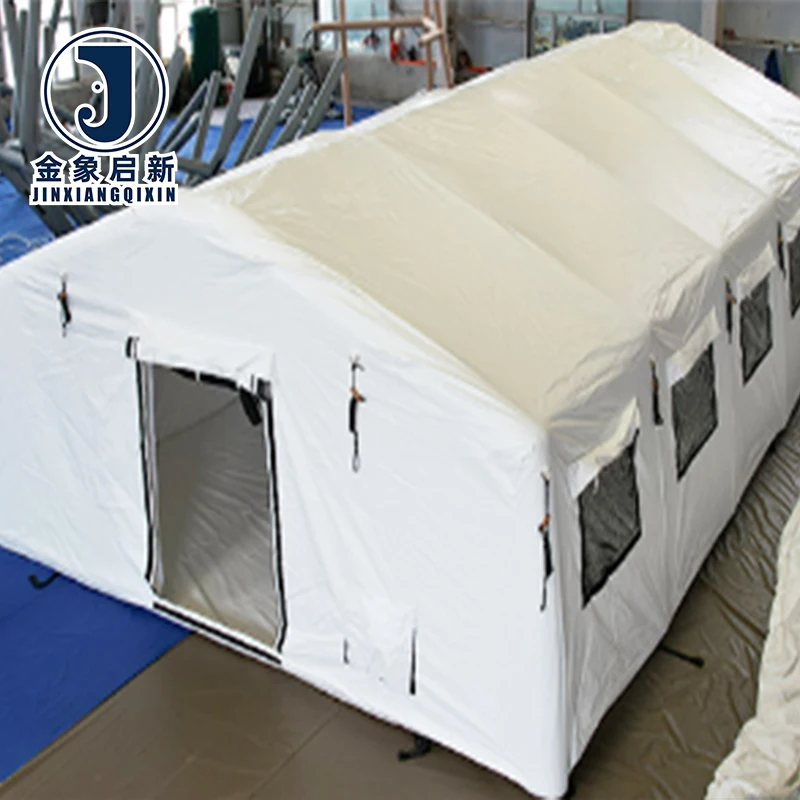
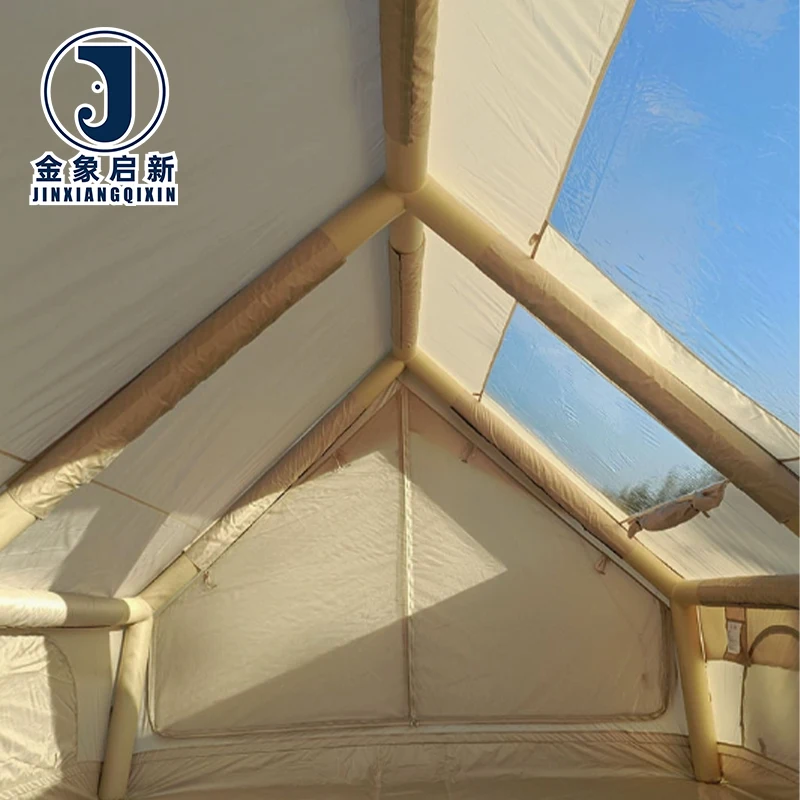
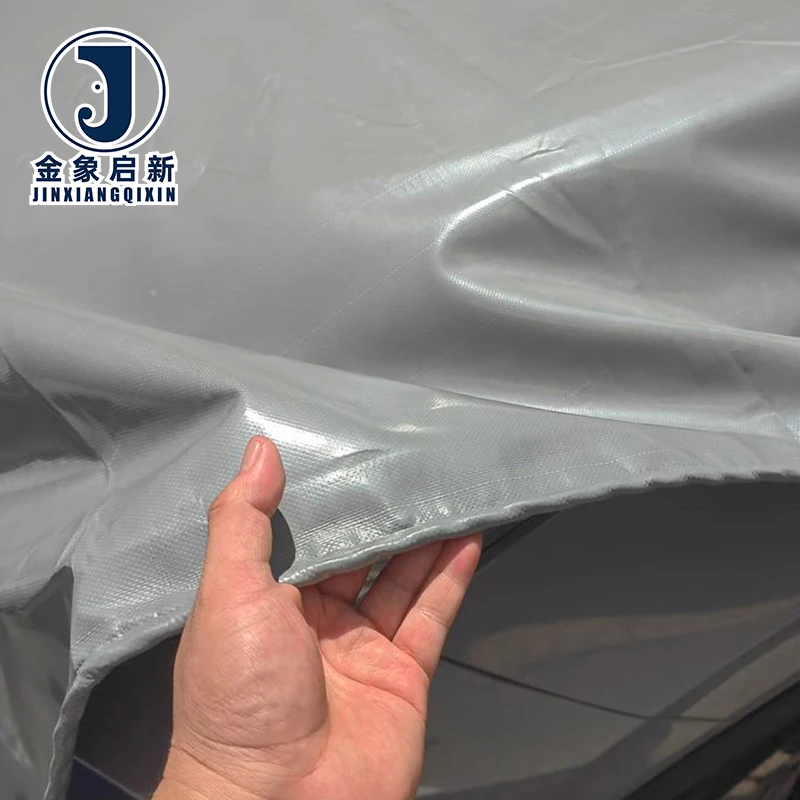
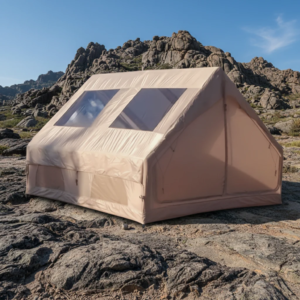
Luxury Inflatable Camping Tent With Skylight for 6-8 Person — waterproof PVC tarpaulin with fire-retardant and anti-static treatment, portable air beam structure.
- Engineered for commercial glamping resorts and outdoor event deployments
- Knife-coated PVC fabric ensures uniform thickness and tear resistance under high wind loads
- Welded seam technology eliminates leakage points found in stitched alternatives
- Full OEM & ODM customization: size, color, logo, skylight configuration
Supported by 3 full production lines, 10-person R&D team, and 12-point quality inspection before every shipment.
Description
Deep process control over coating weight — every roll of PVC tarpaulin used in our inflatable tents is weighed and verified against the stated specification before leaving the facility, eliminating the gsm discrepancies that cause rejections on site.
Technical Specifications
| Parameter | Value |
|---|---|
| Product Type | Inflatable Tent |
| Core Material | PVC tarpaulin |
| Capacity | 6-8 Person |
| Key Features | Waterproof, UV-resistant, tear-resistant, fire-retardant, anti-static |
| Structural Feature | Skylight, portable air beam structure |
| Customization | OEM & ODM — sample customization, pattern printing, size adjustments, color matching, logo printing, structural modifications |
| Production Facility | 9,180 m² with 3 full production lines |
| Processing Equipment | 36 sets |
| R&D Team | 10 technicians |
| Quality Control | 12-point quality inspection, full-process QA/QC |
| Certifications | ISO9001, ISO14001, ISO45001, CE |
Application Suitability
| Application | Exposure & Requirement |
|---|---|
| Commercial glamping resorts | Repeated seasonal deployment, sustained UV exposure, guest-facing aesthetics, waterproof integrity across varying weather |
| Festival and outdoor event management | Rapid setup and teardown cycles, high foot traffic, crowd safety compliance, wind load resistance |
| Corporate retreats and hospitality operations | Four-season usability, fire-retardant requirements for occupied structures, consistent branding across multiple units |
| Tourism and eco-lodge operators | Remote site logistics, minimal foundation requirements, durability under direct sun and rain exposure |
Why Fabric Specs Decide Whether an Inflatable Tent Survives Its First Season
The difference between a tent that holds pressure through a storm and one that sags by mid-season comes down to verified material data, not catalog photos.
Sourcing an inflatable tent aftermarket supplier means navigating claims that sound identical across quotations but perform very differently once the structure is inflated on site. A tent fabric that lacks consistent coating weight will develop soft spots along the air beams, and those soft spots become failure points under wind load. Buyers who focus solely on price per unit often discover that the PVC tarpaulin used in the inflatable structure does not match the weight stated on the original spec sheet [NEED_CITE: tensile and tear test methods for coated fabrics per ISO 1421].
Coated Fabric Construction for Structural Inflation
The PVC tarpaulin used in this inflatable tent is produced through a coating process that bonds the polymer layer to the base fabric under controlled tension. This bond determines how well the material holds air pressure across the beam structure without delaminating at stress concentrations. As an inflatable tent aftermarket supplier, we control the coating parameters to maintain consistent adhesion throughout each production run, which directly affects how the tent behaves when inflated repeatedly over multiple seasons.
The air beam design relies entirely on fabric integrity because the structural rigidity comes from internal pressure rather than rigid poles. Any inconsistency in coating thickness or base fabric density creates uneven load distribution. This is why our 12-point quality inspection examines the material before fabrication begins, catching deviations that would otherwise only become visible after the tent is deployed in the field.
Fire Safety and Surface Treatment for Occupied Structures
Inflatable tents used for commercial glamping and event hosting must address fire safety requirements that vary by jurisdiction. The fire-retardant and anti-static additives incorporated into the PVC tarpaulin are selected based on the destination market’s regulatory framework. We recommend that buyers confirm the specific fire classification required — whether NFPA 701, DIN 4102, or a local equivalent — before production begins [NEED_CITE: DIN 4102 fire classification for building materials].
The UV-resistant formulation addresses a failure mode common in temporary structures left exposed for extended periods. Direct sunlight degrades untreated PVC, causing surface chalking and loss of tensile strength at the coating layer. The skylight panel, which admits additional solar exposure into the tent interior, is fabricated from the same treated material to ensure uniform aging across all surfaces. Color consistency across multiple units deployed side by side at a festival or resort site is controlled through batch-matched pigment dispersion.
Understanding What the Specification Sheet Actually Tells You
Coating weight and base fabric denier work together to determine how the inflatable tent handles mechanical stress. A heavier coating provides abrasion resistance and waterproofing, but the base fabric’s weave density is what resists tear propagation when the material is punctured or overstressed at a seam. Evaluating gsm in isolation can mislead buyers into selecting a material that is heavy but structurally weak. The knife-coating process used on this PVC tarpaulin ensures uniform layer thickness, which supports reliable heat welding — critical for the airtight seams in air beam construction.
Surface finish affects both maintenance and visual performance. A glossy surface sheds dirt and water more readily, while a matte finish reduces glare for guest-facing applications. The choice depends on the deployment environment and how frequently the tents will be cleaned between uses. Available in fire-retardant grades — confirm the grade required for your market before specifying.
The Hidden Cost of Incorrect Material Specification
When the PVC tarpaulin used in an inflatable tent does not match the quoted specification, the consequences compound. A batch delivered below the agreed coating weight may pass visual inspection but fail under the cyclic pressure loading of daily inflation and deflation. Welded seams on underspecified material tend to fail at the junction where the air beam flexes most, which is exactly where structural integrity matters most [NEED_CITE: seam strength testing standards for coated technical textiles].
Color variation between production batches becomes a visible problem when multiple inflatable tents are deployed together at a glamping resort or event venue. Guests and attendees notice when adjacent units do not match, and the operator faces the cost of selective replacement or full redeployment. This is why sample approval must include color verification against a physical reference, not just a digital proof.
Why Source This Inflatable Tent Here
Nearly 30 years of focused coated fabric production means our process control is built on direct experience with PVC tarpaulin behavior across diverse applications. The 10-person R&D team handles material selection and structural modifications specific to inflatable tent geometry, including skylight integration and custom ventilation port placement. Three full production lines and 36 sets of processing equipment give us the capacity to deliver consistent quality across bulk orders without outsourcing fabrication steps.
Every roll is inspected against the stated specification before fabrication, and the 12-point quality inspection covers seam strength, coating adhesion, and dimensional accuracy of the finished inflatable tent. Sample development within days allows buyers to verify material weight, color, and weld behavior before committing to full production. Documentation accompanies every shipment, providing traceability from raw material through to the finished unit.
Documentation & Verification
- Material specification sheet stating gsm, base fabric denier, and coating type for the inflatable tent fabric
- Fire-retardant and UV test reports matched to the specific batch used in production
- Pre-shipment inspection record covering seam integrity and air beam pressure testing
- Weight verification per roll against the stated gsm before dispatch
- Certificate of origin and customs documentation for international shipments
- Roll packing list with batch codes for material traceability
Fabrication, Handling & Storage
- Heat-weld all air beam seams using temperature and dwell settings matched to the PVC tarpaulin coating weight
- Reinforce skylight perimeter with additional weld passes to distribute stress at the panel junction
- Store rolled inflatable tent fabric upright in climate-controlled conditions to prevent coating transfer and permanent creasing
- Allow cold-stored material to reach ambient temperature before unfolding to avoid coating cracking at fold lines
- Use mild detergent and soft cloth for cleaning; avoid solvent-based products that attack the PVC coating surface
- Repair minor punctures with compatible PVC patch material heat-welded at manufacturer-recommended temperature settings
What to Include in Your Inquiry
To provide an accurate specification and lead time, we need the intended deployment environment, including typical wind exposure and seasonal temperature range. Specify the fire classification or safety standard required by your local jurisdiction for occupied temporary structures. Confirm whether you need finished inflatable tents with skylights and air beams, or fabric rolls for your own fabrication line. Indicate color references, pattern or logo printing requirements, and annual volume expectations.
Frequently Asked Questions
Q: What customization options are available for size, color, logo, and structural features like additional skylights or ventilation ports?
A: We support full OEM and ODM customization including dimensional adjustments, color matching to physical references, logo printing, and structural modifications such as additional skylights, ventilation ports, or partition layouts. The R&D team develops a sample for your approval before production, ensuring all custom features meet performance requirements.
Q: How is batch-to-batch color and material consistency controlled across large orders?
A: Each production batch uses pigment-matched formulations verified against a physical color reference under controlled lighting. The 12-point quality inspection includes visual comparison of adjacent panels from different rolls. Material weight and coating thickness are measured per roll to ensure uniformity across the entire inflatable tent order.
Q: What fire-retardant and UV test documentation accompanies each shipment?
A: We supply test reports specific to the batch used in your order, covering fire-retardant classification and UV resistance data. Buyers should specify the target market standard — such as DIN 4102 or NFPA 701 — during the inquiry stage so that testing aligns with local compliance requirements.
Q: How are welded seams tested to ensure they match or exceed fabric strength?
A: Welded seams on the inflatable tent air beams undergo peel and tensile testing during the 12-point inspection process. Weld parameters are calibrated to the specific PVC tarpaulin coating weight, and seam samples from each production run are destructively tested to verify bond integrity before the batch is cleared for dispatch.
Q: What is the sample development and approval process before full production?
A: Once we receive your specification requirements, the R&D team produces a sample within days for your review. The sample covers material weight, color, surface finish, and any custom structural features. Production begins only after written sample approval, ensuring the finished inflatable tents match your confirmed expectations.
Related products
-
Luxury PVC Inflatable Tent for Glamping Outdoor Waterproof with Quick Automatic Opening Four-Season Foldable Design and Pump
Read more -
Premium Four-season PVC Inflatable Tents for Camping Easy-to-Use Spacious Portable Waterproof Outdoor Tent with Pump
Read more -
Inflatable Camping Tent PVC Four-Season Waterproof Outdoor Air Tent with Quick Automatic Opening for 2-3 Person
Read more -
High Quality Four-Season Inflatable Tent for Camping Durable PVC Material All-Weather Resistance Quick Automatic Opening
Read more