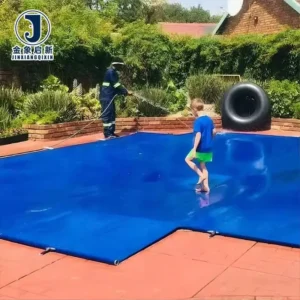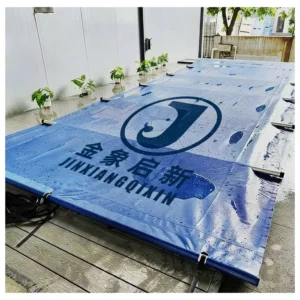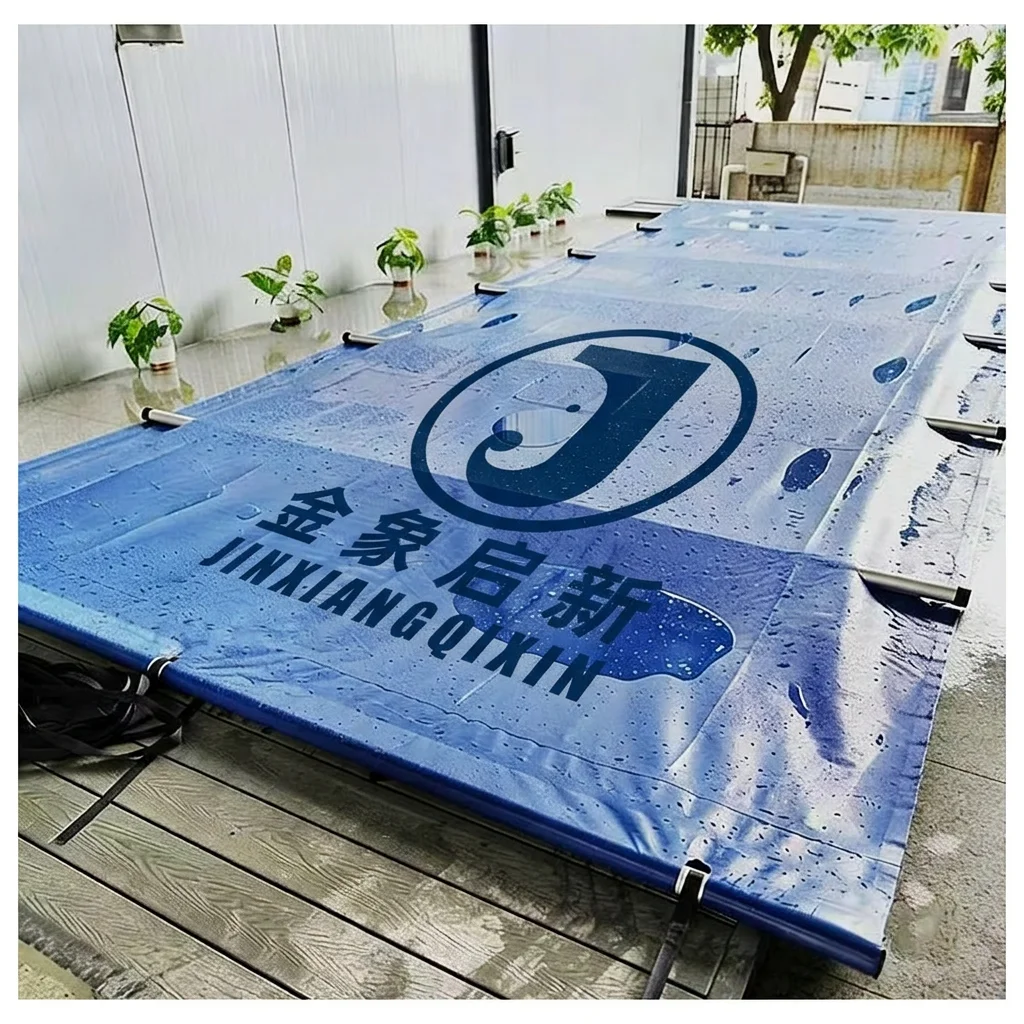
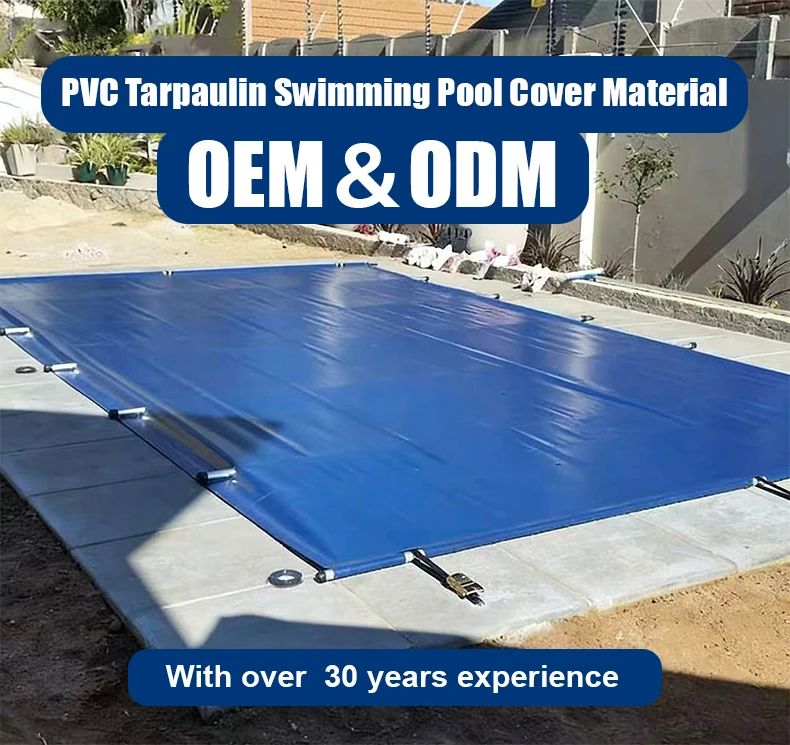
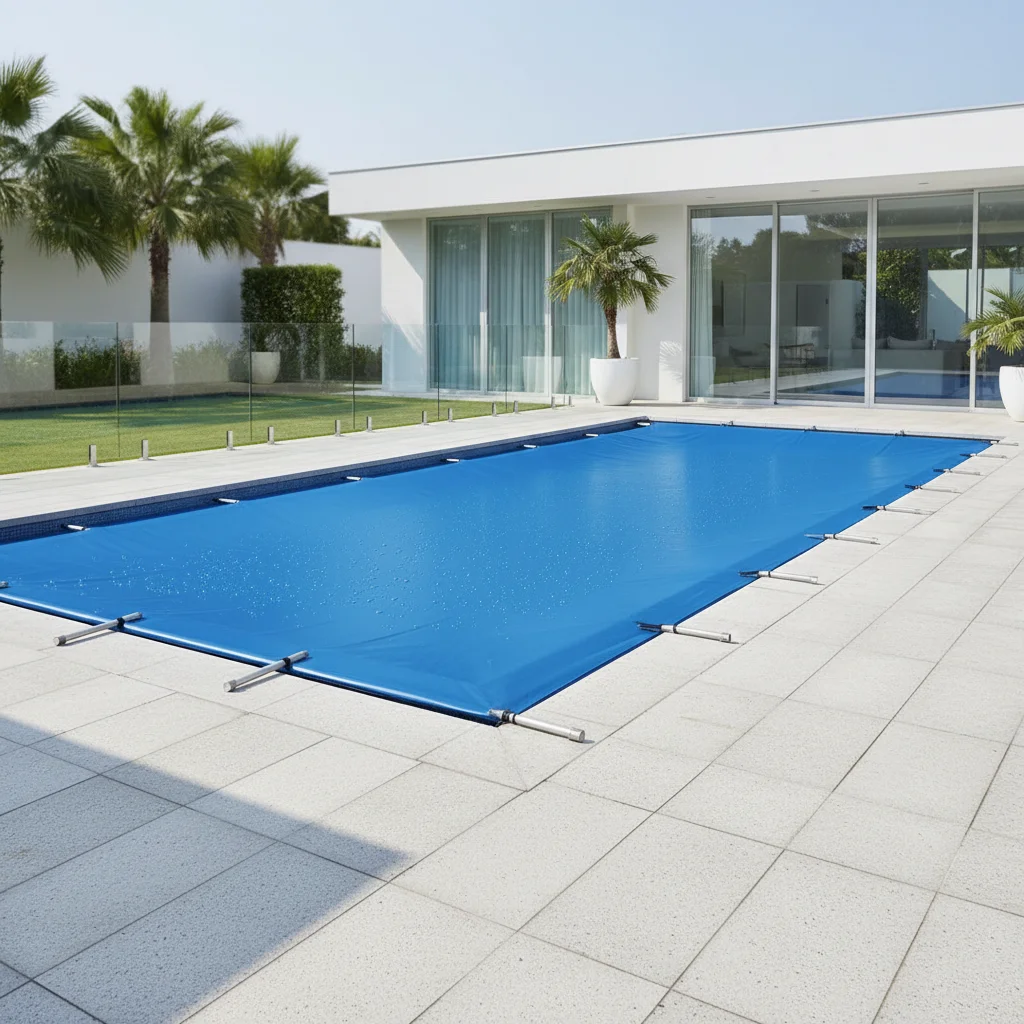
PVC Tarpaulin Pool Cover, 50gr/m2 ~ 220gr/m2, 0.2-0.4mm Thickness — knife coated fabric with UV-resistant, anti-aging and waterproof treatment for residential and commercial pool protection.
- Specify GSM and thickness together — both determine tensile load and wind uplift resistance, not weight alone
- Knife coated method delivers higher peel strength at welded seams vs laminated alternatives
- Brass anchors, ratchet tensioners and aluminium poles matched to cover weight and deck type under one roof
Backed by 3 full production lines, 100% pre-shipment inspection, and a 10-person R&D team handling custom sizing and sample development within days.
Description
Process Control Over Coating Weight — every roll of PVC knife coated fabric is verified against the stated GSM before leaving the line, ensuring the pool cover material you specify is the material you receive.
Technical Specifications
| Parameter | Value |
|---|---|
| Product Type | PVC Tarpaulin Pool Cover |
| Material | PVC Knife Coated Fabric |
| Weight Range | 50gr/m2 ~ 220gr/m2 |
| Thickness | 0.2-0.4mm / 8 mil-16 mil / Custom |
| Features | Waterproof, UV-Resistant, Windproof, Tear Resistant, Mildew Proof, Anti-aging |
| Colour Options | Blue, Blue/Orange, Green, Grey, Black, Clear, Grey/Green, Orange, or Custom |
| Hardware Compatibility | Brass Anchor, Triangular Hook, Ratchet System, Aluminium Poles |
| Operation Options | Manual or Motorized Winders, Self-sinking Stainless Steel Connections |
| Certification | ISO 9001, ISO 14001, ISO 45001, CE |
Application Suitability
| Application | Exposure & Requirement |
|---|---|
| Residential in-ground pool cover | Seasonal UV exposure, standing water, debris load, anchor point tension from wind uplift |
| Commercial and municipal pool cover | Frequent deployment and retraction, chemical splash from pool treatment, high pedestrian handling |
| Above-ground pool winter cover | Snow and ice load, prolonged UV exposure, edge abrasion against pool frame |
| Pool construction phase protection | Dust and debris shielding, temporary water pooling, site foot traffic over the cover |
Why Hardware and Fabric Must Be Specified as One System
A PVC Tarpaulin Pool Cover aftermarket supplier that only quotes fabric without confirming anchor and tensioner compatibility is setting you up for field failure at the connection points.
When I supplied knife coated fabric for a pool cover project, the welds held fine in the flat panel but the brass anchor points tore through under wind load because the GSM chosen was too light for the ratchet tensioner pull. The cover did not fail in the middle — it failed where the hardware met the fabric. Specifying the cover material without matching it to the anchoring system and support poles creates a weak link that shows up on the first windy night [NEED_CITE: tensile and tear test methods for coated fabrics per ISO 1421]. The PVC Tarpaulin Pool Cover aftermarket supplier should confirm anchor type, pole spacing and tensioner rating alongside the fabric weight.
Matching GSM to Pool Size and Climate Exposure
The weight range of 50gr/m2 ~ 220gr/m2 covers light-duty residential splash covers up to heavy-grade commercial winter protection. A PVC Tarpaulin Pool Cover intended for a small above-ground pool in a mild climate performs adequately at the lower end of this range, while a large municipal pool exposed to snow load and high wind requires material at the upper end. The correct specification depends on the span the cover must bridge, the anchoring tension applied and the environmental load it must carry between retraction cycles.
Complete Hardware Integration Under One Specification
Brass anchors, triangular hooks, ratchet tensioners and aluminium poles are available as a matched set for the cover weight and deck type. Motorized winder systems and self-sinking stainless steel connections can be specified for commercial installations where manual deployment is impractical. Sourcing the PVC Tarpaulin Pool Cover fabric and hardware from the same supply chain ensures the anchor reinforcement pattern is designed around the actual fabric thickness and tear resistance rather than a generic assumption [NEED_CITE: anchoring load distribution on coated fabric pool covers].
How Knife Coating Differs From Lamination for Pool Cover Use
PVC knife coated fabric achieves its waterproof barrier through a direct coating process where liquid PVC is applied to the base fabric and cured, creating a continuous film bonded to the yarn structure. This differs from laminated constructions where a pre-formed film is bonded to the substrate with adhesive. The knife coating method produces higher peel strength at the coating-to-yarn interface, which matters at welded seams where the heat must fuse two coating layers without delaminating from the base fabric. Thickness options from 0.2-0.4mm allow selection based on the flexibility needed for manual winding versus the rigidity required for motorized retraction systems. The anti-aging and UV-resistant treatment options are applied during the coating stage and should be confirmed with test documentation for the target market’s exposure conditions.
The Hidden Cost of Welding Parameters That Do Not Match the Fabric
I have seen coated rolls fail at the weld line when the heat sealing temperature was set for a different thickness. The joint looks clean coming off the welding table, but under the first real wind load the seam opens before the fabric body reaches its breaking point. With PVC knife coated fabric in the 0.2-0.4mm range, the hot air wedge temperature and travel speed must be tuned to the exact thickness and coating formulation. A seam that is under-welded peels apart; one that is over-welded scorches the PVC and creates a brittle line that cracks in cold weather. Every production run requires a test weld pulled to failure before the main panels are joined [NEED_CITE: hot air welding parameters for PVC coated polyester fabric].
Why Consistent Batch Verification Matters for Multi-Cover Projects
Colour variation between rolls in the same order becomes visible when covers are installed side by side on adjacent pools. GSM that is stated on the quotation but not verified on arrival means the cover may be lighter than the anchor system was designed for, leading to premature tearing at the brass anchor points. Anti-aging and UV-resistant treatment claimed without a test result to support it leaves the buyer exposed when the cover chalks or embrittles before the expected service period. These issues compound on commercial projects where dozens of covers must match in appearance and perform identically under the same maintenance schedule.
Why Procurement Teams Source This Material Here
Three full production lines and 36 sets of professional equipment support bulk output of PVC knife coated fabric with on-time delivery for seasonal pool cover demand. A 10-person R&D team handles material selection, custom colour matching and sample development so buyers can approve a production swatch before the full order runs. Dedicated QA and QC inspection at every production stage with 100 percent pre-shipment checking means GSM, colour and coating adhesion are verified per roll, not sampled from the batch. Deep process control over coating weight and adhesion developed across nearly 30 years of coated fabric production ensures the welding behaviour of each roll is predictable for the fabricator. Custom width, length and colour are available with roll-to-roll batch consistency for multi-pool projects where appearance and performance must be uniform.
Documentation & Verification
- Material specification sheet stating GSM, base fabric construction and coating type for each roll
- UV and anti-aging treatment test report matching the grade specified on the purchase order
- Pre-shipment inspection record confirming weight and colour per roll against order requirements
- ISO and CE certificates covering the production facility and coated fabric process
- Roll packing list with individual roll dimensions and net weight for customs clearance
- Certificate of origin and customs documentation for international pool cover fabric shipments
Fabrication, Handling & Storage
- Hot air wedge welding temperature must be matched to the 0.2-0.4mm thickness for reliable seam peel strength
- Brass anchor reinforcement patches should use the same PVC knife coated fabric grade as the main panel
- Rolls stored upright on hard paper tubes to prevent flat-spot creases that show through the finished cover
- Allow cold-stored rolls to reach ambient temperature before unrolling to avoid coating micro-cracking
- Mildew-proof treatment reduces biological growth but does not replace periodic cleaning with non-solvent detergent
- Offcut material from the 50gr/m2 ~ 220gr/m2 range can be heat-welded into repair patches for field damage
What to Include With Your Enquiry
Provide the pool dimensions, cover operation method and the anchor type specified for the deck so the correct GSM and hardware set can be matched. Confirm whether UV-resistant or anti-aging treatment documentation is required for your market’s compliance standards. State the colour reference and whether you need finished covers cut to size or fabric rolls for your own fabrication facility. Indicate annual volume and whether a pre-production colour sample is needed for approval before the bulk order runs.
Frequently Asked Questions
Q: What is the difference between PVC knife coated and PE laminated tarpaulin for pool covers?
A: PVC knife coated fabric applies liquid PVC directly to the base weave, producing higher peel strength and better heat-welding performance than PE laminated construction. For pool covers that are retracted and redeployed frequently, the coating adhesion of PVC knife coated material resists delamination at fold lines and anchor points more effectively than a laminated PE film.
Q: Can I order the fabric roll separately from the hardware kit?
A: Yes. The PVC knife coated fabric is available as rolls packed on hard paper tubes for buyers who fabricate covers in their own facility. Brass anchors, triangular hooks, ratchet systems and aluminium poles can be ordered separately or as a matched kit sized to the cover dimensions and GSM selected.
Q: What GSM is recommended for above-ground versus in-ground pool covers?
A: Above-ground pool covers typically use lighter GSM within the 50gr/m2 ~ 220gr/m2 range because the span is smaller and the load is primarily UV and debris. In-ground pool covers bridge a wider unsupported span and face higher wind uplift, requiring heavier GSM matched with ratchet tensioners and closer anchor spacing.
Q: Do you supply motorized winder systems compatible with this cover?
A: Motorized winders are available and specified based on the cover weight, pool length and deployment frequency. The winder torque rating must match the GSM and thickness chosen, and self-sinking stainless steel connections are recommended for the lead edge to prevent the cover from riding up during automated retraction.
Q: How do you ensure colour consistency across multiple covers in one order?
A: Each production batch is mixed to a single colour reference and verified before coating. A pre-production sample is available for buyer approval. Rolls from the same batch are allocated to a single order to prevent visible variation when covers are installed on adjacent pools at the same site.
Related products
-
JX PVC Laminated Waterproof Breathable Anti-UV Blackout Organic Plain Weft Swimming Pool Covers Tarpaulin Coated
¥1.78 Select options This product has multiple variants. The options may be chosen on the product page -
Custom PVC Pool Cover for In-ground Winter Safety – Manufacturer
Read more -
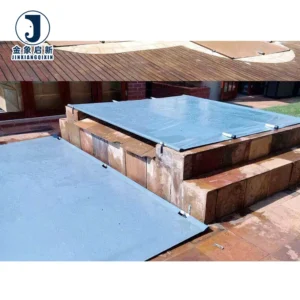
China Manufacturer 18oz 610gsm Heavy Duty Pvc Swimming Pool Cover Pvc Coated Tarpaulin Fabric Roll Roofing Cover Tarp Sheet
¥2.50 Select options This product has multiple variants. The options may be chosen on the product page -
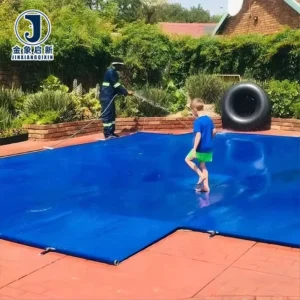
PVC Laminated Waterproof Breathable Anti-UV Blackout Organic Plain Weft Swimming Pool Covers Tarpaulin Coated
¥1.78 Select options This product has multiple variants. The options may be chosen on the product page