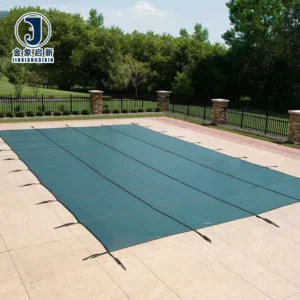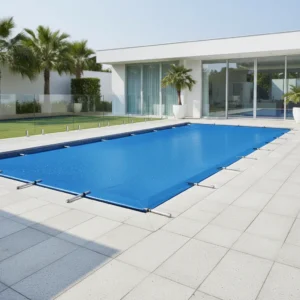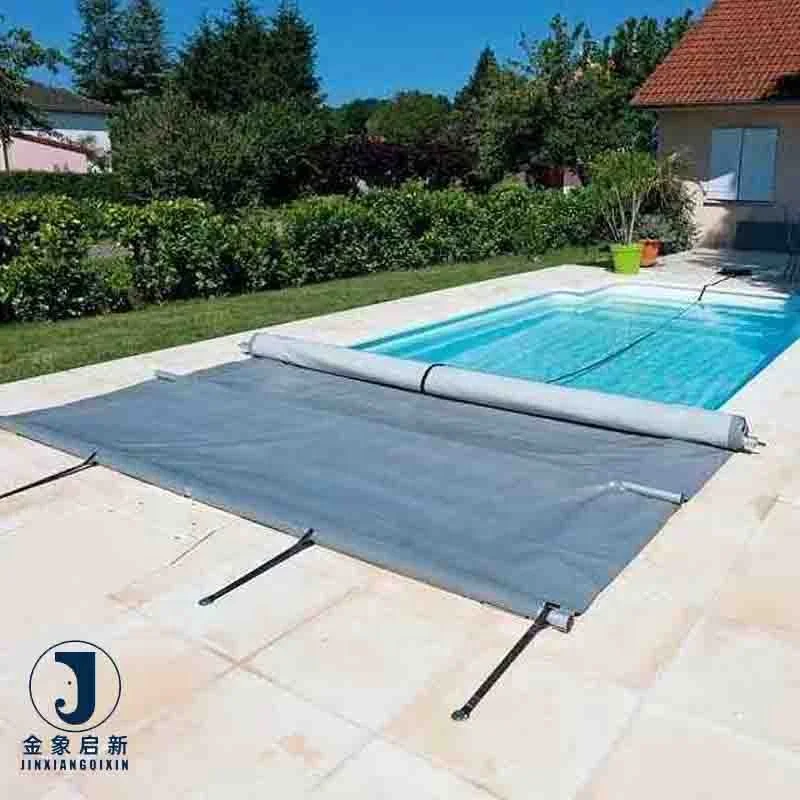
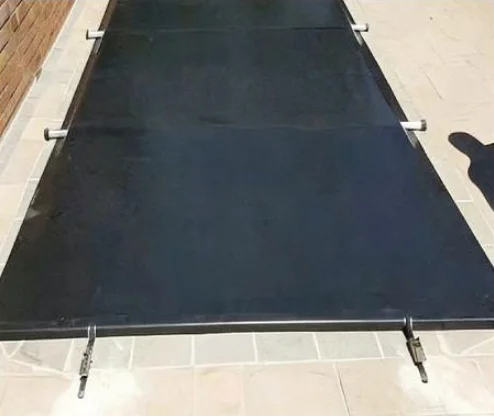
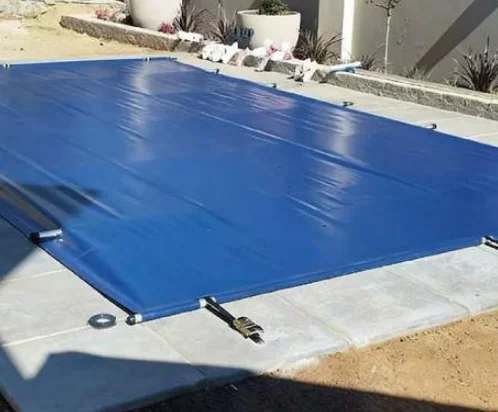
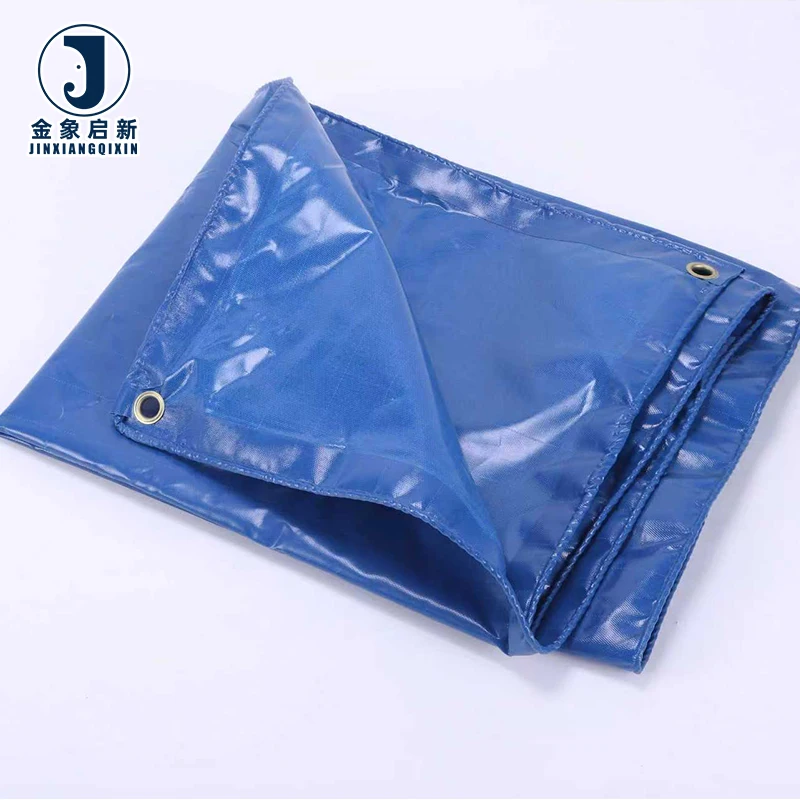
PVC Pool Cover Tarpaulin — 350gsm to 750gsm, 0.32mm–0.65mm thickness, hot-melt coated on high-strength polyester mesh.
Laminated and hot-melt coating ensures consistent PVC-to-base adhesion, while controlled colour matching across rolls eliminates visible panel mismatch once installed side by side. Outstanding tearing strength at welded seams handles the flex points where pool covers load most under tension.
Backed by 100% pre-shipment inspection with batch-traceable roll packing and verified GSM on every delivery.
Description
Complete Custom Capability — PVC pool cover fabric from roll stock to finished contoured covers, manufactured in-house with 30 years of coating process control ensuring adhesion strength, color consistency, and weld-line reliability across every order.
Technical Specifications
| Parameter | Value |
|---|---|
| Product Type | PVC Coated Tarpaulin |
| Material | PVC + High-strength polyester mesh fabric |
| Coating Method | Laminated technology / Hot-melt Coating technology |
| Weight (GSM) | 350gsm / 420gsm / 500gsm / 550gsm / 600gsm / 750gsm |
| Total Thickness | 0.32mm / 0.35mm / 0.4mm / 0.45mm / 0.5mm / 0.65mm |
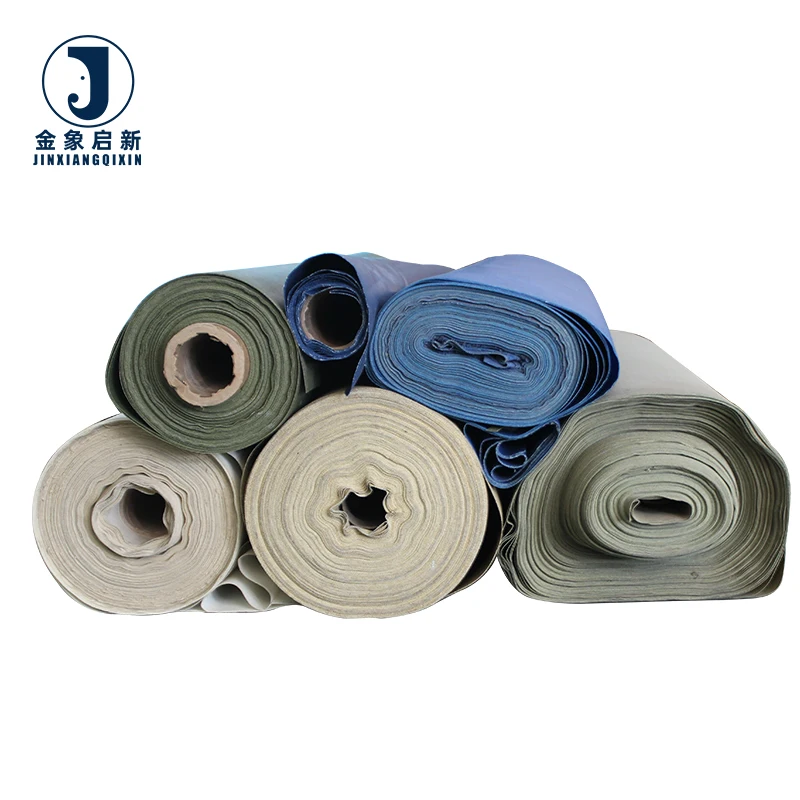
| Roll Size | 2m width × 75m length / 2.1m width × 50m length |
| Finish Product Size | Custom items as per customer’s needs, or sold by inventory |
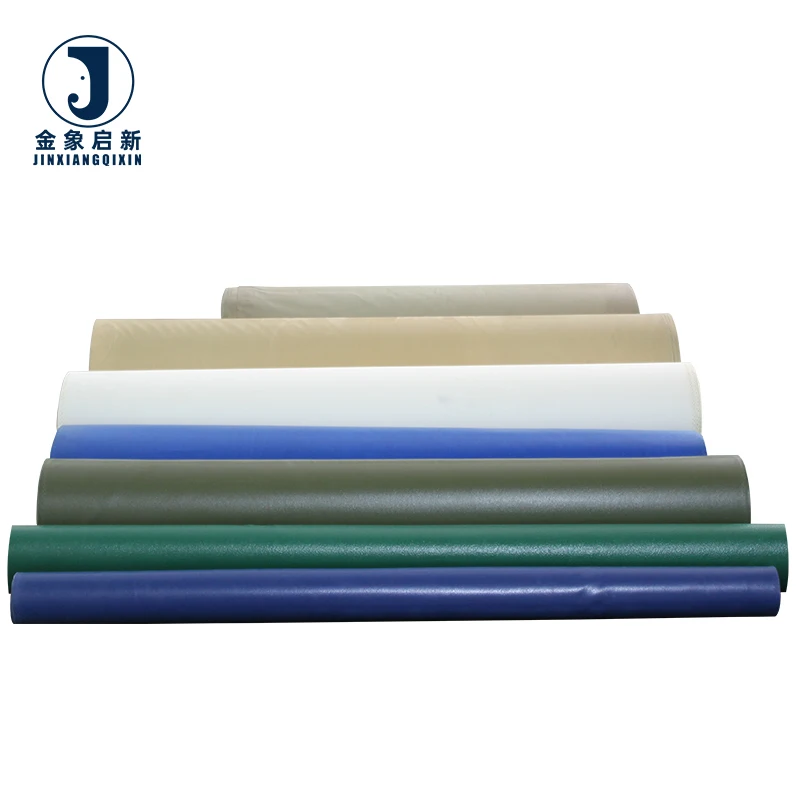
| Color | Blue / Red / Yellow / Light blue / Grey (Customized) |
| Key Features | High tenacity polyester yarns, cold crack resistance, anti-mildew, waterproof, sunproof, outstanding tearing strength for welding, color fastness |
| Special Treatments Available | Flame retardant (grade not stated), anti-static (standard not stated), anti-cold, anti-mildew, 3P |
| Standards | ISO, CE |
Application Suitability
| Application | Exposure & Requirement |
|---|---|
| Residential swimming pool covers | Continuous UV and rain exposure, debris loading, evaporation control, safety tensioning via hook or aluminium bar systems |
| Commercial and municipal pool covers | High-frequency deployment and retraction, chemical splash from pool treatment, wind uplift on large spans |
| Irregular-shaped pool covers | Contoured cutting with hook attachment, seam welding along curves, color matching across multiple panels |
| Aquaculture and fish tank covers | Permanent water contact, anti-mildew requirement, waterproof integrity over extended submersion |
| Roll stock for pool cover fabricators | Batch color consistency across rolls, predictable weld behavior, reliable GSM for downstream cost calculation |
Why the Weld Line Fails Before the Fabric Does on Pool Covers
The seam carries the tension load, not the panel centre. When a PVC swimming pool cover tarpaulin custom manufacturer quotes a high GSM, buyers assume the entire cover is strong. In practice, pool covers flex most at the attachment edges and welded seams. If the coating adhesion to the base fabric is weak, the PVC layer delaminates at the weld before the polyester mesh reaches its tear limit [NEED_CITE: tensile and tear test methods for coated fabrics per ISO 1421]. Hot-melt coating and laminated technology address this directly by forcing the PVC into the mesh structure under heat and pressure, rather than simply sitting on top of it. The result is a bond that survives the repeated tension-release cycles a pool cover endures every time it is deployed or retracted across the water surface.
Coating Adhesion and Why It Governs Pool Cover Lifespan
Pool covers are tensioned structures. Whether installed with a hook system around irregular contours or pulled tight with an aluminium bar and ratchet on a rectangular pool, every square metre of PVC pool cover tarpaulin is under constant pull. The coating must remain bonded to the polyester mesh through temperature swings, chemical exposure from pool water, and mechanical stress at the seams. Laminated and hot-melt coating technologies produce a mechanical and chemical bond between the PVC and the high-tenacity yarns that simple paste coating cannot match. This bond is what allows the weld line to carry structural load without peeling apart under tension.
Color Fastness Across Rolls for Multi-Panel Pool Installations
Commercial pools and resort installations often require multiple panels installed side by side. If color varies between rolls within the same order, the mismatch becomes visible once the panels are tensioned next to each other in direct sunlight. Consistent color fastness across production batches is controlled through standardized pigment dosing and coating temperature management during the laminating process. For buyers specifying a PVC swimming pool cover tarpaulin custom manufacturer for large-scale projects, requesting a color reference sample before full production confirms the target shade will hold across the entire order quantity [NEED_CITE: color fastness testing standards for coated textiles].
Reading GSM and Thickness Together, Not Separately
A common mistake in pool cover specification is selecting a product based on GSM alone. Weight tells you how much material is present, but thickness reveals how that material is distributed between the base fabric and the coating layers. A 550gsm fabric at 0.45mm thickness with a dense polyester mesh will behave very differently under tension than a 550gsm fabric at 0.55mm thickness where extra coating fills the gap. The base fabric denier and weave density determine tear propagation resistance, while the coating thickness governs abrasion resistance and weld behavior. For pool covers subjected to wind uplift and mechanical retraction, both values must be considered together to predict field performance accurately.
The Hidden Cost of Underspecified Pool Cover Fabric
Pool operators who select the lightest available GSM to reduce material cost often face premature failure at the attachment points. Hook systems concentrate load at each fixing, and if the fabric lacks sufficient tear strength, a single torn eyelet can propagate across the panel. Similarly, specifying a PVC swimming pool cover tarpaulin without confirming the anti-UV treatment grade means the cover may chalk, stiffen, or crack after limited sun exposure — particularly in regions with high solar intensity. Batch color inconsistency forces contractors to reject rolls on site, delaying installation and creating waste. These failures trace back to specification gaps at the procurement stage, not to defects in manufacturing [NEED_CITE: common failure modes in tensioned PVC fabric structures].
Why Procure Pool Cover Fabric Through This Supply Chain
Three full production lines and 36 sets of professional equipment provide the capacity to run large roll orders and custom cut-to-size covers simultaneously without queueing one behind the other. The 10-person R&D team handles color matching, custom sizing, and sample development within days, allowing buyers to verify material and color before committing to full production volume. Dedicated QA/QC at every production stage means GSM, coating weight, and color are checked during coating runs, not only at final packing. Pre-shipment inspection covers 100 percent of the order, with a record documenting the actual measured values against the specification sheet. This level of process control applies to every PVC pool cover tarpaulin order, whether the buyer is a distributor purchasing container loads of roll stock or a contractor requesting a single custom-shaped cover with reinforced hems.
Documentation & Verification
- Material specification sheet stating base fabric, coating method, GSM, thickness, and color reference
- Pre-shipment inspection record confirming weight verification per roll against the stated GSM
- Test reports for UV treatment and flame-retardant grades where applicable to destination market
- Roll packing list with batch traceability linking each roll to its production run
- ISO and CE certificates included with shipment documentation
Fabrication, Handling & Storage
- Hot-air welding parameters must match the coating thickness, whether 0.32mm or 0.65mm, to avoid scorching or incomplete fusion
- Reinforced hems at hook attachment points distribute tension across the polyester mesh, preventing tear propagation
- Rolls stored upright on pallets prevent flat-spot deformation that shows as visible creases after deployment
- Cold-condition rolls should be acclimatized before unrolling to prevent coating crack on the laminated surface
- Mild detergent cleaning preserves the anti-mildew treatment; solvent-based cleaners may degrade the PVC coating layer
- Panel layout from 2m or 2.1m roll widths should be planned to minimize cross-grain welds on large pool covers
What We Need to Quote Your Pool Cover Project
To provide an accurate specification and lead time, share the pool dimensions or contour drawing, the attachment system type (hook or aluminium bar), and the target GSM range for your application. If the cover must meet specific fire classification or anti-UV performance for your market, state the required grade so the correct treatment can be confirmed with a test report. For color-matched or branded covers, provide a Pantone or RAL reference along with the quantity so batch consistency can be planned from a single production run.
Frequently Asked Questions
Q: How is the stated GSM verified before the pool cover fabric ships?
A: Every roll is weighed and measured during pre-shipment inspection. The inspection record documents the actual GSM against the specification sheet and is included with the shipment documentation. This means you receive verified weight data, not just the quoted figure, before the material leaves the factory.
Q: What UV treatment options are available and how are they documented?
A: Anti-UV treatment is available as a standard feature with sunproof performance noted in the material specification. If your market requires a specific UV test standard for compliance, state the requirement during inquiry so the applicable test report can be prepared and supplied with your order.
Q: How do you control color consistency when I order multiple rolls for one pool project?
A: Color is matched against a reference standard during pigment dosing, and all rolls for a single order are produced within the same batch where possible. A pre-shipment inspection record includes the color reference, allowing you to verify consistency against your approved sample upon arrival.
Q: What are the options for custom-sized pool covers versus roll stock?
A: Both supply modes are available. Roll stock ships in 2m × 75m or 2.1m × 50m formats for fabricators cutting their own panels. Custom cut-to-size covers are produced to your pool dimensions with reinforced hems and attachment provisions included as specified.
Q: How do the hook system and aluminium bar methods differ for pool cover installation?
A: Hook systems suit irregular pool contours where individual fixing points follow the pool edge. Aluminium bar with ratchet tensioner suits large rectangular pools where a straight, continuous tension line is needed. Both methods require the PVC pool cover tarpaulin to have sufficient tear strength at the attachment edge to hold under sustained load.
Related products
-
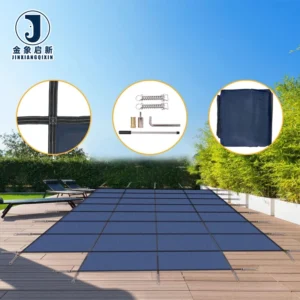
Rain Permeability Coated Organic Weft Plain Boys Blackout Blue Mesh Pool Safety Cover 18x36ft Rectangular Inground 4x8ft Center
¥0.83 Select options This product has multiple variants. The options may be chosen on the product page -
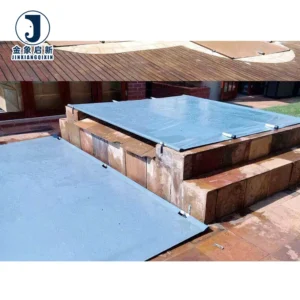
China Manufacturer 18oz 610gsm Heavy Duty Pvc Swimming Pool Cover Pvc Coated Tarpaulin Fabric Roll Roofing Cover Tarp Sheet
¥2.50 Select options This product has multiple variants. The options may be chosen on the product page -
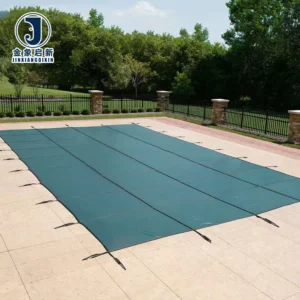
Custom PVC Pool Cover for In-ground Winter Safety – Manufacturer
Read more -
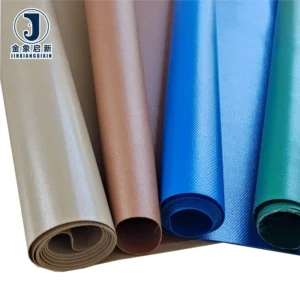
PVC Laminated Waterproof Breathable Anti-UV Blackout Organic Plain Weft Swimming Pool Covers Tarpaulin Coated
¥1.78 Select options This product has multiple variants. The options may be chosen on the product page