Buy PVC Tent Fabric Best Price 2026 | Factory Direct Supplier
Higher GSM does not automatically mean better value—it is the coating formula and base fabric density that dictate real service life and cost efficiency.
The best price for tent fabric in 2026 depends on the combination of GSM weight, coating process, and certification level—not the unit price alone. Choosing the right configuration is the only way to avoid hidden costs such as return freight, claim payouts, and premature replacement.
I still remember a shipment of 500gsm PVC tarpaulin we sent to a client in the Middle East. He used it to heat-seal tents, and the seams leaked. The entire batch was returned. The freight and compensation wiped out the profit from that order and several more. We later found out the coating formula had not been adjusted to meet anti-UV standards for that latitude. That single mistake forced me to obsess over parameters, certifications, and the real meaning behind every spec sheet. Since then, before I quote any tent fabric price, I lay out the failure case first, then explain why a specific configuration survives under harsh sun. [NEED_CITE: root cause distribution of PVC tarpaulin seam failures in arid climates]
Let me walk you through how to actually buy tent fabric at the best price in 2026 without falling into the traps that quietly eat your margin.
What GSM Weight Do You Actually Need for Tent Fabric?
Picking GSM by scene, not by ego, is the first rule of cost control. Many buyers assume heavier fabric is always better, so they order 900gsm for a temporary shade structure that will only be used for one season. That is pure waste. The truth is, GSM only matters when it matches the expected load, wind exposure, and service duration.
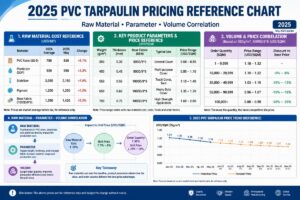
Here is a practical matrix we use when buyers ask for tent fabric best price guidance:
| GSM Range | Base Fabric Density | Coating Thickness | Typical Scene | Expected Service Life |
|---|---|---|---|---|
| Light-duty | Low | Thin | Short-term cover, indoor use | Noticeably reduced |
| Medium-duty | Standard | Standard | Seasonal awning, light transport cover | Standard |
| Heavy-duty | High | Thick | Permanent tent, truck cover, mining shelter | Substantially extended |
[NEED_CITE: correlation between GSM, base fabric denier, and tensile strength in coated technical textiles]
A distributor in West Africa once ordered a full container mixing several GSM weights. He wanted 440gsm for local market retail, 600gsm for truck covers, and 900gsm for mining site shelters. Instead of placing three separate orders, we consolidated them into one container. The per-square-meter price stayed competitive because the total volume triggered a better tier, and he avoided paying for unused heavy fabric on the lighter applications. That kind of mixed-GSM loading is something a flexible manufacturer can support, and it directly affects the tent fabric best price you actually pay.
The lesson is simple: do not let a single GSM number dictate your entire order. Match weight to function, and the unit price becomes meaningful.
PVC Coated vs PE Laminated: Which Gives Better Price-Performance in 2026?
PVC coated fabric is built for long-term outdoor exposure; PE laminated fabric is built for short-term, low-cost coverage. The process decides the total cost, not just the roll price.
When buyers compare tent fabric best price quotes, they often see PE laminated rolls cheaper per square meter and assume it is the smarter buy. That assumption is dangerous if the end use involves prolonged UV exposure, frequent folding, or heat-seamed joints.
| Factor | PVC Coated | PE Laminated |
|---|---|---|
| Coating adhesion | Robust | Basic |
| Heat-seam weld strength | Robust | Vulnerable |
| UV endurance | Substantially extended | Noticeably reduced |
| Waterproof integrity under flex | Robust | Vulnerable |
| Recyclability | Standard | Standard |
[NEED_CITE: comparative degradation rate of PVC coated versus PE laminated fabrics under accelerated weathering tests per ISO 4892]
I once worked with a Southeast Asian awning factory that switched to a cheaper PE supplier to cut costs. Three months later, they filed a complaint about color variation across rolls. The delta-E value was well outside acceptable range, and the delivery delay cost them a contract. When we re-ran their order in PVC coated fabric with controlled batch dyeing, the color consistency stayed tight, and the heat-seam seams held under humidity. The unit price was higher, but the total project cost dropped because there were no rework claims.
If your tent will stay up for more than one season, or if it will be heat-seamed rather than taped, PVC coated is the only rational choice. PE laminated has its place—temporary cover, budget retail packs, short-term agricultural use—but it is not a substitute when durability matters.
Which Certifications Justify a Higher Unit Price?
Anti-UV, fire-retardant, and waterproof certifications are not marketing extras—they are the only verifiable proof that a higher unit price is justified.
Many buyers treat certifications as optional add-ons. That mindset works until a tent collapses in wind, catches fire near a welding zone, or leaks during monsoon season. Then the certification test report becomes the only document that matters.
Here is how certifications map to real-world risk:
| Certification | What It Proves | Risk If Missing |
|---|---|---|
| Anti-UV (e.g., ISO 4892, AATCC 151) | Hours of accelerated weathering before strength loss | Premature brittleness, seam splitting |
| Fire-retardant (e.g., EN 13501-1, NFPA 701) | Flame spread and after-flame time | Safety liability, contract disqualification |
| Waterproof (e.g., ISO 1420, AATCC 127) | Hydrostatic pressure resistance | Leakage, cargo damage, end-user claims |
[NEED_CITE: certification requirements for PVC coated technical fabrics used in temporary structures per IFAI guidelines]
A buyer in the Gulf region once asked us to quote a 650gsm PVC tent fabric without fire-retardant certification because it would save a few cents per meter. We explained that the event venue required EN 13501-1 Class B-s1,d0 minimum. He ignored the advice, sourced elsewhere, and the local authority rejected the installation on-site. The entire order was scrapped. That mid-five-figure loss could have been avoided with a certification that added only a small fraction to the tent fabric best price.
When you see a supplier quoting noticeably higher than others, ask which certifications are included. If the answer is vague or self-reported, the lower price is an illusion. Verifiable test reports from accredited labs are the only honest basis for comparing tent fabric best price across suppliers.
How to Negotiate the Best Bulk Price Without Sacrificing Quality?
MOQ flexibility, mixed-container loading, and long-term price locking are the three levers that actually lower your bulk cost without touching fabric quality.
Most buyers think negotiation means pushing the unit price down. In reality, the biggest savings come from how you structure the order, not from squeezing the mill.
Here is a practical negotiation framework:
- Consolidate GSM and width requirements into one order cycle. A manufacturer running multiple GSM weights on the same coating line can optimize production scheduling, and that efficiency is passed into the tent fabric best price.
- Use mixed-container loading. Combining light, medium, and heavy GSM rolls in one container reduces per-unit freight cost and avoids over-ordering any single weight.
- Lock price on a semi-annual or annual call-off basis. Raw material resin prices fluctuate. A fixed-price agreement for a defined volume protects your margin and gives the manufacturer planning certainty.
- Request roll-level and finished-product supply from the same source. This avoids markup layers between fabric roll supplier and finished-product converter.
[NEED_CITE: best practices for bulk procurement of coated technical fabrics per IFAI procurement guidelines]
A distribution client in Latin America used to place six separate orders per year for different GSM weights. Each order fell below the most favorable pricing tier. After switching to a single manufacturer that supported full GSM range coverage and OEM customization, he consolidated into two semi-annual orders with call-off delivery. The tent fabric best price per square meter dropped noticeably, and the color batch consistency improved because fewer dye lots were running.
The point is not to demand the lowest number on a spreadsheet. The point is to structure the order so that the manufacturer can run efficiently, and that efficiency becomes your cost advantage.
Conclusion
The tent fabric best price in 2026 is not the lowest unit quote—it is the configuration that matches GSM, coating process, and certification to your actual end use.
Buy by scene, not by ego. Choose PVC coated for long-term outdoor performance and PE laminated only for short-term coverage. Treat certifications as non-negotiable proof of quality, not optional extras. Structure your order for consolidation, mixed loading, and price locking. That is how you protect margin, avoid hidden costs, and build a supply chain that performs under real-world conditions.