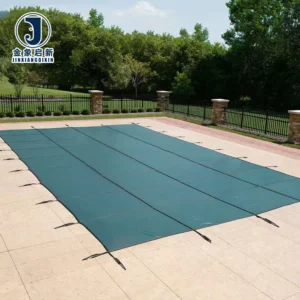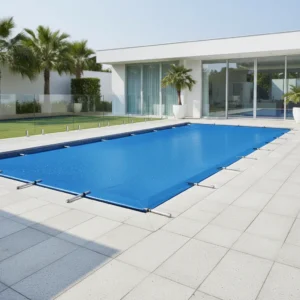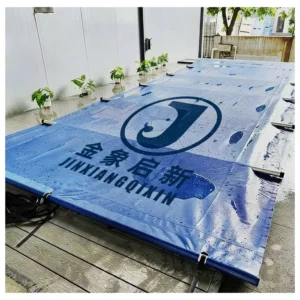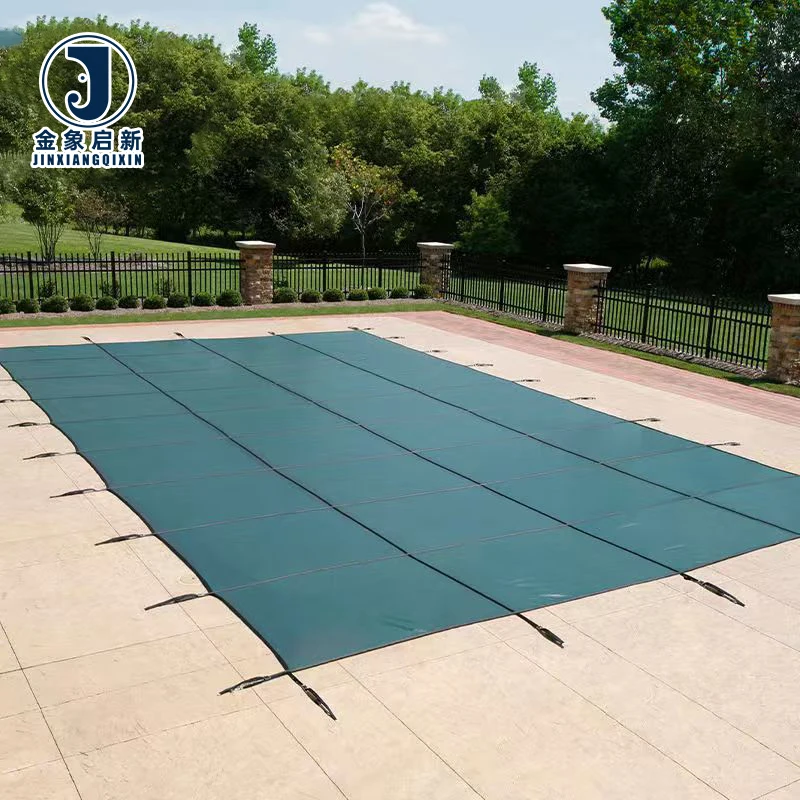
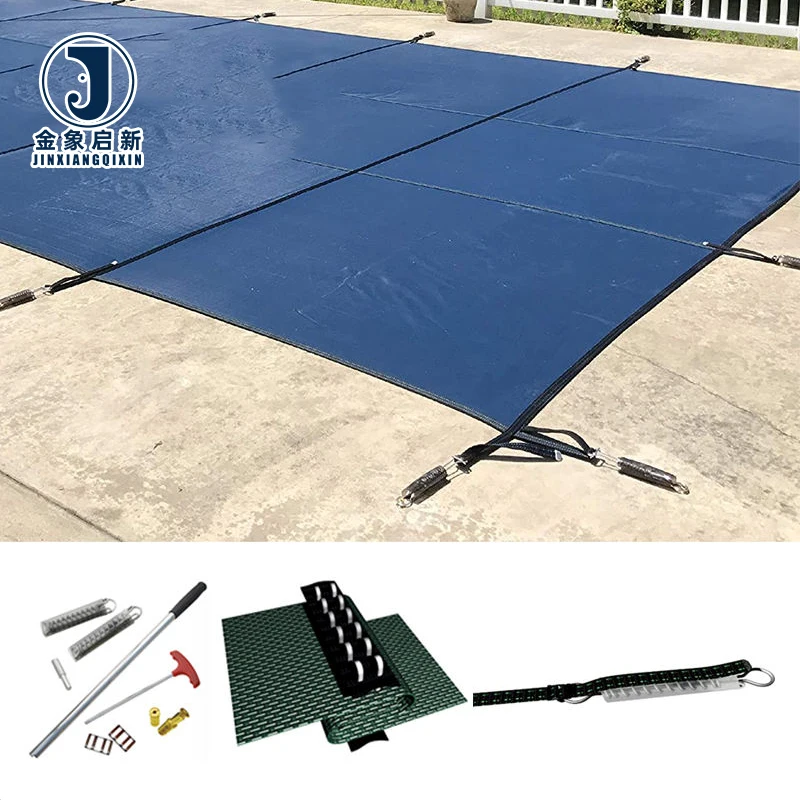
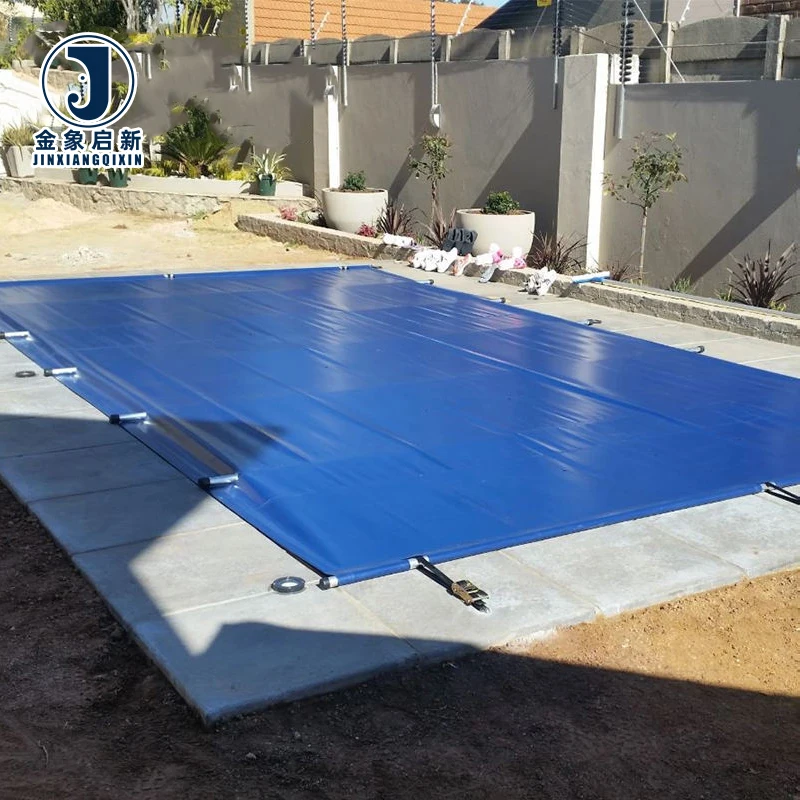
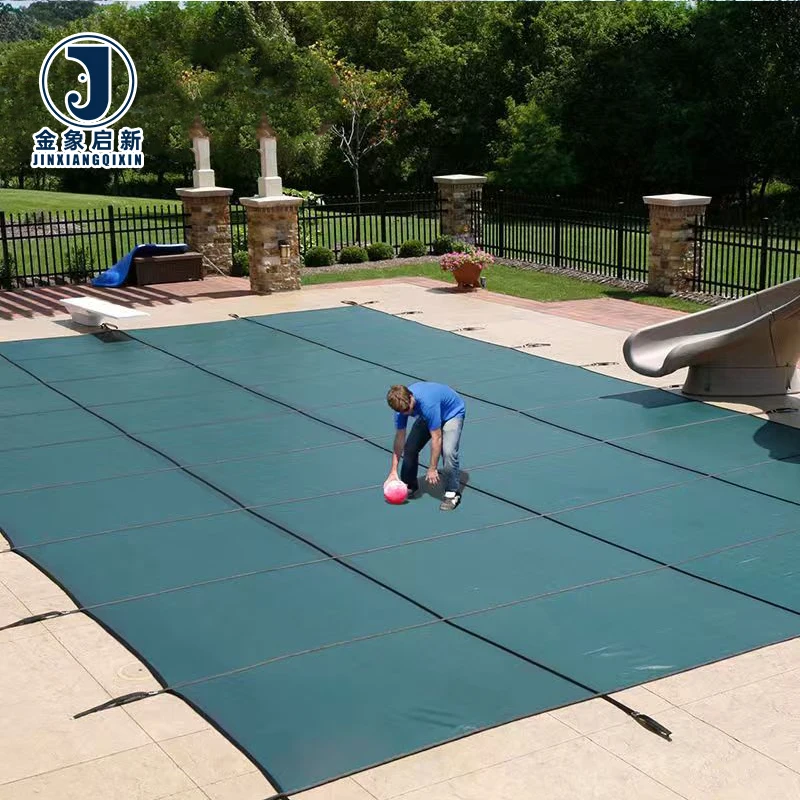
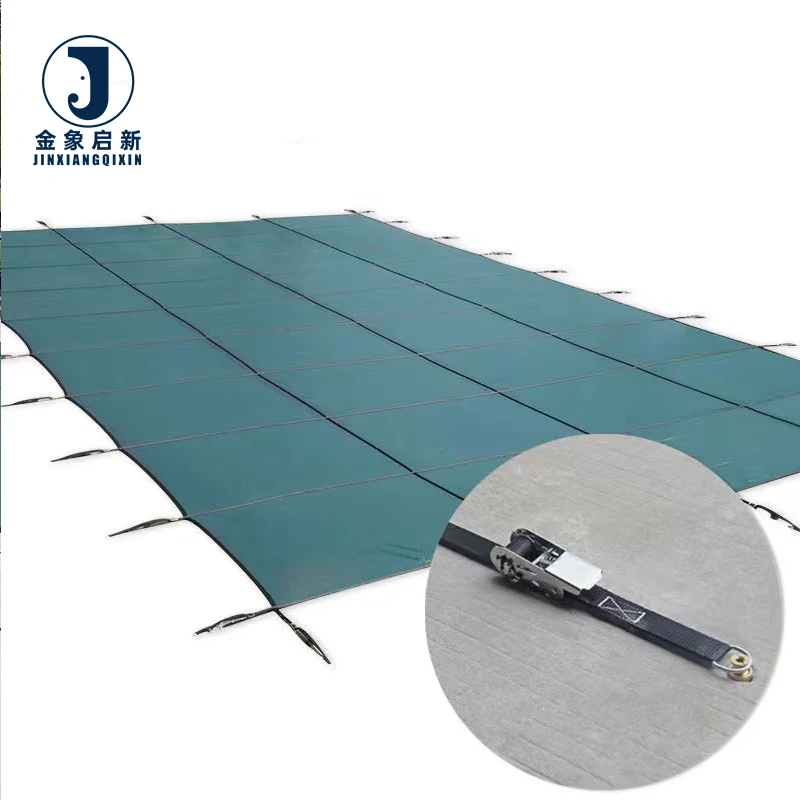
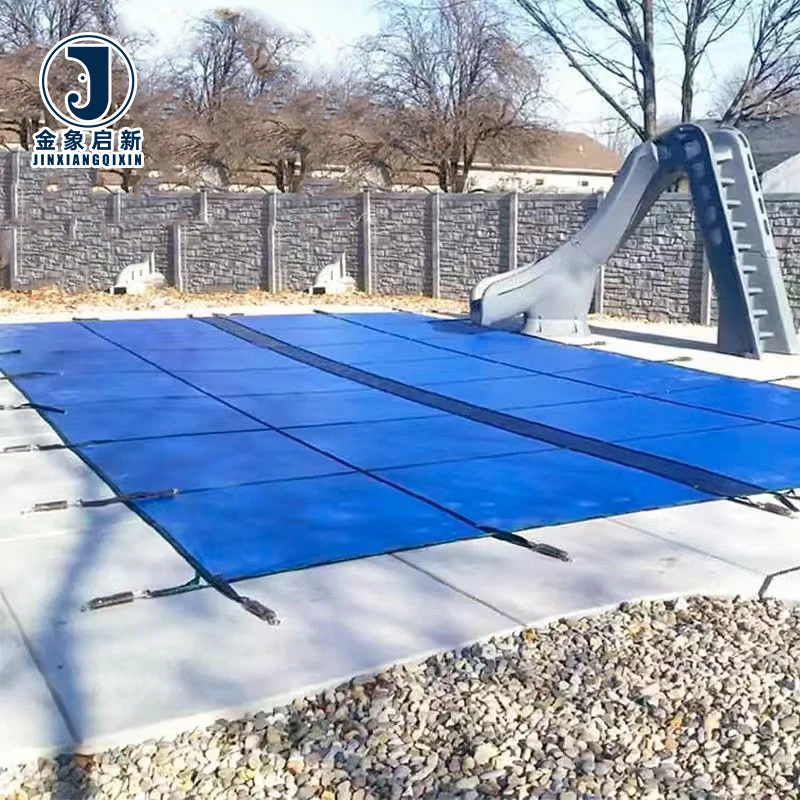
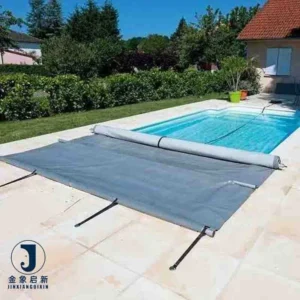
PVC Pool Cover for In-ground Winter Swimming Pools — 500D-500D polyester base, 450-900 g/m² PVC coated tarpaulin with smooth leather-like surface texture.
- Water-resistant, anti-UV treated and flame-retardant customizable construction
- Integrated hot-press seams eliminate stitched failure points under load
- Three installation systems: brass anchors, aluminium battens with ratchets, or heavy-duty water tube loops every 4 ft
- Custom sizing for rectangular, round and square in-ground pool shapes
Coating weight and base fabric denier together determine tensile strength and long-term weather resistance — our process controls both at every stage.
Dedicated QA/QC with 100% pre-shipment inspection and full material specification documentation provided per order.
Description
Deep process control over coating weight and adhesion — verified on every roll before it leaves our Jinan facility, ensuring PVC pool covers arrive at your warehouse matching the GSM and finish you approved.
Technical Specifications
| Parameter | Value |
|---|---|
| Product Type | PVC Pool Cover |
| Material | PVC Coated Polyester Tarpaulin |
| Yarn Count | 500D × 500D |
| Weight Range | 450–900 g/m² (available in multiple GSM grades — confirm weight required for your pool size and climate) |
| Flame Retardancy | Flame-retardant grades available — confirm the grade required for your market |
| UV Resistance | Anti-UV treatment available — test report provided upon confirmation of grade |
| Surface Finish | Smooth, leather-like texture |
| Waterproof Performance | Fully waterproof coated construction |
| Abrasion Resistance | High abrasion resistance |
| Construction Method | Integrated hot-press welding (no stitched seams) |
| Repairability | Repairable by hot air welding |
| Installation Options | Brass anchoring system; aluminium battens with stainless steel hooks and ratchets; heavy-duty water tube loops every 4 ft |
| Certifications | ISO, CE |
Application Suitability
| Application | Exposure & Requirement |
|---|---|
| In-ground winter safety cover | Seasonal snow load, freezing temperatures, debris accumulation, child and pet safety barrier |
| Residential pool winterization | UV exposure during shoulder seasons, leaf and dirt protection, evaporation reduction |
| Commercial pool seasonal closure | High foot-traffic perimeter, repeated installation and removal cycles, regulatory compliance |
| Pool construction contractor supply | Bulk sizing consistency across multiple projects, custom shapes including rectangular, round and irregular pools |
Why Pool Cover Buyers Get Burned on Material Specs They Never Verified
The quotation says one thing; the roll that arrives weighs something else entirely.
Every season I see the same pattern. A distributor orders a batch of winter swimming pool covers at a specified gsm, and when the container lands, the material is lighter than agreed. The coating thickness drops, the polyester base feels thinner, and the pool cover PVC aftermarket supplier who shipped it has already moved on. The gsm gap might only show up on a scale, but the performance gap shows up six months later when the cover cracks along a fold line or tears under a snow load. [NEED_CITE: tensile and tear test methods for coated fabrics per ISO 1421]
How the Coated Fabric Determines Whether Your Pool Cover Survives One Winter or Five
The PVC pool cover aftermarket supplier you choose is really selling you a coating formula and a base fabric, not a finished product. The 500D × 500D polyester base in this material provides the structural skeleton. The PVC coating applied to both sides locks out water and resists microbial growth. When these two layers bond correctly through controlled coating processes, the resulting fabric handles the repeated stress of seasonal installation, pooling water, and snow accumulation without delamination.
The hot-press construction method used here eliminates stitched seams entirely. Stitched seams on pool covers are a known weak point — water wicks through the needle holes, the thread degrades faster than the fabric, and the seam splits under load. Integrated pressing fuses the material at every joint, so the cover fails as a single system rather than at its weakest stitch line.
Three Installation Systems and Why the Choice Matters for Your Pool Edge
Selecting the right PVC pool cover aftermarket supplier means confirming they can deliver covers matched to your pool perimeter construction. This product family supports three distinct installation methods. Brass anchoring systems work well for concrete deck perimeters where flush-mounted anchors are already in place. Aluminium battens with stainless steel hooks and ratchet tensioners suit installations where a rigid edge seal is needed to prevent wind lift. Water tube loops, spaced every 4 ft, provide ballast for pools where deck drilling is not an option. [NEED_CITE: pool safety cover installation standards and load requirements]
Each system places different demands on the fabric edge. Brass anchors concentrate load at discrete points, so the material around each anchor must resist tear propagation. Aluminium battens distribute force along a continuous line, requiring consistent coating adhesion across the full width of the batten contact zone. Water tubes demand reinforced loops that hold weight without stretching or tearing over repeated freeze-thaw cycles.
Reading the Spec Sheet: What Yarn Count and Coating Weight Actually Control
The 500D × 500D yarn count defines the denier of both the warp and weft threads in the polyester base fabric. Higher denier means thicker individual yarns, which directly increases tear resistance — a critical property when a pool cover must resist puncture from falling branches or ice sheets. However, denier alone does not determine strength. The weave density, meaning how many yarns per centimetre in each direction, works together with denier to set the tensile and tear baseline.
The PVC coating weight, reflected in the 450–900 g/m² range, adds waterproofing, UV protection, and surface durability on top of that base fabric. A heavier coating fills the weave more completely, reducing the chance of water penetration and improving abrasion resistance at contact points. But heavier coating also increases stiffness, which affects how the cover folds for off-season storage. The smooth, leather-like surface finish on this material balances flexibility with a surface that sheds debris and resists staining from pool chemicals.
The Cost of Choosing the Wrong Grade for Your Climate Zone
Ordering a lightweight grade for a region with heavy snowfall means the cover will sag under load, pool standing water, and eventually split at a stress point. Conversely, specifying the heaviest available gsm for a mild climate wastes material cost and makes the cover difficult for homeowners to handle during installation and removal. [NEED_CITE: climate zone classification for seasonal pool cover material selection]
Flame-retardant grades present a different risk. If your local building code or commercial insurance policy requires a specific fire classification and the cover arrives without supporting test documentation, the entire installation can fail inspection. Always confirm the required grade with your PVC pool cover aftermarket supplier before production begins, and request the corresponding test report with your shipment documentation.
Batch-to-batch colour variation is another hidden cost. When multiple covers are installed side by side at a commercial facility or displayed together in a distributor showroom, visible colour differences between rolls signal inconsistent production control. This material is produced with dedicated QA at every stage to maintain colour consistency across the full order.
What Our Production Process Means for Your Order
Nearly three decades of focused coated fabric production gives our team deep process control over coating weight and adhesion, which is exactly what determines whether a PVC pool cover survives its first winter. Three full production lines and 36 sets of professional equipment support bulk capacity, so custom-sized pool covers ship on schedule even during peak autumn ordering season. A 10-person R&D team handles material selection, pattern printing, and custom sizing, developing samples within days when you need to verify colour, weight, or finish before committing to a full container.
Every roll undergoes 100% inspection before shipment, with gsm verified against the quoted specification. This eliminates the most common buyer complaint in this category — receiving material lighter than agreed. Pre-shipment inspection records accompany your documentation package, so you have proof of compliance before the container leaves the factory.
Documentation & Verification
- Material specification sheet stating confirmed GSM, base fabric denier, and PVC coating details for your exact order
- UV and flame-retardant test reports matched to the specific grades applied to your pool cover batch
- Pre-shipment weight verification record confirming each roll meets quoted gsm before dispatch
- ISO and CE certificates covering the production facility and coated fabric processes
- Roll packing list with dimensions and weights for customs clearance and warehouse receiving
- Certificate of origin supporting preferential tariff treatment in eligible markets
Fabrication, Handling & Storage
- Hot air welding at correct temperature settings ensures seam strength matches the 450–900 g/m² PVC coated fabric
- Brass anchor points require reinforced patches bonded by hot-press to distribute load across the 500D polyester base
- Store rolls upright on pallets to prevent permanent creasing in the PVC coating layer
- Avoid dragging covers across rough concrete decks to protect the smooth leather-like surface finish
- Clean with mild detergent only — harsh solvents degrade the PVC coating and compromise waterproof performance
- Punctures repair on-site using hot air welding with matching PVC scrap material
What to Include in Your Inquiry
To receive an accurate specification recommendation, provide your target pool shapes and size range, the climate zone where covers will be deployed, and any flame-retardant or fire classification requirements for your market. Let us know whether you need finished covers with your chosen installation system or roll stock for your own fabrication line, and whether custom colour or branding is part of the project scope.
Frequently Asked Questions
Q: How do I measure my pool for a custom-fit cover?
A: Measure the pool opening at its widest and longest points, including any step-outs or irregular edges. For rectangular pools, provide length, width, and corner radius if applicable. For round or freeform pools, a scaled drawing with perimeter dimensions produces the most accurate cover. Our R&D team reviews your drawing and confirms sizing before production begins.
Q: What GSM weight is right for my climate and pool size?
A: Larger pools and regions with heavy snow or ice require higher gsm grades within the 450–900 g/m² range to resist sagging and tearing under load. Mild climates with light debris can use lighter grades. Provide your location and typical winter conditions, and we recommend the appropriate weight with a sample for your approval before bulk production.
Q: Can I get flame-retardant certification for my local building code?
A: Flame-retardant grades are available for this PVC pool cover material. Confirm the specific fire classification your market requires — such as B1 per DIN 4102 or NFPA 701 — and we formulate the coating accordingly. The corresponding test report ships with your documentation package for inspection and compliance verification.
Q: What is the lead time for custom size and colour orders?
A: Custom sizing and colour matching add time compared to stock grades, particularly during peak autumn ordering. Samples are developed within days for your approval. Once approved, production lead time depends on order volume and current line scheduling. We confirm the timeline at quotation stage and provide a production update before dispatch.
Q: How do I repair a PVC pool cover if it gets punctured?
A: The integrated hot-press construction makes field repairs straightforward. Clean the damaged area, apply a PVC patch from matching scrap material, and use a hot air welder to fuse the patch to the cover. The welded repair bonds at the coating level, restoring waterproof integrity without stitching or adhesive that can degrade over time.
Related products
-
JX PVC Tarpaulin Swimming Pool Cover Material Knife Coated Fabric Waterproof UV-Resistant Windproof
¥13.00 Select options This product has multiple variants. The options may be chosen on the product page -
PVC Laminated Waterproof Breathable Anti-UV Blackout Organic Plain Weft Swimming Pool Covers Tarpaulin Coated
¥1.78 Select options This product has multiple variants. The options may be chosen on the product page -
JX PVC Tarpaulin Swimming Pool Cover Material Knife Coated Fabric Waterproof UV-Resistant Windproof
¥13.00 Select options This product has multiple variants. The options may be chosen on the product page -
JX PVC Laminated Waterproof Breathable Anti-UV Blackout Organic Plain Weft Swimming Pool Covers Tarpaulin Coated
¥1.78 Select options This product has multiple variants. The options may be chosen on the product page