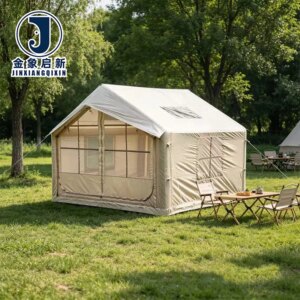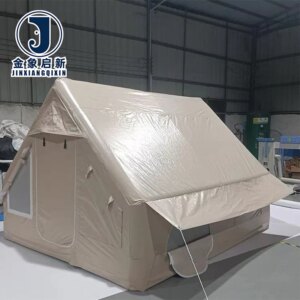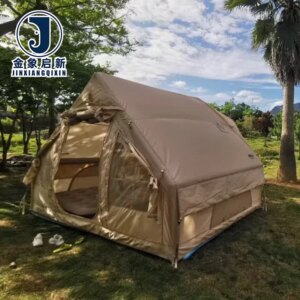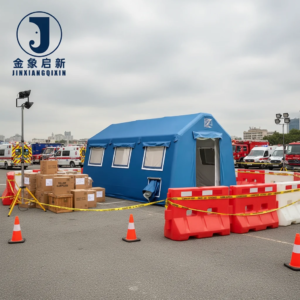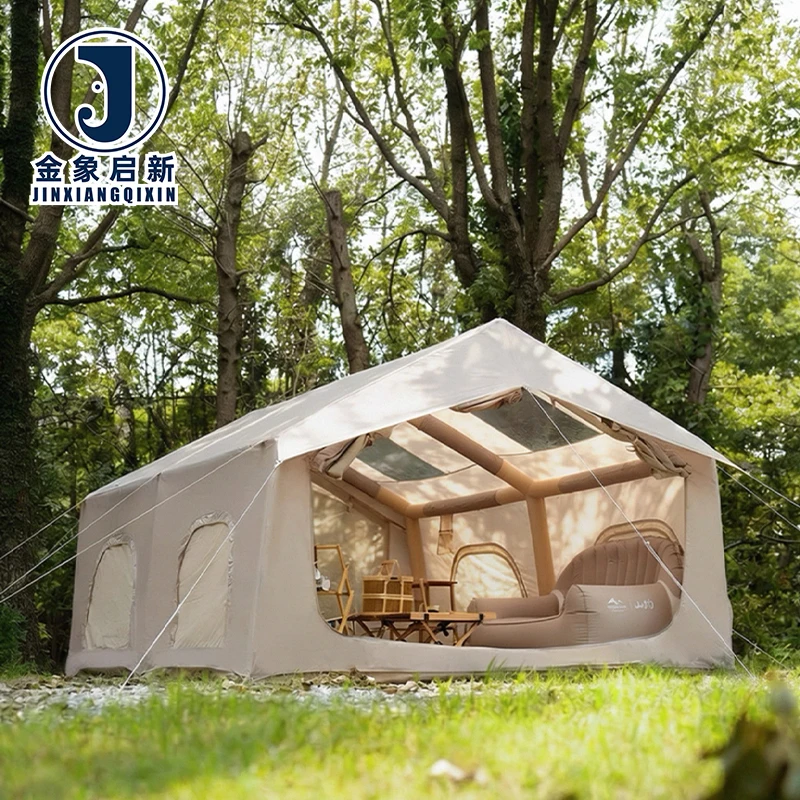
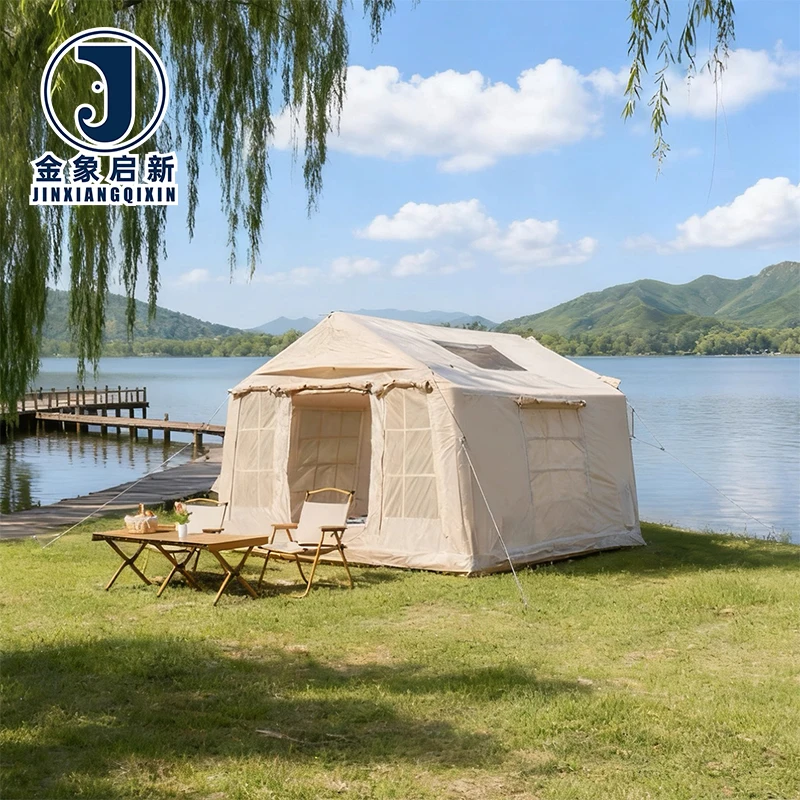
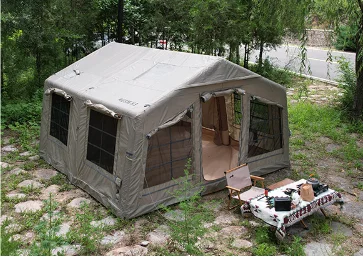
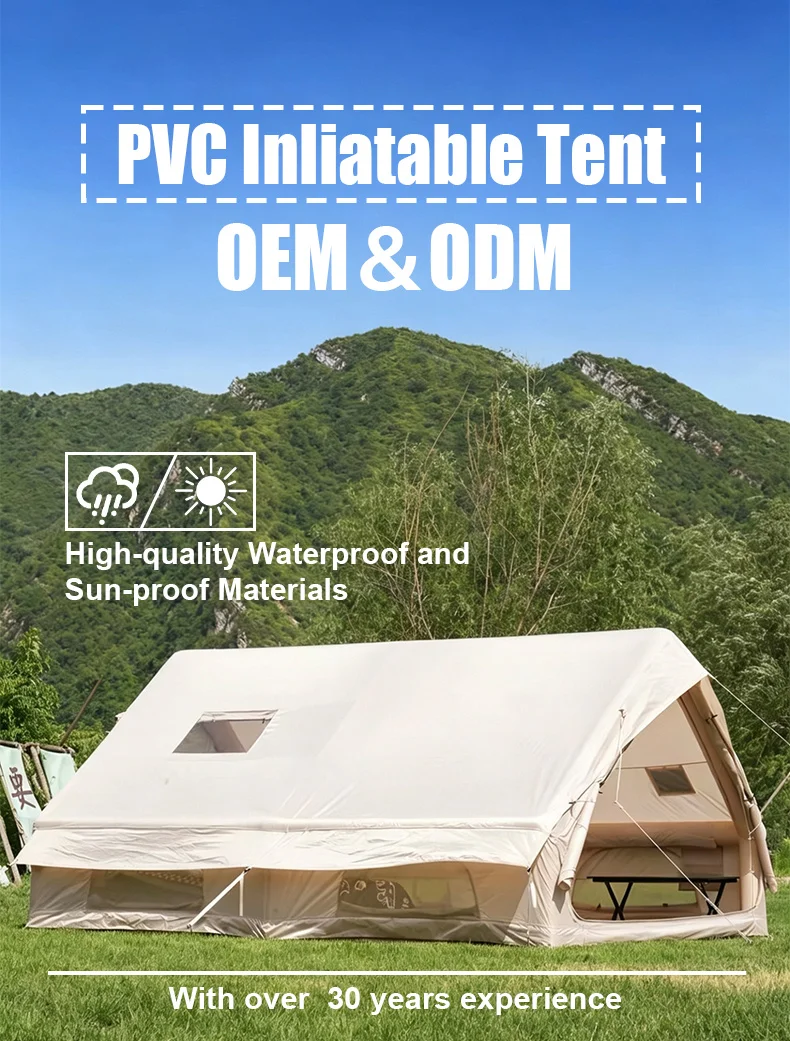
Inflatable Camping Tent, Durable PVC Material, Quick Automatic Opening — single layer, four-season design for year-round industrial deployment.
- Built from PVC coated fabric with waterproof and anti-UV treatment, supporting rapid setup at remote construction sites and temporary workspaces
- Full OEM & ODM customization covering material selection, sizing, and pattern printing
Backed by dedicated QA/QC at every production stage with 100% inspection before shipment, ensuring batch-to-batch consistency.
Description
Deep Process Control Over Coated Fabric — coating weight and adhesion are monitored at every production stage to ensure the inflatable tent fabric maintains structural integrity under continuous inflation cycles and field stress.
Technical Specifications
| Parameter | Value |
|---|---|
| Product Type | Inflatable Tent |
| Core Material | PVC coated fabric |
| Construction | Single layer |
| Key Performance | Quick automatic opening, four-season all-weather design |
| UV Treatment | Anti-UV resistant material (test basis not stated in source) |
| Waterproof Rating | Stable waterproof performance (rating not stated in source) |
| Flame Retardant | Available in flame retardant grades — confirm the grade required for your market |
| Customization | OEM & ODM support, pattern printing, custom sizing |
| Certifications | ISO9001, ISO14001, ISO45001, CE |
Application Suitability
| Application | Exposure & Requirement |
|---|---|
| Temporary shelter at construction sites | Wind load, rain ingress, repeated inflation and deflation cycles, site debris abrasion |
| Outdoor equipment storage space | Prolonged UV exposure, standing water, temperature fluctuation across seasons |
| Temporary workspace in remote locations | Rapid deployment demand, off-grid conditions, dust and sand infiltration |
| Year-round industrial operations | Sub-zero winter deployment, summer heat retention, continuous operational uptime |
Why Coating Adhesion Matters More Than GSM Alone for Inflatable Tent Fabric
An inflatable structure lives or dies at the seam — not in the middle of the panel.
Buyers often focus on GSM when comparing Inflatable Tent Fabric manufacturer custom options, but weight alone does not predict how long a welded seam will hold under the constant internal pressure of an inflated frame. [NEED_CITE: tensile and peel test methods for coated fabrics per ISO 1421] When coating adhesion is weak, the seam delaminates before the base fabric shows any sign of wear. This is especially critical for inflatable tents deployed in industrial settings, where the structure may stay pressurised for days under wind loading and temperature swings. A heavier fabric with poor coating bond will fail faster than a lighter one with strong adhesion.
Single-Layer Construction for Rapid Field Deployment
The single-layer PVC construction of this inflatable tent balances portability with the structural durability needed for inflatable airframes. Reducing layers cuts overall roll weight, which matters when a site crew carries the material to a remote location and needs to achieve full inflation within minutes. The coating formulation is designed to work with standard hot-air welding equipment, so fabricators do not need to recalibrate machines between jobs. An Inflatable Tent Fabric manufacturer custom order in single-layer format also simplifies quality inspection — both sides of the coating are visible and testable without separating bonded plies.
Four-Season Formulation Across Temperature Extremes
Four-season suitability means the PVC compound must remain flexible at low temperatures without becoming overly soft in summer heat. Rigid coating cracks at the fold line when a winter deployment requires the tent to be unpacked and inflated in sub-zero conditions. [NEED_CITE: low-temperature flexibility test standards for PVC coated fabrics] The material used here is formulated to maintain pliancy across seasonal temperature ranges, reducing the risk of cold-cracking at stress points where the inflatable beam bends. This is essential for project managers who cannot afford to wait for warmer weather before establishing a temporary workspace.
Reading the Specification Sheet Beyond the Headline Numbers
Coating weight and base fabric denier work together to determine the final tensile and tear behaviour of the Inflatable Tent Fabric manufacturer custom order. A high-denier base fabric with a thin coating may show strong tensile figures in lab tests but poor abrasion resistance in field use, because the yarns are exposed to direct contact with ground surfaces and equipment edges. The PVC coating method — whether knife-over-roll, lamination, or calendering — directly affects peel strength at welded seams, which is the most common failure point on inflatable beams. Surface finish also plays a role: a glossy top coat sheds water faster and resists dirt adhesion, while a matte finish provides better print adhesion for branded tent panels. Buyers should match these parameters to the specific deployment environment rather than selecting on a single headline figure.
What Happens When Fabric Specifications Do Not Match the Application
Ordering a material that is too light for the intended inflation pressure leads to beam distortion under wind load — the structure does not collapse immediately but slowly deforms until zippers and door frames no longer align. [NEED_CITE: field failure modes of inflatable temporary structures] Colour variation between rolls in the same shipment becomes visible once panels are welded side by side, forcing the contractor to either accept a patchwork appearance or reorder at project expense. When flame-retardant certification is required by local fire safety regulations but the supplied fabric carries no matching test report, site inspectors can shut down operations until compliant documentation is produced. These are not manufacturing defects — they are specification mismatches that surface only after the material is cut, welded, and inflated on site.
Sourcing from a Coated Fabric Specialist
Coating weight and adhesion are controlled in-house through dedicated QA at every production stage, not outsourced to a third-party coater. Three full production lines and 36 sets of professional processing equipment support bulk roll output with consistent quality across batches. A 10-technician R&D team handles material selection, custom sizing, pattern printing, and sample development for specific Inflatable Tent Fabric manufacturer custom requirements. Pre-shipment inspection covers every roll before dispatch, catching GSM deviation and coating defects before they reach the buyer. Samples for custom specifications are developed within days, allowing buyers to validate welding parameters and colour matching before committing to a full production run.
Documentation & Verification
- Material specification sheet stating base fabric, coating method, and PVC weight per square meter
- Test reports for UV resistance and flame-retardant grades matched to batch where applicable
- ISO9001, ISO14001, ISO45001, and CE certificates for compliance documentation
- Pre-shipment inspection record with weight verification per roll against stated GSM
- Roll packing list and certificate of origin for customs clearance support
Fabrication, Handling & Storage
- Hot-air weld temperature should be calibrated to the specific PVC coating weight before production starts
- Store rolls upright on pallets in a dry, shaded area to prevent pressure creasing on the single-layer PVC
- Avoid dragging cut panels across abrasive ground surfaces to protect the outer coating finish
- Clean with mild pH-neutral detergent — solvents can degrade the PVC coating and affect seam adhesion
- Field repairs on minor punctures use compatible PVC adhesive patches matched to the coating formulation
- Plan cutting layout to maximise roll utilisation and minimise cross-grain welds on inflatable beam sections
Request a Specification Recommendation
Provide your target deployment climate, expected inflation pressure range, and any fire-safety classification required in your market. Share the roll width and annual volume you need so we can confirm production line allocation and lead time. If you require printed branding or custom colour matching across multiple rolls, send your Pantone or RAL references with artwork files for sample development.
Frequently Asked Questions
Q: How is GSM and coating weight verified on each roll of inflatable tent fabric before shipment?
A: Every roll undergoes weight verification against the stated specification during pre-shipment inspection. Dedicated QA staff sample from each roll and record the measured GSM on the inspection report. This report accompanies the shipment so you can cross-check received material against the quoted specification before cutting.
Q: What UV test basis supports the anti-UV claim for this fabric?
A: The material is formulated with anti-UV additives for extended outdoor exposure. The specific test standard and exposure hours depend on the grade selected. Confirm the UV test requirement for your target market when requesting a quotation so we can match the appropriate formulation and provide the corresponding test report.
Q: Can custom widths, colours, and printed branding be matched consistently across rolls in one order?
A: Yes. Our R&D team develops a pre-production sample for approval before the full run begins. Colour matching is controlled across the production batch using standardised references. Pattern printing and branding are applied in-line, and batch consistency is verified during the 100% pre-shipment inspection process.
Q: What flame-retardant grades are available for inflatable tent fabric?
A: Multiple flame-retardant grades are available depending on the regulatory requirements of your destination market. Confirm the specific standard your project requires — such as regional building material fire classifications — when inquiring. We will recommend the matching grade and supply the corresponding test documentation with the shipment.
Q: What is the sample development timeline and MOQ for custom inflatable tent fabric?
A: Samples for custom specifications, including colour, width, and printed branding, are typically developed within days of specification confirmation. Minimum order quantities vary by the level of customisation required. Share your detailed requirements so we can provide an accurate sample schedule and MOQ for your project.
Related products
-
Inflatable Tent Family Size Four-Season Quick Automatic Opening Waterproof 2-8 Person Factory Direct Sale
Read more -
Barraca de Camping Inflável PVC Impermeável Resistente a UV Quatro Estações Abertura Rápida Automática Personalizável 2-3 Pessoas
Read more -
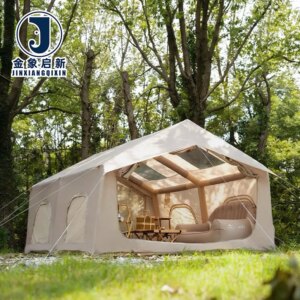
Camping Tent Inflatable UV Resistant Customizable Four-season Waterproof PVC Quick Automatic Opening 2-3 Person Outdoor
Read more -
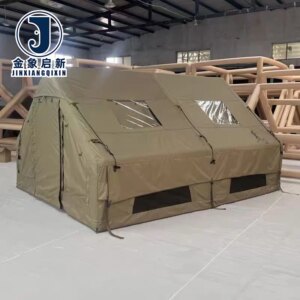
Waterproof Inflatable Camping Tent Outdoor Easy Setup Air Tent for Camping
Read more