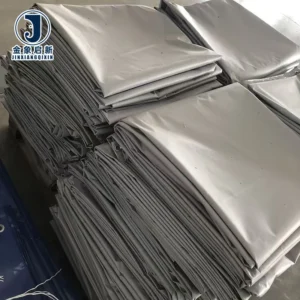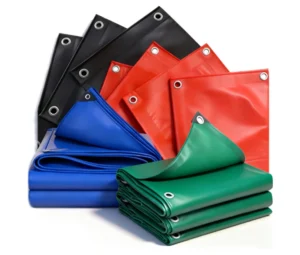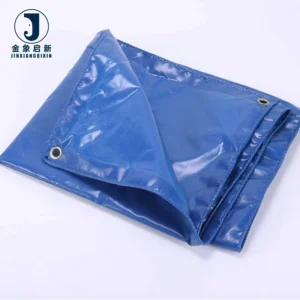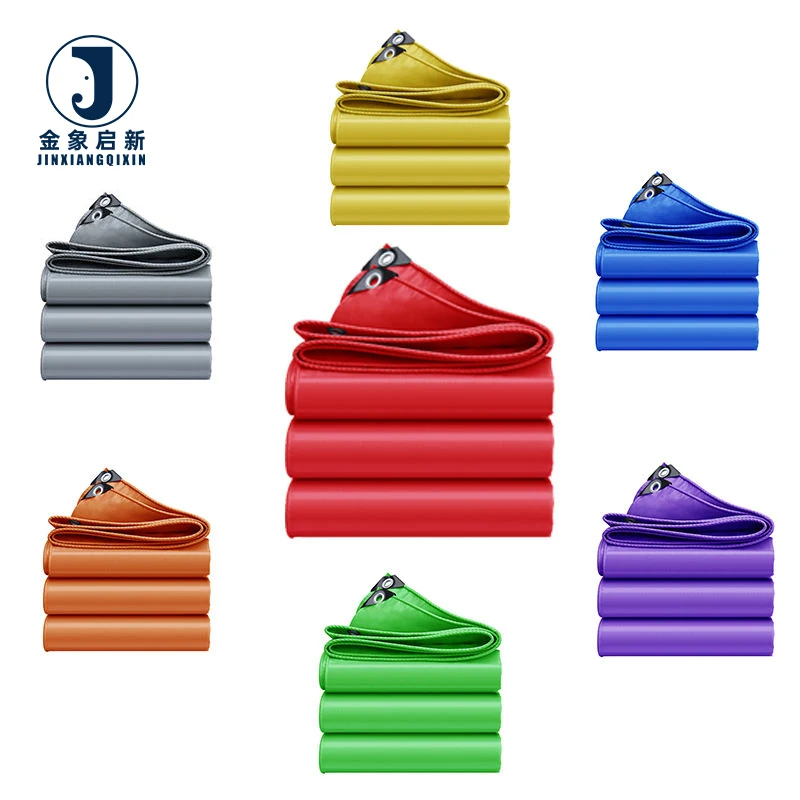
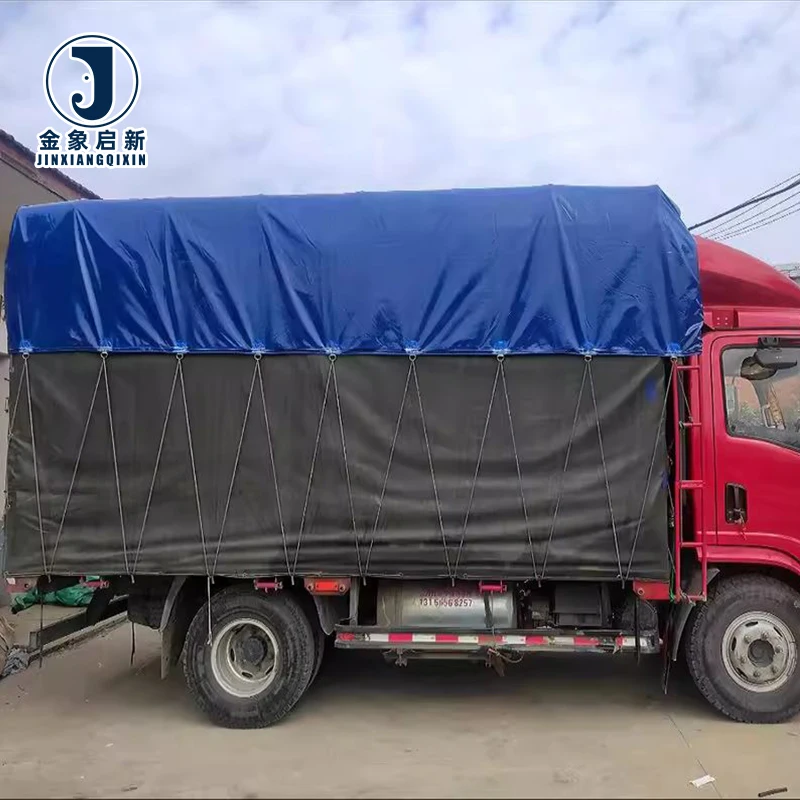
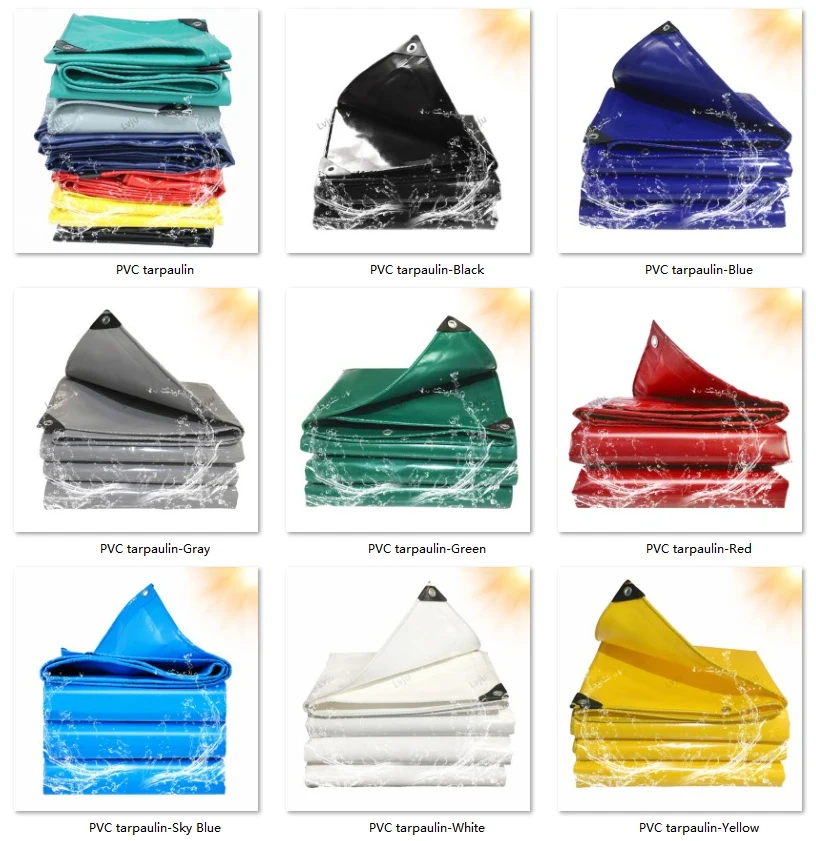
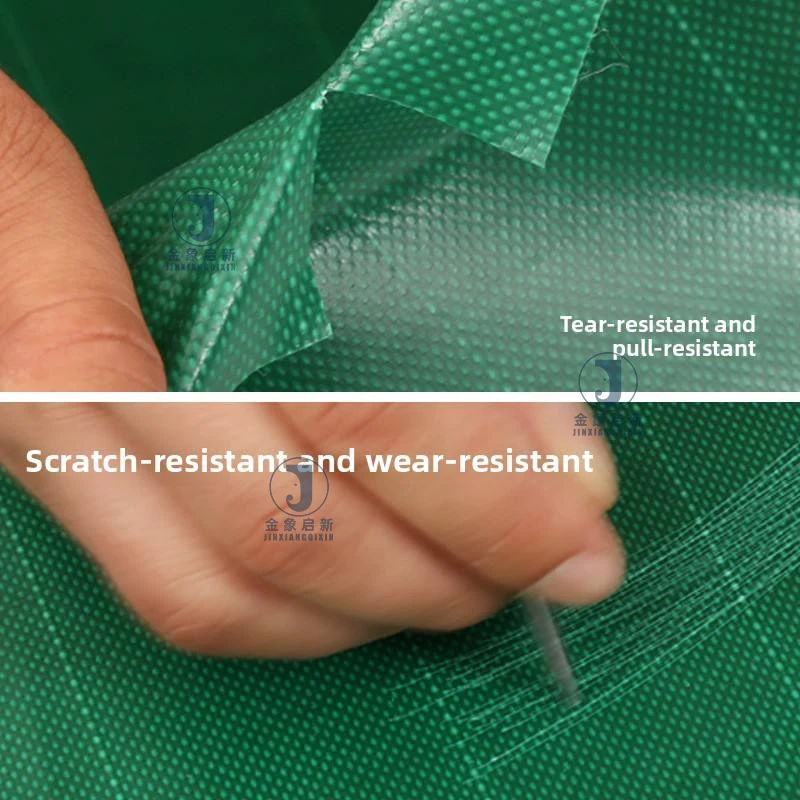
PVC Coated Tarpaulin for Tents & Truck Covers, 400-1500 g/m², 500D-2000D Base, up to 6m Width — 100% PES dipping coated with reinforced PP rope hems and galvanized eyelets at 1m intervals for secure tie-down.
- Weight and base denier matched to tensile demand, not over-specified
- Dipping coating ensures adhesion across flex points where welded seams take the highest load
- Roll width and length set to cut waste and reduce field joins on large covers
Backed by 100% pre-shipment inspection, a 10-person R&D team for custom sizing and print, and three dedicated lines for reliable bulk output.
Description
Deep Process Control Over Coating Weight — Every roll of PVC coated tarpaulin leaving our facility carries a verified GSM that matches the quotation, eliminating the mismatch between stated specification and delivered material.
Technical Specifications
| Parameter | Value |
|---|---|
| Product Type | PVC Coated Tarpaulin |
| Base Fabric | 100% PES, knitting and plain weave construction |
| Base Fabric Denier | 500D / 1000D / up to 2000D (confirm grade for your application) |
| Coating Material | PVC, dipping coating process |
| Weight Range | 400–500 GSM (medium) / 700–1000 GSM (heavy-duty) / 1100–1500 GSM (super heavy) — confirm the grade for this item |
| Total Thickness | 0.35–0.45 mm (medium) / 0.70–1.0 mm (heavy-duty) / 1.2–1.5 mm (super heavy) |
| Tensile Strength | Warp 1500–3000 / Weft 1200–2800 N/5cm (varies by grade, test basis not stated in source) |
| Waterproof | Yes — fully coated construction |
| UV Treatment | Available (test basis not stated in source) |
| Anti-Mildew | Yes |
| Tear Resistance | Tear resistant (verify against manufacturer test report) |
| Roll Width Options | 2m / 4m / 6m / 6ft / 8ft / 10ft / 12ft |
| Roll Length Options | 100 yards / 100 meters / custom |
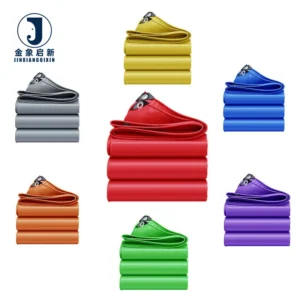
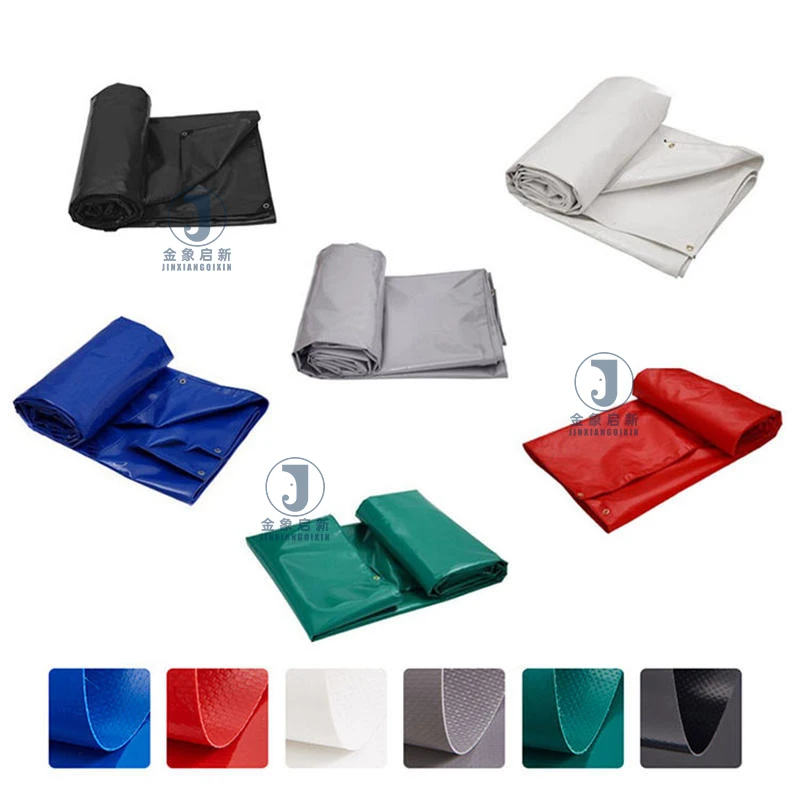
| Color Options | Blue, Blue/Orange, Green, Grey, Black, Clear, Grey/Green, Orange, or custom |
| Hem Reinforcement | PP rope reinforced hem on all four edges |
| Eyelets | Galvanized eyelets every 3ft or 1 meter |
| Corner Reinforcement | Reinforced plastic corners |
| Printing | Custom printing available |
| Flame Retardant | Available in flame retardant grades — confirm the grade required for your market |
| Certification | ISO, CE |
Application Suitability
| Application | Exposure & Requirement |
|---|---|
| Truck and trailer side curtains | Constant flexing at load points, road debris abrasion, prolonged UV and weather exposure, tie-down stress at eyelets |
| Flatbed load covers for steel and lumber | Heavy point loads from sharp-edged cargo, wind uplift during transit, repeated folding and unfolding |
| Tent and awning structures | Tensioned fabric under sustained load, rain pooling risk, solar degradation over extended outdoor seasons |
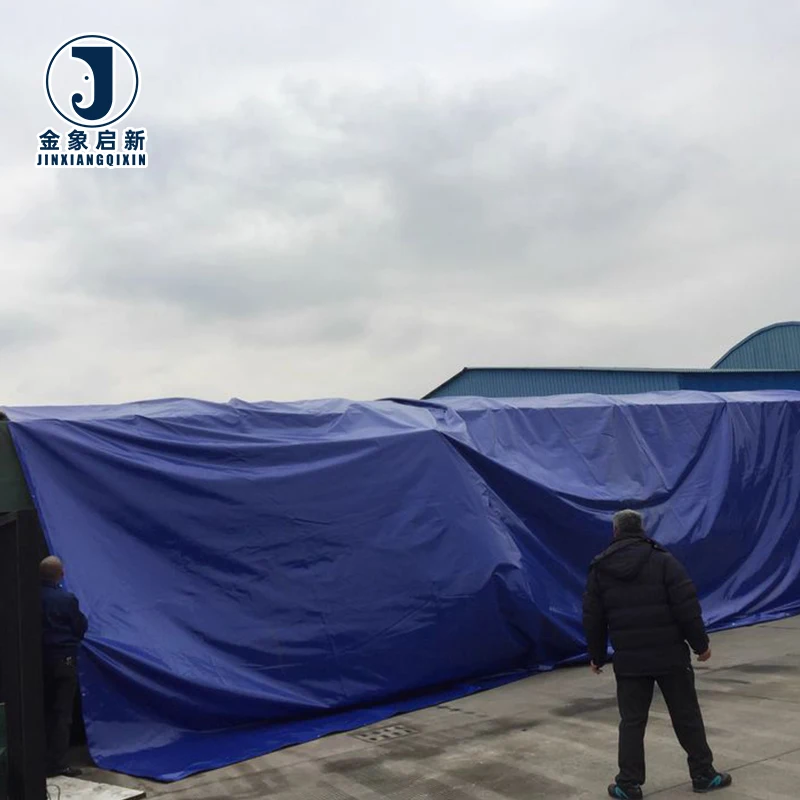
| Industrial pipe canopy and storage covers | Long-term static loading, moisture ingress at seams, chemical residue from stored materials |
| Construction site enclosures | Wind-driven rain, scaffold abrasion, frequent repositioning and mechanical handling damage |
| Tensioned membrane structures | Biaxial stress under wind load, welded seam integrity, colour consistency across large visible surfaces |
Why GSM Alone Does Not Determine How Long Your Tarpaulin Survives on a Truck
Fabric longevity depends on base fabric denier, weave density, and coating adhesion working together — not on weight alone.
Buyers routinely specify a GSM figure on the purchase order and assume the material will perform accordingly. In practice, two PVC coated tarpaulin rolls at the same weight can behave completely differently on a trailer if one uses a loose 500D base and the other a tight 1000D weave. The coating adds mass but not structural integrity when the base fabric is undersized for the application [NEED_CITE: tensile and tear test methods for coated fabrics per ISO 1421]. I have watched logistics fleets replace covers twice a season because the specification conversation stopped at weight and never addressed the denier or weave construction underneath. A PVC Coated Tarpaulin custom manufacturer who understands the full construction stack will always ask about the load profile before recommending a grade.
Three Thickness Tiers Mapped to Real Load Conditions
The medium-weight tier at 0.35–0.45 mm suits light-duty covers and temporary enclosures where the fabric is handled frequently and weight savings matter. Heavy-duty grades at 0.70–1.0 mm cover standard truck tarpaulin and construction site applications where the material faces daily mechanical stress and weather exposure. The super-heavy tier at 1.2–1.5 mm addresses steel tarps, coil covers, and tensioned structures where point loads and sustained biaxial stress demand maximum fabric substance. Selecting the correct PVC Coated Tarpaulin tier for the specific application prevents both overspecification costs and premature field failures.
Full Custom Capability From Roll Width to Printed Branding
Custom width options spanning 2m to 12ft allow buyers to match roll dimensions to their cutting tables, reducing offcuts and weld lines on finished products. Colour matching across multiple rolls in a single order is controlled through batch-level pigment dosing, which matters when large tent panels or truck curtains sit side by side on installation. Custom printing is available for fleet operators who need branded PVC coated tarpaulin surfaces that remain legible after prolonged sun and road salt exposure [NEED_CITE: colour fastness testing methods for coated fabrics under UV exposure]. The R&D team develops samples within days so buyers can approve weight, colour, and print quality before full production begins.
How Base Fabric Construction Drives Tear Propagation
The 100% PES base fabric is available in both knitting and plain weave constructions, each serving different failure-mode profiles. Plain weave interlaces warp and weft at every crossover, producing higher tensile readings but a more rigid hand that can crack along fold lines in cold weather. Knitted construction distributes stress across multiple yarn paths, which slows tear propagation when a puncture starts at an eyelet or a sharp cargo edge. The denier of the base yarn — whether 500D for medium-duty or up to 2000D for super-heavy applications — determines how much energy each individual fibre can absorb before breaking. When you pair a high-denier knitted base with a dipping PVC coating, the resulting composite resists both the initial puncture and the subsequent tear spread that destroys cheaper tarps in the field. Coating adhesion to the base fabric is equally critical: if the PVC layer delaminates under flex stress, the base fabric is left exposed and unprotected.
What Happens When Specifications Are Chosen by Price Instead of Load Profile
When a buyer selects a medium-weight roll for a heavy-duty flatbed application to save on per-metre cost, the cover typically fails first at the welded seams where cargo flexes the material most. The PVC coated tarpaulin fabric itself may hold, but the heat-welded joints concentrate stress and separate after repeated load cycles [NEED_CITE: welded seam strength testing for PVC coated fabrics]. Colour inconsistency between rolls forces tent manufacturers to reject entire batches when panels show visible shade variation after installation. Underspecified eyelet spacing causes grommets to pull through the hem under wind load, leaving the cover flapping and the cargo exposed. Every one of these field failures traces back to a specification conversation that did not account for the actual mechanical and environmental conditions the fabric would face.
Why Sourcing This PVC Coated Tarpaulin Here Makes Sense
Three full production lines and 36 sets of professional equipment run simultaneously, giving bulk orders consistent lead times without splitting batches across subcontracted facilities. A 10-person R&D team handles material selection, pattern printing, custom sizing, and sample development in-house, so specification changes do not require re-quoting from a third-party coater. Dedicated QA and QC checkpoints operate at every production stage rather than relying on end-of-line random sampling, which catches coating weight deviations before the roll is wound. Nearly 30 years of focused coated-fabric production provides the process memory to adjust dipping parameters for seasonal temperature shifts, maintaining adhesion quality year-round. Full documentation — from material specification sheets to pre-shipment inspection records — travels with every shipment, giving your receiving team verifiable data instead of trust-based claims.
Documentation & Verification
- Material specification sheet stating GSM, base fabric denier, coating weight, and colour reference for every PVC coated tarpaulin order
- Pre-shipment inspection record documenting roll-by-roll weight verification against the quoted specification
- UV and flame retardant test reports provided where applicable to the grade ordered
- Roll packing list with net weight, roll count, and dimensions for container loading and customs clearance
- Certificate of origin and full customs support documentation included with every international dispatch
Fabrication, Handling & Storage
- Heat-weld seams at temperatures matched to the PVC coating thickness — heavier grades at 1.2–1.5 mm require slower travel speeds to ensure full fusion
- Install galvanized eyelets through the PP rope reinforced hem to distribute tie-down loads across the rope core, not just the fabric
- Store rolls horizontally on padded racks to prevent flat-spot deformation on the outer coating layer, especially in warm warehouse conditions
- Allow cold-stored PVC coated tarpaulin rolls to reach ambient temperature before unrolling to avoid coating crack at fold lines
- Clean surfaces with mild detergent and soft brush — avoid solvent-based cleaners that can soften the PVC coating and reduce adhesion
- Plan cutting layouts to minimise cross-width welds on wide rolls up to 12ft, reducing the number of potential failure points on finished covers
What We Need From You to Quote Accurately
To provide a specification and sample that matches your actual requirement, share the end-use application, the environmental conditions the fabric will face, and the target market for any fire safety or compliance requirements. Let us know whether you need roll stock for your own fabrication line or finished cut-to-size tarps with specific eyelet spacing and hem reinforcement. If you have a colour reference or printed branding requirement, sending that early allows the R&D team to develop a physical sample for your approval before we schedule production.
Frequently Asked Questions
Q: How can I verify that the GSM on delivery matches the quoted specification?
A: Every PVC coated tarpaulin shipment includes a pre-shipment inspection record with roll-by-roll weight verification. Our QA team weighs samples from each production batch against the stated GSM before the rolls are packed. If you require an independent third-party test report, specify this at the inquiry stage so it can be arranged before dispatch.
Q: Can you match a specific colour across multiple rolls in the same order?
A: Yes. Batch-level pigment dosing ensures colour consistency when multiple rolls of PVC coated tarpaulin are produced in the same run. We recommend requesting a physical colour sample for approval before production begins, especially for large orders where panels will be installed side by side and any shade variation would be immediately visible.
Q: What flame retardant grades are available, and how do I choose the right one?
A: PVC coated tarpaulin fabric is available in flame retardant grades suited to different market requirements. The specific grade you need depends on your end-use application and local regulations. Share your target market and application context at the inquiry stage, and we will confirm the appropriate grade and provide the corresponding test documentation with your order.
Q: Do you supply finished tarps with eyelets and hems, or only roll stock?
A: Both options are available. Roll stock suits buyers with in-house fabrication capability, while finished PVC coated tarpaulin tarps come with PP rope reinforced hems, galvanized eyelets at your specified intervals, and reinforced plastic corners. Custom printing and cut-to-size dimensions are handled on the same production lines, so finished products carry the same QA standards as roll stock.
Q: What is the typical sample lead time for a custom specification?
A: The R&D team develops samples within days once the specification is confirmed. This covers custom width, colour matching, print approval, and weight verification. Approving a physical sample before full production runs eliminates the risk of receiving a batch that does not meet your requirement for weight, colour, or finish.
Related products
-
PVC Fabric Material Woven Tarpaulin Waterproof Woven Fabric Tarpaulin
¥0.50 Add to cart -
500gsm MULTI-PURPOSE Green Waterproof Green Tarp for Emergency Rain Shelter. Outdoor Cover
¥7.72 Select options This product has multiple variants. The options may be chosen on the product page -
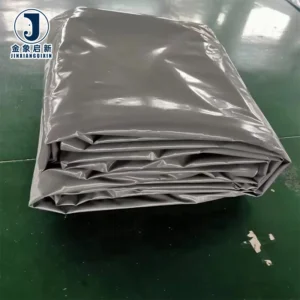
630 Gsm Blue/Grey/Orange Pvc Tarpaulin Roll Pvc Tarpaulin Truck Tarpaulin Pvc Coated Tarpaulin
¥1.66 Add to cart -
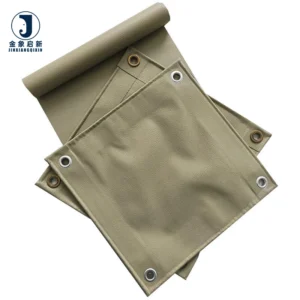
JX PVC Waterproof Fabric High-strength Sheeting for Industrial and Outdoor Coverings
¥1.90 Select options This product has multiple variants. The options may be chosen on the product page