PVC Pool Tarpaulin 440-1000gsm | Wholesale Supplier for Sale
Thicker does not mean longer-lasting. Coating adhesion and UV dosage matter far more than raw GSM.
The best tarpaulin for swimming pool depends on matching GSM range, UV-hour rating, and seam construction to your actual use case — seasonal winter cover, year-round aquaculture conversion, or temporary resort installation. PVC-coated fabrics outperform PE-laminated sheets in tropical and high-wind environments, but PE remains cost-effective for short-cycle, low-UV applications.
I still think about that first container of pool cover fabric we shipped to a shrimp farm conversion project near Can Tho. The buyer wanted waterproof lining, we supplied standard UV-stabilized material, and within weeks the edges turned chalky and started splitting along the fold lines. The equatorial sun in southern Vietnam does not negotiate. We replaced the entire order at our cost. Since then, I have made it a habit to ask buyers exactly how the fabric will be deployed before quoting GSM or coating type — because the failure mode is almost never the material itself, but a mismatch between spec and environment. [NEED_CITE: degradation mechanisms of PVC-coated textiles under tropical UV exposure per IFAI technical bulletins]
Getting the spec right starts with understanding what actually drives service life. Let us walk through the parameters that matter.
PVC vs PE: Which Pool Tarpaulin Material Fits Your Use Case?
PVC-coated polyester and PE-laminated woven fabrics behave fundamentally differently under sustained UV, wind load, and chemical exposure — and there is no universal winner.
The choice between PVC and PE is not about which material is “better” in absolute terms. It is about which failure mode your project can tolerate and which cost structure your buyer accepts.
| Parameter | PVC-Coated Polyester | PE-Laminated Woven |
|---|---|---|
| Base fabric strength | High-tenacity polyester scrim | Woven HDPE tape |
| Coating method | Knife-over-roll or calender | Extrusion lamination |
| UV resistance ceiling | Substantially extended with carbon black loading | Noticeably reduced beyond moderate exposure |
| Waterproofing integrity | Robust — coating encapsulates yarns | Vulnerable — laminate can delaminate |
| Seam options | Heat welding or stitched | Heat welding only (stitching punctures laminate) |
| Typical use case fit | Year-round covers, aquaculture conversion, high-wind zones | Seasonal covers, short-cycle temporary pools |
A resort operator in coastal Kenya ran a side-by-side test on a temporary guest pool. The PE cover held through one dry season but began delaminating at the fold creases before the second rainy season. The PVC replacement, same project, remained intact through multiple seasonal cycles. The unit cost of PE was lower, but the total replacement frequency made the PVC option more economical over the same timeframe. [NEED_CITE: comparative service life of PVC vs PE geomembrane and cover materials in outdoor water containment applications]
For distributors stocking pool covers across multiple climate zones, the practical approach is to carry both: PE for price-sensitive seasonal buyers, PVC for buyers who need the best tarpaulin for swimming pool applications that face year-round sun or chemical exposure.
GSM, UV Hours & Coating: The 3 Specs That Actually Matter
Most buyers fixate on GSM alone — but coating adhesion and UV-hour rating determine whether a pool cover survives one season or several.
GSM tells you the weight of the fabric per unit area. It correlates loosely with puncture resistance and hand-feel, but it tells you almost nothing about how the coating will hold up against sustained sunlight or how well the layers bond together.
The three specifications that actually predict field performance are:
GSM range — Lightweight covers suit temporary or indoor use. Mid-range GSM handles seasonal outdoor covers with moderate wind. Heavy-duty GSM is required for aquaculture-to-pool conversions, permanent installations, and high-wind coastal sites. [NEED_CITE: GSM classification ranges for industrial tarpaulin fabrics per ISO standards]
UV-hour rating — This is the accelerated weathering test result, measured in hours of QUV or xenon-arc exposure before measurable property loss. Standard commercial grades handle moderate exposure. Extended UV formulations are necessary for equatorial and desert installations. The difference between a cover that chalks and cracks versus one that remains flexible is almost entirely a function of UV stabilizer dosage and dispersion quality.
Coating system — PVC coating (knife-coated or calendered) encapsulates the polyester scrim fully, giving superior waterproofing and tear resistance. PVC lamination bonds a pre-formed film to the scrim, which is adequate for many applications but can be vulnerable to edge delamination if not heat-sealed properly. PE lamination is the lightest and cheapest but offers the least chemical and UV resistance of the three.
A buyer in the Arabian Peninsula specified a heavy GSM cover for an outdoor residential pool but did not verify the UV-hour rating. The fabric was thick and felt durable, but the stabilizer package was rated for moderate exposure only. After one summer of direct Gulf sunlight, the surface became brittle. The GSM was high. The UV dosage was not. [NEED_CITE: relationship between UV stabilizer concentration and accelerated weathering hours in PVC-coated technical fabrics]
When you evaluate the best tarpaulin for swimming pool applications, ask for the UV test report, not just the GSM certificate.
Heat Welded vs Stitched Seams: How to Avoid Edge Failure
Seam construction is where most pool covers fail first — and the right choice depends on whether the cover will be folded repeatedly or left stationary.
Heat welding fuses two panels of PVC-coated fabric together using heated air or a welding rod, creating a continuous bonded joint. Stitched seams use thread — typically polyester or nylon — passed through the fabric with an industrial sewing machine, often with a overlapped flap for waterproofing.
The common assumption is that heat welding is always stronger. In practice, the answer depends on the installation pattern:
| Factor | Heat Welded Seam | Stitched Seam |
|---|---|---|
| Waterproofing at joint | Robust — continuous fusion | Resistant — depends on flap overlap and sealant |
| Fold-cycle durability | Vulnerable — repeated flexing causes stress cracking along the weld line | Noticeably reduced — thread abrasion and needle holes |
| Wind-load edge retention | Standard — requires reinforced edge tape | Controlled — rope-hemmed edges distribute load across stitching |
| Field repairability | Difficult — requires portable welding equipment | Noticeably reduced — can be re-stitched with basic tools |
| Best suited for | Stationary covers, winter covers, liner installations | Covers that are regularly folded, rolled, or repositioned |
A landscape contractor in the Levant region installed heat-welded PVC covers on a series of ornamental pools. The covers sat perfectly through winter. But when the client asked for a removable cover on a seasonal display pool — one that would be folded and unfolded weekly — the weld lines began cracking within weeks. Switching to a rope-hemmed stitched design solved the problem entirely. [NEED_CITE: seam failure modes in flexible fabric structures under repeated flexural loading per IFAI engineering resources]
For the best tarpaulin for swimming pool covers that will be removed and reinstalled seasonally, stitched seams with reinforced rope hems typically outperform heat-welded joints. For stationary winter covers and permanent aquaculture liners, heat welding provides superior waterproof integrity.
Total Cost of Ownership: Cheap Tarp vs Long-Life Tarp
The lowest per-square-meter price almost never produces the lowest cost per season of service.
Distributors and project buyers naturally compare quotes on a price-per-square-meter basis. This is rational for a single purchase. But pool covers are consumable assets — they degrade, they get replaced, and the labor cost of removing and reinstalling a failed cover often exceeds the material cost itself.
Consider the total cost of ownership framework:
Material cost per square meter — The upfront invoice price. PE is typically lower than PVC at equivalent weight. Within PVC, lighter GSM is cheaper than heavier GSM.
Expected service cycles — How many seasons or years the cover will last before replacement. This is driven by UV rating, coating quality, and seam construction — not just GSM.
Replacement labor and logistics — Removing a failed cover, disposing of it, and installing a new one involves labor, transport, and potential pool downtime. For commercial pools and resort installations, this cost can dwarf the material savings of a cheaper fabric.
Failure-mode risk — A cover that tears at the seam or delaminates mid-season creates emergency replacement scenarios, which always cost more than planned procurement.
A distributor in West Africa compared two PVC pool cover options for a hotel chain project. Option A was priced noticeably lower per square meter, with a standard UV rating. Option B carried a higher unit price but specified an extended UV stabilizer package and reinforced edge construction. Over the same multi-year period, Option A required replacement twice. Option B remained in service throughout. The total spend on Option A — including two rounds of shipping, customs, and installation labor — exceeded the single-purchase cost of Option B by a substantial margin. [NEED_CITE: total cost of ownership analysis frameworks for industrial textile covers in outdoor applications]
When advising buyers on the best tarpaulin for swimming pool projects, walking them through a replacement-cycle calculation is more persuasive than any spec-sheet comparison.
Sourcing Checklist: What to Ask Your Supplier Before Ordering
Before placing a container order, verify that your supplier can back every claim with documentation — not just verbal assurances.
The gap between a supplier’s quotation and the actual fabric that arrives at the port is where most sourcing problems originate. A structured pre-order checklist protects both the buyer and the supplier’s reputation.
Request the UV test report — Ask for a third-party accelerated weathering test result, specifying the test standard and the hours achieved. Self-reported claims without lab documentation are unverifiable. [NEED_CITE: recognized third-party testing laboratories for UV weathering of coated technical fabrics]
Confirm the coating system — Is the fabric knife-coated, calendered, or laminated? Each method has different performance characteristics. The coating method should match the application requirement.
Specify seam construction — If the cover will be supplied as a finished product, confirm whether edges are heat-welded or stitched, and whether rope hems or D-rings are included. If you are buying roll goods for in-house fabrication, confirm the roll width and whether the supplier can provide welding-grade edge finishes.
Ask about the base scrim — Polyester scrim quality varies. Tenacity, denier, and weave density all affect tear strength. A heavy coating on a weak scrim will not produce a durable fabric.
Verify color and finish consistency — For distributors stocking multiple containers over time, batch-to-batch color matching matters. Ask whether the supplier maintains color standards and can provide reference swatches.
Clarify MOQ and lead time — Roll goods and finished covers have different production flows. Confirm minimum order quantities for both options, and whether custom sizes or colors affect the production timeline.
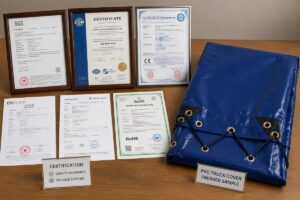
Jinxiang supplies PVC and PE pool tarpaulin fabrics across a full GSM range from light-duty to heavy-duty specifications, with knife-coated and calendered PVC options available. We provide UV test documentation, waterproof certification, and fire-retardant certification where required. Finished covers and roll goods are both available, with flexible MOQ arrangements and custom sizing to match project specifications. For buyers sourcing the best tarpaulin for swimming pool applications, we support specification consultation before order confirmation — because getting the spec right is cheaper than replacing the wrong fabric.
Conclusion
The best tarpaulin for swimming pool applications is the one whose GSM, UV rating, coating system, and seam construction match the actual deployment environment — not the one with the highest number on a spec sheet. Match material to climate, seam type to handling frequency, and evaluate cost per service cycle rather than cost per square meter. Verify every claim with documentation before ordering.