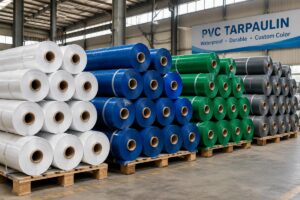
Truck Cover Supplier for Philippines: China Factory Direct
Thicker tarpaulin does not automatically mean longer service life in tropical climates.
When sourcing from a truck cover supplier for Philippines operations, importers must prioritize verified GSM tolerances, coating methodology, and UV-resistance certifications over unit price alone. A China factory-direct partnership eliminates intermediary markups while enabling precise material customization for high-humidity, high-UV environments.
I still remember the sting of watching an entire container of PE tarpaulins get rejected at Manila port years ago. The GSM specification on paper looked right, but the actual rolled product carried a negative tolerance that no one had flagged during production. That mid-six-figure loss reshaped how I evaluate every shipment spec sheet. Since then, I have seen countless Filipino buyers make the same mistake—comparing quotes based on thickness claims alone, only to discover that the material degrades within months under relentless equatorial sun. The real differentiator between a reliable truck cover supplier for Philippines-bound cargo and a risky one lies in transparency: verifiable test reports, controlled coating processes, and documented UV stabilization packages. [NEED_CITE: root cause analysis of tarpaulin field failures in tropical maritime climates]
Let me walk you through the technical and commercial factors that separate a dependable truck cover supplier for Philippines logistics from one that will cost you double in replacement cycles.
PVC vs PE Truck Covers: Which Material Suits the Philippine Climate?
PVC-coated polyester delivers superior durability and UV resistance for heavy-duty Philippine applications, while PE laminated fabric offers a cost-effective solution for short-term or light-duty coverage.
The Philippine climate presents a brutal combination: sustained high temperatures, near-constant humidity, and intense ultraviolet exposure year-round. Choosing between PVC and PE is not just a budget decision—it is a lifespan calculation.
| Parameter | PVC-Coated Polyester | PE Laminated Fabric |
|---|---|---|
| Base Fabric | High-tenacity polyester scrim | Woven PE tape with LDPE lamination |
| Coating Method | Knife-over-roll or calendering | Extrusion lamination |
| Typical GSM Range | Substantially higher load-bearing capacity | Lighter weight options available |
| UV Resistance | Robust with proper stabilizer package | Vulnerable without additive treatment |
| Waterproofing | Verifiable hydrostatic resistance | Basic water repellency |
| Heat Weldability | Excellent seam integrity | Limited—requires tape or adhesive |
| Tear Strength | Noticeably higher directional strength | Moderate, prone to propagation |
| Service Life Expectancy | Substantially extended under tropical exposure | Noticeably reduced without UV package |
[NEED_CITE: comparative weathering performance of PVC versus PE flexible fabrics under accelerated UV testing per IFAI standards]
A mining fleet operator in Cebu once switched from generic PE covers to PVC-coated polyester after experiencing repeated seam failures during monsoon season. The PE covers, despite being labeled “heavy-duty,” showed seam separation within a single rainy season. The PVC replacement, with proper heat-welded seams and controlled UV stabilizer infusion, ran substantially longer before any field-visible degradation appeared.
For a truck cover supplier for Philippines mining and heavy transport sectors, offering both material lines with clear application guidance is non-negotiable. Jinxiang manufactures the full spectrum—from standard PE rolls for agricultural haulage to high-GSM PVC for mineral transport—ensuring buyers match material to actual operating conditions rather than guessing.
Key Specifications to Verify Before Ordering
Demand third-party test reports for every critical parameter; self-declared specifications from unverified sources carry hidden risk.
When evaluating a truck cover supplier for Philippines import, three specification categories separate professional-grade product from commodity-grade risk:
GSM and Tolerance Control
Actual weight must align with declared weight within an industry-acceptable tolerance band. Uncontrolled negative tolerance means you are paying for material that does not exist. Reputable manufacturers provide batch-level weight verification rather than catalog-level claims. [NEED_CITE: industry tolerance standards for flexible coated fabrics per ISO measurement protocols]
Coating Process and Adhesion
Knife-over-roll coating produces a continuous polymer layer mechanically bonded to the base scrim, yielding superior waterproofing and heat-weldability. Extrusion coating or simple lamination may suffice for temporary applications but fails under sustained mechanical flex and thermal cycling. Ask for peel strength data, not just coating thickness claims.
Certification Documentation
Fire retardancy, UV stabilization, and waterproofing certifications must come from recognized third-party laboratories—not factory-internal test sheets. A legitimate truck cover supplier for Philippines-bound orders should provide SGS, TÜV, or equivalent lab reports upon request, with batch traceability linking the report to the shipped product.
| Verification Level | What It Means | Risk If Absent |
|---|---|---|
| Full batch-level testing | Every production lot independently verified | Uncontrolled quality variance |
| Sample-level testing | One representative sample per order | Batch-to-batch inconsistency |
| Self-reported only | No independent verification | Unverifiable claims |
A distributor in Metro Manila learned this the hard way when a shipment of supposedly fire-retardant PVC covers failed on-site inspection by the local fire marshal. The supplier had provided only an internal test sheet—no third-party certification existed. The entire order became unsellable, and the buyer absorbed the full financial hit.
How to Avoid Common Import Pitfalls
Clarify tolerance standards, production timelines, and documentation requirements before placing any order—ambiguity is where losses accumulate.
Working with any overseas truck cover supplier for Philippines delivery involves logistical and quality checkpoints that demand upfront alignment.
Tolerance Agreements
Specify acceptable GSM deviation ranges in your purchase contract. Without written tolerance bands, you have no recourse when delivered product falls below expected weight. Professional manufacturers control production within defined parameters and will confirm these in writing before production begins.
Production and Shipping Timeline
Custom-width rolls, specific color matching, and finished truck cover sewing all require lead time. Ocean freight from Chinese ports to Manila, Cebu, or Davao adds further weeks. A realistic timeline accounts for raw material procurement, production scheduling, quality inspection, and port handling—rushing any stage invites quality shortcuts. [NEED_CITE: typical lead time structures for custom flexible fabric orders from Chinese manufacturing facilities]
Documentation Completeness
Philippine customs and industry regulators require specific import documentation. A seasoned truck cover supplier for Philippines trade understands these requirements and prepares commercial invoices, packing lists, certificates of origin, and any required product certifications in advance. Missing paperwork delays clearance and incurs demurrage charges.
An agricultural transport cooperative in Davao switched suppliers after their previous vendor repeatedly delivered covers with incorrect dimensions—off by several centimeters on width, requiring costly on-site re-cutting. The new supplier, implementing controlled cutting protocols and pre-shipment measurement verification, eliminated dimensional complaints entirely.
Why Choose a China Factory Direct for Philippines Truck Covers?
Direct factory sourcing eliminates intermediary costs, enables custom specifications, and ensures consistent restocking for repeat orders.
The traditional import chain—factory to trading company to local distributor to end buyer—adds layers of cost and communication distortion at each step. When you source directly from a manufacturer-based truck cover supplier for Philippines markets, you gain:
Specification Control
Communicate directly with production engineers about GSM, width, color, coating type, and finishing requirements. No message passes through a middleman who may misinterpret technical details.
Cost Structure Transparency
Factory-direct pricing reflects actual material, labor, and overhead costs without trading company margins stacked on top. For container-load orders, the per-square-meter savings compound significantly.
Customization Flexibility
Whether you need rolls in non-standard widths for specific truck bed dimensions or finished covers with reinforced corner patches and brass eyelets, direct manufacturers accommodate these requests within feasible production parameters.
Restocking Consistency
Repeat orders match previous batches in color, weight, and performance characteristics—a critical factor for distributors maintaining inventory continuity.
Jinxiang operates as a factory-direct truck cover supplier for Philippines buyers across the full GSM spectrum, from light-duty PE agricultural covers to heavy-duty PVC for mining and long-haul transport. Custom dimensions, color matching, fire-retardant treatment, and anti-UV stabilization are all handled within the same production ecosystem, with complete export documentation prepared for seamless Philippine import clearance.
Conclusion
Selecting the right truck cover supplier for Philippines applications requires technical verification, not just price comparison. Material selection between PVC and PE must align with actual operating conditions, specification claims must carry third-party documentation, and import logistics must be planned with realistic timelines. Factory-direct sourcing from an established manufacturer eliminates unnecessary cost layers while providing the customization and consistency that Philippine importers demand.