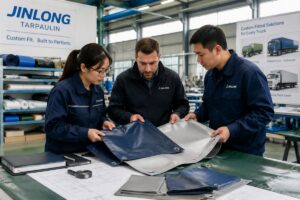
Wholesale Truck Cover Price in Vietnam: 2026 PVC Tarpaulin Supplier Guide
Most buyers assume heavier GSM always means higher price — the real cost driver is UV additive ratio and coating工艺, not the base fabric weight.
In 2026, truck cover price in Vietnam typically ranges from basic PE covers at the lowest tier, to mid-range PVC at 500-650gsm, up to heavy-duty 1000gsm PVC for mining and construction. The final per-square-meter cost depends on three variables: GSM weight, UV resistance grade, and coating type — not just the raw material weight tag.
I still remember a shipment I sent to a Ho Chi Minh City fleet operator a few years back. We quoted standard 500gsm PVC truck cover fabric, the kind that works fine in temperate climates. Three months into the rainy season, the covers started cracking along the fold lines. The driver sent me photos — the material had turned brittle, almost like old newspaper. That failure wasn’t about GSM. It was about UV degradation in southern Vietnam’s intense sunlight, combined with monsoon-level thermal cycling. Since then, I’ve restructured how I spec covers for the Vietnamese market, and the pricing logic follows directly from those lessons. [NEED_CITE: Vietnam’s southern region receives higher annual UV index compared to the north per meteorological data]
Let me walk you through what actually moves the needle on truck cover price in Vietnam this year, and how to avoid the mistakes I’ve seen cost fleets dearly.
What Factors Affect Truck Cover Price in Vietnam 2026?
GSM, UV additive concentration, and coating method are the three pricing variables — and they don’t scale linearly.
Most procurement teams start by asking for a per-square-meter quote based on GSM alone. That’s where the first misunderstanding happens. Yes, heavier fabric costs more per square meter, but the gap between 500gsm and 650gsm PVC is often smaller than buyers expect. The real price jump comes when you add UV stabilizers or switch from single-side to double-side coating.
Here’s how the cost structure typically breaks down:
| Factor | Basic Spec | Mid-Range Spec | Heavy-Duty Spec |
|---|---|---|---|
| GSM Weight | 440-500gsm | 600-700gsm | 800-1000gsm |
| UV Resistance | None | Standard additive | High-concentration UV package |
| Coating Type | PE laminated | PVC single-side | PVC double-side |
| Weld Strength | Basic | Standard | Reinforced |
| Typical Use Case | Light cargo, short haul | Regional freight, seasonal | Mining, construction, heavy abrasion |
A Vietnamese logistics company I work with in Hanoi once compared roll supply versus finished covers. They assumed buying rolls and cutting in-house would save money. But when we factored in material waste from irregular truck bed dimensions and the labor cost of heat welding, the total cost per finished unit was actually higher than ordering pre-cut covers directly. [NEED_CITE: material waste percentage in manual tarpaulin cutting operations]
The lesson: truck cover price in Vietnam isn’t just about the fabric roll tag. It’s about the total cost of getting a functional cover onto your truck.
PVC vs PE Truck Covers: Which Costs More in the Long Run?
PVC costs more upfront but lasts substantially longer — the total cost of ownership favors PVC for most commercial fleets.
This is the second most common question I get. PE covers are cheaper per square meter, no doubt. But PE degrades faster under UV exposure, tears more easily at stress points, and doesn’t hold up well against the abrasion you get from loading and unloading rough cargo.
Let me give you a real example. A construction supply hauler in central Vietnam was using PE covers for their flatbed trucks carrying aggregate and sand. They replaced covers multiple times within a single year. When they switched to 650gsm PVC with reinforced edges, the replacement frequency dropped noticeably. The initial investment was higher, but the annualized cost per truck went down.
| Material | Initial Cost | UV Durability | Abrasion Resistance | Waterproofing | Typical Lifespan |
|---|---|---|---|---|---|
| PE Tarpaulin | Lower | Vulnerable | Basic | Moderate | Short-term |
| PVC Tarpaulin | Higher | Resistant | Robust | Excellent | Extended service life |
The key insight for Vietnamese buyers: if your trucks run daily in high-UV conditions — which is most of the country south of the Hai Van Pass — PVC isn’t a premium option, it’s the baseline. PE makes sense only for seasonal use or indoor storage covers. [NEED_CITE: comparative lifespan data for PVC versus PE tarpaulins in tropical climates]
When you’re calculating truck cover price in Vietnam, always ask for the cost-per-month-of-service, not just the cost-per-square-meter.
How to Choose the Right GSM for Vietnam’s Climate Zones?
Southern Vietnam needs 650gsm minimum with UV protection — northern regions can use 500gsm for standard freight.
Vietnam’s climate isn’t uniform. The south, including Ho Chi Minh City and the Mekong Delta, gets intense year-round UV exposure plus heavy monsoon rains. The north, around Hanoi, has more seasonal variation with cooler winters. Central Vietnam faces the harshest conditions — high UV, heavy rain, and typhoon-force winds during storm season.
I’ve seen covers fail in three months in the south that would have lasted years in temperate Europe. The failure mode is almost always the same: UV degradation breaks down the polymer chains in the PVC coating, then the fabric becomes brittle and cracks under mechanical stress.
Here’s how I recommend matching GSM to region and use case:
| Region | Recommended GSM | UV Protection Level | Coating Requirement |
|---|---|---|---|
| Southern Vietnam (HCMC, Mekong) | 650gsm and above | High-concentration UV package | Double-side PVC coating |
| Northern Vietnam (Hanoi, Red River Delta) | 500-600gsm | Standard UV additive | Single or double-side PVC |
| Central Vietnam (Da Nang, Hue) | 700gsm minimum | High UV plus wind resistance | Reinforced double-side PVC |
| Mining and heavy abrasion zones | 800-1000gsm | Maximum UV package | Heavy-duty PVC with wear layer |
A fleet operator in Da Nang learned this the hard way. They ordered 500gsm covers for their entire fleet, same spec they used in northern routes. Within one typhoon season, the central region covers were shredded. The southern fleet held up better but still showed premature aging. [NEED_CITE: regional UV index and weather pattern data for Vietnam climate zones]
When you’re evaluating truck cover price in Vietnam, spec the GSM based on your actual operating region, not the cheapest option on the quote sheet.
Roll Supply vs Finished Covers: What’s the Real Total Cost?
Rolls look cheaper per square meter, but processing waste and labor can flip the economics — finished covers often win for small and mid-size fleets.
This is the third misconception I encounter regularly. Buyers see the roll price per square meter, then compare it to the finished cover price, and assume they’ll save money by buying rolls and manufacturing in-house. Sometimes that’s true. Often it’s not.
Let me break down the hidden costs of the roll-to-finished route:
- Material waste from irregular truck bed dimensions — you can’t nest-cut like a professional factory
- Labor cost for cutting, edge finishing, and heat welding
- Equipment investment for welding machines and cutting tables
- Quality inconsistency — hand-welded seams fail more often than machine-welded
- Lead time — in-house processing adds days or weeks before covers are truck-ready
I worked with a mid-size logistics company in Binh Duong that had a small sewing and welding workshop. They bought rolls from us and made their own covers. After six months, they calculated that their total cost per finished cover — including material waste, labor, equipment depreciation, and reject rate — was actually higher than if they’d just ordered finished covers from us. The break-even point for in-house manufacturing only makes sense at very high volume, typically full-container-load quantities of standardized sizes.
| Procurement Method | Best For | Hidden Costs | Quality Control |
|---|---|---|---|
| Roll Supply | Large fleets with in-house manufacturing, standardized truck sizes | Material waste, labor, equipment, reject rate | Depends on in-house capability |
| Finished Covers | Small to mid-size fleets, custom truck dimensions, no manufacturing facility | Higher per-unit price, but predictable total cost | Factory-controlled, consistent |
For most Vietnamese truck cover buyers — especially those operating diverse fleet sizes or custom-built trucks — finished covers deliver better value. The truck cover price in Vietnam for finished units includes the manufacturing margin, but it also eliminates your processing risk. [NEED_CITE: total cost comparison methodology for roll versus finished tarpaulin procurement]
Where to Source Reliable Truck Covers for Vietnam?
Direct sourcing from certified Chinese manufacturers cuts costs noticeably — but UV certification verification is non-negotiable.
Vietnam’s geographic proximity to China makes cross-border sourcing logistically efficient. Shipments from Qingdao or Ningbo to Haiphong or Ho Chi Minh City ports move quickly, and the cost advantage of Chinese manufacturing is substantial compared to sourcing from local distributors or third-country suppliers.
But here’s where buyers get burned: not all PVC tarpaulin is created equal, and not all suppliers can back up their UV resistance claims with verifiable test data. I’ve seen quotes from suppliers claiming “UV resistant” fabric, but when asked for third-party test reports showing actual hours of UV exposure testing, they couldn’t provide documentation.
When you’re evaluating truck cover price in Vietnam from Chinese suppliers, here’s what to verify:
- Third-party UV testing certification with actual test hour data
- GSM range capability — can they supply from light-duty to heavy-duty specs?
- Coating type options — single-side, double-side, laminated?
- Finished product capability — can they deliver ready-to-install covers, not just rolls?
- MOQ flexibility — can they handle small trial orders before you commit to container loads?
- Export documentation — do they handle all customs and compliance paperwork?
A distributor in Ho Chi Minh City sources full container loads of PVC tarpaulin rolls from a Shandong-based manufacturer. They’ve been doing this for years because the factory provides consistent quality, full GSM range coverage, and verifiable UV test reports. The per-square-meter cost is lower than sourcing through regional traders, and the quality consistency means fewer customer complaints. [NEED_CITE: import statistics for PVC tarpaulin into Vietnam from China]
The truck cover price in Vietnam from direct Chinese sourcing is typically lower than regional distributor pricing, but only if you verify the technical specs and don’t just chase the cheapest quote.
Conclusion
Truck cover price in Vietnam is driven by GSM, UV protection, and coating type — not just base material weight.
Smart buyers spec based on regional climate conditions, calculate total cost of ownership rather than per-square-meter price, and verify technical certifications before committing to suppliers. Whether you source rolls or finished covers depends on your fleet size and manufacturing capability, but the economics often favor finished products for small to mid-size operations. Direct sourcing from certified manufacturers delivers cost advantages, but only when you validate UV resistance claims with actual test data.