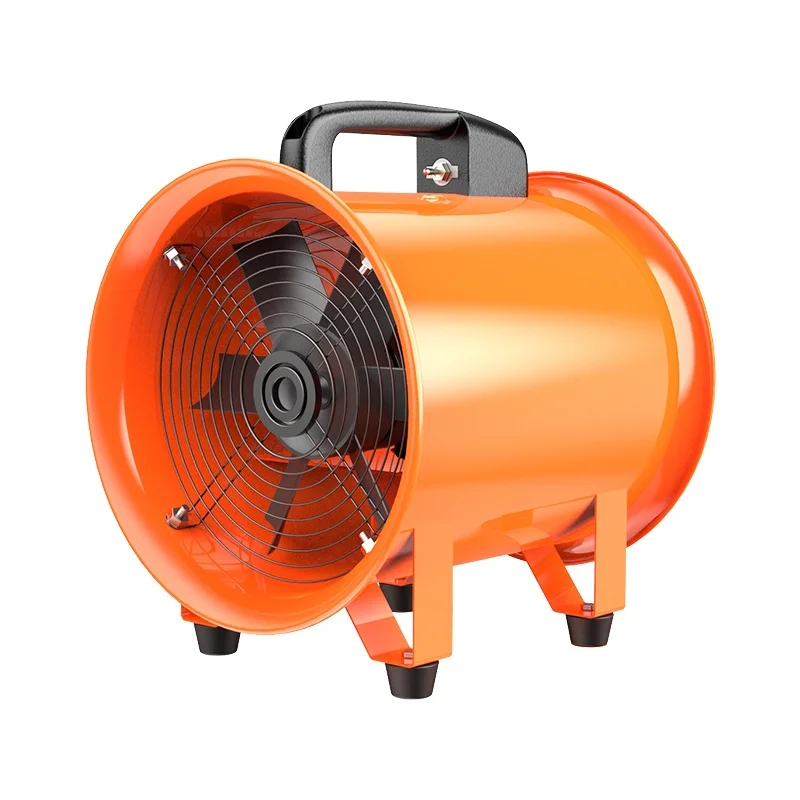
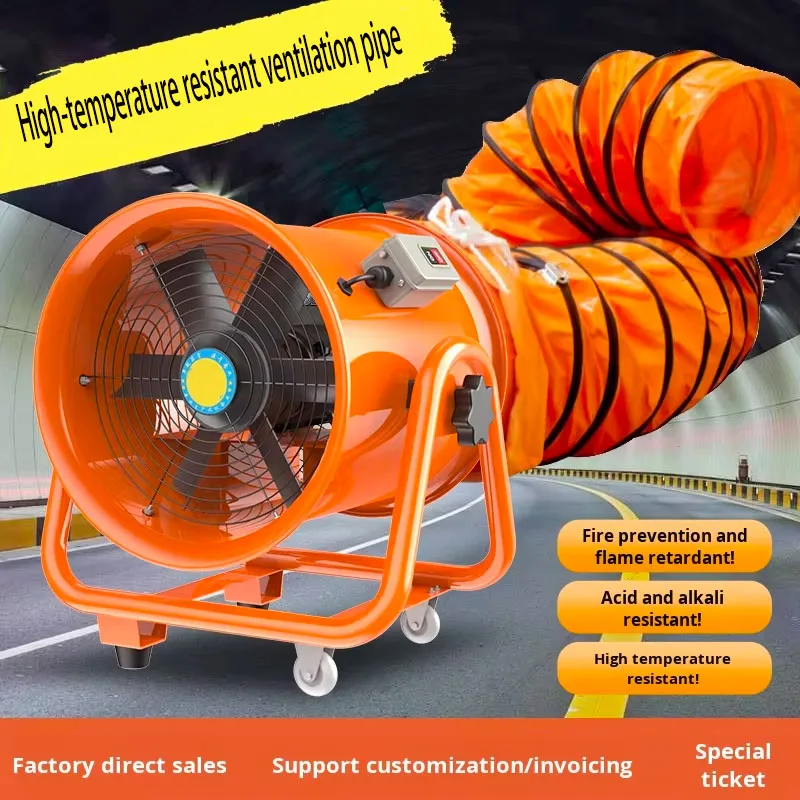
Portable Axial Flow Exhaust Fan, 200mm-900mm, 250W-5500W — ball bearing construction with cast iron housing for confined space ventilation across construction, workshop and mining environments.
- 11 size options covering 1300 m³/h to 28000 m³/h airflow
- Dual voltage 220V/380V compatibility for flexible site deployment
- Noise levels 57-88 dB(A) depending on model selection
Three full production lines and 36 sets of equipment ensure bulk capacity with on-time delivery for your ventilation projects.
Description
Nearly three decades focused on coated fabric — deep process control over coating weight and adhesion ensures every roll of this Portable Axial Flow Exhaust Fan meets the airflow and durability demands of confined space ventilation.
Technical Specifications
| Parameter | Value |
|---|---|
| Product Type | Portable Axial Flow Exhaust Fan |
| Size Options | 200mm / 250mm / 300mm / 350mm / 400mm / 450mm / 550mm / 650mm / 750mm / 850mm / 900mm |
| Power Range | 250W to 5500W |
| Air Volume Range | 1300 m³/h to 28000 m³/h |
| Total Pressure Range | 140 Pa to 320 Pa |
| Voltage | 220V / 380V |
| Noise Level | 57-88 dB(A) depending on size |
| Bearing Type | Ball Bearing |
| Housing Material | Cast Iron |
| Customization | ODM Available |
Application Suitability
| Application | Exposure & Requirement |
|---|---|
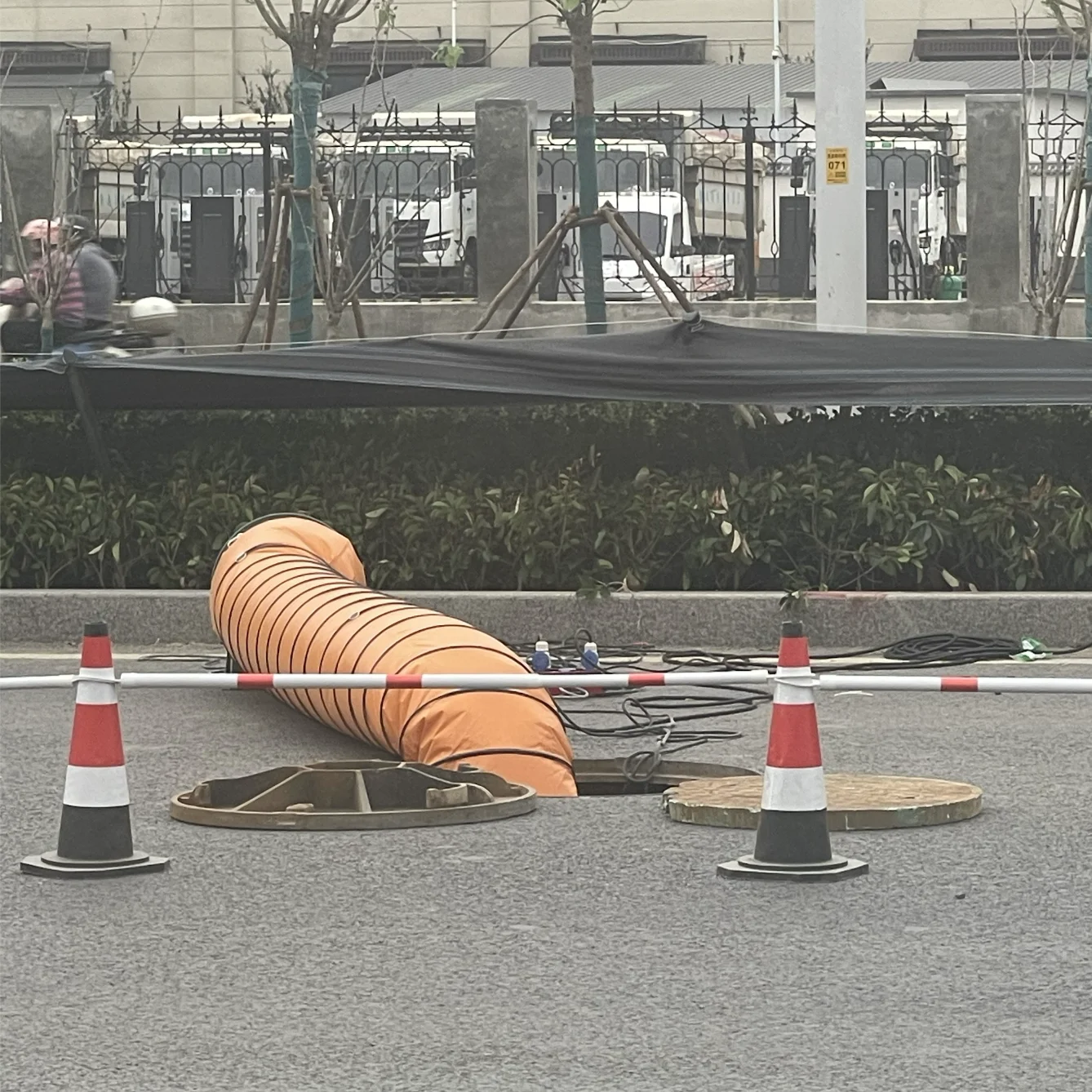
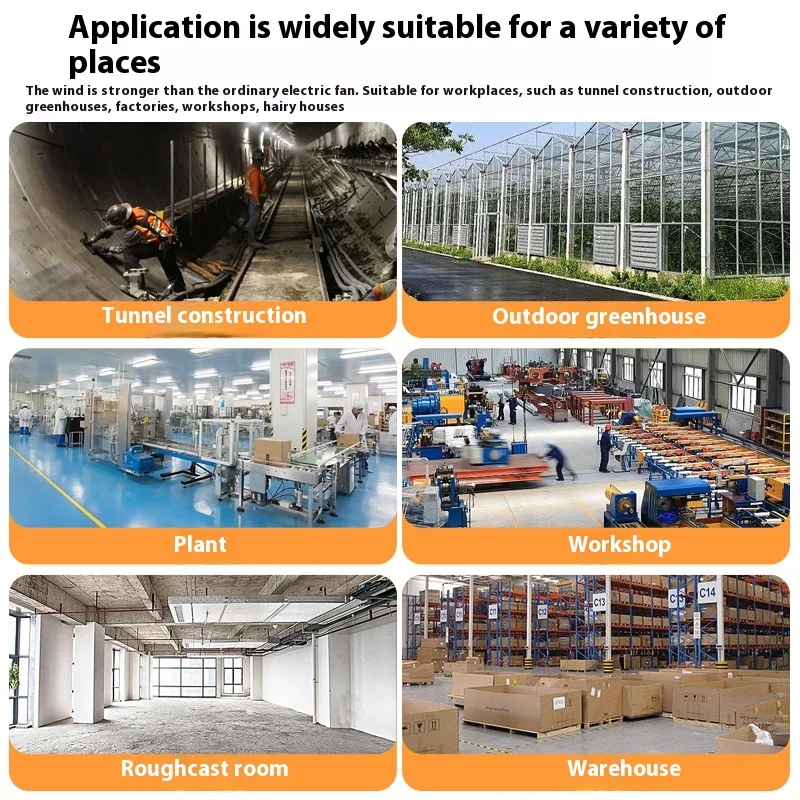
| Confined space ventilation | Limited access areas requiring immediate air exchange during construction or maintenance work, where standard equipment cannot fit. |
| Workshop exhaust extraction | Continuous removal of welding fumes, dust, and chemical vapors in fabrication environments, demanding reliable motor endurance. |
| Construction site ventilation | Tunnel and trench airflow management where equipment faces physical impact, moisture, and variable power supply conditions. |
| Emergency smoke removal | Rapid deployment for fume extraction during renovation or repair projects, requiring portable setup and dual voltage compatibility. |
Why Airflow Volume Alone Does Not Guarantee Effective Ventilation
The right fan size must match both the space volume and the duct resistance to deliver usable airflow at the extraction point.
When contractors specify an axial flow exhaust fan based solely on maximum air volume ratings, they often discover the actual delivered airflow falls short once ducting, bends, and filters are added to the system. The total pressure rating determines how well the fan pushes air through resistance, and undersizing this parameter means the fan struggles in real-world configurations. I have seen job sites where the fan ran continuously but fumes still accumulated because the pressure curve was not matched to the duct run length. [NEED_CITE: relationship between total pressure and effective airflow in ducted ventilation systems]
Ball Bearing Construction for Extended Service Intervals
The ball bearing design in this Portable Axial Flow Exhaust Fan reduces friction and heat buildup during continuous operation, which directly extends the service interval between maintenance cycles. Unlike sleeve bearing alternatives that require regular lubrication and wear faster under heavy loads, ball bearings maintain stable rotation across the full power range from 250W to 5500W. This matters on sites where the fan runs for extended shifts without shutdowns.
Cast Iron Housing for Industrial Abuse Tolerance
The cast iron housing provides structural rigidity that absorbs impact and vibration without cracking or deforming, a common failure point in stamped steel or plastic housings when equipment is moved frequently between job sites. This material choice adds weight but delivers the durability needed when fans are loaded onto trucks, dropped onto concrete floors, and exposed to debris. The housing also dampens motor noise, contributing to the measured noise range of 57-88 dB(A) across the size options.
Matching Fan Diameter to Duct Configuration
Selecting from the eleven available diameters — 200mm through 900mm — requires calculating both the required air changes per hour for your space and the static pressure loss through your duct layout. A 400mm fan may deliver adequate volume in a straight duct run but lose effectiveness when multiple bends restrict flow. The air volume range of 1300 m³/h to 28000 m³/h spans light-duty workshop extraction to heavy industrial tunnel ventilation. [NEED_CITE: duct static pressure calculation methods for axial fan selection]
The Cost of Undersizing Your Ventilation Equipment
When the fan diameter is too small for the duct resistance, the motor works harder to maintain airflow, leading to overheating and premature bearing wear. Conversely, oversizing creates excessive noise and energy consumption without proportional ventilation benefit. I have reviewed projects where the wrong size selection forced contractors to add secondary fans mid-project, doubling equipment rental costs and complicating duct routing. Specifying correctly upfront avoids these compounding expenses. [NEED_CITE: energy consumption and motor thermal limits in undersized axial fans]
Why Procurement Verification Matters Here
Our production lines undergo dedicated QA/QC at every stage, with 100% inspection before shipment catching dimensional deviations and electrical faults before they reach your site. The 10-person R&D team handles custom voltage requirements and ODM modifications, developing samples within days when standard specifications do not match your power infrastructure. Documentation includes test records verifying actual air volume and pressure output against rated values, not just catalog claims. This systematic approach reduces the risk of receiving equipment that fails acceptance testing upon arrival.
Documentation & Verification
- Air volume and pressure test records confirming performance at rated voltage before dispatch
- Noise level measurement report for each size variant in the order
- Electrical safety test documentation for 220V and 380V configurations
- Material certificate specifying cast iron grade and bearing specification
- Pre-shipment inspection record with dimensional verification against ordered diameter
Fabrication, Handling & Storage
- Verify voltage matches site supply — 220V and 380V models are not interchangeable without transformer
- Store cast iron housing units on pallets to prevent moisture contact and base corrosion during extended site storage
- Inspect ball bearing assembly for smooth rotation before first energization after transport
- Use appropriate lifting equipment for larger diameters (750mm and above) due to cast iron weight
- Confirm duct diameter matches fan outlet flange to avoid airflow leakage at connection points
Requesting the Correct Specification
To specify the right Portable Axial Flow Exhaust Fan for your application, provide the volume of the space requiring ventilation, the duct run length and number of bends, and your site voltage availability. If your project has noise restrictions for occupied areas, indicate the maximum acceptable dB(A) level so we can recommend the appropriate size within the 57-88 dB(A) range. For custom voltage or frequency requirements outside 220V/380V, share your target market specifications to confirm ODM feasibility.
Frequently Asked Questions
Q: What size fan do I need for my space volume?
A: Calculate the room volume in cubic meters and multiply by the required air changes per hour for your application — typically 10-20 for workshops, higher for confined spaces with fume generation. Match this target airflow to our air volume range of 1300 m³/h to 28000 m³/h, then verify the total pressure rating of 140 Pa to 320 Pa is sufficient for your duct configuration. We can recommend the specific diameter from our 200mm to 900mm range based on your calculations.
Q: Can this fan handle continuous 24/7 operation?
A: The ball bearing design supports extended run times with reduced friction and heat buildup compared to sleeve bearing alternatives. Continuous operation capability depends on the specific power rating within our 250W to 5500W range and ambient temperature conditions. Request the duty cycle specification for your selected size to confirm it matches your operational requirements before committing to the order.
Q: What’s the difference between 220V and 380V models?
A: The 220V models suit single-phase site power commonly available in workshops and renovation projects, while 380V three-phase models deliver higher power output for the larger diameter fans in our range. Voltage selection affects motor winding configuration and starting current. Confirm your site electrical infrastructure before ordering, as the two variants are not field-convertible without external transformer equipment.
Q: Do you provide ducting accessories with the fan?
A: Our standard supply covers the axial flow exhaust fan unit with cast iron housing and ball bearing assembly as specified. Ducting, flanges, and connection hardware are sourced separately or can be included through ODM arrangement. When requesting a quotation, specify whether you need outlet flange dimensions for your existing duct system or require matched ducting components as part of the complete ventilation package.
Q: Can I order custom voltage or frequency specifications?
A: ODM customization is available for voltage and frequency requirements outside our standard 220V/380V offerings, subject to motor winding feasibility for your selected size and power rating. Provide your target market electrical standards and annual volume requirement to initiate the sample development process. Our R&D team typically delivers custom specification samples within days for evaluation and approval before production commitment.
Related products
-
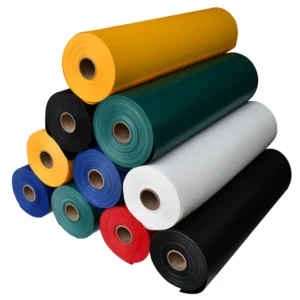
PVC Coated Tarpaulin Fabric for Awning and Tents – Custom Made
Read more -
Custom PVC Tarpaulin Water Storage Tank for Irrigation – Manufacturer
Read more -
Custom Made Collapsible Rain Barrel for Garden Water Storage – Manufacturer
Read more -
Collapsible PVC Rain Water Tank for Garden Use – Custom Made
Read more