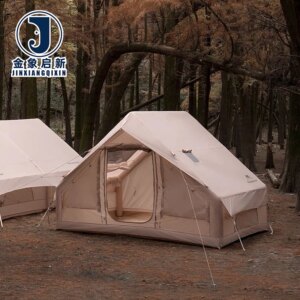
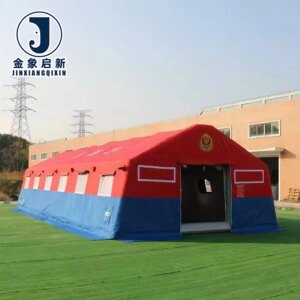
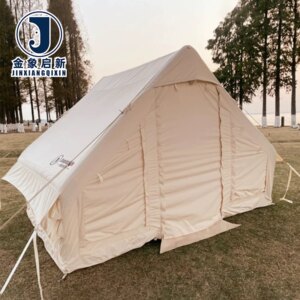
Inflatable Tent — waterproof, UV-resistant, fire-retardant PVC tarpaulin for commercial deployment. Built for rapid setup and year-round outdoor use across construction sites, logistics hubs, and emergency response operations. Full OEM/ODM support with custom sizing, pattern printing, and material selection.
- 2-8 person capacity configurations
- Dedicated QA/QC with 100% pre-shipment inspection ensures batch consistency
- Samples developed within days to validate specifications before production
Description
Process Control Over Coated Fabric — every inflatable tent run is backed by 100% pre-shipment QA across coating adhesion, seam strength, and treatment verification.
Technical Specifications
| Parameter | Value |
|---|---|
| Product Type | Inflatable Tent |
| Core Material | PVC Tarpaulin |
| Product Forms | Inflatable Camping Tent |
| Capacity | 2-8 Person |
| Season Rating | 4-Season |
| Key Features | Waterproof, UV-Resistant, Tear-Resistant, Fire-Retardant, Anti-Static |
| Customization | OEM & ODM (sample customization, pattern printing, material selection, product design) |
| Certifications | ISO9001, ISO14001, ISO45001, CE |
Note: UV-resistant, fire-retardant, and anti-static properties are available — confirm the specific grade or test standard required for your market.
Application Suitability
| Application | Exposure & Requirement |
|---|---|
| Temporary site shelters for construction projects | Continuous weather exposure, wind loading on inflatable frame, abrasion from site debris |
| Mobile storage facilities in logistics hubs | Rain and dust ingress prevention, frequent inflation/deflation cycles, UV exposure during staging |
| Outdoor event pavilions | High foot traffic, rapid deployment, public safety compliance including flame retardancy |
| Emergency response stations for industrial operations | All-weather deployment, fast inflation for rapid setup, visibility and branding requirements |
Why "Flame Retardant" Means Nothing Without a Verified Grade
Request the test report before you approve the sample — not after the container ships.
Inflatable tents deployed on construction sites or at public events sit under fire safety scrutiny from day one. Buyers frequently receive fabric described as flame retardant on the quotation, only to discover at site inspection that no test certificate accompanies the shipment. The tent passes visual checks but fails the safety audit, delaying the project or forcing an expensive replacement mid-deployment. [NEED_CITE: fire classification standards for temporary structures and tents]
When sourcing an Inflatable Tent manufacturer, the gap between a marketing claim and a verifiable grade is where projects stall. A B1 rating per DIN 4102 means something specific in European markets; an NFPA 701 result carries weight in North America. Without the paperwork, the fabric is simply ungraded regardless of its actual behaviour under flame.
Full-Catalogue Capability for Inflatable Shelter Specifications
This is not a stock product picked from a shelf. The inflatable tent range covers capacities from two-person field shelters to eight-person operational pavilions, and each configuration can be developed from the base fabric specification upward. An Inflatable Tent manufacturer with in-house coating and fabrication lines can adjust material weight, panel layout, and inflation tube diameter to match the structural load and deployment speed your application demands.
Pattern printing, window placement, door configuration, and anchoring method are all variables that get locked during the sample stage. The 10-person R&D team develops prototypes within days, allowing buyers to validate dimensions, inflation pressure, and pack size before committing to a production run. This sample-first process eliminates the most common source of dispute: a bulk order that does not match the buyer’s expectation.
How Coated Fabric Quality Determines Inflatable Frame Integrity
The air tubes that form the structural skeleton of an inflatable camping tent endure internal pressure, external wind load, and repeated flex cycles every time the unit is inflated and deflated. The PVC tarpaulin used for these tubes must maintain coating adhesion to the base fabric through thousands of pressurisation cycles without delamination. [NEED_CITE: coating adhesion test methods for PVC coated fabrics per ISO 2411]
A failure at the weld seam or a pinhole in the tube wall does not just leak air — it compromises the entire shelter. Fabric destined for inflatable structures therefore requires tighter control over coating weight consistency and weld seam strength than material used for flat covers. Batch-specific inspection records confirm that each roll meets the adhesion and tensile thresholds set during sample approval.
Reading Between the Specs: What Actually Drives Tent Fabric Performance
The PVC tarpaulin core material is defined by more than its surface weight. Base fabric denier and weave density determine how the material resists tear propagation — a high denier yarn in a tight weave stops a puncture from becoming a split. Coating weight and the method of application influence how well the fabric heat-seals at panel joints, which is the critical junction on any custom Inflatable Camping Tent.
Fire-retardant and anti-static treatments are available in different grades depending on market requirements, and these treatments affect surface feel, weld temperature settings, and long-term colour stability. UV-resistant formulations extend service life under continuous sun exposure but must be selected to match the expected deployment duration and latitude. Each of these variables interacts with the others, which is why material selection is handled during the sample development stage rather than assumed from a generic data sheet.
The Hidden Cost of Skipping Pre-Production Verification
Buyers who approve a quotation based on a PDF specification sheet and skip the sample stage often encounter problems only visible at full scale. Colour drift between rolls becomes apparent when panels are welded side by side on a large pavilion. Weld seam strength that passed on a small test coupon may behave differently across a long production seam where heat input varies. [NEED_CITE: common causes of seam failure in welded PVC structures]
Fire-retardant treatment applied unevenly across a production batch can leave some panels below the required threshold, a defect that only surfaces during the compliance audit. These are not fabric defects in the traditional sense — they are process control gaps that a rigorous in-line QA programme catches before the material leaves the factory. The consequence of skipping verification is never just a return; it is a site shutdown, a failed inspection, or a reputational hit with the end client.
Why Procurement Teams Specify Through This Line
Nearly 30 years of focused coated fabric production means the coating formulation, lamination parameters, and welding behaviour are controlled from resin to finished roll. Three full production lines and 36 sets of professional equipment give the capacity to fulfil bulk inflatable tent orders without splitting a single run across multiple facilities, which protects batch consistency.
Dedicated QA and QC personnel inspect at every stage — incoming base fabric, post-coating weight and adhesion, post-treatment flame and UV verification, and final pre-shipment audit. The documentation package travels with the goods, so the receiving warehouse can verify the shipment against the purchase specification without waiting for email exchanges. Custom requirements, from non-standard panel dimensions to specific pattern printing, move through the R&D team and into production on the same site, keeping the feedback loop short.
Documentation & Verification
- Material specification sheet stating PVC coating type, base fabric denier, and treatment details
- Test reports for UV and flame-retardant grades where applicable to your market
- Pre-shipment inspection record confirming 100% QA audit before dispatch
- ISO9001, ISO14001, ISO45001, and CE certificates provided as standard
- Roll packing list with weight and dimension data for customs and logistics
Fabrication, Handling & Storage
- Heat-seal inflatable tube seams at temperatures validated for the specific PVC tarpaulin batch to prevent delamination under pressure
- Store rolled fabric upright on pallets to avoid flat-spot deformation of the coating surface
- Use compatible PVC adhesive for field repairs on tube walls, matching the coating chemistry of the original material
- Avoid dragging panels across abrasive surfaces during inflation to protect the coated exterior from scoring
- Clean with mild detergent only — solvents degrade the PVC coating and compromise waterproof integrity
What We Need to Move Your Inquiry Forward
Provide the deployment environment and expected weather exposure so we can match the PVC tarpaulin grade to your conditions. Specify the fire safety or compliance standards your local jurisdiction requires for temporary structures. Confirm whether you need finished inflatable tents shipped ready to deploy, or roll stock for your own fabrication line, and include your target capacity and annual volume.
Frequently Asked Questions
Q: How are flame-retardant grades verified and what standards apply to inflatable tents?
A: Fire-retardant grades are confirmed through batch-specific test reports aligned to the standard your market requires, such as DIN 4102 or NFPA 701. We supply the certificate with each shipment. Specify your required standard during inquiry so the correct treatment is applied during production.
Q: What customization options are available for size, capacity, and printing?
A: OEM and ODM customization covers capacity from 2 to 8 persons, panel dimensions, door and window configuration, and pattern printing. The R&D team develops a pre-production sample within days so you can verify fit, inflation behaviour, and visual appearance before mass production begins.
Q: How is batch-to-batch colour and material consistency ensured across orders?
A: Every production run is inspected in-line for coating weight, colour uniformity, and treatment concentration. Pre-shipment inspection records confirm that all rolls in a single order fall within the tolerance window established during sample approval, preventing visible variation once panels are joined on site.
Q: What documentation is included with each shipment for compliance and quality verification?
A: Each shipment includes a material specification sheet, applicable test reports for UV or flame-retardant treatment, a pre-shipment inspection record, ISO and CE certificates, a roll packing list, and a certificate of origin. These documents support customs clearance and on-site compliance audits.
Q: Do you provide samples before bulk orders for custom inflatable tents?
A: Yes. A full pre-production sample is developed based on your confirmed specifications for material, size, and treatment. The sample must be approved in writing before bulk production starts, ensuring the final shipment matches your validated requirements exactly.
Related products
-
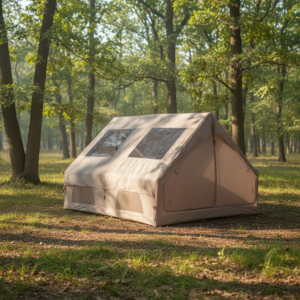
Inflatable Tent Four-Season Quick Automatic Opening PVC 3000mm Waterproof Foldable Eco-Friendly 2-3/3-4/6-8 Person Outdoor Use
Read more -
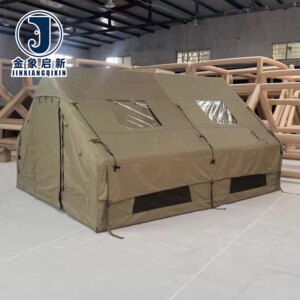
Waterproof Inflatable Camping Tent Outdoor Easy Setup Air Tent for Camping
Read more -
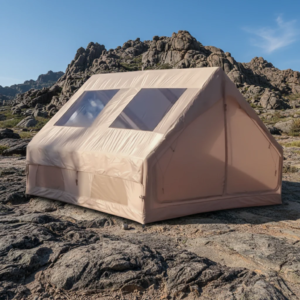
High Quality Four-Season Inflatable Tent for Camping Durable PVC Material All-Weather Resistance Quick Automatic Opening
Read more -
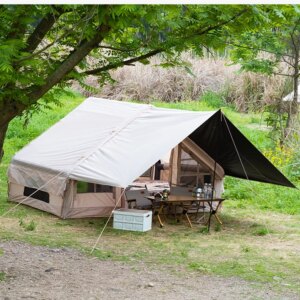
Campingzelt aufblasbar PVC wasserdicht UV-beständig Vier-Jahreszeiten schnell automatisch öffnend anpassbar 2-3 Personen
Read more