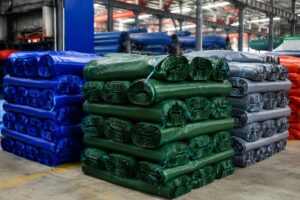
Coated Polyester Fabric for Airport Cargo Coverage Wholesale Supplier
Lighter fabric is not easier to manage on an open tarmac; it is a liability.
For airport cargo coverage, procurement managers must specify high-GSM coated polyester fabric with certified fire-retardant properties and reinforced mechanical stress points. The primary sourcing criterion is not just waterproofing, but compliance with international aviation ground handling standards and customs documentation accuracy to prevent costly port delays.
I still remember the silence in the office when the call came from Dubai. A container of PVC tarpaulins had arrived at the port, ready for a major airport infrastructure project. The cargo was stuck. Not because the quality was poor, but because the fire-retardant certificate did not match the specific format required by local customs authorities. The demurrage charges accumulated daily, eventually surpassing the value of the goods themselves. That incident shifted my entire approach to exporting technical fabrics. It taught me that for airport environments, the physical durability of the material is only half the battle. The other half is ensuring that every roll of coated polyester fabric for airport cargo comes with verifiable, region-specific compliance data.
When sourcing for aviation logistics hubs, the stakes are higher than standard construction sites. The environment is unforgiving: intense UV exposure, rapid temperature shifts, and the constant threat of wind uplift on exposed aprons. Buyers often look for the lowest price per square meter, but they end up paying for replacements when lighter materials tear under the strain of securing heavy freight pallets. This guide breaks down the technical specifications and compliance requirements necessary to select the right supplier.
What Specs Define Airport-Grade Coated Polyester?
The misconception that "thinner is lighter and therefore better" fails dramatically in airport settings. On an open tarmac, wind does not just blow over a cover; it gets underneath it. A lightweight fabric acts like a sail, creating immense tension on the tie-down points. If the base fabric lacks sufficient tensile strength, the eyelets will rip out, or the material will tear along the seam.
Airport-grade coverage requires a balance of weight and flexibility. The core specification to watch is the Grams per Square Meter (GSM). For temporary shelters or equipment protection in these high-stress zones, the GSM typically needs to be in the higher range. Lower GSM materials may suffice for static warehouse storage, but they lack the mass to resist wind lift outdoors.
| Specification Parameter | Standard Commercial Grade | Airport-Grade Requirement | Impact on Performance |
|---|---|---|---|
| Base Fabric Weight (GSM) | 400-550 | 600-1000+ | Higher GSM provides mass to resist wind uplift and abrasion from rough cargo edges. |
| Tensile Strength | Moderate | High | Prevents tearing when securing heavy, irregularly shaped air freight pallets. |
| Coating Type | PE or Light PVC | Heavy-duty PVC | PVC offers superior adhesion to the polyester base, preventing delamination under UV stress. |
| Seam Construction | Single Stitch | Double-Stitched & Welded | Distributes stress across the hem, preventing seam failure during high-wind events. |
[NEED_CITE: ISO standards for textile tensile strength and tear resistance]
Consider a project in the Middle East where UV exposure is extreme. A standard 500gsm tarp might last a season in a temperate climate, but under the desert sun, the plasticizers in the coating can degrade rapidly, leading to cracking. Switching to a higher GSM PVC-coated option with stabilized UV inhibitors extended the service life significantly. The heavier fabric also meant that workers could deploy it faster without it flapping uncontrollably in the wind, a practical benefit often overlooked in spec sheets.
When evaluating suppliers, ask for test reports on tensile strength in both warp and weft directions. A balanced strength profile ensures that the fabric does not fail preferentially in one direction when pulled tight over a sharp corner of cargo.
Why Fire Retardancy is Non-Negotiable for Air Cargo Covers?
In many industries, "fire-retardant" is a marketing buzzword. In aviation, it is a legal requirement. Airports are high-security zones with strict fire codes due to the presence of fuel, electrical equipment, and high-value goods. Using non-compliant materials can lead to immediate rejection of goods, fines, or even shutdowns of ground operations.
The critical issue is not just whether the fabric burns, but how it burns. Aviation authorities often require specific certifications, such as EN 13501-1 or equivalent local standards. These classifications measure not only flammability but also smoke production and droplet formation. A fabric that self-extinguishes but produces thick, toxic smoke is still a hazard in enclosed hangars or near ventilation systems.
| Certification Standard | Focus Area | Typical Requirement for Airport Use | Verification Method |
|---|---|---|---|
| EN 13501-1 | Reaction to Fire | Class B-s1,d0 or equivalent | Third-party lab test report from accredited facility. |
| NFPA 701 | Flame Resistance | Self-extinguishing within seconds | Small-scale flame test observation. |
| Local Aviation Authority | Operational Safety | Compliance with ground handling rules | Review of airport-specific vendor guidelines. |
[NEED_CITE: European Norms for construction products fire classification]
A European logistics hub once faced a delay because their supplier provided a generic "FR" certificate that did not specify the smoke density rating. The airport safety officer rejected the shipment because the documentation did not prove compliance with the stricter s1 (low smoke) requirement. This was not a quality issue with the fabric itself, but a documentation failure. The supplier had to re-test and re-certify, causing a multi-week delay.
When sourcing coated polyester fabric for airport cargo, ensure the supplier can provide current, valid certificates from recognized testing laboratories. Do not accept self-declared statements. The certificate should clearly state the standard tested against and the result achieved. If you are shipping to multiple regions, verify if the certification is mutually recognized or if you need separate tests for each destination.
How to Verify Supplier Quality Before Bulk Order?
Trusting a supplier based on a website photo is a recipe for disaster. The gap between a sample sent via courier and a full container load can be significant if quality control processes are weak. For airport projects, where consistency is key, verification must happen before the production run begins.
Start by requesting pre-shipment inspection reports. These should include measurements of GSM, coating thickness, and visual checks for defects like pinholes or uneven coating. A reputable manufacturer will have these records readily available. If a supplier hesitates to share recent test data, it is a red flag.
Another critical step is to audit the factory’s production capabilities. Can they handle custom widths without splicing? Spliced seams are weak points that can fail under tension. For large airport covers, seamless width is often preferred. Also, check their ability to reinforce stress points. Are the eyelets made of brass or aluminum? Brass is generally more resistant to corrosion and deformation. Are they inserted with a washer on the backside? This simple detail prevents the eyelet from pulling through the fabric.
| Quality Check Point | What to Look For | Risk of Neglect |
|---|---|---|
| GSM Consistency | Uniform weight across the roll | Thin spots lead to premature tearing. |
| Coating Adhesion | No peeling or bubbling when bent | Delamination exposes the base fabric to UV and water. |
| Eyelet Reinforcement | Double-stitched hems with washers | Eyelets pull out under wind load. |
| Color Fastness | Consistent dye lot | Mismatched colors look unprofessional and may indicate poor batch control. |
[NEED_CITE: Industry best practices for PVC tarpaulin manufacturing quality control]
In one case, a buyer for an African cargo terminal requested reinforced eyelets every 50cm instead of the standard 100cm. The supplier initially pushed back, citing increased production time. However, after explaining the rough handling conditions and the need for extra tie-down points, the supplier adjusted the machine settings. The resulting product held up significantly better during storm seasons. This level of customization is only possible with a manufacturer that listens and has flexible production lines.
What Documentation Prevents Customs Delays?
As I learned the hard way in Dubai, the physical product is only half the equation. The paperwork must be flawless. Customs authorities in different countries have varying requirements for importing technical textiles. Missing or incorrect documents can lead to weeks of delays, storage fees, and potential confiscation.
The most common issue is the mismatch between the product description on the commercial invoice and the certificate. If the invoice says "PVC Tarpaulin" but the fire certificate says "Polyester Fabric," customs may flag it for inspection. Ensure that all documents use consistent terminology. Also, verify if your destination country requires specific legalization or apostille of certificates. Some regions accept digital copies, while others demand original, stamped documents.
| Document Type | Purpose | Common Pitfall |
|---|---|---|
| Commercial Invoice | Declares value and description | Vague descriptions like "Fabric" instead of "PVC Coated Polyester". |
| Packing List | Details quantity and weight | Discrepancies between actual weight and declared weight. |
| Certificate of Origin | Proves manufacturing country | Incorrect HS code classification. |
| Fire Retardancy Certificate | Proves safety compliance | Expired date or wrong standard referenced. |
[NEED_CITE: General customs clearance procedures for imported textiles]
For coated polyester fabric for airport cargo, the HS code classification is crucial. Misclassifying the product can lead to incorrect duty rates and further scrutiny. Work with your freight forwarder to confirm the correct code for your specific destination. Additionally, keep digital copies of all documents accessible during transit. If a query arises at the port, being able to email a clear scan of the certificate immediately can resolve issues before they escalate.
Conclusion
Sourcing for airport environments demands precision in both material specs and administrative compliance.
Selecting the right coated polyester fabric for airport cargo involves prioritizing high GSM for wind resistance, verified fire-retardant certifications for safety, and robust mechanical reinforcements for durability. Equally important is ensuring that all accompanying documentation matches local customs requirements to avoid logistical bottlenecks. By focusing on these technical and procedural details, buyers can secure reliable coverage solutions that withstand the rigors of aviation ground handling.