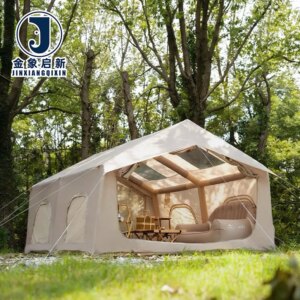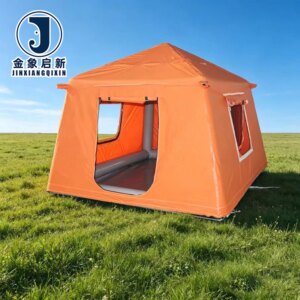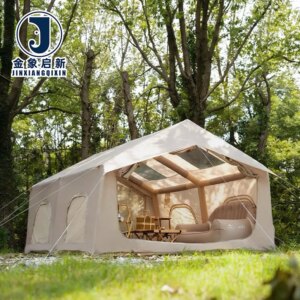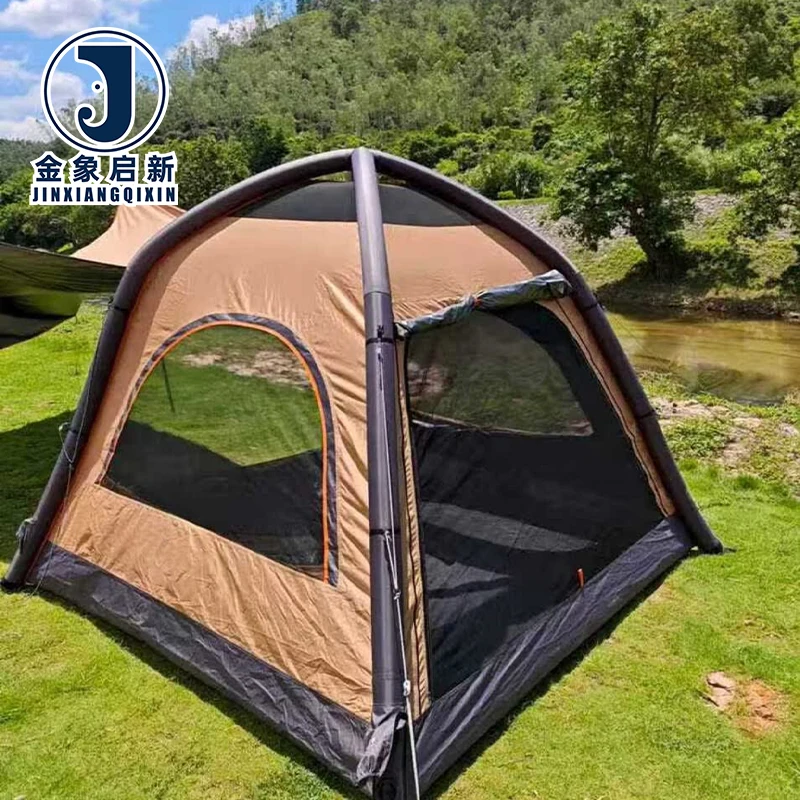
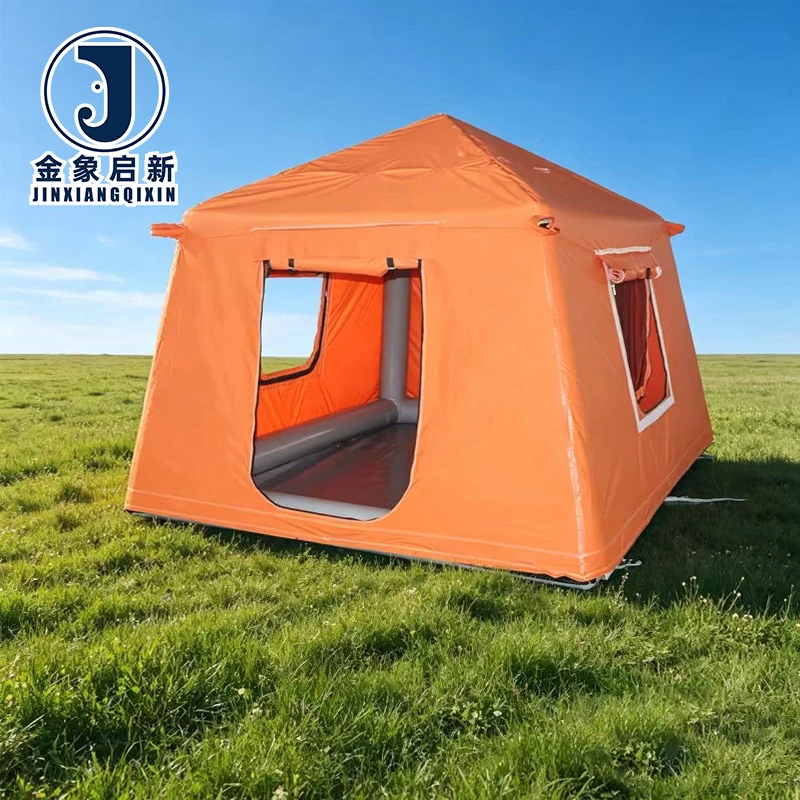
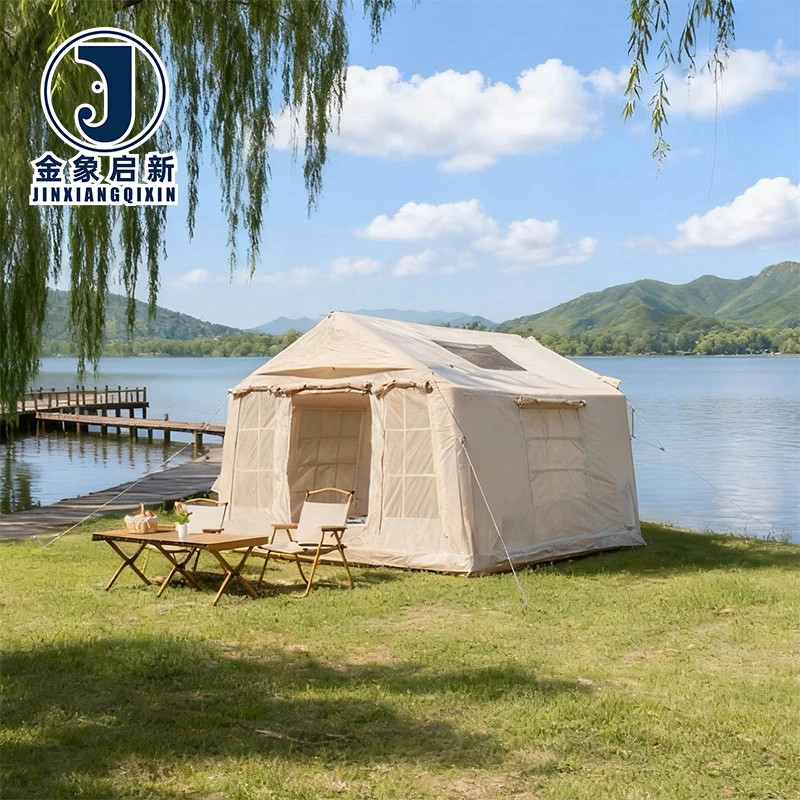
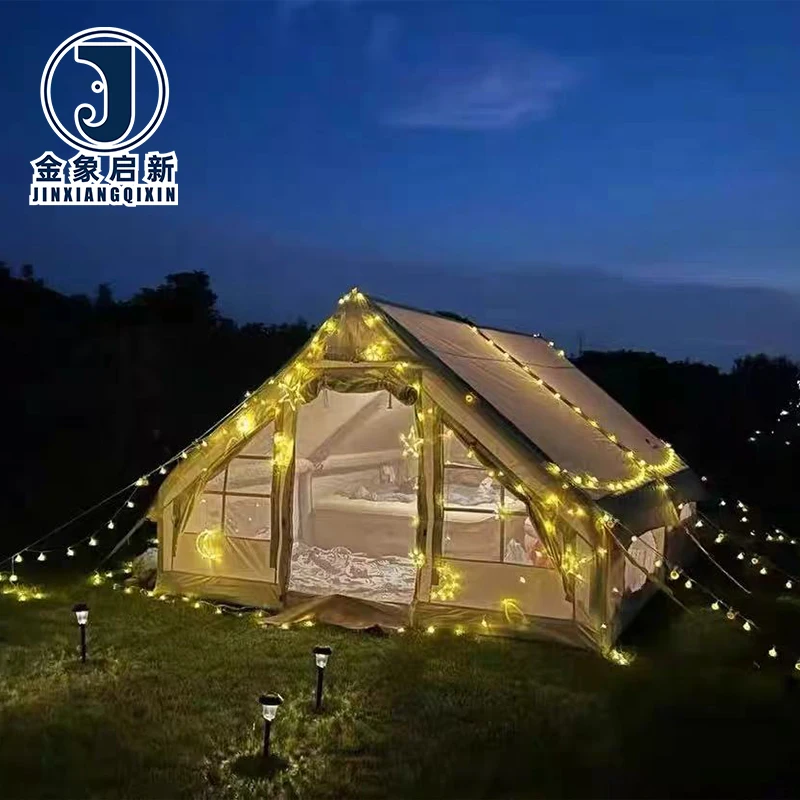
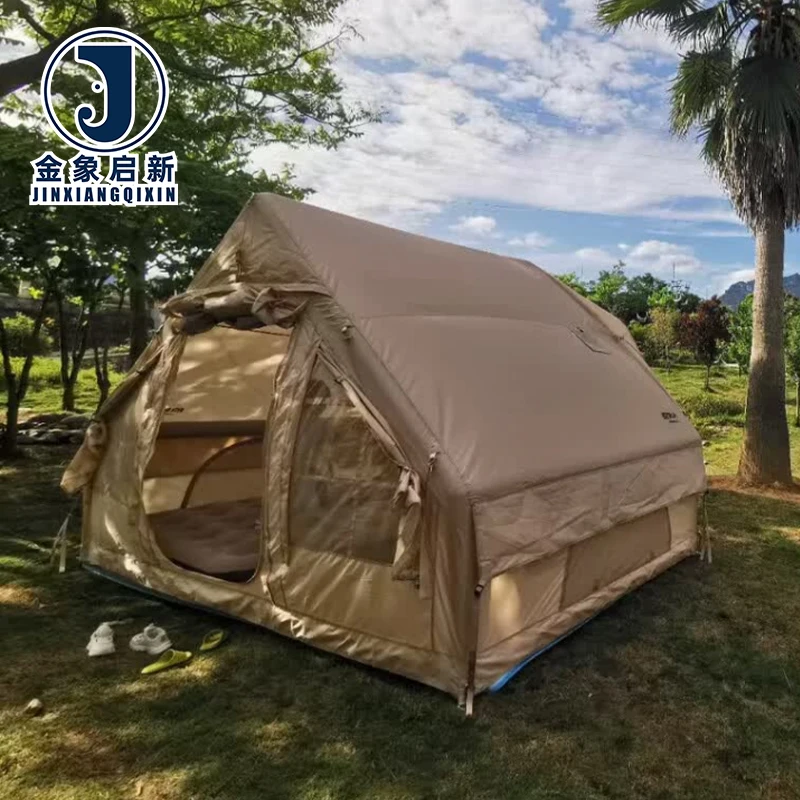
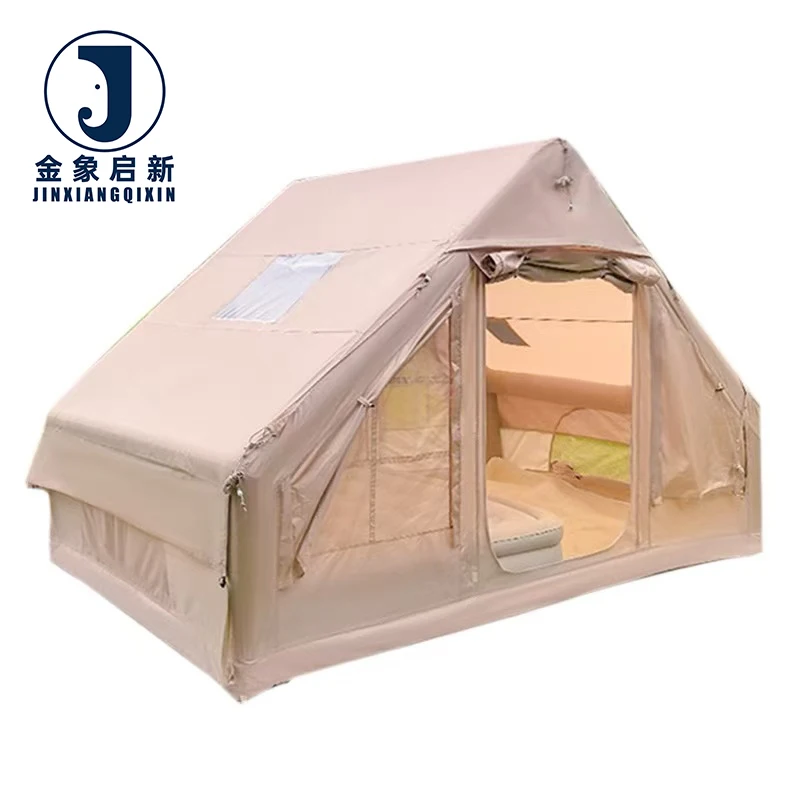
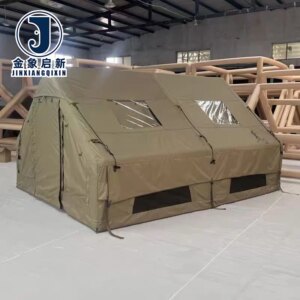
Inflatable Camping Tent, 8-10 Person Capacity, 4-Season Rated — automatic inflatable deployment with full PVC tarpaulin construction for reliable weather protection.
- Waterproof, UV-resistant, tear-resistant, and fire-retardant PVC fabric
- Custom OEM & ODM: size, material thickness, pattern printing, and design
- Certified to ISO9001, ISO14001, ISO45001, and CE standards
Fabric weight and coating adhesion are tightly controlled across our 3 full production lines, ensuring batch-to-batch consistency that commercial buyers can verify on arrival.
Samples developed within days by our 10-person R&D team, with 100% pre-shipment inspection before dispatch.
Description
Coating Process Mastery — nearly three decades controlling PVC adhesion and weight consistency across 36 processing units, validated through batch-specific pre-shipment inspection for every inflatable tent order.
Technical Specifications
| Parameter | Value |
|---|---|
| Product Type | Inflatable Camping Tent |
| Core Material | PVC Tarpaulin |
| Capacity | 8-10 Person |
| Season Rating | 4 Season |
| Construction | Single layer |
| Deployment | Automatic inflatable opening |
| Waterproof | Fully coated waterproof construction |
| UV Resistance | Available with UV-resistant treatment — confirm test basis for your market |
| Fire Retardancy | Available in flame retardant grades — confirm the grade required for your site |
| Anti-static | Available in anti-static grades — confirm the grade required for your market |
| Tear Resistance | Tear-resistant PVC coated fabric |
| Customization Scope | OEM & ODM: size adjustment, material thickness, pattern printing, product design |
| Production Lines | 3 full production lines |
| Processing Equipment | 36 sets of professional equipment |
| R&D Team | 10 technicians |
| Certifications | ISO9001, ISO14001, ISO45001, CE |
Application Suitability
| Application | Exposure & Requirement |
|---|---|
| Construction site temporary offices | Wind loading on inflated frame, daily foot traffic at entry points, prolonged sun and rain exposure |
| Mobile equipment storage shelters | Abrasion from loading and unloading, ground moisture contact, UV degradation over extended deployment |
| Outdoor event pavilions | High occupant density, rapid inflation and deflation cycles, branding and signage visibility requirements |
| Emergency response shelters | Immediate deployment under adverse weather, repeated setup and teardown, transport in compressed state |
| Extended camping operations | Four-season temperature variation, condensation management, ground moisture and puncture risk |
Why the Approved Sample Rarely Matches the Delivered Inflatable Camping Tent Batch
Batch colour drift and unverified treatment claims account for the majority of inflatable tent rejections at site inspection.
Buyers specify a particular PVC grade, fire-retardant classification, and colour reference at sample stage, only to find the production batch arrives with visible shade variation between panels or without the documentation to prove treatment compliance. When a construction contractor erects a temporary site office and the local fire authority asks for the flame-retardant certificate, a generic material claim without a test standard attached becomes a compliance failure. [NEED_CITE: fire classification standards for temporary structures and inflatable buildings] Colour inconsistency across seams is immediately visible once panels are joined under natural light, forcing rework or replacement at the buyer’s expense.
Sizing and Pattern Printing Across the Full Product Range
Every inflatable camping tent order begins with a specification review covering inflated dimensions, air beam diameter, and panel layout. The 10-person R&D team translates these requirements into cutting patterns that account for fabric stretch under internal pressure, ensuring the inflated structure holds its designed geometry without localized stress concentrations. Pattern printing is coordinated with the coating stage so that branded graphics and safety markings bond directly into the PVC surface rather than sitting on top as a vulnerable overlay.
Material Selection as a Custom Variable, Not a Fixed Input
Material thickness and coating weight are adjustable parameters in this production system, not locked catalogue entries. A buyer deploying units in arid, high-UV environments may specify a heavier coating formulation to extend membrane integrity, while a buyer prioritizing pack weight for emergency stockpiles may request a lighter base fabric with a higher denier count to maintain tear strength at reduced GSM. Each option is sampled and approved before mass production commits, eliminating the mismatch between quoted specification and delivered product. [NEED_CITE: relationship between base fabric denier, coating weight, and tear propagation in PVC coated fabrics]
How Coating Weight and Base Fabric Density Interact Under Inflation Pressure
A common specification error is treating PVC tarpaulin GSM as the sole indicator of structural capability. The tensile and tear performance of an inflatable tent membrane depends on the base fabric weave density and yarn denier working together with the coating adhesion method. Knife-coated fabrics achieve higher peel strength between coating and substrate compared to laminated constructions, which directly affects how the material behaves at welded seam junctions where the air beams connect to the outer shell. The denier of the polyester base yarns governs how a puncture or cut propagates — a higher denier yarn arrests tear spread more effectively, which matters when the fabric is under constant internal pressure. Surface finish, whether glossy or matte, influences both cleanability in muddy site conditions and the adhesion quality of printed graphics applied for event branding or safety wayfinding.
The Cost of Specifying Without Verified Test Data
When a buyer accepts a quotation that states "flame retardant" without a referenced test standard, the inflatable tent may pass the factory gate but fail the local fire inspection at the deployment site. Similarly, ordering fabric by GSM alone without specifying the base fabric construction can result in a membrane that meets the weight target yet tears at the air beam junction under wind loading. Batch colour inconsistency across rolls forces fabricators to either reject partial shipments or accept visible panel mismatches that undermine the professional appearance of a commercial installation. Welded seams that fail before the membrane itself typically indicate a mismatch between the heat-sealing parameters and the actual coating formulation delivered, a problem traceable to insufficient in-process quality checkpoints. [NEED_CITE: common failure modes in heat-welded PVC coated fabric structures]
Why Procurement Decisions Land Here
Deep process control over PVC coating weight and adhesion ensures the membrane delivered matches the membrane sampled, verified through stage-by-stage quality inspection rather than end-of-line spot checks. The 36 sets of processing equipment provide the capacity to fulfill bulk inflatable camping tent orders within agreed timelines while maintaining roll-to-roll consistency. The dedicated R&D function handles material selection, pattern engineering, and sample development within days, shortening the gap between initial enquiry and production commitment. A 100-percent pre-shipment inspection protocol catches colour drift, coating weight deviation, and seam integrity issues before dispatch, not after arrival at the buyer’s warehouse.
Documentation & Verification
- Material specification sheet stating PVC tarpaulin grade, base fabric construction, and coating weight
- Test reports for UV-resistant and flame-retardant grades where applicable to your order
- Pre-shipment inspection record with batch-specific quality verification for inflatable tent components
- ISO9001, ISO14001, ISO45001, and CE certification documentation for cross-border compliance
- Roll packing list with item counts, dimensions, and shipment reference traceability
Fabrication, Handling & Storage
- Heat-weld seam parameters must match the specific PVC coating formulation to prevent delamination at air beam junctions
- Store inflated or deflated units dry and flat to avoid permanent crease marks in the PVC tarpaulin membrane
- Use PVC-compatible cleaners only; solvents will degrade the coating surface and compromise waterproof integrity
- Allow adequate ventilation during cold-weather inflation to prevent condensation buildup inside the single-layer shell
- Reinforce all tie-down and anchor contact points with additional PVC patches to distribute load across the coated fabric
- Transport deflated units in protective bags to prevent abrasion damage to the outer coating during transit
What to Include with Your Enquiry
Specify the intended deployment environment, including expected wind conditions, temperature range, and any fire-safety or anti-static compliance requirements at the site. Confirm the required dimensions, capacity, and whether pattern printing or branded graphics are needed on the tent panels. Indicate whether you require finished inflatable camping tent units or cut-to-size fabric panels for your own assembly operation, and state your projected order volume and delivery schedule.
Frequently Asked Questions
Q: What customization options are available for inflatable tent dimensions, material thickness, and printed graphics?
A: Size, material thickness, pattern printing, and structural design elements are all adjustable through the OEM and ODM process. The R&D team develops a sample reflecting your exact specifications, including panel layout and branding placement, for approval before mass production begins.
Q: How is batch-to-batch colour consistency controlled across multiple inflatable tent orders?
A: Colour reference standards are established at sample approval stage and monitored through the coating process. Pre-shipment inspection includes visual and measured colour comparison against the approved reference, ensuring panels from different production runs match when installed side by side.
Q: What fire-retardant and anti-static grades are available for commercial site compliance?
A: Flame-retardant and anti-static treatments are available in various grades depending on the regulatory framework at your deployment site. Specify the standard required for your market, and the appropriate treatment will be applied and documented with a supporting test report.
Q: How does the sample approval process work before production begins?
A: A physical sample is produced to your stated specifications covering material grade, dimensions, colour, and any printed elements. You review and approve the sample before mass production is scheduled, ensuring the delivered order matches your validated requirements exactly.
Q: What documentation accompanies each shipment for import and project compliance?
A: Each shipment includes a material specification sheet, applicable test reports, a pre-shipment inspection record, ISO and CE certification documentation, a detailed packing list, and customs support documents including certificate of origin where required.
Related products
-
Tienda de Camping Inflable PVC Impermeable para Cuatro Estaciones, Tienda de Aire Exterior con Apertura Automática Rápida para 3-4 Personas
Read more -
Carpa de Evento Inflable de Cuatro Estaciones al Aire Libre Impermeable de PVC Apertura Automática Rápida para 6-8 Personas con Logo Personalizado
Read more -
Tienda inflable portátil de camping al aire libre de lujo para uso en todas las estaciones, espacio grande, a prueba de lluvia, aislada, apertura automática rápida.
Read more -
Tienda de camping inflable impermeable al aire libre, fácil de montar, tienda de aire para camping
Read more