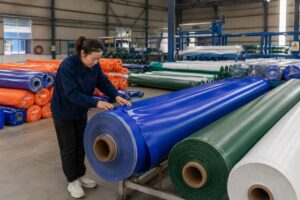
Waterproof PVC Tarpaulin Supplier for Jordan: China Factory Direct OEM
Thicker is not always better—tight weight tolerance is what clears customs at Aqaba.
To source a reliable waterproof tarpaulin supplier for Jordan from China, buyers must prioritize three things: GSM specification within controlled tolerance, coating process matched to local UV and heat conditions, and full export documentation aligned with Jordanian customs requirements. Factory-direct sourcing from a verified Chinese manufacturer balances cost, customization, and compliance far better than trading intermediaries.
I still remember a shipment we sent to a construction site near Amman a couple of years back. The buyer had arranged his own freight forwarder, and when the container reached Aqaba Port, customs held it for weeks. The issue? They claimed the GSM was below spec. We had to fly in third-party test samples before the goods were finally released. That whole episode cost the buyer dearly in demurrage and testing fees—far more than the price difference he thought he was saving by skipping proper pre-shipment verification. Since then, I have seen this pattern repeat across the Middle East: buyers focus on unit price but overlook the parameters that actually determine whether a shipment clears the port. [NEED_CITE: Jordan Customs import inspection procedures for textile and coated fabric products]
Choosing the right waterproof tarpaulin supplier for Jordan is not just about finding the lowest quote—it is about understanding what the local market actually needs, how to verify quality before the container leaves the factory floor, and how to prevent customs headaches on arrival.
What GSM and Coating Specs Does the Jordan Market Actually Require?
The Jordan market predominantly demands PVC tarpaulin in the 600-900gsm range, with dual requirements for UV resistance and fire retardancy depending on the end-use application.
Construction sites across Amman and Zarqa typically use 600-700gsm PVC tarpaulin for scaffolding enclosure, material coverage, and temporary shelter. Mining operations in the southern regions near Aqaba and Ma’an often step up to 800-900gsm for heavy-duty truck covers and equipment protection. The key distinction is not just weight—it is the coating method and the additive package that determine real-world performance under Jordan’s intense solar exposure.
| Parameter | Light-Duty Construction | Heavy-Duty Mining/Transport |
|---|---|---|
| GSM Range | 600-700gsm | 800-900gsm |
| Coating Type | Knife-over-roll | Knife-over-air / calendered |
| Standard | High-stabilizer formula | |
| Fire Rating | Basic self-extinguishing | B1 / M2 certified |
| Tolerance Control | Standard | Tight (±5% critical for customs) |
| Weldability | Heat weld standard | High-frequency weld compatible |
[NEED_CITE: ASTM D3776 standard test method for mass per unit area of woven fabrics]
A distributor in Amman once compared two batches of 600gsm PVC tarpaulin—one coated using a standard knife-over-roll process, the other using a knife-over-air method. After roughly two years of outdoor exposure, the knife-over-air sample retained substantially higher peel strength, while the standard-coated batch showed visible delamination at fold lines. The price gap between the two was minimal, but the service life difference was dramatic. [NEED_CITE: PVC coated fabric peel strength retention after accelerated weathering per ISO 4892]
This is why working with an experienced waterproof tarpaulin supplier for Jordan matters: the right factory will recommend the correct coating process and additive package for your specific application, not just sell you the cheapest roll in the warehouse.
How Do You Verify GSM Tolerance and Coating Quality from a Chinese Factory?
Request pre-production samples, mandate third-party testing with explicit tolerance ranges, and confirm that the test method matches international standards—not just factory-internal benchmarks.
The most common mistake buyers make is accepting the factory’s own weight certificate at face value. A factory may report 600gsm on paper, but if the actual roll-to-roll variation swings between 540gsm and 660gsm, customs inspectors at Aqaba will flag the shipment. The tolerance control—typically ±5% for reputable manufacturers—is what separates a smooth clearance from a costly detention. [NEED_CITE: ISO 3801 method for determining mass per unit area of woven fabrics]
Here is the verification workflow I recommend:
- Pre-production sample approval: Before bulk production begins, request a roll sample from the exact production line. Test it independently or send it to SGS/Intertek for GSM verification, tensile strength, and tear resistance.
- Define tolerance in the purchase contract: Specify not just the nominal GSM but the acceptable deviation range. A clause stating “600gsm ±5%” gives you legal grounds if the shipment tests outside that band.
- Coating adhesion test: Ask for peel strength data per relevant standards. A factory confident in its coating process will provide this without hesitation.
- Mid-production inspection: For large orders, arrange a third-party inspection during production—not just before shipment. This catches issues while there is still time to correct them.
- Pre-shipment testing on multiple rolls: Do not test a single roll from the warehouse floor. Sample from multiple rolls across the batch to verify consistency.
[NEED_CITE: SGS textile and fabric testing service scope for coated materials]
A Middle East construction buyer once received a full container of PVC tarpaulin where the factory’s internal certificate showed perfect GSM readings. But when an independent inspector tested five randomly selected rolls, two of them fell well below the tolerance threshold. The factory had tested only the “best” rolls for the certificate. Without that mid-production check, the buyer would have faced the same Aqaba customs nightmare.
How to Avoid Customs Detention at Aqaba Port?
Prepare complete SGS or equivalent third-party test reports before shipment, ensure all labeling matches contract specifications exactly, and confirm fire-retardant certifications are recognized under Jordanian import regulations.
Jordanian customs at Aqaba Port are known for strict inspection of imported textile and coated fabric products. Discrepancies between declared specifications and actual test results are the primary cause of detention. The most frequent triggers include:
- GSM mismatch: Declared weight does not match physical testing.
- Label inconsistency: Roll labels show different specs than the commercial invoice or packing list.
- Missing or unrecognized fire certificates: Fire-retardant claims lack certification from an internationally recognized body, or the certificate format does not match what customs expects.
- Incomplete documentation: Missing certificates of origin, test reports, or material safety data sheets.
| Document | Purpose | Risk if Missing |
|---|---|---|
| SGS/Intertek Test Report | Verifies GSM, tensile, tear, coating quality | High—customs will likely detain |
| Certificate of Origin | Required for tariff treatment | Medium—delays clearance |
| Fire-Retardant Certificate (B1/M2/NFPA 701) | Validates fire safety claims | High—rejected at port if claimed but unproven |
| Packing List + Commercial Invoice | Must match physical shipment exactly | Medium—triggers full inspection |
| Material Safety Data Sheet | Required for chemical-coated products | Medium—may block entry |
[NEED_CITE: NFPA 701 standard method of fire tests for flame propagation of textiles and films]
[NEED_CITE: EN 13501-1 fire classification standard for construction products]
A mining client once ordered fire-retardant tarpaulin for a site near the Saudi border. The factory provided a fire certificate, but it was an internal test report—not from a recognized third-party lab. Jordanian customs rejected it outright. The buyer had to arrange re-testing through an approved lab, which took weeks and cost several times the original testing budget. The lesson: always confirm which fire certifications Jordanian authorities accept before placing the order, and ensure the certificate comes from a lab they recognize.
Working with a professional waterproof tarpaulin supplier for Jordan who routinely handles Middle East exports means they will prepare the full documentation package proactively—SGS reports, correct labeling, fire certificates in the right format—so your shipment clears Aqaba without delay.
China Factory Direct vs. Trading Company: Cost and Risk Comparison
Factory-direct sourcing delivers clear advantages in customization, quality consistency, and after-sales responsiveness—especially for buyers who need specific GSM, width, color, or fire-retardant specifications.
Many buyers in the Middle East initially approach trading companies because they offer lower upfront prices and seem to handle everything. But when issues arise—whether it is a quality dispute, a documentation error, or a need for a repeat order with slight modifications—the trading company becomes a bottleneck. They must relay your request to the factory, wait for a response, and often add their own margin to any resolution cost.
| Factor | Factory Direct | Trading Company |
|---|---|---|
| Price per sqm | Lower (no middleman margin) | Higher (trading margin added) |
| Customization (GSM, width, color) | Full control, direct communication | Limited, depends on factory willingness |
| Quality consistency | Direct oversight of production | Variable, depends on factory sourcing |
| Documentation accuracy | Factory prepares own certificates | May rely on factory docs without verification |
| After-sales response | Direct contact, faster resolution | Delayed, relayed communication |
| MOQ flexibility | Negotiable based on production schedule | Fixed by trading company policy |
[NEED_CITE: China textile export factory direct sourcing advantages for B2B buyers]
A distributor in Jordan once sourced PVC tarpaulin through a trading company for two years. The prices were competitive, but every time he needed a custom width or a specific color match, the process took weeks and often resulted in compromises. When he switched to direct factory sourcing, he gained the ability to specify exact roll widths, choose from a broader color range, and receive production updates directly. His reorder cycle shortened noticeably, and quality complaints from his customers dropped.
The trade-off is that factory-direct sourcing requires more due diligence upfront—you must verify the factory’s capabilities, audit their quality systems, and confirm their export experience. But for buyers who plan to order regularly and need consistent quality, the investment pays off quickly.
Conclusión
Sourcing a waterproof tarpaulin supplier for Jordan from China requires attention to GSM tolerance, coating process selection, fire certification validity, and complete export documentation. Factory-direct partnerships with experienced manufacturers eliminate middleman margins, ensure specification accuracy, and provide the responsiveness needed for Middle East market demands. Verify quality through third-party testing, define tolerance in contracts, and prepare documentation that meets Jordanian customs requirements—these steps prevent costly port detentions and build a reliable, long-term supply chain.