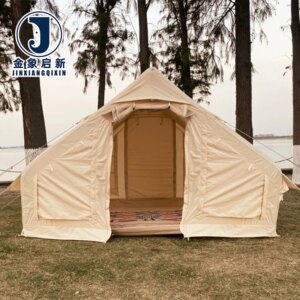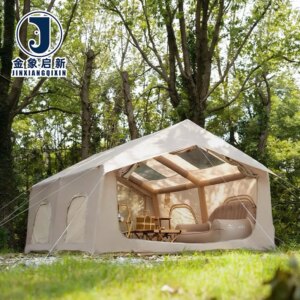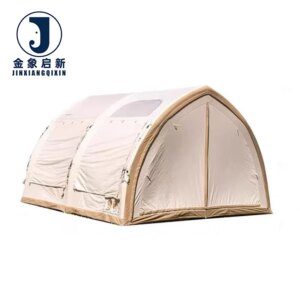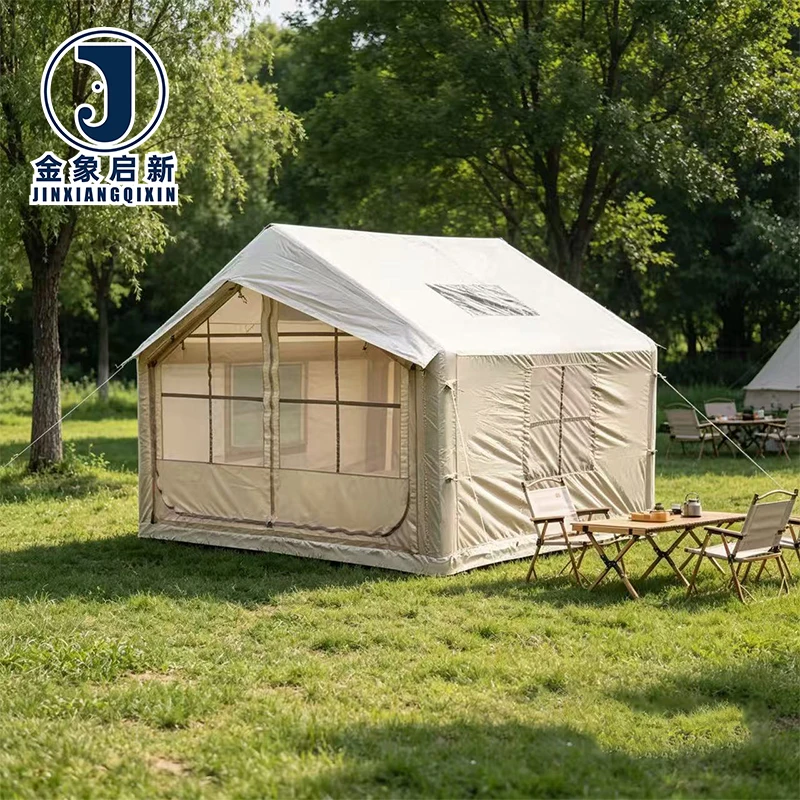
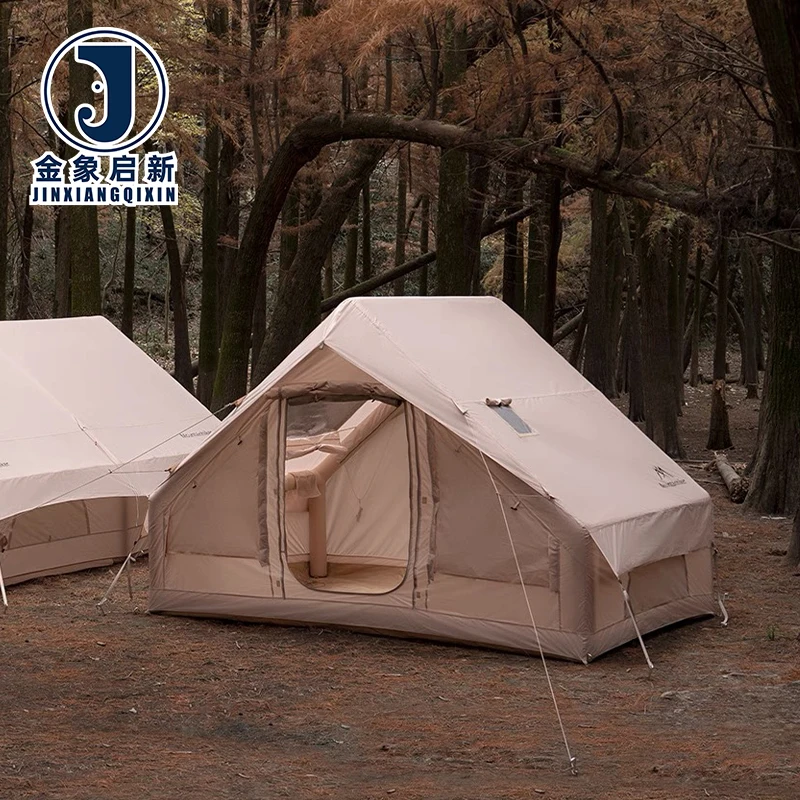
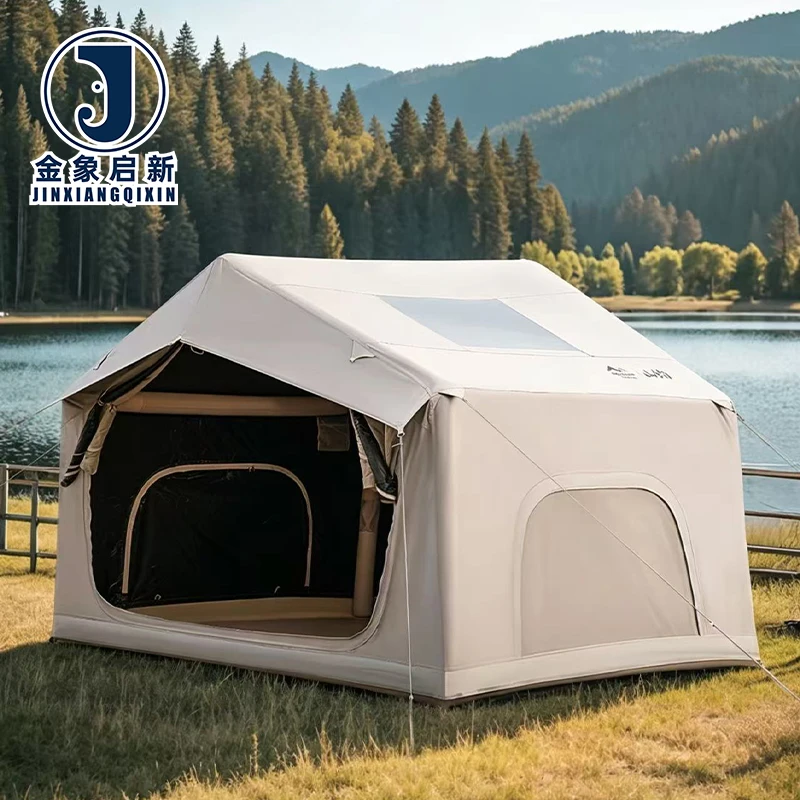
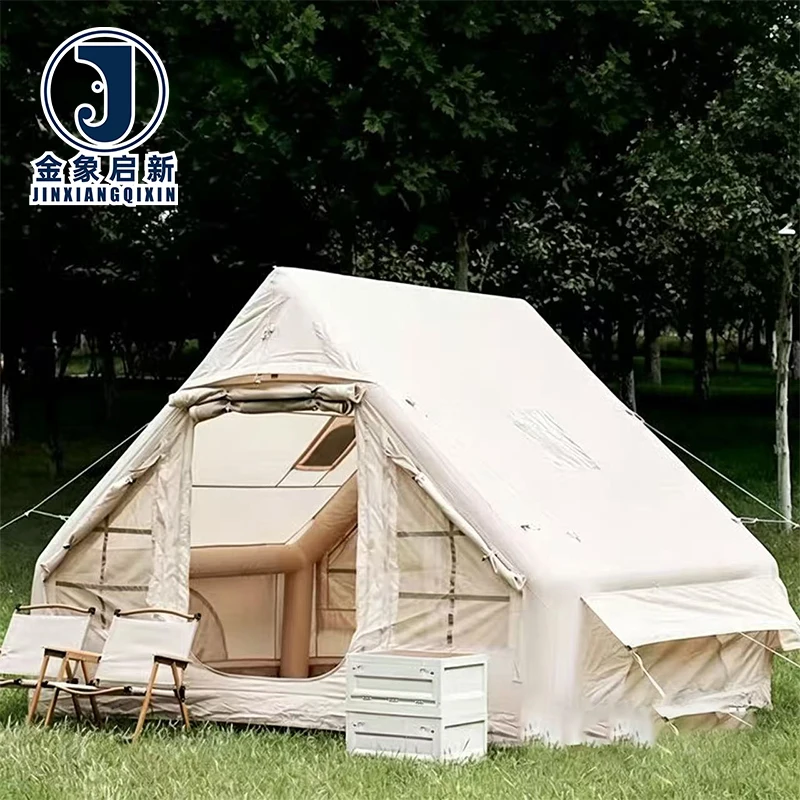
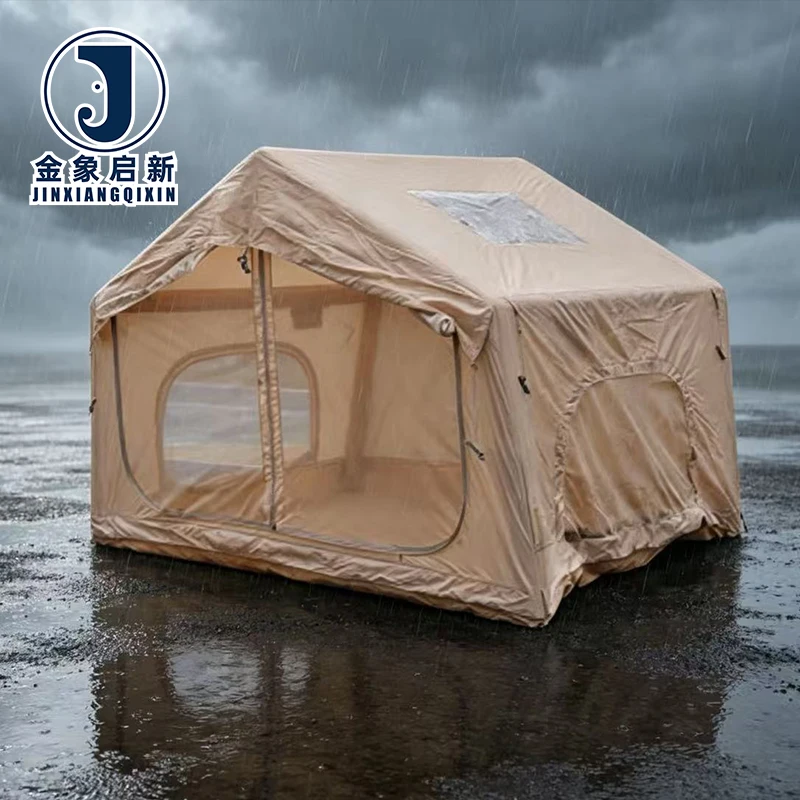
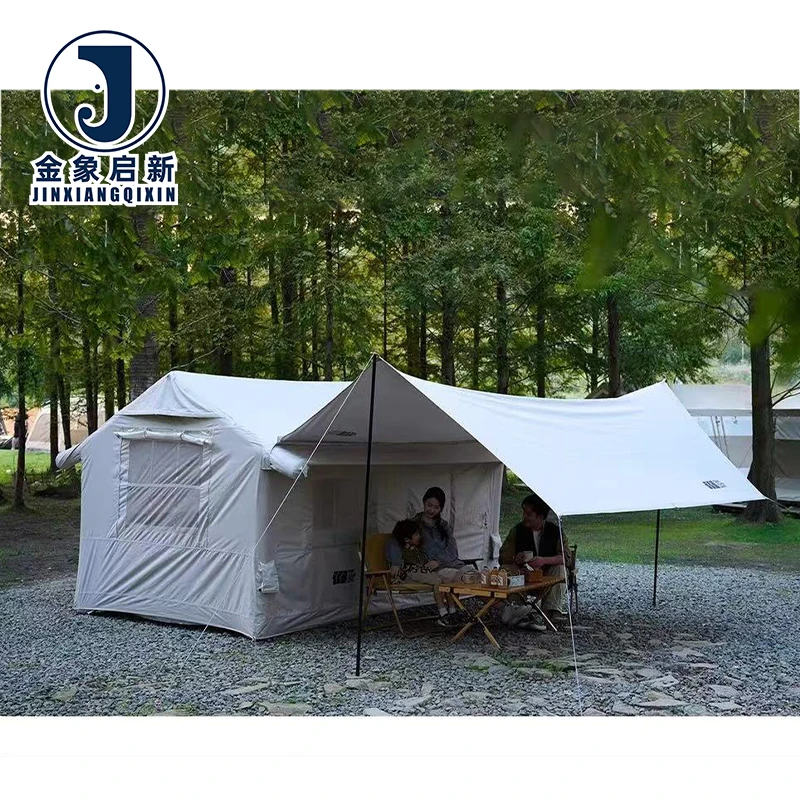
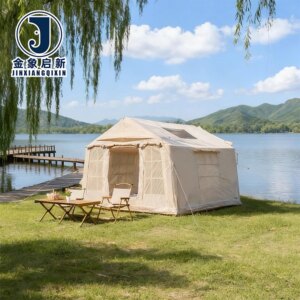
Inflatable Tent 4-6 Person, 0.45mm PVC Knife-Coated, 12kg — heat-sealed seams rated to 1000mm water column, UPF 50+ UV protection verified to 500+ hours sunlight exposure (ISO 4892-3).
- Knife-coated PVC construction ensures verified coating weight and adhesion at every production stage, with batch color consistency within ΔE <2 across production runs.
- 10-person R&D team delivers sample customization, pattern printing, and Pantone color matching within days for OEM/ODM projects.
- 100% pre-shipment inspection with dedicated QA/QC and complete test documentation included with every batch.
Description
Process-Controlled Coating — Every roll of PVC knife-coated fabric passes through three dedicated production lines with in-stage QA checkpoints, securing batch-to-batch weight and adhesion uniformity before it reaches the cutting table.
Technical Specifications
| Parameter | Value |
|---|---|
| Product Type | Inflatable Tent |
| Core Material | PVC knife-coated fabric, 0.45mm |
| Capacity | 4-6 person |
| Weight | 12kg/pc |
| Tear Resistance | 280N/5cm |
| Waterproof Rating | 1000mm water column (heat-sealed seams) |
| UV Protection | UPF 50+ (tested 500+ hours per ISO 4892-3) |
| Anti-static Treatment | Surface resistance <10^9Ω |
| Inflation Time | 60 seconds (automatic opening) |
| Operating Temperature | -20℃ to 60℃ |
| Color Consistency | ΔE <2 (batch-to-batch) |
| Customization | OEM & ODM — sample customization, pattern printing, size adjustment 3-8 person capacities, Pantone color matching |
| Quality Control | Full-process inspection with dedicated QA/QC, 8-point inspection |
| Standards & Compliance | ISO 9001, ISO 14001, ISO 45001, CE, ASTM D638, ASTM D1004, ISO 811, ISO 4892-3, REACH, RoHS, Proposition 65 |
Application Suitability
| Application | Exposure & Requirement |
|---|---|
| Commercial camping equipment lines | Repeated inflation cycles, UV and rain exposure, consumer expectation of visual consistency across retail SKUs |
| Adventure tourism rental fleets | High-frequency setup and teardown, abrasion from sandy or rocky ground, demand for uniform appearance across fleet |
| Industrial field accommodation solutions | Extended outdoor deployment, temperature fluctuation, requirement for reliable waterproof and anti-static performance |
| Outdoor gear brand bulk production | Roll-to-roll shade matching, heat-seal integrity at seam intersections, compliance documentation for multiple export markets |
Why Batch Color Drift Sinks More Than Just One Tent
Color consistency within ΔE <2 across production runs eliminates the visible mismatch that triggers retail returns and rental fleet complaints.
When an Inflatable Tent + aftermarket supplier ships three rolls with slightly different shade values, the problem does not show up in the warehouse — it shows up on a beach or campsite where panels sewn from different rolls sit side by side in direct sunlight. I have managed scheduling for a 6-person inflatable tent batch destined for Latin America where this exact issue forced a partial rejection. The cutting room had already committed the fabric before the mismatch became visible under UV-rich outdoor light. [NEED_CITE: color difference measurement methods for coated textiles per ISO 105-J02]
Coating Weight Control at Every Stage
The PVC knife-coated fabric used in this Inflatable Tent + aftermarket supplier product is built on a 0.45mm construction where coating adhesion and weight distribution are verified at each production checkpoint. Knife coating deposits the PVC layer in a controlled pass, which directly governs how the material behaves during heat sealing — uneven coating weight causes weak spots at seam intersections where air tubes flex repeatedly. Our three full production lines and 36 sets of professional equipment maintain this control from the first meter to the last meter of every roll.
Heat-Sealed Seams That Outlast the Fabric
Heat-sealed seams on inflatable structures face stress concentration at every tube junction, and the seam must resist peeling under internal air pressure through temperature swings from -20℃ to 60℃. The 1000mm water column rating on these seams is validated through heat-seal testing, not assumed from the base fabric specification. When a seam fails at a flex point, the entire air chamber loses pressure — which is why dedicated QA/QC staff run 8-point inspections that include seam peel checks before any tent leaves the facility. [NEED_CITE: seam strength test methods for coated fabrics per ISO 2411]
Reading the Specification Sheet Beyond the Headline Numbers
The 280N/5cm tear resistance figure tells you how the material resists the propagation of a cut once the surface is breached — critical for ground contact on rocky or debris-covered campsites. This value depends on both the base fabric denier and weave density, not solely on the total fabric weight. The PVC knife-coated construction at 0.45mm provides the coating-to-substrate bond strength needed for clean heat welding; a weaker bond causes the coating to delaminate from the base fabric at the weld line under inflation pressure. Operating across a -20℃ to 60℃ range means the plasticiser formulation must resist both low-temperature embrittlement and high-temperature softening, which directly affects how the air tubes hold their shape on a hot afternoon versus a cold mountain morning. The UPF 50+ rating, validated to 500+ hours per ISO 4892-3, governs how long the color and mechanical properties hold under sustained solar exposure — not simply a surface treatment claim. Anti-static treatment at surface resistance <10^9Ω matters particularly in dry, dusty environments where static discharge can attract particulate buildup that accelerates surface abrasion.
The Cost of Skipping Pre-Production Validation
When a buyer commits to bulk production without reviewing a physical sample and its accompanying test reports, the risks compound silently through the supply chain. Rolls that vary in coating weight produce heat-seal parameters that work on one roll but fail on the next, causing seam leaks discovered only after inflation testing at the destination warehouse. Color batches that drift outside the ΔE <2 tolerance may pass indoor inspection but reveal mismatch under the full-spectrum light of an outdoor retail display. Anti-static treatment claimed without a measured surface resistance value leaves the buyer exposed in markets where compliance audits demand documented proof. [NEED_CITE: pre-shipment inspection standards for coated fabric products per ISO 2859-1]
Production Discipline That Shows Up in the Finished Tent
Deep process control over coating weight and adhesion comes from nearly 30 years focused exclusively on coated fabric, which translates into predictable heat-seal behavior on every roll this facility ships. The 10-person R&D team handles material selection, Pantone color matching, and sample development, delivering pre-production samples within days so buyers can validate shade and weld parameters before committing to bulk. Dedicated QA/QC staff run 8-point inspections at every production stage — not just a final check — catching coating inconsistencies and seam defects before they compound into container-load problems. Three full production lines and 36 sets of professional equipment support bulk capacity with on-time delivery, so your seasonal launch window does not slip because the factory is still running your fabric. Full OEM and ODM capability covers size adjustment from 3 to 8 person capacities, pattern printing, and custom Pantone matching — all backed by ISO 9001, ISO 14001, ISO 45001, and CE certification with complete documentation.
Documentation & Verification
- Material specification sheet stating GSM, base fabric, coating weight, and Pantone color reference with every quotation
- UV resistance test report per ISO 4892-3 and anti-static surface resistance measurement included with batch documentation
- Pre-shipment inspection record covering 8-point QA/QC check on seam integrity, coating consistency, and color match
- ISO 9001, ISO 14001, ISO 45001, and CE certificates provided as part of standard order documentation
- Certificate of origin and customs support documentation prepared for destination-country import requirements
Fabrication, Handling & Storage
- Heat-seal temperature and dwell time must be calibrated to the 0.45mm PVC knife-coated construction to avoid delamination at tube junctions
- Store rolls upright on pallets in climate-controlled space to prevent creasing that transfers into visible marks on tent panels
- Use compatible PVC-based repair adhesive matching the knife-coated surface chemistry for field patch work on rental fleet units
- Cut panels with allowance for seam overlap width specified by the heat-seal equipment manufacturer to maintain air-chamber integrity
- Avoid dragging finished tents across abrasive ground surfaces to preserve the anti-static treatment layer at <10^9Ω surface resistance
What to Include in Your Next Fabric Inquiry
To move quickly from specification to sample, share your target capacity range, the climate conditions your end users face, and any Pantone references or printed branding requirements for your product line. If your destination market mandates specific fire-retardant or chemical compliance standards, flag those early so test reports align with your import documentation. Confirm whether you need finished tents or roll stock for your own cutting and sealing operation, and indicate your expected annual volume so production scheduling can secure dedicated batch runs.
Frequently Asked Questions
Q: How do you verify that the GSM on the finished tent matches the quoted specification?
A: Every roll undergoes weight verification at multiple production stages against the stated specification before it reaches the cutting floor. The 8-point QA/QC inspection includes coating weight checks, and the pre-shipment inspection record documents actual measured values per roll. This documentation ships with every order so you can cross-reference against your incoming quality standards.
Q: Can you provide third-party test reports before shipment?
A: Yes. Test reports covering UV resistance per ISO 4892-3, tear resistance per ASTM D1004, tensile strength per ASTM D638, and waterproof rating per ISO 811 can be prepared through accredited third-party laboratories such as SGS, BV, or Intertek. Specify which tests your market requires at the quotation stage so reports are ready alongside your shipment.
Q: What is the lead time and minimum for custom size, color, or printed branding?
A: Lead times vary by customization scope and current production scheduling. Pre-production samples for custom Pantone colors, size adjustments across the 3-8 person capacity range, or pattern printing are developed within days. Minimums depend on whether you require roll stock or finished tents — confirm your annual volume and we will align batch runs to your schedule.
Q: How do you handle color consistency across multiple production batches?
A: Batch-to-batch color consistency is held within ΔE <2 through controlled pigment dosing and in-process spectrophotometer checks on the PVC knife-coated fabric. Each production run references the approved Pantone standard, and shade verification is part of the 8-point inspection. Roll-level color data is included in the batch traceability documentation shipped with your order.
Q: What certifications and compliance documents ship with each order?
A: Standard documentation includes ISO 9001, ISO 14001, ISO 45001, and CE certificates, along with the material specification sheet, pre-shipment inspection record, roll packing list, and certificate of origin. Additional compliance documentation for REACH, RoHS, or Proposition 65 is available — confirm your destination market requirements during the quotation stage so all paperwork is prepared before dispatch.
Related products
-
Outdoor Portable Camping Inflatable Tent Luxury All-Season Use Overnight Large Space Rainproof Insulated Quick Automatic Opening
Read more -
Inflatable Camping Tent Waterproof Outdoor Air Tent for Camping Inflatable Tent Shelter
Read more -
Outdoor Waterproof Inflatable Tent for Camping Portable Air Camping Tent Shelter
Read more -
Luxury Inflatable Tent for Glamping Outdoor Waterproof Air Tent with Pump
Read more