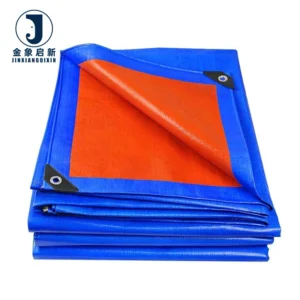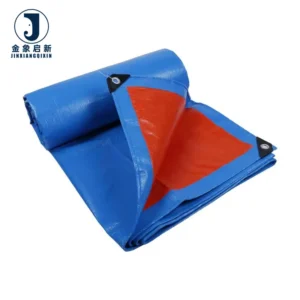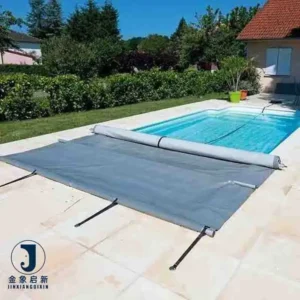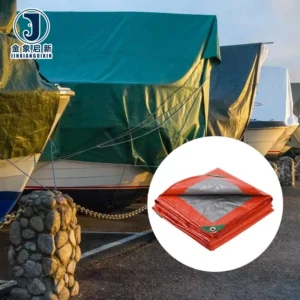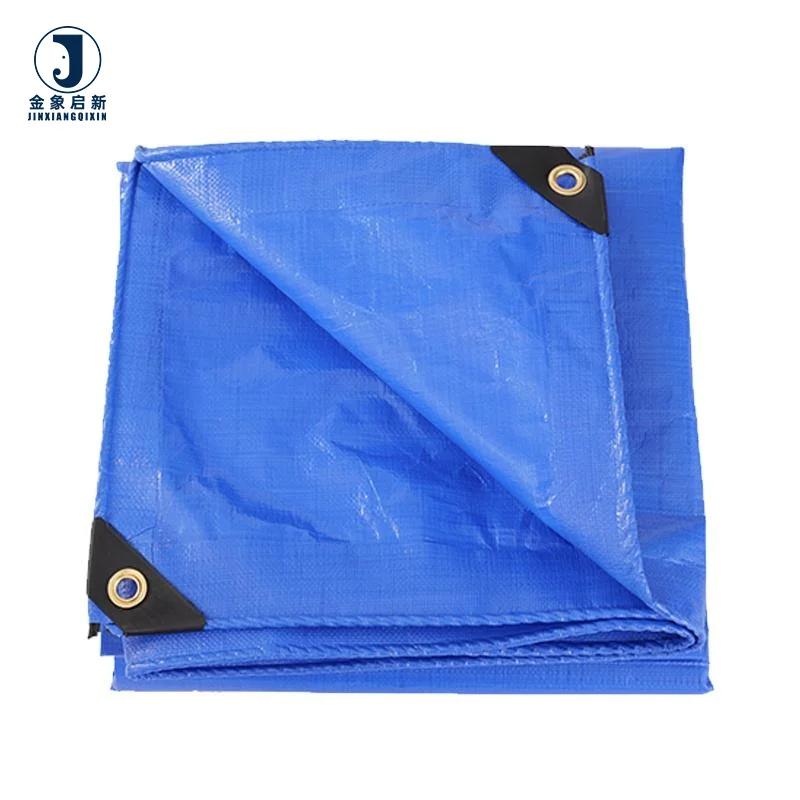
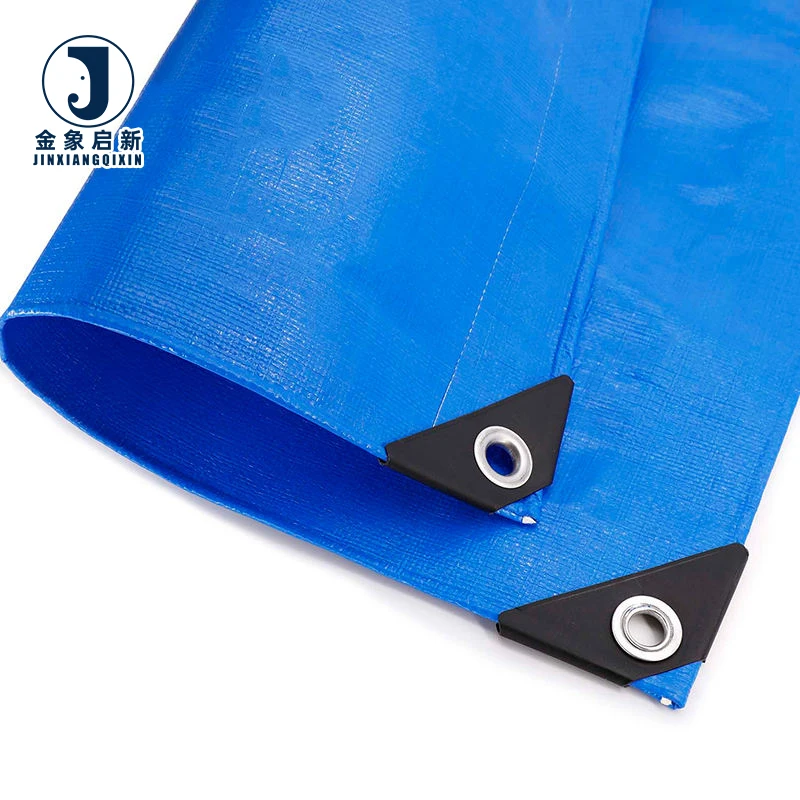
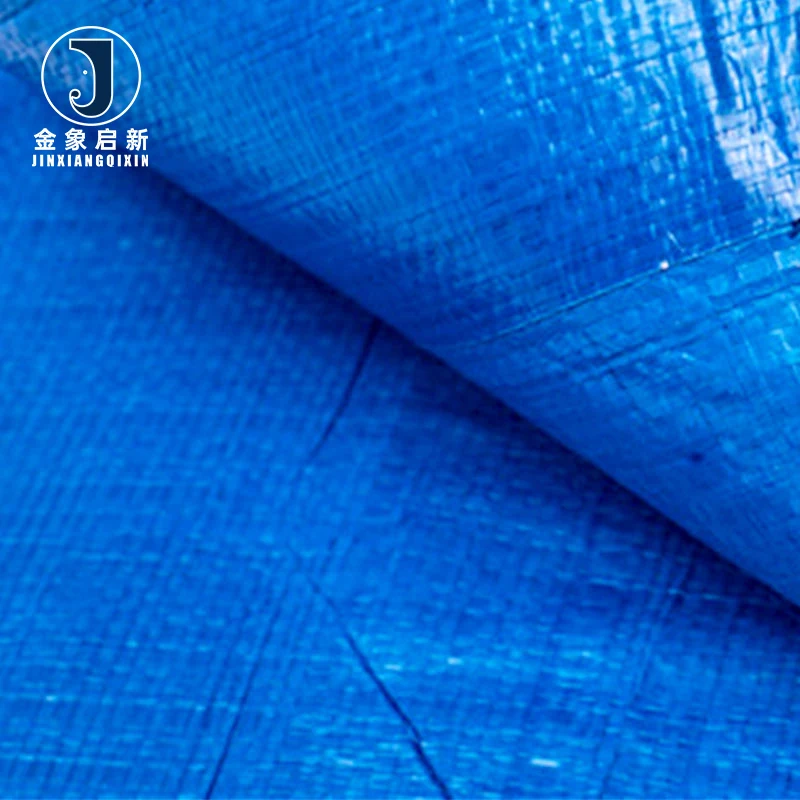
PE Tarpaulin Cover — HDPE Woven, LDPE Laminated, Waterproof for construction and transport applications.
- Three weight tiers (80-110, 120-150, 160-240 g/m²) with verified knitting density and tensile strength at each grade
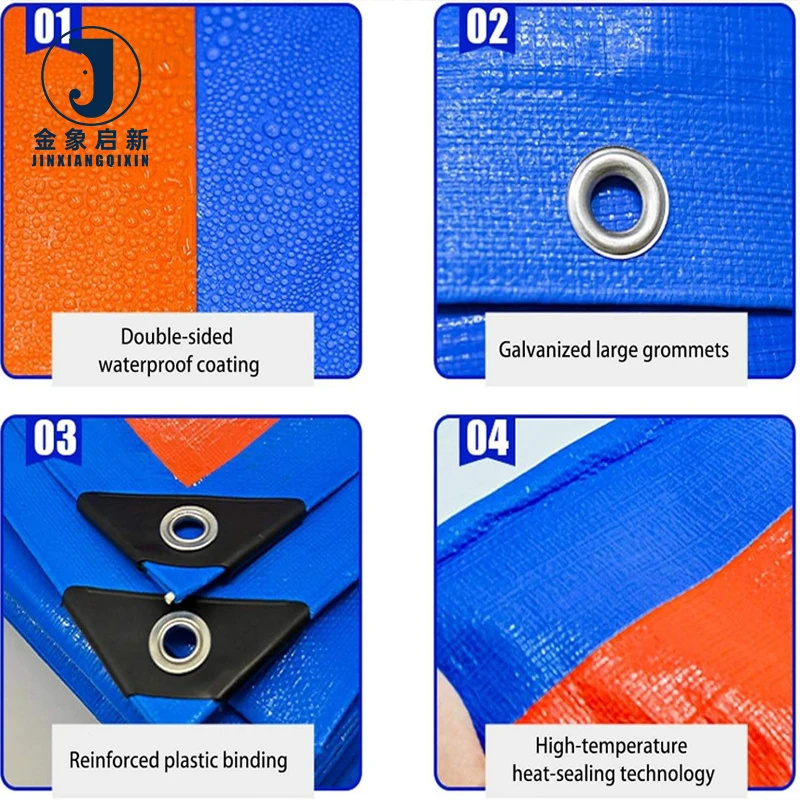
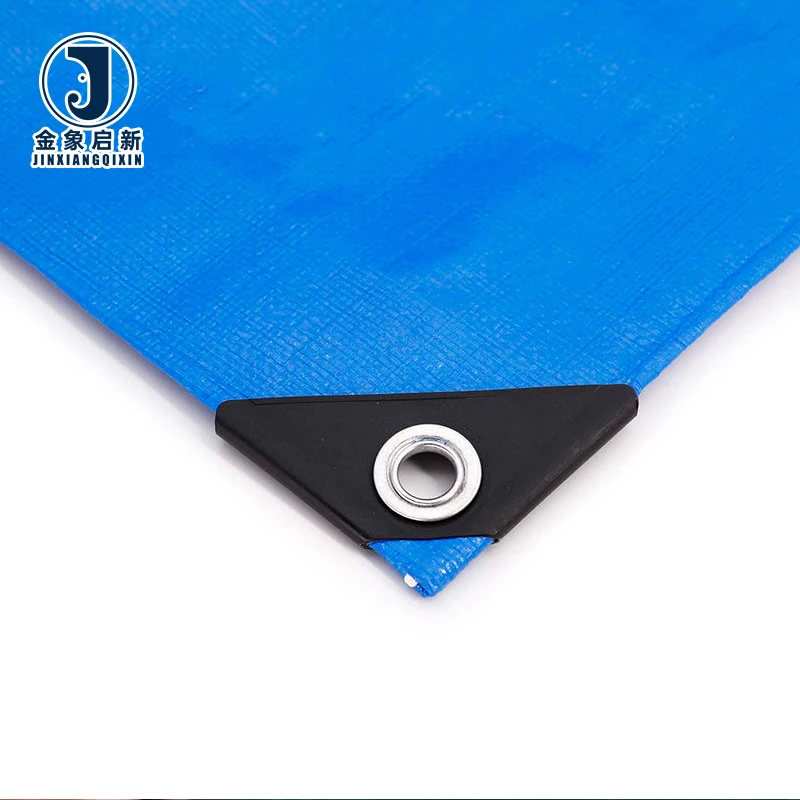
- PP rope-reinforced hems, galvanised eyelets every 3ft, reinforced plastic corners at stress points
- Available in roll stock or finished cut sizes with custom width, length, colour and UV treatment
Sourcing the right PE tarpaulin means matching GSM to actual load exposure — lighter grades reduce cost without sacrificing integrity when the weave density and lamination are controlled. Every order ships with a material specification sheet, 100% pre-shipment inspection record, and samples developed within days for custom requirements.
Description
Near three decades in coated fabric — we control HDPE weaving density and LDPE lamination weight in-house, verifying every roll of PE tarpaulin before it leaves our facility.
Technical Specifications
| Parameter | Value |
|---|---|
| Product Type | PE Tarpaulin |
| Base Material | HDPE woven fabric with LDPE lamination on both sides |
| Weight Range Available | 50 gr/m² to 220 gr/m² (confirm the grade for your application) |
| Lightweight Grade Weight | 80–110 g/m² |
| Medium Grade Weight | 120–150 g/m² |
| Heavy-Duty Grade Weight | 160–240 g/m² |
| Lightweight Thickness | 0.18–0.22 mm |
| Medium Thickness | 0.22–0.28 mm |
| Heavy-Duty Thickness | 0.30–0.35 mm |
| Lightweight Knitting Density | 8×8 |
| Medium Knitting Density | 10×10 |
| Heavy-Duty Knitting Density | 12×12 |
| Tensile Strength (Lightweight) | Meridian 300–500 / Latitude 250–450 N/5cm |
| Tensile Strength (Medium) | Meridian 500–800 / Latitude 400–700 N/5cm |
| Tensile Strength (Heavy-Duty) | Meridian 900–1200 / Latitude 700–1000 N/5cm |
| Roll Width Options | 6 ft, 8 ft, 10 ft, 12 ft / 2 m, 4 m, 6 m |
| Roll Length Options | 100 yards, 100 meters, or custom |
| Finished Edge Construction | All four edges reinforced with PP rope in hem |
| Eyelet Specification | Galvanised eyelets every 3 ft or 1 m interval |
| Corner Reinforcement | Reinforced plastic corners |
| Colour Options | Blue, Blue/Orange, Green, Grey, Black, Clear, Grey/Green, Orange, or custom |
| Key Features | Waterproof, washable, tear resistant, mildew proof, anti-aging, UV treatment available (test basis to be confirmed per order), blackout finish available |
| Standards | ISO, CE |
Application Suitability
| Application | Exposure & Requirement |
|---|---|
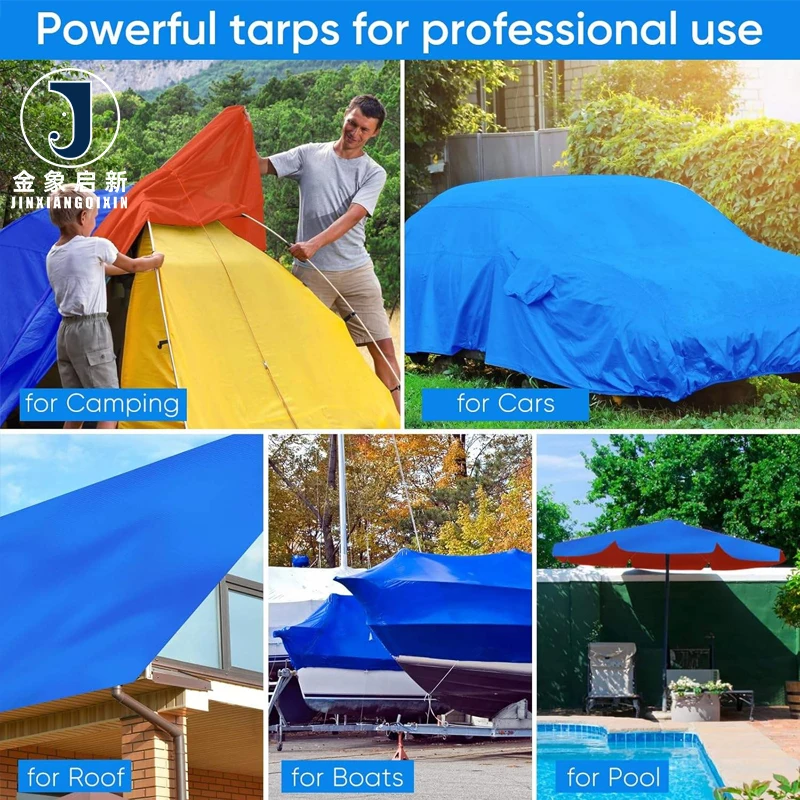
| Construction site enclosure | Wind-driven rain, scaffold abrasion, UV exposure, repeated install and removal cycles |
| Truck and trailer load cover | Road debris impact, tie-down strap tension at eyelets, flex at load edges, weather exposure during transit |
| Agricultural stock and hay cover | Prolonged sun exposure, moisture ingress prevention, mildew resistance for organic material proximity |
| Warehouse equipment protection | Indoor dust and moisture barrier, forklift handling stress at reinforced hems, long-term storage coverage |
| Temporary industrial shelter | Weather exposure, need for blackout or opacity, structural frame contact abrasion |
Why Stated GSM Does Not Guarantee Actual Cover Performance
Verified weight per square metre, documented before dispatch, is the only way to close the gap between quotation and delivery.
A recurring issue across the tarpaulin supply chain is material arriving lighter than the GSM specified on the original quote. Lightweight covers intended for short-term site use end up tearing in the first wind event, while medium-duty transport covers develop pinholes along the hem line within weeks. The problem compounds when UV treatment is claimed but no test basis accompanies the shipment, leaving the buyer with no way to assess expected service life. For a PE tarpaulin manufacturer supplying cross-border, this gap between stated and actual specification is where most commercial disputes originate [NEED_CITE: common causes of coated fabric specification disputes in international trade].
Roll Stock Consistency Across the Shipment
When you order multiple rolls of PE tarpaulin for distribution or large-scale fabrication, colour and weight must hold from the first core to the last. A variance in LDPE lamination thickness between rolls shows up immediately once the covers are installed side by side on a job site or across a fleet. Our production lines run continuous weight checks during the lamination stage, and we supply a material specification sheet per roll stating the actual GSM, base fabric density, and colour reference so that you can match what arrives to what was quoted.
Finished Covers Built Around the Tie-Down Point
The weakest link on any truck or construction cover is rarely the field of the fabric — it is the hem, the eyelet, and the corner. A finished PE tarpaulin that uses standard hem stitching without PP rope reinforcement will pull through at the eyelet under sustained strap tension. Every finished size we produce is built with a PP rope inserted into the folded hem, galvanised eyelets pressed at regular intervals, and reinforced plastic corners at the four stress points. This construction directs tie-down load into the rope and the corner patch rather than into the laminated weave alone [NEED_CITE: hem and eyelet reinforcement methods for heavy-duty tarpaulins].
Reading the Specification Sheet Beyond the GSM Number
GSM alone does not tell you how a PE tarpaulin will perform under load. A 150 g/m² cover woven at 10×10 density from a finer denier yarn can deliver different tensile behaviour than the same weight woven at 8×8 from a thicker yarn. The knitting density determines how load distributes across the weave: a tighter weave resists tear propagation better because more yarns must break sequentially before a rip extends. Meanwhile, the LDPE lamination weight on each side governs waterproof integrity and surface abrasion resistance. When you evaluate a custom PE tarpaulin quote, request the knitting density and the lamination split alongside the total GSM. Tensile values in the N/5cm format tell you where the fabric will hold and where it will not — meridian versus latitude imbalance indicates directional weakness that matters if the cover is oriented a specific way on a load or structure.
The Hidden Cost of Specifying on Price Per Kilogram Alone
Buyers who source PE tarpaulin by driving down cost per kilogram often receive material with reduced LDPE coating weight. The base fabric meets the quoted denier, but the thinner lamination compromises waterproof performance and makes the surface more susceptible to scratching during handling. In finished covers, the reduced coating adhesion causes delamination at the hem fold — the point where the material is folded and heat-sealed or stitched — long before the field of the fabric shows wear. We have seen batches rejected at the destination port because the actual GSM fell outside tolerance and the buyer had no pre-shipment inspection record to reference [NEED_CITE: coating weight verification methods for laminated polyethylene fabrics].
How We Support the PE Tarpaulin Specification You Actually Need
Our 10-person R&D team develops samples within days for custom width, colour, or printed branding, so you can confirm the material before committing to bulk production. Three full production lines equipped with dedicated lamination and weaving capacity handle roll widths up to 6 m without splice joins across the width. Every production stage carries its own QA checkpoint, and we conduct a 100% pre-shipment inspection on every roll and finished tarp — not a statistical sample. This means the inspection record you receive reflects the actual batch, not a representative subset. Documentation travels with the shipment: material spec sheet, ISO and CE certificates, roll packing list, and certificate of origin, giving your receiving team everything needed to verify the delivery against the purchase order.
Documentation & Verification
- Material specification sheet stating exact GSM, HDPE base density, and LDPE lamination weight per roll
- Colour reference card matched to the production batch for cross-roll consistency checks
- UV treatment test documentation available upon confirmation of the grade required for your market
- 100% pre-shipment inspection record covering weight, dimensions, and visual defects for every roll or finished tarp
- ISO and CE certificates included with export documentation and certificate of origin
Fabrication, Handling & Storage
- Heat-seal LDPE laminated surfaces at moderate temperature; excessive heat burns through the lamination before the HDPE base
- PP rope hem reinforcement distributes eyelet load across the full edge — do not punch eyelets outside the hem zone
- Store rolls upright on cores to prevent flat-spot creasing that weakens the lamination bond along the fold line
- Reinforced plastic corners on finished tarps must align with tie-down strap contact points for load-bearing use
- Avoid dragging heavy-duty grades across abrasive surfaces; the LDPE lamination can scuff even though the HDPE weave remains intact
- Cut-to-size finished covers should be folded along the weave direction to minimise stress on the lamination at fold lines
What to Include in Your PE Tarpaulin Enquiry
Specify the application environment — whether the cover will face continuous UV exposure, chemical contact, or mechanical abrasion — so we can recommend the appropriate weight tier and treatment. Provide the target roll width and length, or the finished dimensions with hem and eyelet requirements, along with annual volume estimates. If your market requires a specific UV performance grade or colour standard such as RAL or Pantone, state this upfront so we can develop a sample for approval before bulk production runs.
Frequently Asked Questions
Q: How do I verify the GSM I receive matches the GSM on the quotation?
A: Every roll and finished tarp ships with a material specification sheet stating the actual GSM measured during our pre-shipment inspection. We also provide a roll packing list that cross-references each roll number to its measured weight. If you require independent laboratory verification, we can supply test samples cut from the production batch for your own testing before the container is sealed.
Q: What is the test basis for your UV treatment, and how does it relate to outdoor service life?
A: UV treatment is available across all weight tiers, but the specific test basis and performance grade depend on the formulation selected for your order. We recommend you specify the UV standard required by your end market or application, and we will develop a sample with the corresponding treatment for your approval before production begins.
Q: Can you match a specific RAL or Pantone colour, and how do you control colour consistency across rolls?
A: Custom colour matching is available, and we produce a sample swatch for your approval before the bulk run. During production, we monitor LDPE lamination colour at the extrusion stage to hold consistency from the first roll to the last. The material specification sheet included with shipment records the colour reference for that batch.
Q: What hem reinforcement and eyelet spacing options are available for finished tarps?
A: Standard construction includes PP rope inserted into all four folded edges, galvanised eyelets spaced at 3 ft or 1 m intervals, and reinforced plastic corners. We can adjust eyelet spacing or add additional corner reinforcement patches for covers that will face high tie-down tension or sustained wind load.
Q: What are the lead time and minimum order for custom width, colour, or printed branding?
A: Lead times and minimums depend on the specific customisation requested — roll width, colour match, or printed branding each carry different production requirements. We develop samples within days so you can evaluate the material before committing to the full order, and we confirm the schedule once the sample is approved.
Related products
-
Custom Made PE Tarpaulin with Eyelets – Waterproof Tear-Resistant
Read more -
China JINGXIANG PE Coated Waterproof Blackout Truck & Trailer Cover Tarpaulin for Boys & Girls
¥0.35 Select options This product has multiple variants. The options may be chosen on the product page -
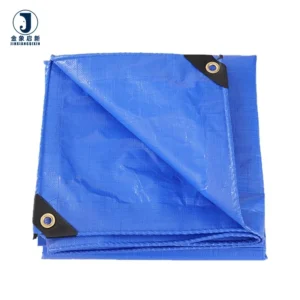
Hot Selling Organic Coated Blackout Waterproof Canvas PE Tarpaulin Tarp for Boys & Girls Construction Transportation Cover
¥1.68 Select options This product has multiple variants. The options may be chosen on the product page -
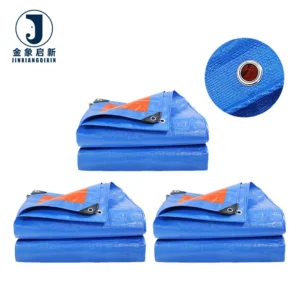
Multi-color & Size Waterproof Breathable Organic Blackout Coated PE Tarpaulin with UV Customizable Weft Knitted for Boys & Girls
¥0.21 Select options This product has multiple variants. The options may be chosen on the product page