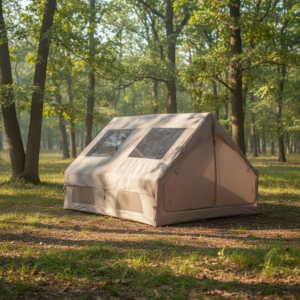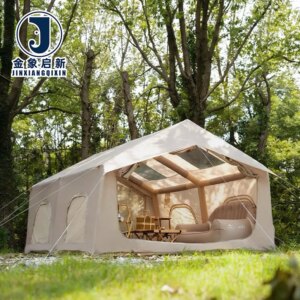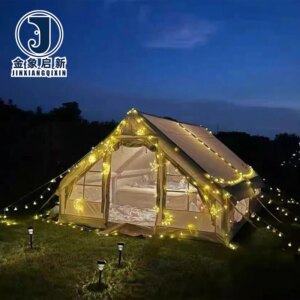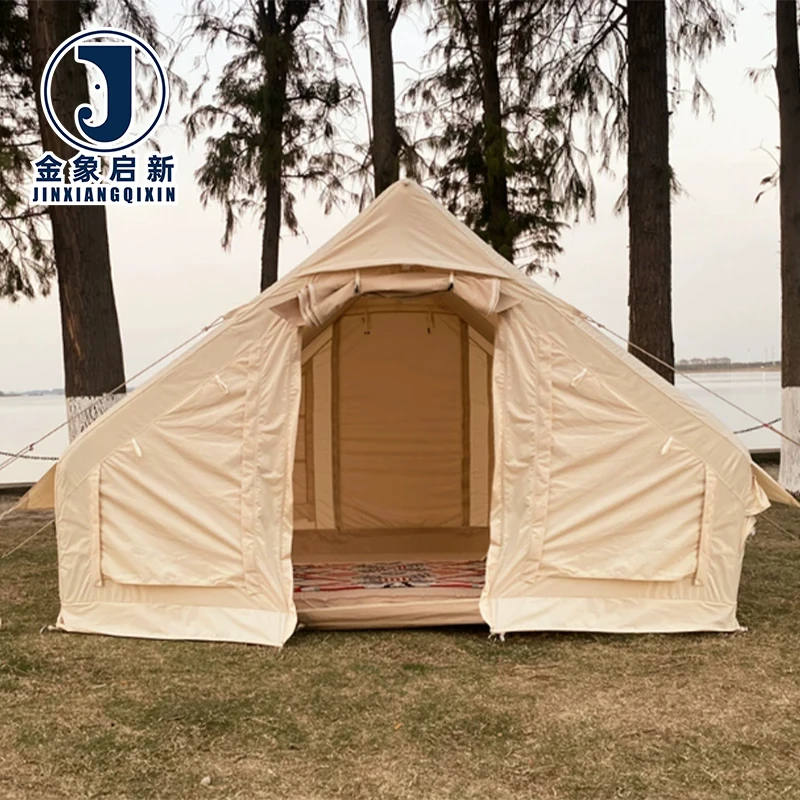
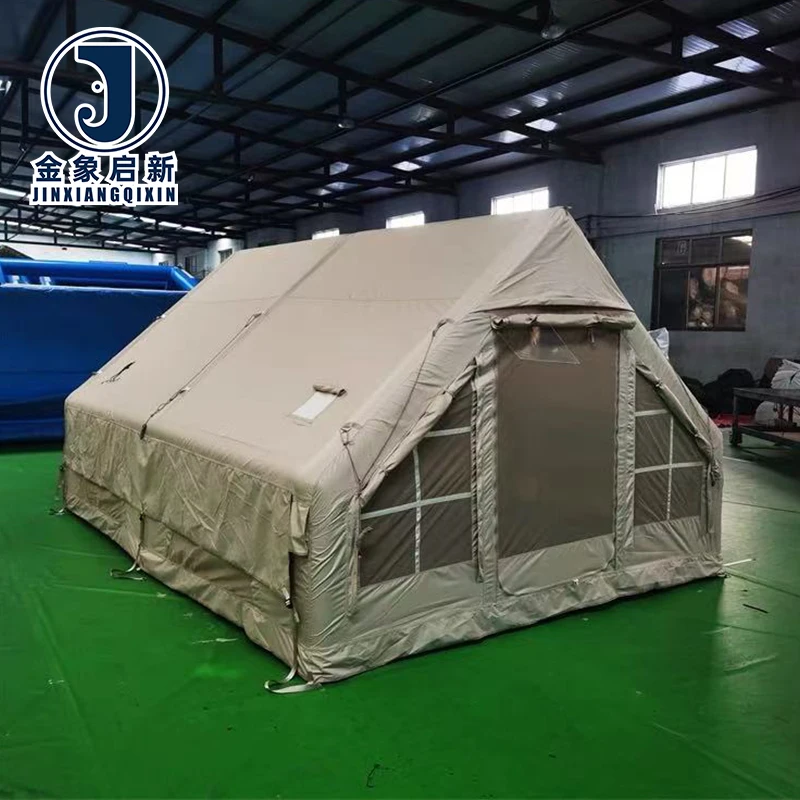
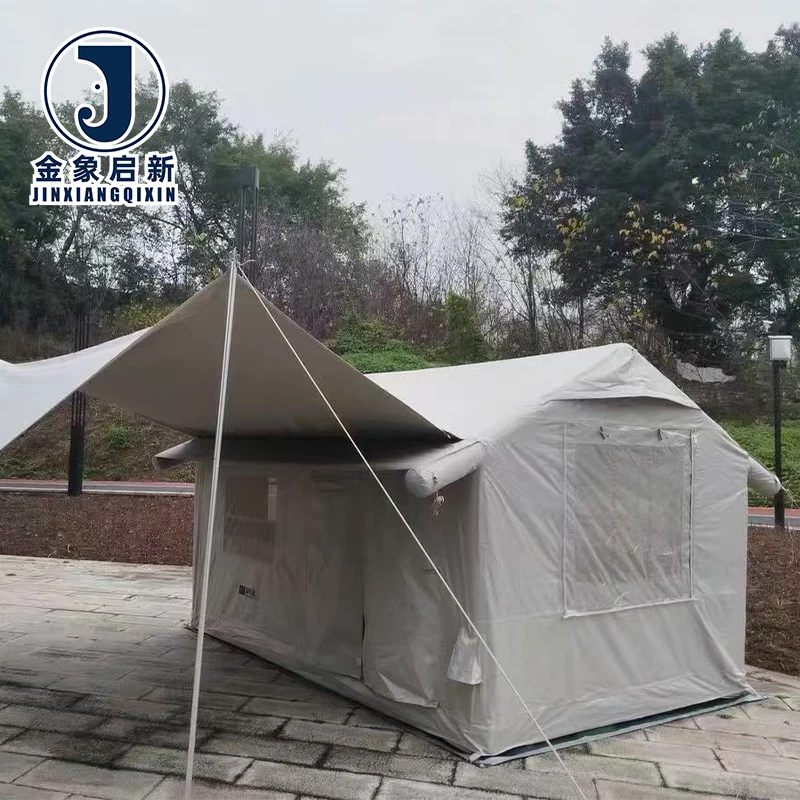
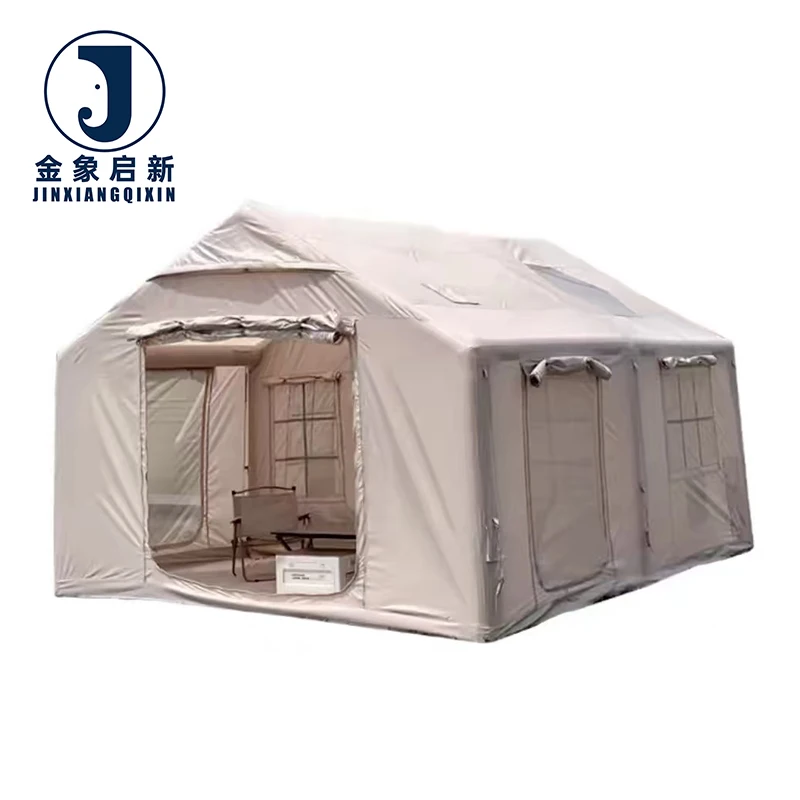
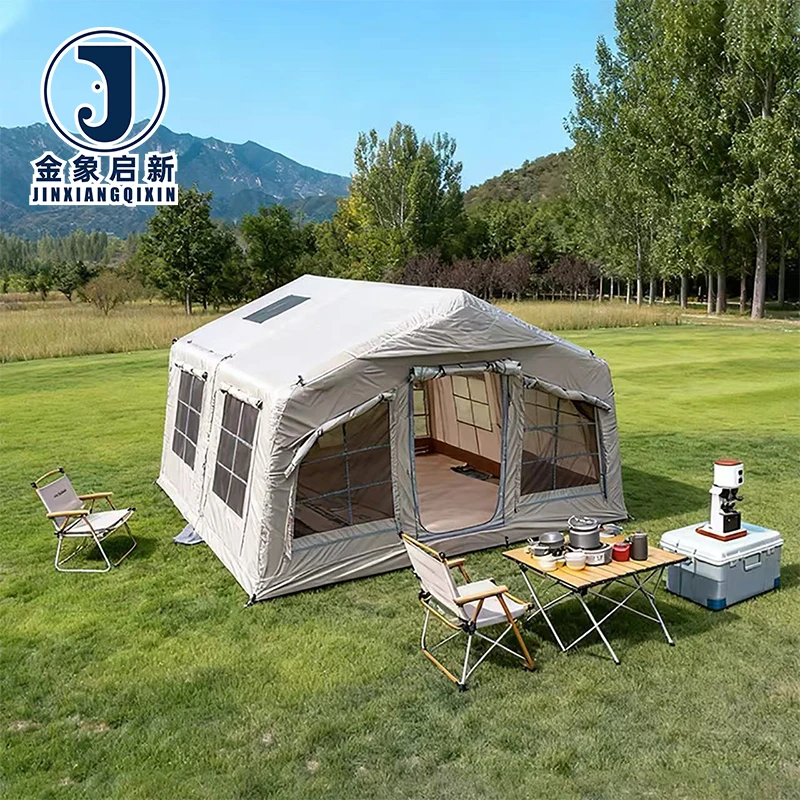
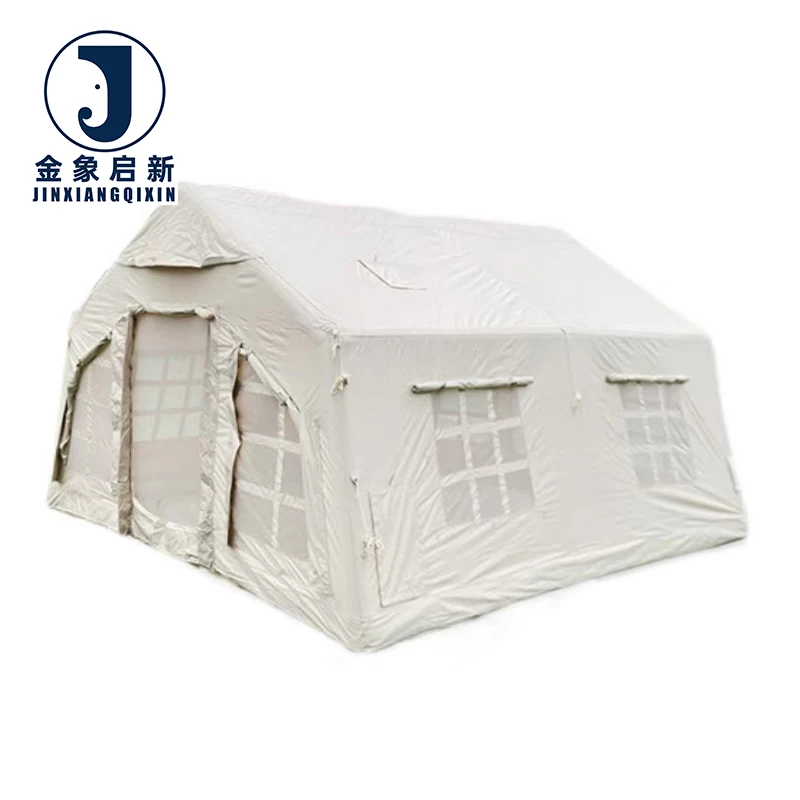
Inflatable Tent PVC Tarpaulin, >3000mm Waterproof, 4-Season Windproof — single layer extended construction with quick automatic opening for rapid deployment in emergency and industrial scenarios.
- Base fabric denier and weave density balanced for tear resistance and transport weight, with PVC coating adhesion controlled to maintain seam weld integrity at structural flex points under wind load
- Waterproof rating validated through batch-specific testing, supporting reliable performance in disaster relief, construction site shelters, and temporary workspace applications
Backed by nearly 30 years of coated fabric process control, 100% pre-shipment inspection, and sample development within days for custom sizing or print requirements.
Description
Coating Control Mastery — Every roll of PVC inflatable tent fabric is coated in-house across three dedicated lines, with adhesion and weight verified at every stage to prevent the GSM shortfalls that cause field rejections.
Technical Specifications
| Parameter | Value |
|---|---|
| Product Type | Inflatable Tent |
| Core Material | PVC tarpaulin |
| Waterproof Rating | >3000mm |
| Structural Design | Windproof, single layer construction |
| Product Form | Extended Type, Single Layer Construction |
| Deployment Mechanism | Quick automatic opening (inflatable) |
| Seasonal Rating | 4-season design |
| Customization | OEM & ODM (sample customization, pattern printing) |
| Production Facility Area | 9,180 square meters |
| Production Lines | 3 full production lines |
| Processing Equipment | 36 sets of professional processing equipment |
| R&D Team Scale | 10 technicians |
| Quality Control | Full-process inspection, 24-hour inflation test per unit, dedicated QA&QC staff |
| Standards | ISO 9001, ISO 14001, ISO 45001, CE |
Application Suitability
| Application | Exposure & Requirement |
|---|---|
| Temporary site offices during disaster recovery | Continuous weather exposure, rapid deployment demand, wind load on single-layer membrane |
| Equipment storage shelters on construction sites | UV and rain contact, abrasion from stored machinery, puncture risk from sharp edges |
| Temporary workspace for industrial maintenance | Enclosed environment requiring waterproof integrity, frequent inflation and deflation cycles |
| Emergency response rapid deployment scenarios | Extreme transport conditions, cold-weather handling, immediate structural integrity upon inflation |
Why Waterproof Claims Fail When the Storm Actually Hits
A >3000mm rating on paper means nothing if the coating weight and seam welds were never batch-tested. When procurement teams specify a PVC inflatable tent aftermarket supplier, they often receive generic catalogue figures that were validated on a different formulation or production run. I have watched shelters fail during their first heavy rainfall not because the fabric itself leaked, but because the welded seams separated under wind-induced flex — a failure point that coating adhesion testing would have caught before the material left the factory floor. The gap between stated performance and verified performance widens further when orders cross multiple batches, each with slightly different coating parameters that nobody documented. [NEED_CITE: tensile and tear test methods for coated fabrics per ISO 1421]
Coating Adhesion Determines Whether Your Tent Survives Its First Storm
The PVC coating must bond to the base fabric strongly enough to resist delamination at stress points — particularly where inflatable tubes meet the main membrane and where the structure flexes under wind load. Our coating process controls adhesion through precise temperature and pressure parameters on each of the three production lines, and every batch undergoes peel testing before release. This is what separates a PVC inflatable tent aftermarket supplier that backs its claims from one that merely prints a number on a data sheet.
Single-Layer Construction Demands More From Every Square Metre
A four-season inflatable tent built as a single-layer extended structure places the entire burden of waterproofing, wind resistance, and thermal performance on one membrane. There is no secondary liner to catch leaks or distribute loads. The PVC tarpaulin must therefore deliver consistent coating weight across the full roll width, with no thin spots that become failure origins under sustained inflation pressure. Our QA protocol includes continuous thickness monitoring during coating and 100% pre-shipment inspection to catch anomalies before they reach your assembly line. [NEED_CITE: coating weight consistency standards for inflatable structure fabrics]
Reading the Specification Sheet Beyond the Headline Number
The >3000mm waterproof rating tells you the hydrostatic head the fabric can withstand, but it does not tell you how that rating was achieved or whether it survives repeated inflation cycles. The base fabric denier and weave density determine tear propagation resistance — critical when a single-layer tent skin catches a gust and the load concentrates at anchor points. The PVC coating method and weight govern both waterproof integrity and weld behaviour: too light a coat and the weld penetrates through to the base fabric, too heavy and the seam becomes brittle at low temperatures. Fire-retardant and anti-static treatments are available in various grades — confirm the grade required for your market before production begins. Surface finish affects cleaning behaviour and print adhesion; glossy surfaces shed dirt faster while matte finishes accept branding inks more reliably.
The Hidden Cost of Skipping Batch-Level Verification
When a buyer accepts a PVC inflatable tent aftermarket supplier quotation based on stated GSM without demanding batch-specific verification, the risk is not theoretical. Coating weight that drifts below specification reduces waterproof performance and weakens weld integrity at exactly the points where the inflatable structure flexes most. Colour variation between rolls in the same shipment becomes visible only after the panels are cut and assembled side by side — by which point the cost of replacement far exceeds the cost of pre-shipment inspection. Weld failures that originate from inconsistent coating adhesion show up in the field, not in the warehouse, and the blame lands on the tent manufacturer rather than the fabric source. [NEED_CITE: common failure modes in welded PVC inflatable structures]
Why Technical Buyers Source Their Inflatable Tent Fabric Here
Our three full production lines and 36 sets of processing equipment give us the capacity to hold delivery schedules on bulk orders while maintaining the process control that inflatable tent fabric demands. The 10-person R&D team develops custom samples within days, handling material selection, pattern printing, and sizing to your exact pattern requirements. Every production run carries full-process QA with 24-hour inflation testing per unit and dedicated inspection staff checking coating weight, adhesion, and surface quality before dispatch. We supply complete documentation — material specification sheets, batch test reports, certificates of origin — so your compliance team never has to chase paperwork after shipment. ISO 9001, ISO 14001, ISO 45001, and CE certification underpin the production system, not just the marketing brochure.
Documentation & Verification
- Material specification sheet stating GSM, base fabric type, coating weight, and colour reference per production batch
- Batch-specific test report confirming waterproof rating achieved on the actual rolls supplied
- ISO and CE certificates tied to the production facility with order traceability
- Pre-shipment inspection record documenting coating adhesion, surface quality, and dimensional accuracy per roll
- Certificate of origin and customs documentation prepared for destination market requirements
Fabrication, Handling & Storage
- Heat-weld parameters must be adjusted to match the specific PVC coating weight to prevent burn-through or weak seams
- Store rolls upright on pallets to avoid flat-spotting the coated surface before cutting
- Use compatible PVC adhesive for field repairs on the single-layer membrane at tube junction points
- Allow material to acclimatise before unrolling in cold conditions to prevent coating micro-cracking
- Pattern printing requires surface tension verification on the glossy or matte finish before ink application
What We Need From You to Quote Accurately
To specify the right PVC inflatable tent fabric for your application, share the deployment climate and expected wind exposure so we can recommend coating weight and treatment levels. Confirm the fire-retardant or anti-static grade your local regulations require — different markets enforce different standards. Provide your target panel dimensions and annual volume so we can calculate roll utilisation and production scheduling across our lines.
Frequently Asked Questions
Q: What GSM and coating weight options are available for different deployment climates?
A: We offer PVC tarpaulin across a range of weight grades suited to transport constraints and climatic demands. Lighter grades suit rapid-deploy emergency shelters where pack weight matters; heavier grades provide additional tear resistance for semi-permanent construction site installations. Share your deployment scenario and we will recommend the appropriate specification with supporting test data.
Q: Can fire-retardant or anti-static treatment be applied, and what certification ships with it?
A: Fire-retardant and anti-static treatments are available for our inflatable tent fabric. The specific grade must be confirmed against your market’s regulatory requirements before production. Each treated batch ships with a test report documenting the achieved classification, referenced to the applicable standard.
Q: How is batch-to-batch colour and performance consistency controlled?
A: Every production run undergoes continuous coating weight monitoring and colour reference verification against the approved sample. Pre-shipment inspection covers surface quality and dimensional accuracy per roll. We do not mix production batches within a single order without documented buyer approval.
Q: What documentation package ships with each order?
A: Each shipment includes a material specification sheet, batch test report for waterproof rating, pre-shipment inspection record, ISO and CE certificates, certificate of origin, and a roll packing list. Additional documentation for customs or site compliance can be prepared based on your destination market requirements.
Q: What is the sample-to-production timeline for custom dimensions or specialised treatment?
A: Our 10-person R&D team develops samples within days for custom sizing, pattern printing, or specialised treatment requirements. Once the sample is approved, full production is scheduled across our three lines with lead time confirmed at quotation stage. We recommend ordering samples early to lock in coating parameters before committing to volume.
Related products
-
High Quality Four-Season Inflatable Tent for Camping Durable PVC Material All-Weather Resistance Quick Automatic Opening
Read more -
Luxury PVC Inflatable Tent for Glamping Outdoor Waterproof with Quick Automatic Opening Four-Season Foldable Design and Pump
Read more -
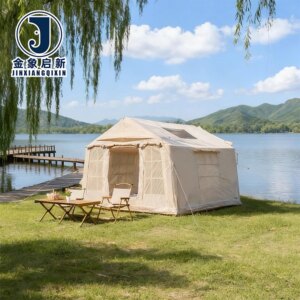
Luxury Inflatable Tent for Glamping Outdoor Waterproof Air Tent with Pump
Read more -
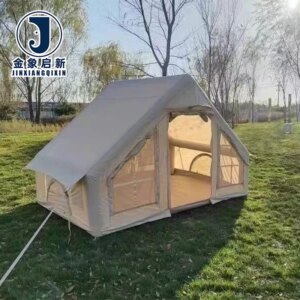
Outdoor Portable Camping Inflatable Tent Luxury All-Season Use Overnight Large Space Rainproof Insulated Quick Automatic Opening
Read more