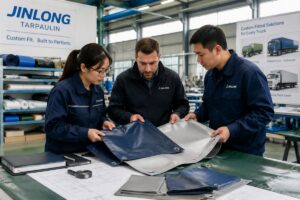
PVC Mining Tarpaulin Manufacturer | Heavy-Duty Wholesale Supplier
Heavier GSM does not guarantee longer service life underground.
The best tarpaulin for mining is not a single product but a matched combination of base fabric structure, coating chemistry, and certified performance ratings—selected according to whether the end use is ventilation ducting, equipment protection, or open-site covering.
I still remember the first time a mining buyer in Western Australia opened a sample roll of our PVC-coated fabric and shook his head. The GSM was right, the color was right, but when he held a lighter to the edge, the coating melted and dripped instead of self-extinguishing. He was building ventilation ducts for a deep-level gold operation, and his site safety officer had specified a strict oxygen index threshold we had not confirmed before shipping. That single mismatch nearly killed the entire order. Since then, every inquiry I handle for a best tarpaulin for mining application starts with one question: where exactly will this fabric live, and what will it be asked to survive? [NEED_CITE: ISO 3409 oxygen index test method for conveyor belt flammability]
Getting that answer right is what separates a supplier who ships rolls from a partner who keeps a mine running. Let me walk you through how we make that call, and how you can evaluate any best tarpaulin for mining offer that lands on your desk.
PVC vs PE Tarpaulin for Mining: Which Suits Your Application?
PVC-coated polyester and PE-laminated fabrics behave fundamentally differently under heat, chemical exposure, and mechanical stress—choosing between them is a工况 decision, not a price decision.
Many buyers assume PVC is automatically superior because it costs more. In mining, that assumption can waste budget or, worse, create a safety gap. The coating resin determines how the fabric reacts to the specific hazards present at the working face, the workshop, or the stockpile yard.
| Parameter | PVC-Coated Polyester | PE-Laminated Woven |
|---|---|---|
| Base fabric tensile behavior | High tear resistance, stable under tension | Moderate, elongates under sustained load |
| Heat resistance range | Withstands sustained elevated temperatures | Softens noticeably at moderate heat |
| Chemical exposure response | Resistant to mild acids, alkalis, oils | Vulnerable to hydrocarbon contact |
| Flame behavior with retardant additive | Self-extinguishing, low drip | Melts and drips unless heavily treated |
| Weight-to-strength ratio | Heavier per square meter | Lighter, easier to handle manually |
| Typical service environment | Underground ducts, chemical-exposed covers | Temporary surface covers, short-term stockpile protection |
[NEED_CITE: comparative thermal degradation behavior of PVC and PE polymer coatings under mining conditions]
A copper mining operation in Central Africa once ordered a large batch of PE-laminated covers for haul truck beds, assuming the lower unit price would stretch their budget. Within months, the fabric exposed to diesel exhaust residue and direct equatorial sunlight became brittle and cracked along fold lines. Replacing the entire fleet of covers cost several times the original savings. When they switched to a PVC-coated polyester with anti-UV stabilization for the next procurement cycle, the covers lasted substantially longer and the total cost of ownership dropped noticeably.
The lesson is simple: if the fabric will sit near heat sources, contact oils, or remain installed for extended periods under strong sunlight, PVC-coated polyester is the appropriate choice. If the requirement is short-term, lightweight, and cost-driven surface protection with minimal chemical exposure, PE-laminated fabric can serve adequately. No single material wins every scenario.
Mining Ventilation Ducts: Fabric Specs You Cannot Compromise On
Ventilation duct fabric is the one application where a tarpaulin specification error directly endangers lives—temperature rating, flame propagation, and flexibility retention are non-negotiable.
Underground ventilation ducts carry fresh air to working faces and extract dust, gas, and heat. The fabric forming these ducts must remain flexible enough to be hung, joined, and repositioned, while simultaneously resisting flame propagation and maintaining structural integrity under continuous airflow pressure. This is where the best tarpaulin for mining designation matters most, because duct failure means air supply failure.
The critical parameters to verify are:
- Flame retardancy rating — the fabric must meet the oxygen index and vertical burning test requirements of the applicable mining safety standard. [NEED_CITE: EN 14527 flame retardancy requirements for mining ventilation duct fabrics]
- Anti-static performance — in gassy mines, static charge accumulation on duct surfaces can become an ignition source. Conductive yarn integration or surface treatment is required.
- Temperature endurance — the coating must not become tacky at elevated ambient temperatures or brittle in cold intake airways.
- Flexibility after aging — the fabric must retain foldability after prolonged exposure to airflow, humidity, and UV if surface sections are involved.
- Air leakage control — seam welding quality and coating adhesion determine whether the duct delivers rated airflow volume to the face.
A gold mining client in Central Asia placed a bulk order for ventilation duct fabric based on GSM alone. The selected fabric was heavy but used a base weave that lacked dimensional stability under tension. When the ducts were pressurized, the seams distorted and air leakage increased noticeably, forcing the ventilation team to run auxiliary fans at higher capacity—driving up energy costs across the entire operation. The root cause was not the coating weight but the base fabric construction, a detail that only became visible under real working pressure.
When you evaluate a best tarpaulin for mining supplier for duct applications, ask for test reports covering all five parameters above, not just a generic flame retardant certificate. Duct fabric is a safety-critical component, and the documentation should reflect that.
How to Verify Supplier Claims: Certifications and Testing Standards
A certificate is only as trustworthy as the testing body behind it—verifying the issuing laboratory, the standard version, and the sample traceability separates real compliance from paperwork.
In the mining tarpaulin market, claims of fire retardancy, anti-UV performance, and waterproofness are common. What is less common is a supplier who can show you exactly which accredited laboratory tested which production batch against which version of the standard. This gap between claim and proof is where procurement mistakes happen.
The verification process I follow with every serious buyer involves several steps:
- Request the full test report, not just a certificate summary. A valid report includes the testing laboratory name and accreditation mark, the specific standard number and version year, the sample identification traceable to a production batch, and the actual measured values against the pass criteria. [NEED_CITE: ISO 17025 accreditation requirements for testing laboratories issuing textile certification reports]
- Cross-check the standard version. Mining safety standards are updated periodically. A certificate issued against a superseded version may not satisfy current site safety officers. Confirm that the test was conducted against the version currently accepted by the mine’s regulatory authority.
- Verify the testing body’s accreditation. Reports from unaccredited in-house labs carry limited weight. Look for accreditation from recognized bodies such as CNAS, UKAS, or equivalent national authorities.
- Request pre-shipment samples from the actual production batch. Certificates may cover a reference formulation, but production variations in coating thickness, additive dispersion, and base fabric lot can shift performance. Testing a sample from the shipped roll against the same standard closes this gap.
- Conduct a small trial installation before full deployment. A section of duct or a set of equipment covers installed in real conditions for a defined period reveals performance behavior that no laboratory report fully predicts.
A Middle East mining procurement team once received a shipment of best tarpaulin for mining products accompanied by a flame retardant certificate. The certificate looked complete until they checked the testing body—it was an unaccredited internal lab with no recognized accreditation mark. The site safety officer rejected the entire shipment. Resubmitting samples to an accredited laboratory, waiting for results, and arranging replacement stock delayed the project by months and cost significantly more than proper upfront verification would have.
Common Procurement Mistakes and How to Avoid Them
Overlooking site-specific conditions, selecting on price alone, and accepting unverified certificates are the three most frequent errors in mining tarpaulin procurement—and all three are preventable.
The first mistake is specifying a generic product without defining the actual working environment. A fabric suitable for covering surface stockpiles in a temperate climate will fail quickly if installed as a ventilation duct in a hot, gassy underground mine. The buyer’s specification document must describe the installation location, exposure conditions, expected service life, and applicable safety standards before any product selection begins.
The second mistake is choosing the lowest unit price without calculating total cost of ownership. A cheaper fabric that requires replacement twice as frequently, or that causes air leakage in ducts forcing higher fan energy consumption, costs far more over the life of the mine than a correctly specified product purchased at a higher initial price.
The third mistake is accepting a certificate at face value without verifying the details described in the previous section. Paper certificates are easy to produce; accredited test reports traceable to production batches are not.
| Common Error | Corrective Action |
|---|---|
| Generic specification without site conditions | Define installation environment, exposure, and applicable standards before product selection |
| Selection based on lowest unit price | Evaluate total cost of ownership including replacement frequency and operational impact |
| Accepting unverified certificates | Request full accredited test reports and cross-check standard versions |
| Skipping sample testing before bulk order | Conduct trial installation under real conditions before full deployment |
| Ignoring base fabric construction details | Verify weave structure and tensile properties, not just coating weight |
A European mining operator learned this the hard way when they accepted a large order of ventilation duct fabric based solely on a supplier’s self-declared compliance statement. The fabric failed the site’s independent incoming inspection for flame retardancy. The entire batch was rejected, the supplier could not provide accredited test documentation, and the operator had to source replacement fabric on short notice at a premium. The disruption to the ventilation schedule was the most costly consequence of all.
Conclusion
Selecting the best tarpaulin for mining is a technical matching exercise, not a commodity price comparison.
The right fabric depends on the specific application—ventilation duct, equipment cover, or site protection—and the specific hazards present at the working location. PVC-coated polyester and PE-laminated fabrics serve different roles, and neither is universally superior. Certification verification, sample testing, and trial installation are essential steps that protect both safety and budget. A supplier who welcomes these verification steps and provides transparent documentation is the supplier worth building a long-term relationship with.