PVC Tarpaulin Price in Germany: 2026 Wholesale Buyer Guide
Higher GSM does not automatically mean higher price per square meter — coating process and certification tier often swing the final cost more than raw material weight.
PVC tarpaulin price in Germany is determined by three factors working in combination: GSM weight range, coating technology (knife-over-roll vs. calendering/lamination), and EU certification tier (DIN/EN compliance level). Buyers who treat GSM as the sole pricing variable routinely overpay on lightweight grades or receive non-compliant goods on heavy-duty orders. A realistic price assessment requires mapping specification to application, then layering certification and landed cost on top.
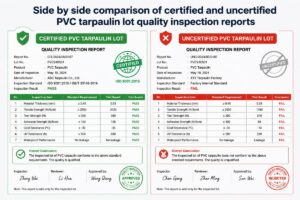
I still remember the first time a Hamburg-based truck cover importer rejected an entire container of ours. We had shipped what we considered a standard 700gsm PVC tarpaulin, fully tested and certified under Chinese national standards. The buyer opened the container, pulled a sample, and handed me a DIN 53857 tear strength printout. Our material passed our spec — but fell short of the European test method. The entire shipment was discounted, and the re-inspection cycle stretched across weeks. That single misalignment between test standards cost us the equivalent of an entire quarter’s margin on that account. Since then, every spec sheet I review for the German market gets read line by line — grammage, flame retardancy class, UV resistance hours, tear strength method — because the PVC tarpaulin price in Germany is never just about the fabric itself. [NEED_CITE: DIN 53857 test method scope and applicability for coated fabrics]
Understanding how these variables interact is the difference between sourcing efficiently and sourcing expensively. Let us break down each layer.
What Determines PVC Tarpaulin Price in Germany?
Three variables form the pricing triangle: GSM weight, coating process, and certification tier. Changing any one of them shifts the PVC tarpaulin price in Germany materially.
Most buyers start their inquiry with a single question: how much per square meter? But that question is unanswerable without context. A 500gsm calendered PVC sheet for temporary construction covers sits at a completely different price point than a 900gsm knife-coated fabric with B1 flame retardancy certification for truck tarpaulins — even though both are technically “PVC tarpaulin.”
The GSM weight establishes the baseline material cost. Heavier fabrics consume more PVC resin, polyester scrim, and plasticizer. However, the coating process determines how efficiently that material is applied and how consistently it performs. Knife-over-roll coating produces a more uniform, fully bonded layer with superior tear and weld strength — but it runs slower and consumes more energy than calendering. [NEED_CITE: comparative production efficiency of knife-over-roll versus calendering coating methods for PVC coated fabrics]
Then there is certification. A fabric that meets basic waterproofing requirements costs substantially less than one carrying DIN EN 13675 compliance, REACH conformity, and B1 flame retardancy classification. Testing fees, third-party audit costs, and ongoing batch verification all feed into the per-square-meter price.
| Factor | Basic Tier | Mid Tier | High Tier |
|---|---|---|---|
| Coating Process | Calendered | Knife-coated | Knife-coated with top treatment |
| Certification | Self-reported | Sample-level tested | Full batch-level DIN/EN certified |
| Tear Strength Consistency | Variable | Standard | Controlled |
| Flame Retardancy | None | Basic self-extinguishing | B1 classified per DIN 4102 |
| UV Resistance | Uncontrolled | Standard | Substantially extended |
A Middle East distributor once asked me why his 650gsm quote from one supplier was nearly identical to his 900gsm quote from another. The answer: the cheaper 900gsm was calendered with minimal certification, while the 650gsm was knife-coated with full EN testing. The lighter fabric actually cost more per square meter because the process and compliance overhead were higher. [NEED_CITE: EN 13675 standard requirements for flexible sheetings used in construction]
PVC Tarpaulin Price Matrix by GSM and Specification
Mapping GSM ranges to application tiers reveals where the PVC tarpaulin price in Germany clusters — and where buyers commonly misjudge value.
The German and broader European market segments PVC tarpaulin demand into recognizable tiers based on grammage and end use. Understanding this matrix helps buyers avoid the trap of specifying heavier material than necessary — or worse, specifying lighter material that fails in the field.
| GSM Range | Typical Application | Coating Preference | Certification Expectation | Relative Price Position |
|---|---|---|---|---|
| 440–500gsm | Temporary covers, light agriculture, basic waterproofing | Calendered | Basic | Entry |
| 550–650gsm | Truck side curtains, general transport covers, awning backing | Knife-coated preferred | DIN/EN sample-level | Mid |
| 700–800gsm | Heavy-duty truck tarps, container covers, industrial curtains | Knife-coated | Full DIN/EN, B1 flame retardant | Upper-mid |
| 850–1000gsm | Mining ventilation ducts, pond liners, long-term outdoor structures | Knife-coated with reinforcement | Full certification, chemical resistance | Premium |
A European truck cover manufacturer I worked with initially specified 900gsm for all their side curtain products. After reviewing their actual wear patterns and replacement cycles, we demonstrated that 650gsm knife-coated fabric with proper UV stabilization delivered equivalent service life for their fleet — at a noticeably lower per-square-meter cost. The savings across their annual volume were significant enough to fund an additional production shift.
The critical insight: GSM is a starting point, not a destination. The coating quality, scrim density, and additive package (UV stabilizers, fungicides, flame retardants) determine whether a 650gsm fabric outperforms a poorly manufactured 900gsm roll. [NEED_CITE: relationship between scrim density and tensile performance in PVC coated polyester fabrics]
Hidden Costs: Certifications, Testing and Compliance for the EU Market
EU regulatory compliance adds measurable cost layers to the PVC tarpaulin price in Germany — and these costs are frequently underestimated by first-time importers.
When I lost that Hamburg container, the direct financial hit was the discount. The indirect cost — re-testing, documentation replacement, delayed delivery to the buyer’s own customers — was several times larger. Certification is not a line item you can negotiate away; it is a structural cost embedded in compliant supply.
The primary regulatory frameworks affecting PVC tarpaulin imports into Germany include:
- DIN EN 13675 — flexible sheetings for waterproofing, covering mechanical properties, dimensional stability, and durability requirements. [NEED_CITE: DIN EN 13675 scope and testing parameters for flexible sheetings]
- DIN 4102 / EN 13501-1 — flame retardancy classification. B1 rating (DIN 4102) or equivalent Euroclass is often contractually required for construction and transport applications.
- REACH Regulation (EC 1907/2006) — restricts specific phthalates and heavy metals in PVC formulations. Compliance requires documented supply chain verification and periodic testing. [NEED_CITE: REACH regulation restrictions applicable to PVC coated fabrics containing phthalates]
- DIN 53857 — tear strength testing method. European buyers specify this method; results from alternative test methods are often rejected.
A construction project buyer in Bavaria once needed B1-rated tarpaulin for a temporary industrial enclosure. The difference between standard self-extinguishing fabric and fully B1-classified material represented a meaningful percentage premium on the per-square-meter price. However, the certification documentation preparation cycle added weeks to the production timeline. Buyers who fail to plan for this lead time face expedited testing fees or project delays — both of which erode the apparent savings of sourcing uncertified material.
| Compliance Element | Basic Supply | Compliant Supply |
|---|---|---|
| Flame Retardancy Testing | Self-reported | Third-party B1 classified |
| REACH Documentation | Not provided | Verifiable per batch |
| Tear Strength Method | Supplier standard | DIN 53857 verified |
| Batch Traceability | Sample-level | Full batch-level |
| Lead Time Impact | Noticeably reduced | Standard with certification cycle |
The pattern I see repeatedly: buyers compare per-square-meter quotes from two suppliers, see a gap, and assume the higher quote is inflated. In reality, the higher quote often includes certification costs that the lower quote simply omits — leaving the buyer exposed to customs rejection, customer claims, or project non-compliance. [NEED_CITE: EU market rejection rates for non-compliant imported flexible sheeting products]
FOB vs Landed Cost: How to Calculate True Import Price to Germany
The quoted FOB price is only the starting point — freight, duties, port handling, and inland transport determine the actual PVC tarpaulin price in Germany at your warehouse door.
A buyer in Frankfurt once showed me two quotes side by side. One supplier quoted FOB Shanghai; another quoted CIF Hamburg. The FOB quote looked cheaper — until the buyer added ocean freight, marine insurance, German import duty, port discharge fees, customs clearance, and truck transport to his warehouse. The CIF quote, which included freight and insurance to Hamburg, actually landed at a lower total cost than the FOB quote plus all the separately calculated charges.
Here is the typical cost structure for importing PVC tarpaulin from China to Germany:
- FOB price — material cost, packaging, loading, and export documentation at the Chinese port.
- Ocean freight — varies by container type, season, and routing. Full container loads are substantially more economical per cubic meter than LCL shipments. [NEED_CITE: average ocean freight rate trends for China to Northern Europe container shipping]
- Marine insurance — typically a small percentage of cargo value, but essential for high-value coated fabric shipments.
- EU import duty — PVC coated fabrics fall under specific CN codes; the applicable duty rate depends on exact classification. [NEED_CITE: EU TARIC duty rates for PVC coated polyester fabrics under relevant CN headings]
- Port handling and terminal charges — Hamburg, Bremerhaven, and other Northern Range ports have distinct fee structures.
- Customs clearance — broker fees, documentation verification, and potential inspection costs.
- Inland transport — truck or rail from port to final warehouse.
A common mistake: buyers fixate on the per-square-meter FOB price and ignore the duty classification. A slight difference in how the product is described on the commercial invoice can shift the CN code — and the applicable duty rate — materially. I have seen cases where proper classification saved the buyer a noticeable percentage on total landed cost, simply because the product was correctly described as coated fabric rather than finished tarpaulin.
| Cost Component | Visibility at Quote Stage | Typical Buyer Attention |
|---|---|---|
| FOB Price | Fully visible | High |
| Ocean Freight | Quoted or estimated | Moderate |
| Import Duty | Requires classification | Frequently overlooked |
| Port and Handling | Known after routing | Often estimated late |
| Inland Transport | Variable | Rarely included in comparison |
The discipline I recommend: always convert quotes to a DDP-equivalent landed cost before comparing suppliers. The PVC tarpaulin price in Germany only becomes meaningful when it reflects what you actually pay to have the material on your floor, compliant and ready for use.
How to Source PVC Tarpaulin from China Without Costly Mistakes
Avoiding costly errors in PVC tarpaulin procurement requires aligning specification, certification, and commercial terms before the first roll is produced — not after the container arrives.
At Jinxiang, we produce PVC and PE tarpaulins across the full GSM spectrum — from 440gsm lightweight covers to 1000gsm heavy-duty industrial fabrics — using both calendering and knife-coating processes. This range means we can match the correct process to the application rather than forcing every order into a single production line. But the manufacturing capability is only half the equation. The other half is how the buyer communicates requirements.
The most common sourcing failures I have witnessed share a pattern:
Specification ambiguity. A buyer requests “heavy-duty PVC tarpaulin” without defining GSM, coating type, or test standard. The supplier produces to their own interpretation of “heavy-duty” — which may not match the buyer’s expectation. Always specify: GSM weight, coating method preference, required test standards (DIN, EN, or ISO), and flame retardancy class if applicable.
Sample approval without production correlation. A pre-production sample is approved, but the bulk production run uses a different resin batch or scrim supplier. Request production-aligned samples — taken from the actual production run or from material produced under identical conditions. [NEED_CITE: best practices for production sample approval in coated fabric manufacturing]
Certification timing mismatch. The buyer needs DIN-certified material but places the order without allowing time for third-party testing. Production completes, but shipment is delayed waiting for test results. Build certification lead time into your procurement schedule from the outset.
MOQ misalignment. A buyer needs a specific width and color in a small quantity, but the supplier’s minimum run is set for standard widths. Jinxiang offers MOQ flexibility from single rolls to full container loads, which allows buyers to test new specifications without committing to production-scale quantities. This is particularly valuable when entering the German market with a new product line or validating a new application.
| Sourcing Step | Common Error | Correct Approach |
|---|---|---|
| Specification | Vague description | Full parameter definition with test standards |
| Sampling | Pre-production sample only | Production-aligned sample verification |
| Certification | After-production testing | Pre-planned certification timeline |
| MOQ | Forced to standard runs | Flexible from roll to container |
| Documentation | Incomplete export papers | Full export documentation package |
A construction buyer in Central Asia needed fire-retardant ventilation ducts for a mining project. The specification called for a specific GSM, B1 flame rating, and DIN-tested tear strength. By confirming all parameters and certification requirements before production — and aligning the testing timeline with the production schedule — the entire order shipped on time with full compliance documentation. No surprises at destination. No discount negotiations. No delayed project milestones.
Conclusion
The PVC tarpaulin price in Germany is a function of specification precision, not just material weight. Buyers who define their GSM range, coating process requirement, and certification tier upfront — then calculate landed cost rather than comparing FOB quotes — consistently avoid the overpayment and non-compliance traps that plague less disciplined procurement. The suppliers who can deliver across the full specification matrix, with verified certification and flexible commercial terms, become long-term partners rather than transactional vendors.