Truck Cover Price in Qatar: 2026 Wholesale Supplier Guide
Most buyers think truck cover price in Qatar is decided by per-square-meter quotes. It is not. GSM weight, UV coating grade, and heat-resistant finish are the real cost drivers—and picking the wrong spec for desert conditions turns a cheap roll into a recurring loss.
Truck cover price in Qatar in 2026 is shaped by GSM range (440 to 1000), coating type (single-side vs double-side PVC), UV stabilizer grade, and order format (roll vs finished cover). A standard 650gsm cover with basic UV treatment fails within months under Qatar’s summer surface temperatures, while a 900gsm double-coated cover with high UV grade lasts substantially longer. The true cost is measured in replacement cycles and fleet downtime, not unit price.
I still remember the first full-container order we shipped to a Doha construction hauler years ago. They asked for 650gsm PVC truck covers, standard UV treatment, the kind we had been exporting to milder climates for seasons. The price looked right on paper. By the third month of summer, the covers were cracking along the weld seams. The surface temperature on a flatbed parked under the midday sun was far beyond what that spec was built for. We had to resend the entire order at our cost. That loss rewired how I handle every truck cover price in Qatar inquiry—starting with route conditions and surface heat, not the price list [NEED_CITE: surface temperature range of vehicles in Middle East summer conditions].
Let me walk you through what actually moves the truck cover price in Qatar today, and how to read a quote so you do not repeat the mistake I made.
What Determines Truck Cover Price in Qatar in 2026?
Truck cover price in Qatar is driven by four factors: GSM weight, coating structure, UV and heat-resistant additive grade, and whether you buy rolls or finished covers. Per-square-meter price is only the surface layer.
When a fleet manager or a local distributor opens a quote, the first number they see is price per square meter. But that number hides the real cost structure. GSM (grams per square meter) is the most visible variable—heavier fabric uses more PVC compound and base scrim, so raw material cost climbs with GSM. Yet GSM alone does not tell the full story. A 650gsm cover with single-side coating and basic UV stabilizer costs noticeably less than a 650gsm cover with double-side coating and high-grade UV package, even though the base weight is identical [NEED_CITE: PVC tarpaulin cost structure by coating type and GSM range].
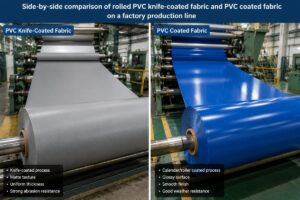
Coating structure matters because double-side coating adds an extra pass through the coating line, more PVC paste, and additional curing energy. For Qatar’s desert haulage, where both the cargo side and the sun-facing side face extreme heat and abrasion, double-side coating is not a luxury—it is a survival requirement.
UV and heat-resistant additives are where many quotes quietly cut corners. Standard UV stabilizers work well in temperate climates but degrade quickly under sustained high-intensity solar exposure. High-grade UV packages, often based on hindered amine light stabilizers, cost more per kilogram of fabric but extend service life dramatically. Some suppliers blend lower-grade stabilizers and still label the product “UV resistant.” The only way to verify is to ask for accelerated weathering test data [NEED_CITE: accelerated UV weathering test methods for coated fabrics].
Order format is the fourth driver. Rolls are cheaper per square meter because the factory ships them without cutting, hemming, or adding grommets. Finished covers include all of that labor and trimming waste. The gap between roll price and finished cover price is significant, and the right choice depends on whether you are a distributor with your own sewing line or a fleet buying ready-to-use covers.
| Cost Driver | Basic Spec | Mid-Range Spec | Heavy-Duty Spec |
|---|---|---|---|
| GSM Range | Light weight class | Medium weight class | High weight class |
| Coating Structure | Single-side coated | Double-side coated | Double-side coated with reinforced scrim |
| UV Grade | Basic stabilizer | Standard UV package | High-grade HALS UV package |
| Heat Resistance | Standard | Enhanced | High-temperature resistant formulation |
| Order Format | Roll supply | Roll or semi-finished | Finished with custom sizing |
A Middle East transport distributor once showed me his warehouse after a summer season. Pallets of cracked, faded 440gsm covers sat next to a smaller stack of 900gsm double-coated covers that were still in service. The per-square-meter price of the heavier spec was higher, but the annual replacement cost told a completely different story.
Which GSM and Coating Spec Survives Qatar’s 70°C Summer?
Standard 650gsm with basic UV fails within a single summer season in Qatar. 900gsm with double-side coating and high-grade UV lasts multiple seasons. The truck cover price in Qatar for the heavier spec is higher upfront but lower in annual cost.
Qatar’s summer is not just hot air temperature. The surface temperature of a dark-colored truck cover lying on a flatbed under direct sunlight climbs well beyond ambient. This is where basic UV treatment collapses. The PVC compound becomes brittle, micro-cracks form along the weave direction, and the coating begins to peel at the seams [NEED_CITE: PVC degradation mechanisms under high temperature and UV exposure].
Here is how the GSM and coating tiers actually perform in the field:
| GSM Class | Coating Type | UV Grade | Typical Field Life in Qatar Summer |
|---|---|---|---|
| 440gsm | Single-side | Basic | Vulnerable, single-season use only |
| 550gsm | Single-side | Standard | Noticeably reduced life vs heavier specs |
| 650gsm | Single-side | Basic | Fails within months under peak heat |
| 650gsm | Double-side | Standard | Moderate extension, still limited |
| 900gsm | Double-side | High-grade HALS | Substantially extended service life |
| 1000gsm | Double-side | High-grade HALS | Robust, multi-season durability |
A construction haulage fleet in the Gulf once ran a side-by-side test. One batch of trucks was fitted with 650gsm single-side covers with standard UV. Another batch got 900gsm double-side covers with high-grade UV. The lighter covers started showing seam cracking and surface chalking within months. The heavier covers were still intact after multiple seasons of continuous desert haulage. The truck cover price in Qatar for the 900gsm spec was higher per square meter, but the fleet avoided the cost of mid-season replacements and the downtime that came with swapping covers on the road.
The counterintuitive point is this: thickness alone does not guarantee survival. A 900gsm cover with poor UV formulation will still fail. A 650gsm cover with proper double-side coating and high-grade UV can outperform a heavier spec with inferior additives. The coating recipe matters as much as the weight.
How to Compare Truck Cover Quotes: Price vs Total Cost of Ownership?
The lowest per-square-meter truck cover price in Qatar often leads to the highest annual cost. Total cost of ownership—unit price multiplied by replacement frequency plus fleet downtime—is the only honest comparison.
When two quotes land on your desk, one at a lower price per square meter and one at a higher price, the instinct is to pick the cheaper one. In temperate climates, that instinct might be right. In Qatar, it is usually wrong.
The total cost of ownership framework is simple in structure but rarely applied in tarpaulin purchasing. You take the unit price per cover, multiply it by the number of replacements needed per year, and add the cost of vehicle downtime during each replacement. For a fleet running dozens of trucks, even a small increase in replacement frequency compounds into a significant annual expense [NEED_CITE: total cost of ownership methodology for fleet consumables].
Consider a typical scenario. A fleet of trucks needs covers that are replaced at regular intervals. If a basic-spec cover fails within a single season, the fleet buys multiple sets per year. If a heavy-duty spec lasts multiple seasons, the fleet buys far fewer sets. The unit price of the heavy-duty spec may be higher, but the annual purchase volume drops sharply.
| Cost Component | Basic Spec Cover | Heavy-Duty Spec Cover |
|---|---|---|
| Unit Price per Square Meter | Lower | Higher |
| Replacement Frequency per Year | Multiple replacements | Substantially fewer replacements |
| Annual Material Spend | Noticeably higher | Noticeably lower |
| Fleet Downtime per Replacement | Recurring | Minimal |
| Total Annual Cost | Higher | Lower |
A building materials hauler in the Middle East once calculated this after switching from a light spec to a heavy spec. The per-square-meter truck cover price in Qatar went up, but the annual spend on covers dropped because replacement cycles stretched out. More importantly, the trucks spent fewer days off the road waiting for cover replacements. That downtime cost was never on the original quote, but it was very real on the balance sheet.
The lesson is that comparing truck cover price in Qatar by unit price alone is like comparing fuel cost by price per liter without checking consumption rate. The number on the label is not the number that hits your budget.
Roll Supply vs Finished Covers: Which Buying Format Saves More?
Truck cover price in Qatar differs sharply between roll supply and finished covers. Distributors with sewing capacity save on rolls. Fleet buyers without in-house production save on finished covers with custom sizing and grommets.
This is one of the most misunderstood parts of the purchasing process. Some buyers automatically assume rolls are always cheaper and therefore always better. Others assume finished covers are more convenient and therefore always worth the premium. Neither assumption holds across all situations.
Roll supply means the factory ships wide-width fabric in standard or custom-length rolls. The buyer receives raw material and handles all cutting, welding, hemming, and grommet installation in-house. The per-square-meter cost is lower because the factory’s labor and trimming waste are removed from the equation. For a distributor who runs a local sewing workshop and serves multiple fleet clients, buying rolls makes strong economic sense. The distributor can cut to the exact sizes each client needs, add branded labeling, and capture the margin that the factory would otherwise charge for finished work [NEED_CITE: roll vs finished tarpaulin cost structure comparison].
Finished covers mean the factory cuts, welds, hems, and installs grommets or D-rings to the buyer’s exact dimensions. The per-square-meter price is higher, but the buyer receives a ready-to-install product. For a fleet that does not have sewing equipment or skilled welding operators, finished covers eliminate the need for local production infrastructure. The fleet also avoids the waste and inconsistency that come with in-house cutting.
| Buying Format | Per-Sqm Cost | Custom Sizing | Grommets and Finishing | Best Suited For |
|---|---|---|---|---|
| Roll Supply | Lower | Buyer handles | Buyer handles | Distributors with sewing capacity |
| Finished Covers | Higher | Factory handles | Factory handles | Fleets without in-house production |
A tarpaulin distributor in the Gulf region initially ordered only rolls to minimize unit cost. But he soon realized that his sewing team could not keep up with the variety of sizes his fleet clients requested, and waste from cutting errors was eating into his margin. He shifted to ordering a mix: standard-size rolls for his high-volume items and finished covers for the custom sizes. The blended approach reduced waste and improved delivery speed to his clients.
For a buyer evaluating truck cover price in Qatar, the right format depends on your operational setup. If you have the sewing line, the rolls give you flexibility and margin. If you do not, finished covers save you the capital and labor cost of building one.
How to Verify Quality Before Placing a Container Order?
Before committing to a container of truck covers, verify UV test reports, request sample rolls in your target GSM, and confirm coating type and additive grade. These steps prevent the kind of failure that turns a good truck cover price in Qatar into an expensive lesson.
The tarpaulin market has no shortage of suppliers who will quote competitive prices and claim UV resistance. But claims without verification are just words. When you are buying for Qatar’s desert conditions, the cost of a wrong container is far higher than the cost of a few sample rolls and test reports.
Start by asking for accelerated weathering test data. Reputable factories run their fabrics through UV chambers that simulate extended sun exposure and can provide test reports showing weight retention, color fastness, and tensile strength after a defined number of hours [NEED_CITE: ISO or ASTM accelerated weathering test standards for PVC coated fabrics]. If a supplier cannot produce this data, treat the UV claim with caution.
Next, request sample rolls in each GSM and coating tier you are considering. Do not rely on a single swatch. A full sample roll lets your local team cut, weld, and install a test cover on an actual truck. Run it through a summer season or, if that is not possible, expose it to direct sunlight for an extended period and inspect for cracking, chalking, or seam failure.
Confirm the coating structure in writing. Is it single-side or double-side? What is the UV additive package—basic stabilizer or high-grade HALS? These details should be on the proforma invoice, not just in a sales email.
| Verification Step | What to Request | What to Confirm |
|---|---|---|
| UV Test Report | Accelerated weathering data | Verifiable test house or in-house lab report |
| Sample Roll | Target GSM and coating | Physical inspection and field trial |
| Coating Structure | Written specification | Single-side or double-side confirmed |
| UV Additive Grade | Technical data sheet | High-grade HALS or equivalent confirmed |
| Weld Seam Strength | Seam peel test data | Consistent with base fabric strength |
A transport company in the Arabian Peninsula once placed a large order based on a price quote and a verbal assurance of UV resistance. No test report was requested. No sample roll was tested. When the covers arrived and were put into service, they failed within months. The truck cover price in Qatar had looked attractive, but the total cost—reshipment, replacement, and lost cargo protection—was far higher than what a proper heavy-duty spec would have cost from the start.
Conclusion
Truck cover price in Qatar is not a single number—it is a function of GSM, coating structure, UV grade, and buying format, and the real measure is total annual cost, not unit price. Matching the right spec to Qatar’s desert heat, verifying quality before ordering, and choosing the buying format that fits your operation are the three steps that separate a smart purchase from an expensive repeat order.