Vet Container Cover Tarp Manufacturer for Sweden Import: OEM & Bulk
The lowest price is often the most expensive line item on your Swedish import ledger.
To successfully vet a container cover tarp manufacturer for Sweden import, you must prioritize verified REACH compliance and independent GSM validation over initial unit cost. Swedish customs authorities, specifically TULLverket, enforce strict chemical safety and material consistency standards that frequently result in detention for non-compliant PVC shipments. A reliable supplier provides third-party lab reports for flammability and chemical composition before production concludes, ensuring seamless clearance at ports like Gothenburg.
I still remember the silence in the office when the phone rang from Gothenburg. It was not a celebration of a new order, but a notification that an entire container of container covers had been held at the port. The issue was not visible damage or missing paperwork, but a discrepancy in the declared weight versus the actual physical properties of the material. The local testing facility found the gram per square meter (GSM) value deviated significantly from the certificate, and worse, the plasticizers used did not meet the specific Nordic environmental expectations. That incident taught me that importing into Sweden is not merely about logistics; it is about technical adherence to rigorous European standards. When you vet a container cover tarp manufacturer for Sweden import, you are essentially auditing their ability to navigate these invisible regulatory barriers.
Many buyers assume that a waterproof certificate is sufficient. In reality, Swedish customs prioritize chemical safety and material durability under extreme cold. This guide breaks down the critical verification steps to ensure your supplier can deliver without triggering costly delays.
Why Do Swedish Customs Reject Tarpaulins?
Documentation gaps and chemical non-compliance are the primary drivers of customs detention in Sweden.
Sweden operates under the European Union’s regulatory framework, but its enforcement through TULLverket is notably stringent regarding environmental and safety standards. The most common reason for rejection is not the physical utility of the tarp, but its chemical composition. PVC tarpaulins require plasticizers to remain flexible, and certain phthalates are restricted under the REACH regulation. If a manufacturer cannot provide a valid test report confirming the absence of Substances of Very High Concern (SVHC), the goods may be held for weeks while authorities conduct their own analysis. [NEED_CITE: REACH regulation requirements for imported PVC products]
Another frequent issue is the lack of proper fire-retardant certification. For container covers used in transport and storage, compliance with EN ISO 6941 or similar European flammability standards is often mandatory. A factory might claim their product is "fire-resistant," but without a certified test report from an accredited laboratory, this claim holds no weight at the border. I have seen shipments where the manufacturer provided a self-declared statement instead of a third-party certificate, leading to immediate scrutiny and delay.
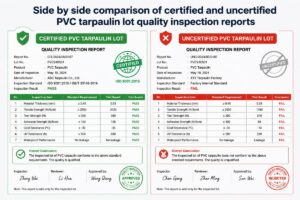
When you vet a container cover tarp manufacturer for Sweden import, ask for their REACH SVHC test reports and fire-retardant certificates upfront. Do not accept generic templates. Verify that the test dates are recent and that the batch numbers correspond to your specific order. A reputable manufacturer will have these documents ready and will understand why they are non-negotiable for the Swedish market.
How to Verify Material Consistency Before Shipment?
Independent third-party lab verification is the only safeguard against GSM discrepancies.
One of the most pervasive issues in the tarpaulin industry is the mismatch between declared and actual GSM. Manufacturers may declare a higher weight to justify a premium price, but the actual product may be lighter due to thinner coating or lighter base fabric. In Sweden, where quality expectations are high, such discrepancies can lead to rejection by the end-user or even customs if the declaration is deemed fraudulent. [NEED_CITE: Importance of accurate weight declaration in international trade]
To avoid this, do not rely on the factory’s internal quality control alone. Implement a pre-shipment inspection protocol that includes random roll sampling. Cut samples from multiple rolls across the container and send them to an independent laboratory for weight and thickness measurement. The tolerance should be tight, typically within a few percentage points of the declared value. If the actual weight is significantly lower, it indicates poor process control or intentional misrepresentation.
| Verification Aspect | Self-Declared by Factory | Independent Third-Party Lab |
|---|---|---|
| GSM Accuracy | Unverified / Potential Bias | Certified / Objective Data |
| Coating Thickness | Estimated / Sample Only | Measured / Batch Representative |
| Material Composition | Generic Statement | Detailed Chemical Analysis |
| Risk Level | High | Low |
In my experience, a professional manufacturer will welcome this level of scrutiny. For instance, Jinxiang provides pre-shipment third-party lab reports for GSM and coating thickness to ensure smooth clearance. This practice demonstrates confidence in their production consistency and reduces the risk of disputes upon arrival. When you vet a container cover tarp manufacturer for Sweden import, look for suppliers who offer this transparency as a standard part of their service, not as an optional extra.
What Certifications Are Non-Negotiable for Sweden?
Fire-retardant and chemical safety standards are critical for market access.
Beyond REACH compliance, specific performance certifications are required for container covers used in industrial and transport applications. The European standard EN ISO 6941 for flammability is a key benchmark. This test measures how quickly a material ignites and how fast the flame spreads. For tarps used near machinery or in storage facilities, a low flame spread rating is essential for safety and insurance purposes. [NEED_CITE: EN ISO 6941 standard details for textile flammability]
Additionally, consider the cold-crack resistance of the material. Sweden experiences harsh winters, and PVC can become brittle at low temperatures if the plasticizer ratio is incorrect. While there may not be a single universal "Swedish cold standard," suppliers should provide data on the material’s performance at sub-zero temperatures. Ask for test results showing the material remains flexible and crack-free at temperatures below -20°C. This is not just a comfort feature; it is a durability requirement for year-round use.
| Certification Type | Purpose | Relevance to Sweden |
|---|---|---|
| REACH SVHC Report | Chemical Safety | Mandatory for Import |
| EN ISO 6941 | Flammability | High Priority for Safety |
| Cold-Crack Resistance | Durability in Winter | Critical for Performance |
| UV Stability | Longevity | Important for Outdoor Use |
A credible supplier will have these certifications readily available and can explain how their production process ensures compliance. They should also be able to provide references from other European clients who have successfully cleared customs with similar products. When you vet a container cover tarp manufacturer for Sweden import, verify that their certifications are current and issued by recognized accreditation bodies.
How to Assess Manufacturer’s Export Experience?
Past performance in Nordic markets is a strong indicator of future reliability.
Experience matters, but not just any experience. You need a supplier who understands the specific nuances of the Swedish market. Ask for case studies or references from previous exports to Scandinavia. A manufacturer with a track record in this region will be familiar with the documentation requirements, packaging standards, and logistical challenges. They will know that pallets must be sturdy, labels must be clear, and paperwork must be precise.
Look for signs of proactive communication. A seasoned exporter will anticipate potential issues and address them before they become problems. For example, they might suggest specific packaging methods to prevent moisture damage during sea freight or recommend alternative materials if certain chemicals are facing tighter regulations. This level of insight comes from years of dealing with similar clients and learning from past mistakes.
When evaluating a potential partner, ask detailed questions about their export process. How do they handle customs documentation? What is their procedure for dealing with quality complaints? How do they ensure consistency across large batches? Their answers will reveal their level of professionalism and commitment to quality. A manufacturer that views these questions as burdensome is likely not the right fit for the demanding Swedish market.
Conclusion
Success in importing container covers to Sweden lies in rigorous pre-shipment verification.
Avoiding customs delays requires a shift from price-focused sourcing to compliance-focused partnering. By demanding independent GSM validation, verifying REACH and fire-retardant certifications, and assessing Nordic-specific export experience, you mitigate the risks that trap inexperienced buyers. When you vet a container cover tarp manufacturer for Sweden import, prioritize transparency and technical proof over initial quotes. This approach ensures that your goods clear TULLverket smoothly and perform reliably in the challenging Scandinavian environment.