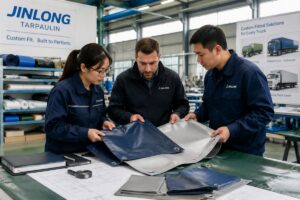
Waterproof Tarpaulin Supplier for Peru: China Factory Direct
Cheaper PE tarpaulins often cost more per year of service in Peru’s high-UV environment than heavier PVC options.
For Peru-based buyers, selecting a reliable waterproof tarpaulin supplier from China means balancing material type (PVC vs. PE), GSM weight range, UV stabilization levels, and landed cost structure (FOB vs. CIF Callao). The right spec choice prevents cargo rejection at port and avoids premature field failure under Andean sun intensity.
I still remember a shipment of heavy-duty PVC rolls we sent to Callao a few years back. The buyer had confirmed a specific blue shade via email, but nobody locked down a Pantone or Lab value. When the container arrived, the color was visibly off under the dock lights. The buyer’s end customer refused the lot, and we had to negotiate a steep discount just to keep the relationship. That single container taught me more about color control than any textbook ever could. Since then, I walk every Peru-bound order through a strict pre-production sample loop, and I always push buyers to confirm Lab values in writing before the coating line runs [NEED_CITE: color tolerance standards for coated flexible fabrics per ISO 105-A02].
Getting the spec right from day one is what separates a smooth import cycle from a costly dispute. Let me break down the four areas that matter most when you source from a waterproof tarpaulin supplier for the Peruvian market.
PVC vs PE Tarpaulin: Which Spec Fits Peru’s Climate?
PVC-coated polyester suits heavy-duty, long-life applications; PE laminated fabric fits lighter, shorter-cycle jobs. The choice hinges on expected service life, mechanical stress, and UV exposure intensity.
Peru’s coastal deserts, highland mining zones, and humid jungle regions each punish tarpaulin differently. Before I lay out the comparison, here is the core principle: PVC uses a polyester scrim coated on both sides with flexible PVC paste, while PE is a woven HDPE tape laminated with LDPE sheets. The structural difference drives everything else [NEED_CITE: coated versus laminated fabric construction methods in industrial textiles].
| Parameter | PVC-Coated Polyester | PE Laminated Fabric |
|---|---|---|
| Base Structure | Polyester scrim, knife-coated | HDPE woven tape, laminated |
| Typical GSM Range | Medium to heavy | Light to medium |
| Waterproof Mechanism | Continuous coating film | Laminate bond + weave density |
| Tear Resistance | Robust | Moderate |
| UV Endurance | Substantially extended | Noticeably reduced without stabilizers |
| Heat Weldability | Full batch-level seam integrity | Sample-level, depends on laminate quality |
| Flame Retardancy | Certified options available | Basic or none |
| Cost per Square Meter | Higher upfront | Lower upfront |
A mining client near Arequipa once asked why their PE covers kept cracking after a single dry season. The answer was simple: PE without adequate UV stabilizer degrades fast under coastal Atacama-adjacent sunlight. Switching to a PVC-coated roll with controlled UV additive dosing extended their replacement cycle by a factor of several times, which more than offset the higher per-meter price [NEED_CITE: UV degradation mechanisms in polyolefin versus PVC-coated textiles under high irradiance].
On the flip side, a distributor in Lima selling short-term construction covers found PE perfectly adequate. Their customers replaced covers every few months anyway, so paying for PVC longevity would have been wasted margin.
The takeaway: match material to actual use cycle, not to catalog price.
How to Avoid Color & Quality Issues at Callao Port?
Lock Lab color values, run a pre-production sample, and arrange third-party inspection before the container is sealed. These three steps eliminate the majority of Callao rejection scenarios.
Callao is Peru’s main gateway, and customs plus buyer QC teams there are particular. I have seen color disputes, GSM shortfalls, and roll-length mismatches all trigger claims. The pattern is always the same: insufficient confirmation before production.
Here is the workflow I follow with every buyer working with a waterproof tarpaulin supplier:
- Lab Value Confirmation – Buyer provides or approves a Pantone code; the factory converts it to a Lab value and sends it back in writing. Both sides sign off before the coating batch is mixed.
- Pre-Production Sample – A small roll from the actual coating line is cut, photographed under standard light, and couriered to the buyer. Approval is required before full production starts.
- In-Line Inspection – A third-party inspector checks GSM, coating thickness, width, and color consistency across multiple rolls during production, not just at the end.
- Final Random Inspection – Before container loading, rolls are sampled for visual defects, roll length, and packing marks. A photo report goes to the buyer.
- Export Documentation – Packing list, commercial invoice, bill of lading, and any certificates (flame retardant, UV test) are cross-checked against the physical cargo.
A mid-sized distributor in Trujillo once received a container where the GSM was slightly below spec across several rolls. Without an in-line inspection report, the dispute dragged on for months. After that, they mandated third-party inspection for every order, and claims dropped to near zero [NEED_CITE: role of pre-shipment inspection in reducing import disputes for coated fabrics].
The lesson is not that factories cut corners on purpose. It is that coating lines run long, and minor drift in paste viscosity or calender gap can shift GSM or shade over a multi-roll batch. Catching it mid-run is cheap; catching it at Callao is expensive.
What GSM Range Offers the Best Cost-Performance for Peru?
The mid-weight band covers the majority of Peru’s truck cover, agriculture, and mining shelter needs. Going heavier only makes sense for extreme abrasion or long-static installations.
GSM (grams per square meter) is the single most misunderstood spec. Buyers often assume heavier is always better, or they chase the lightest roll to save on per-container square meters. Both approaches can backfire.
A waterproof tarpaulin supplier offering a full GSM range lets you match weight to real stress, not to guesswork. Here is how the bands typically break down in the Peruvian market:
| GSM Band | Typical Use Case | Durability Expectation | Cost Position |
|---|---|---|---|
| Light Band | Temporary crop covers, short-term shelter | Moderate | Lowest per roll |
| Mid-Weight Band | Truck side curtains, general cargo covers, farm storage | Substantially extended | Balanced |
| Heavy Band | Mining equipment covers, long-term static shelters, containment | Robust | Highest per roll |
| Extra-Heavy Band | Specialized industrial containment, extreme abrasion zones | Very high | Premium |
The mid-weight band hits the sweet spot for most buyers. It handles the mechanical stress of trucking along the Panamericana, resists UV well enough for a multi-year field life, and still loads enough square meters per container to keep landed cost reasonable.
I worked with a fleet operator in Chiclayo who switched from a light-band PE to a mid-weight PVC for their grain transport covers. Their replacement frequency dropped noticeably, and the cost per year of actual cover service fell even though the per-meter price went up. That is the kind of math that only shows up after a full season in the field [NEED_CITE: relationship between fabric GSM, tensile strength, and service life in coated flexible fabrics].
Going heavier than the mid-weight band is justified only when abrasion is severe (like covering crushed ore) or the cover will sit static for years. Otherwise, you are paying for capacity you will never use, and you lose container loading efficiency because heavier rolls take up more weight before the container hits its payload limit.
How Does Factory-Direct Pricing Actually Work for Peru Buyers?
The quoted per-meter price is only part of the landed cost. Order volume, container type (full vs. consolidated), and Incoterms (FOB vs. CIF Callao) reshape the real number you pay per square meter on the dock.
Many buyers contact a waterproof tarpaulin supplier expecting the factory gate price to be the final number. It never is. Freight, insurance, port charges, and customs duties all layer on top, and the structure of your order changes how those layers stack.
Here is what actually drives your landed cost:
- Order Volume and MOQ – Factories run coating lines in batch sizes. A full container order spreads setup and handling cost over more square meters. Below a certain threshold, the per-meter price creeps up because the factory still has to change colors, clean the coater, and run quality checks.
- Full Container vs. Consolidated Shipment – A full container gives you the best per-cubic-meter freight rate. If your order is too small to fill a container, you share space in a consolidated shipment, and the freight cost per square meter can rise sharply, sometimes wiping out any factory-direct price advantage [NEED_CITE: freight cost structure differences between FCL and LCL shipments to South American ports].
- FOB vs. CIF Callao – Under FOB, you control ocean freight and insurance, which can be cheaper if you have a strong forwarder. Under CIF, the factory arranges everything, which is simpler but often carries a margin on the freight component. Neither is universally better; it depends on your logistics setup.
- Raw Material Fluctuation – PVC resin and polyester scrim prices move with global petrochemical markets. A factory-direct supplier with stable sourcing can hold prices longer, but buyers placing large orders should lock in pricing windows rather than assume quotes stay valid indefinitely.
A distributor in Arequipa once ordered a small batch of mixed GSM rolls to test the market. The per-meter factory price looked great, but the consolidated freight to Callao ate most of the margin. On their second order, they consolidated the GSM range into a single full container, and the landed cost per square meter dropped noticeably. That is the kind of volume leverage that only works when you plan the order around the container, not the other way around.
The honest advice: ask your waterproof tarpaulin supplier for a landed cost simulation, not just a factory quote. Run the numbers both ways (FOB and CIF, full and consolidated) before you commit.
Conclusion
Spec selection, color control, GSM matching, and landed cost calculation are the four pillars of a successful tarpaulin import into Peru. A waterproof tarpaulin supplier who walks you through each of these steps, confirms details in writing, and supports full export documentation will save you far more than the difference in per-meter price. Match the material to the climate, lock the color before the line runs, pick the GSM that fits the real use cycle, and model the landed cost before you sign the order.