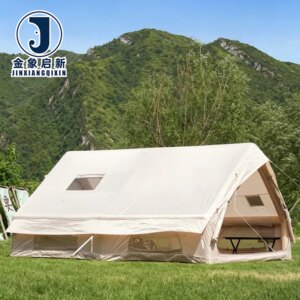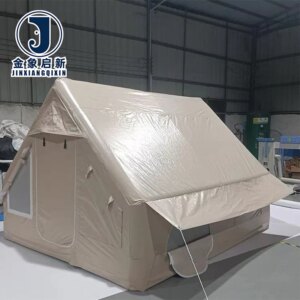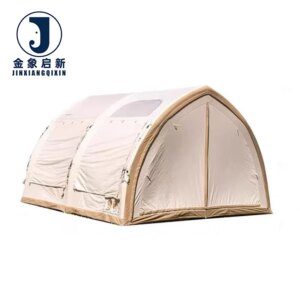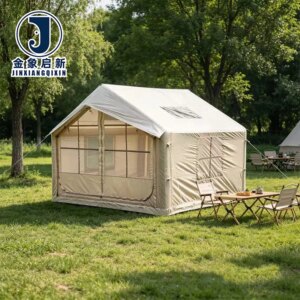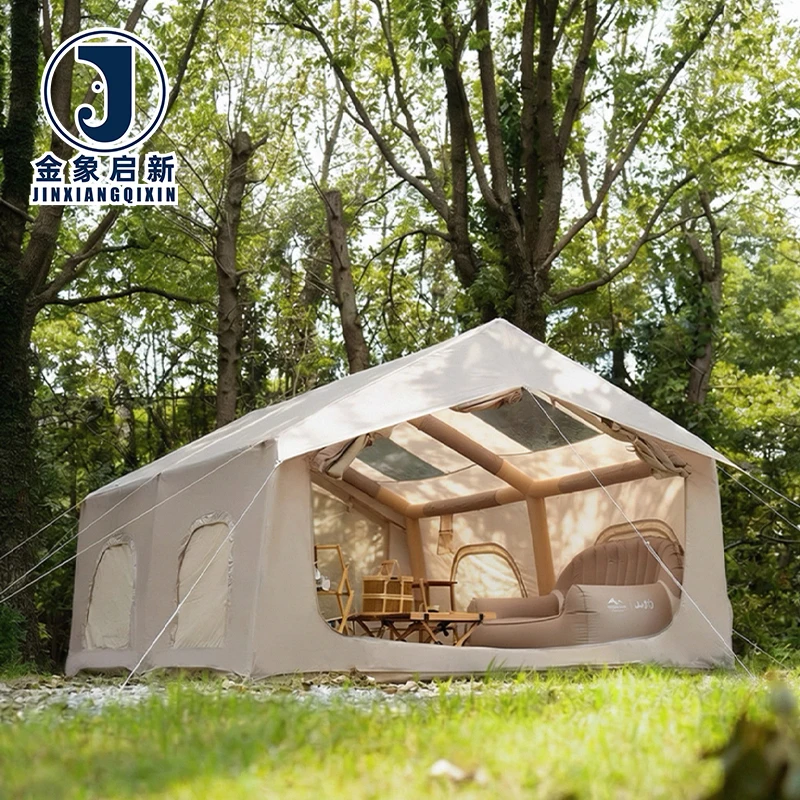
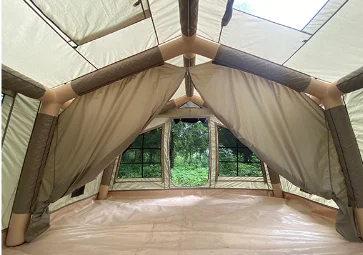
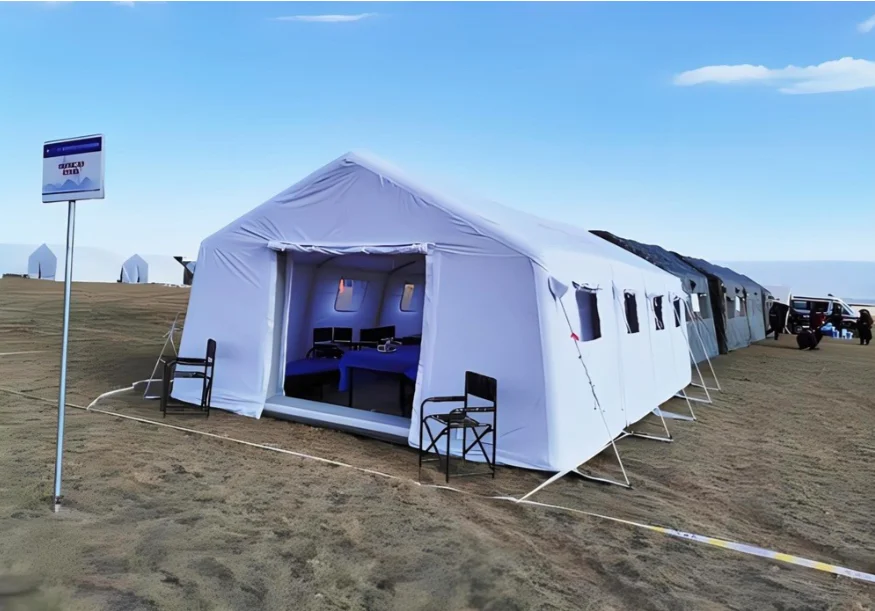
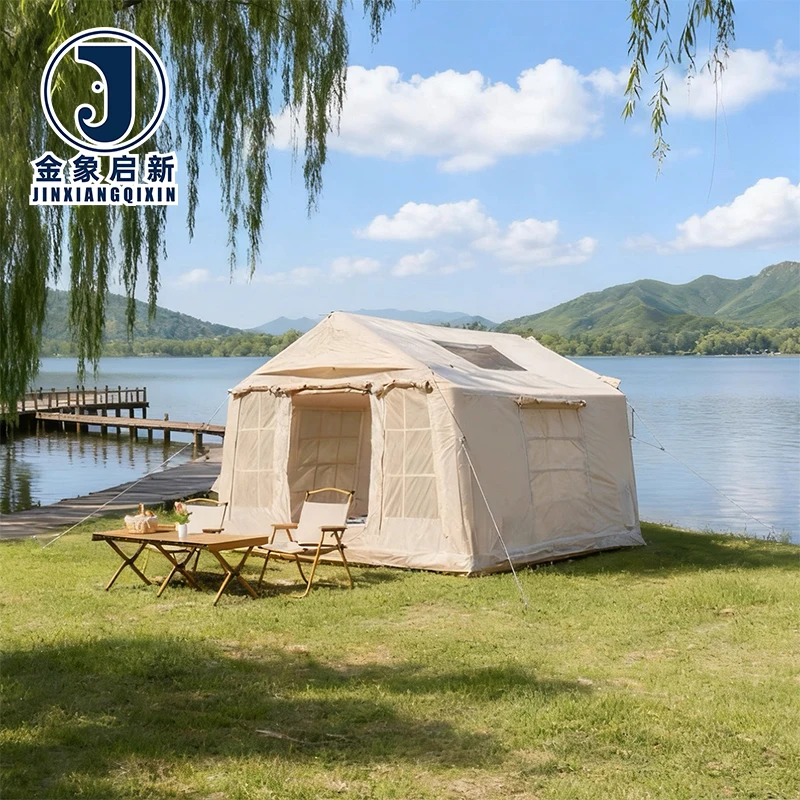
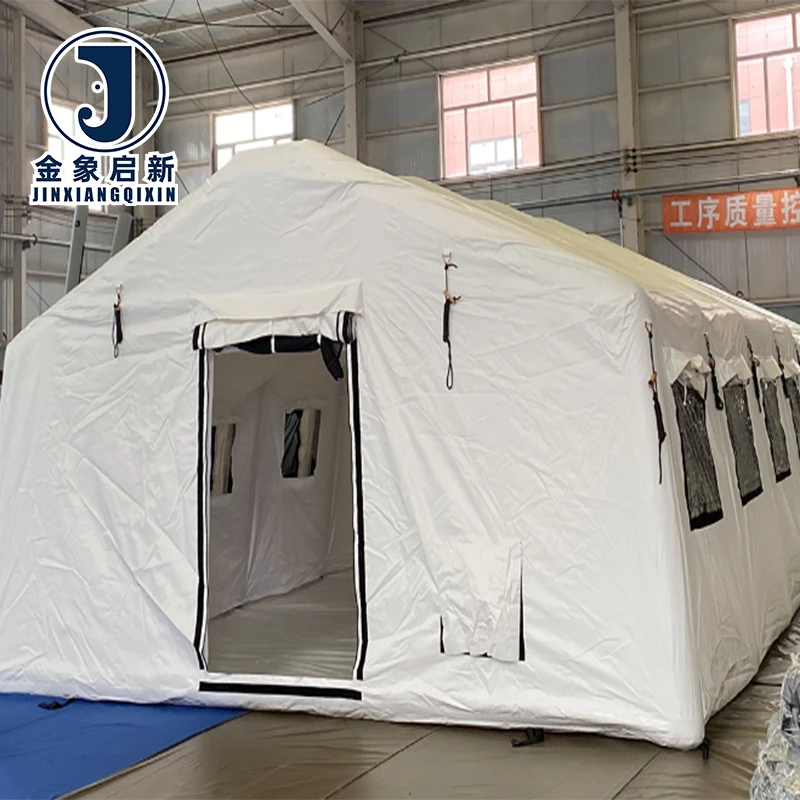
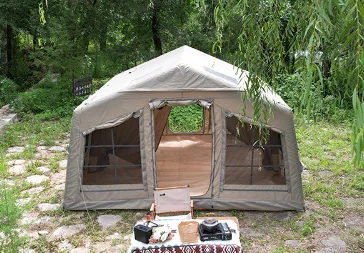
Inflatable Tent with waterproof PVC tarpaulin, UV-resistant and tear-resistant construction for commercial deployment.
- Single-layer design balances durability with transport efficiency across 1-12 person capacities
- 24-hour pressure retention testing verifies airtightness on every unit before dispatch
- Full OEM/ODM customization with pattern printing and sample development
- ISO & CE certified production ensures batch-to-batch consistency for bulk procurement
Supported by three dedicated production lines and 100% pre-shipment inspection with complete documentation including material specs and test reports.
Description
Deep Process Control — nearly 30 years focused on coated fabric with full in-process QA on coating weight and seam adhesion for every inflatable camping tent produced.
Technical Specifications
| Parameter | Value |
|---|---|
| Product Type | Inflatable Camping Tent |
| Core Material | PVC Tarpaulin |
| Construction | Single Layer |
| Capacity Range | 1-12 Person |
| Season Rating | Four-Season Design |
| Deployment Mechanism | Automatic Inflatable Opening |
| Key Performance | Waterproof, UV-resistant (test basis not stated), Tear-resistant |
| Customization Service | OEM & ODM — sample customization, pattern printing, size adjustments, material specification modifications |
| Quality Testing | 24-hour pressure retention test for airtightness |
| Certifications | ISO9001, ISO14001, ISO45001, CE |
Application Suitability
| Application | Exposure & Requirement |
|---|---|
| Temporary site accommodations for construction crews | Continuous outdoor exposure, wind load, repeated inflation cycles, abrasion from ground contact |
| Mobile field operations bases | Rapid deployment requirement, multi-season weather resistance, structural integrity under inflation pressure |
| Emergency response staging areas | All-weather reliability, fast setup without external frame, visibility and access configuration |
| Outdoor event infrastructure | Frequent setup and breakdown cycles, UV exposure during extended use, surface wear from handling |
| Group camping operations | Occupant capacity variation, ground moisture barrier, thermal retention in cold conditions |
What Happens When Inflatable Tent Fabric Fails at the Seam
Seam failure always costs more than fabric replacement — it costs project downtime.
When procuring an Inflatable Camping Tent manufacturer for commercial or industrial projects, the air-holding structure depends entirely on heat-sealed seams maintaining integrity under continuous internal pressure. I have seen coated fabric perform perfectly in tensile tests while the welded joints delaminate within the first inflation cycle. The failure point is rarely the PVC tarpaulin itself — it is where two panels meet under stress and flex repeatedly during deployment [NEED_CITE: tensile and tear test methods for coated fabrics per ISO 1421]. A seam that separates during a multi-day outdoor event or on a construction site creates immediate safety liability and forces unplanned replacement orders.
Coating Consistency Across Every Panel
The waterproof and airtight performance of a custom Inflatable Tent depends on uniform coating thickness across the entire PVC tarpaulin surface. Any variation in coating weight creates localized weak points where water ingress or air leakage develops under sustained inflation pressure. Our 10-person R&D team controls the coating process parameters and verifies adhesion at every production stage, ensuring the single-layer construction delivers consistent performance from the first panel to the last unit in a bulk order.
Airtightness Verification Before Dispatch
Each finished Inflatable Camping Tent undergoes a 24-hour pressure retention test that confirms the heat-sealed seams and valve connections hold internal pressure without measurable drop. This protocol catches manufacturing defects that visual inspection alone cannot detect — micro-channels in weld lines, incomplete fusion at panel intersections, and valve seat irregularities [NEED_CITE: airtightness testing standards for inflatable membrane structures]. Units that do not pass this extended hold test are rejected before packing, eliminating the scenario where a tent arrives on site and fails its first inflation.
Reading the Specification Sheet Beyond GSM
The PVC tarpaulin used for inflatable tent structures must balance air-holding capability with transport weight and pack size. GSM alone does not determine how well the fabric performs under inflation pressure — base fabric denier, weave density, and coating adhesion strength collectively define tear propagation resistance and weld line durability. A high-GSM material with poor coating adhesion will delaminate at the seam before a lower-GSM fabric with superior bond strength fails in the field [NEED_CITE: coating adhesion test methods for PVC tarpaulin per DIN 53354]. The single-layer construction selected here prioritizes the coating-to-substrate bond that keeps heat-sealed joints intact through repeated inflation and deflation cycles.
The Cost of Inconsistent Batch Quality
When ordering multiple inflatable tents for a single project — whether for a construction camp, event series, or emergency stockpile — colour variation between production batches and inconsistent seam quality create visible and functional problems on site. Tents deployed side by side with mismatched colour tones signal poor procurement control to end users and clients. More critically, units with varying seam integrity require individual pressure testing before every deployment, adding labour cost and delaying project timelines [NEED_CITE: batch consistency requirements for commercial textile procurement]. These failures trace directly to insufficient in-process quality control during coating and fabrication.
Why Procurement Teams Specify This Source
Dedicated QA and QC staff inspect raw material thickness, density, and coating adhesion before production begins, not only at final packing. The 9,180 square metre facility runs 3 full production lines with 36 sets of professional processing equipment, supporting volume orders without compressing inspection time. Sample development for custom sizes, pattern printing, and material specification modifications is completed within days, allowing buyers to verify fit and performance before committing to full production runs. Every Inflatable Camping Tent manufacturer claims quality — here, the pre-shipment inspection record and 24-hour pressure test data ship with your order as verifiable documentation.
Documentation & Verification
- Material specification sheet stating base fabric, coating type, and colour reference for every batch of inflatable tent fabric
- 24-hour pressure retention test record for each finished Inflatable Camping Tent confirming airtightness before dispatch
- Batch inspection report detailing raw material thickness, coating adhesion, and seam integrity results
- ISO9001, ISO14001, ISO45001, and CE certification documents supporting cross-border procurement compliance
- Pre-shipment inspection record with full unit count and individual test status before container loading
Fabrication, Handling & Storage
- Heat-sealed seams require controlled temperature and dwell time specific to the PVC tarpaulin coating weight used
- Store inflated or packed units away from sharp ground contact to protect single-layer construction from puncture
- Clean PVC tarpaulin surfaces with mild detergent only — abrasive cleaners damage the coating finish
- Avoid folding along the same crease line repeatedly to prevent coating crack at stress points
- Repair minor punctures with PVC-compatible adhesive patches matched to the coating formulation
- Allow full inflation pressure stabilization before applying guy lines or anchoring loads to the structure
Before You Request a Quote
Provide the intended application environment — construction site, event venue, emergency staging — along with expected occupant count and seasonal exposure conditions. Specify whether your project requires custom sizing, pattern printing, or material specification modifications beyond the standard range. Confirm any fire classification or compliance requirements your local jurisdiction mandates for temporary structures. Indicate your target delivery timeline and whether sample approval is needed before full production authorization.
Frequently Asked Questions
Q: What customization options are available for size and pattern printing on inflatable tents?
A: OEM and ODM services cover size adjustments, custom pattern printing, and material specification modifications. The 10-person R&D team develops samples within days for buyer approval before bulk production begins. Specify your required dimensions, print artwork, and any performance adjustments needed for your application environment.
Q: Does the inflatable tent include quality certifications for commercial procurement?
A: Production is certified to ISO9001, ISO14001, ISO45001, and CE standards. Documentation including material specification sheets, batch inspection reports, and pressure retention test records ships with every order. These documents support compliance verification for commercial and industrial procurement requirements across international markets.
Q: Can samples be provided before committing to a bulk order?
A: Sample development covers custom sizing, pattern printing, and material specification modifications for buyer evaluation. Samples are produced on the same equipment and coating lines as bulk orders, ensuring the approved sample accurately represents production quality. Approval of the sample triggers full production scheduling.
Q: How is batch consistency maintained across multiple inflatable tent units?
A: Raw material thickness, density, and coating adhesion are verified before each production run begins. Dedicated QA and QC staff conduct in-process inspection at every stage, and each finished unit undergoes a 24-hour pressure retention test. Colour reference standards are maintained per order to prevent variation between units deployed together.
Q: What documentation ships with each inflatable tent order?
A: Every order includes a material specification sheet, batch inspection report, pre-shipment inspection record, and 24-hour pressure test results for each unit. ISO and CE certification documents are provided for customs and compliance purposes. Certificate of origin and customs support documentation are available upon request for international shipments.
Related products
-
Inflatable Tent Family Size Four-Season Quick Automatic Opening Waterproof 2-8 Person Factory Direct Sale
Read more -
Aufblasbares Campingzelt Wasserdicht PVC Outdoor Luftzelt Einfacher Aufbau Familiencamping Schutz Vier-Jahreszeiten >3000mm Wasserdicht Schnell
Read more -
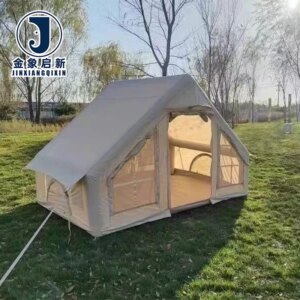
Outdoor Portable Camping Inflatable Tent Luxury All-Season Use Overnight Large Space Rainproof Insulated Quick Automatic Opening
Read more -
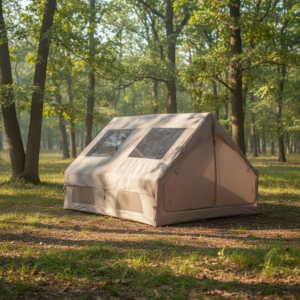
Inflatable Tent Four-Season Quick Automatic Opening PVC 3000mm Waterproof Foldable Eco-Friendly 2-3/3-4/6-8 Person Outdoor Use
Read more