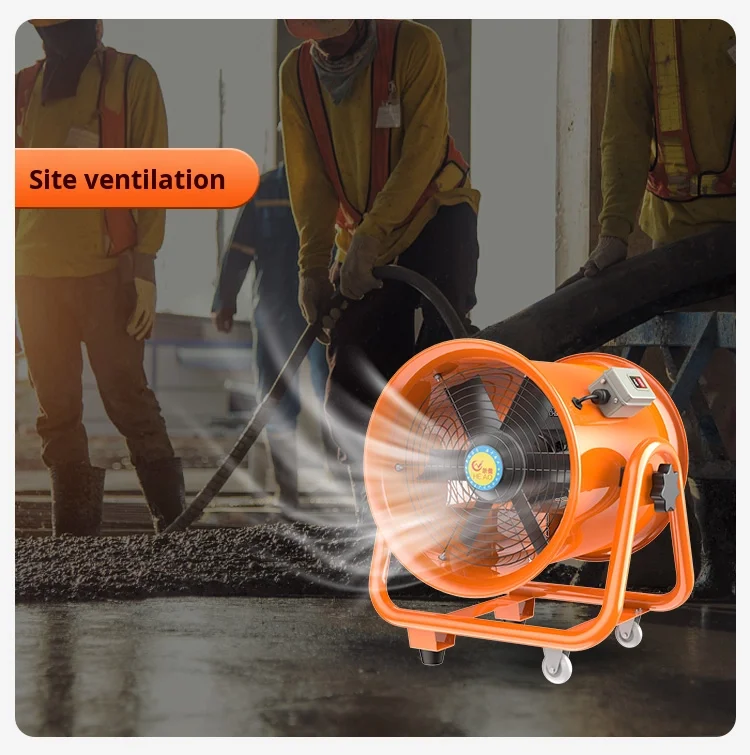
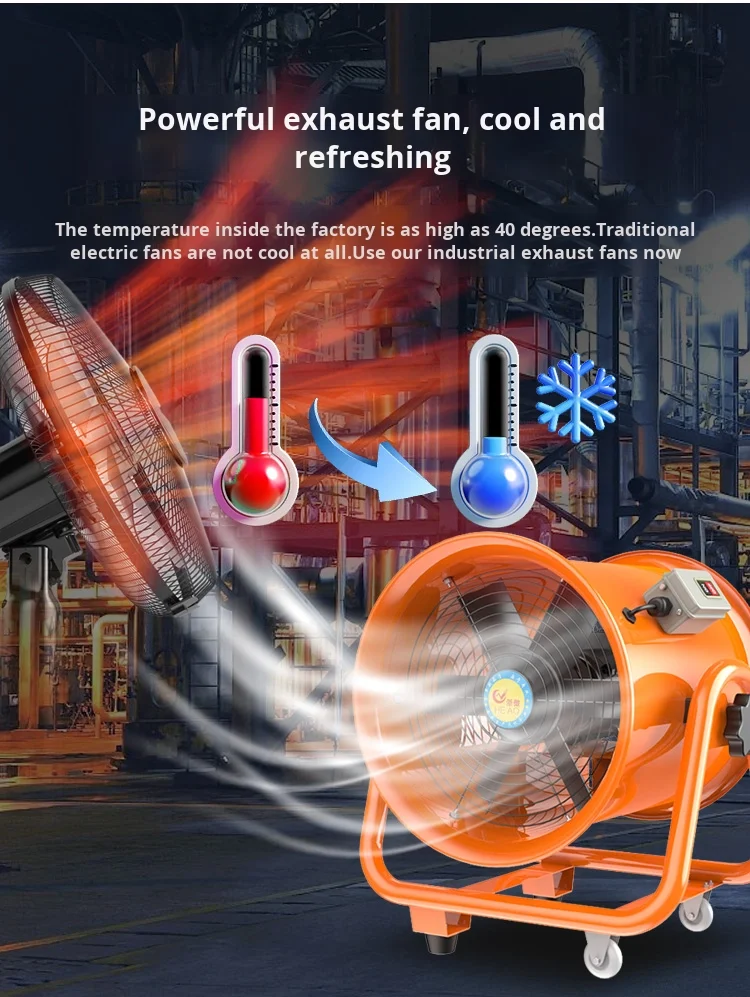
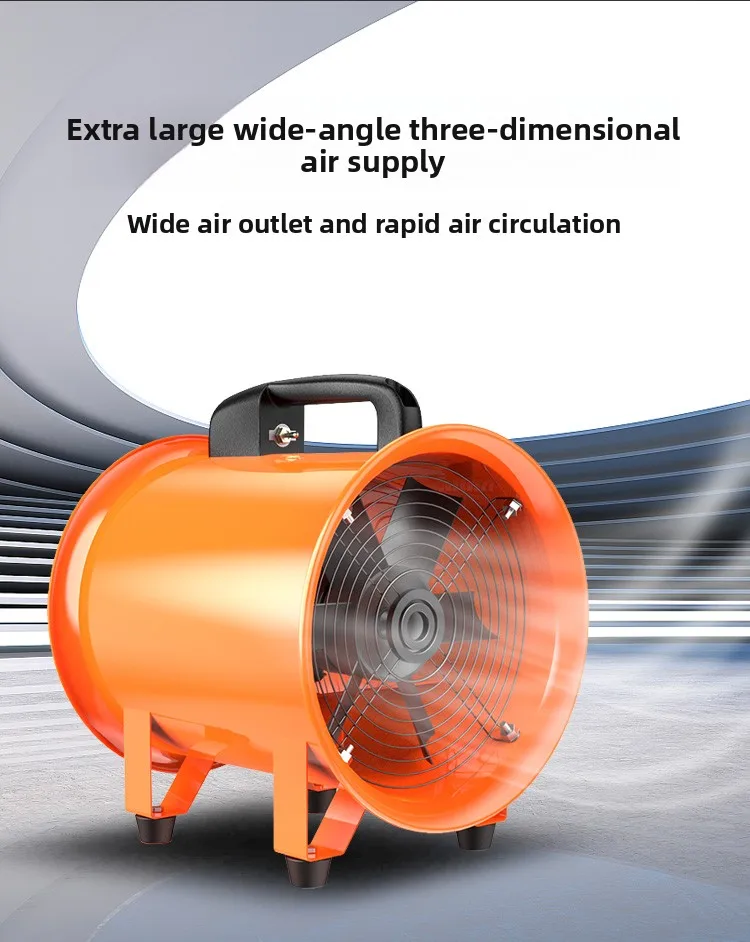
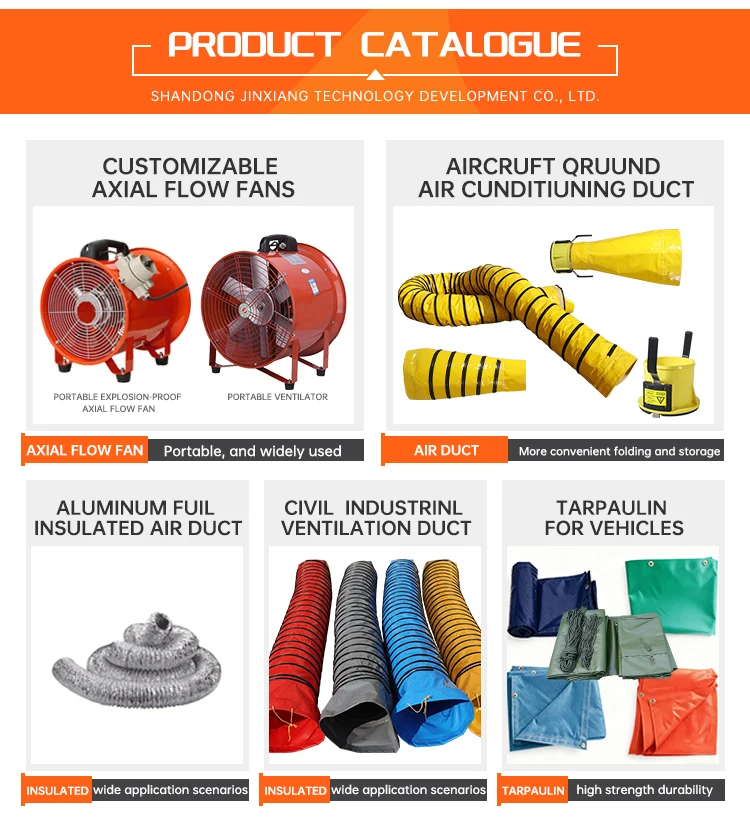

Portable Axial Flow Fan with Flexible Duct Hose, available in 200mm to 900mm sizes, 250W-5500W power range, 1300-28000 m³/h air volume — engineered for construction sites, factory floors, and confined space ventilation where standard blowers fall short.
- Dual voltage 220V/380V compatibility adapts to regional site power infrastructure
- Flexible duct integration routes exhaust around obstacles without airflow sacrifice
- Noise levels from 57-88 dB(A) allow deployment in occupied or residential-adjacent zones
Jinan Jinxiang backs every unit with dedicated QA at each production stage and 100% pre-shipment inspection, ensuring your ventilation system performs exactly as specified on arrival.
Description
Reliable Airflow Deployment — three full production lines support rapid turnaround on portable ventilation assemblies combining axial fans and flexible duct hose, ensuring consistent delivery for temporary and permanent site exhaust needs.
Technical Specifications
| Parameter | Value |
|---|---|
| Product Type | Axial Flow Fan |
| Size Options | 200mm / 250mm / 300mm / 350mm / 400mm / 450mm / 550mm / 650mm / 750mm / 850mm / 900mm |
| Power Range | 250W to 5500W |
| Air Volume Range | 1300 m³/h to 28000 m³/h |
| Total Pressure Range | 140 Pa to 320 Pa |
| Voltage | 220V/380V |
| Noise Level | 57-88 dB(A) depending on size |
| RPM | 3000 |
| Accessory | Flexible duct hose |
| Standards | ISO, CE |
Application Suitability
| Application | Exposure & Requirement |
|---|---|
| Construction site ventilation | Dust-laden air, debris impact, temporary mounting, variable routing around scaffolding |
| Factory floor exhaust | Continuous duty cycles, fume extraction, heat dissipation in occupied production zones |
| Confined space ventilation | Restricted access areas, tanks and vessels, underground chambers requiring flexible hose routing |
| Mining and tunnelling support | Extended duct runs, abrasive particulate, compliance with site-specific airflow mandates |
Ventilation Duct Supplied Without the Certification Your Site Requires
Confirm the fire-retardant or anti-static grade of the flexible duct fabric before the unit arrives on site, not after.
Contractors frequently specify a portable ventilation fan by air volume and pressure while leaving the duct material as a secondary afterthought. The duct is the component that contacts the atmosphere being moved — fumes, dust, welding gases — and it must meet the compliance standard enforced at your project. [NEED_CITE: fire-retardant and anti-static test requirements for flexible ventilation duct in mining and construction]. A Portable Axial Flow Fan with Flexible Duct manufacturer that cannot produce a test report matching your site regulation creates a compliance gap that halts inspections. Verify the documentation chain before committing to the order.
Matching Airflow Capacity to Duct Routing and Site Conditions
Air volume alone does not determine whether a ventilation setup performs adequately. Total pressure dictates how far the air travels through the flexible duct hose before flow drops below the threshold needed for effective extraction. Longer duct runs, multiple bends, and restrictive fittings all increase system resistance. Selecting from the available 200mm to 900mm size range requires cross-referencing your duct length and bend count against the fan curve for each model. This Axial Flow Fan aftermarket supplier provides units across the full diameter spectrum so that capacity aligns with the specific routing demands of your workspace.
Dual Voltage Compatibility for International and Mixed-Infrastructure Sites
Construction projects and industrial facilities operate on varying electrical standards depending on region and site infrastructure. The 220V/380V dual voltage support allows deployment across single-phase and three-phase supply environments without requiring external transformers or voltage converters. This eliminates a common point of failure where undersized transformers overheat during continuous ventilation duty. Specifying the correct voltage at the inquiry stage ensures the Portable Axial Flow Fan with Flexible Duct manufacturer ships a motor wound to match your site supply, avoiding delays from rewinding or replacement upon arrival.
Interpreting Fan and Duct Parameters for Procurement Decisions
The relationship between fan diameter, air volume, and total pressure determines whether a unit clears contaminants from your workspace or simply moves air in a short radius. Larger diameters in the 650mm to 900mm range deliver the 28000 m³/h air volume needed for high-ceiling factory bays or deep excavation sites. Smaller 200mm to 400mm units serve targeted extraction at welding stations or inside confined vessels. Noise output scales with diameter and power — the 57-88 dB(A) range reflects this, with smaller fans remaining within acceptable limits for occupied areas while larger units require hearing protection in proximity. [NEED_CITE: occupational noise exposure limits for industrial ventilation equipment per ISO 1421]. The flexible duct hose material must be confirmed separately: request the base fabric specification, coating type, and any flame-retardant or anti-static treatment grade to ensure it aligns with the environment the duct will serve.
The Hidden Cost of Underspecified Duct Material
When the flexible duct hose material is selected on price alone without verifying its compliance documentation, the consequences emerge during site audits rather than at delivery. A duct that lacks the required fire-retardant grade shuts down an entire work section until compliant replacement arrives, cascading into project delays. Duct fabric that cannot withstand the temperature of extracted welding fumes softens and deforms at the fan collar, reducing airflow and creating a safety hazard. [NEED_CITE: flexible duct temperature degradation and fire classification for confined space ventilation]. Batch-to-batch inconsistency in duct fabric weight means the hose that passed inspection on the last shipment may fail the same test on the next. These failures trace back to the specification stage, not the installation.
Why Source Ventilation Equipment Through This Supply Chain
Three full production lines with 36 sets of professional equipment maintain output capacity for bulk ventilation orders without compromising individual unit inspection. The 10-person R&D team handles custom duct diameter, hose length, and fan-to-duct coupling configurations when standard sizes do not match your routing requirements. Dedicated quality control at every assembly stage ensures fan balance, motor winding verification, and duct fabric integrity before packing. Pre-shipment inspection records document the tested air volume and pressure for each unit, providing traceability that generic wholesale suppliers do not offer. Nearly 30 years of experience in coated fabric production means the flexible duct hose material is understood at the coating level, not treated as a commodity accessory.
Documentation & Verification
- Material specification sheet stating duct base fabric, coating type, and applicable flame-retardant grade
- Fire-retardant or anti-static test report matching the compliance standard required at your project site
- Pre-shipment inspection record covering fan air volume, pressure output, and duct coupling integrity
- ISO and CE certificates verifying manufacturing standards for the fan and duct assembly
- Packing list detailing fan model, duct diameter, duct length, and voltage specification per unit
Fabrication, Handling & Storage
- Verify duct hose diameter matches the fan outlet collar dimension before clamping to prevent air leakage at the joint
- Store flexible duct hose coils horizontally on pallets to avoid permanent creasing in the coated fabric
- Route duct bends with a radius no tighter than the hose diameter to maintain rated air volume and total pressure
- Use compatible cleaning agents on the duct exterior that do not degrade the PVC or PE coating surface
- Inspect fan blade balance and motor mounting bolts after transit before first deployment on site
Specify Your Ventilation Requirements Before Quoting
To ensure the Portable Axial Flow Fan with Flexible Duct manufacturer provides an accurate specification, share the workspace dimensions, contaminant type, and required air changes per hour. State the fire-retardant or anti-static standard enforced at your site so the duct material is matched accordingly. Confirm your available voltage and phase configuration, along with the maximum acceptable noise level for occupied zones. This information eliminates guesswork and ensures the quoted combination performs as required upon arrival.
Frequently Asked Questions
Q: What fire-retardant or anti-static certification does the flexible duct carry?
A: The duct hose material specification depends on the grade required for your site. Request the material specification sheet and test report before ordering. The Portable Axial Flow Fan with Flexible Duct manufacturer can supply documentation for the applicable fire-retardant or anti-static standard — confirm the specific grade your project mandates.
Q: How do I match fan size and air volume to duct length and site airflow demand?
A: Calculate the total system resistance based on duct length, number of bends, and fittings. Compare this against the total pressure range of 140 Pa to 320 Pa for the fan sizes available. Longer runs with multiple bends require larger diameter units to maintain adequate air volume at the duct outlet.
Q: What duct fabric material is used and what is its temperature range?
A: The flexible duct hose base fabric and coating type are documented on the material specification sheet. Request this document along with any temperature test data to confirm the duct can withstand the heat load of the exhaust stream in your application before finalising the specification.
Q: Can the duct hose be customised in length, diameter, or colour?
A: Custom duct length and diameter configurations are available through the R&D team to match non-standard routing requirements. Colour and surface finish options can be confirmed at the sample stage. Specify your requirements during inquiry so the manufacturer develops a sample for approval before production begins.
Q: What documentation is included for site safety compliance audits?
A: Each shipment includes a material specification sheet, test reports for fire-retardant or anti-static grades where applicable, ISO and CE certificates, and a pre-shipment inspection record covering fan performance and duct integrity. These documents support site safety audits and regulatory compliance verification upon delivery.
Related products
-
Collapsible Water Storage Tank for Garden – Custom Made
Read more -
Portable 3000RPM Axial Flow Fan with Flexible Duct Hose for Industrial Exhaust Ventilation in Factories and Construction Sites
¥67.00 Select options This product has multiple variants. The options may be chosen on the product page -
Custom PVC Tarpaulin Water Storage Tank for Irrigation – Manufacturer
Read more -
PVC Tarpaulin 650 Gsm 630 Gsm for Truck Cover – Custom Made
Read more