Buy Boat Cover Custom Size | OEM Wholesale Manufacturer
A bigger cover does not protect your boat better — it pools rain, traps UV stress at fold lines, and accelerates fabric failure.
Ordering a custom size boat cover requires matching fabric GSM, seam welding method, and hardware grade to the vessel’s operating environment — not just length and beam measurements.
I grew up walking past the tarpaulin mills along the Shandong coast, where the smell of heated PVC compound hung in the air year-round. By the time I was old enough to step onto the production floor, I could tell a 440gsm PE roll from a 650gsm PVC roll just by the drag of the fabric against my palm. Years later, when I moved into export sales, I shipped a full container of custom boat covers to a marina operator in Florida. Within weeks, the eyelets rusted through because we had spec’d plain steel hardware instead of marine-grade stainless. The salt air ate them alive. That mistake still shapes how I talk to buyers today — specs first, then the reason behind them. [NEED_CITE: marine hardware corrosion rates by alloy grade in continuous salt spray environments]
Getting the dimensions right is only the starting point. Let me walk you through the decisions that actually determine whether a custom size boat cover survives one season or ten.
What GSM Weight Do You Actually Need for Your Boat Cover?
Fabric weight is the single most misunderstood specification in the cover industry — buyers default to the heaviest option available, assuming thicker always means better, when the real question is how long the cover must perform under what conditions.
Most marina operators and boat dealers I work with start the conversation by asking for the thickest material we produce. I always push back. A 1000gsm PVC cover on a vessel stored indoors for three months is overkill — you are paying for tensile strength and hydrostatic resistance the boat will never demand. Conversely, a 440gsm PE cover left on a center-console in Southeast Asian monsoon season will delaminate before the wet season ends. [NEED_CITE: hydrostatic head rating comparison between PE-laminated and PVC-coated polyester fabrics per ASTM D751]
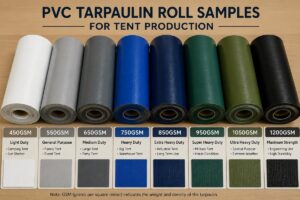
Here is how we map GSM to real-world application at the factory:
| Application Scenario | Fabric Type | GSM Range | UV Treatment | Seam Method | Expected Service Context |
|---|---|---|---|---|---|
| Short-term indoor storage, seasonal transport | PE laminated | 440gsm class | Basic | Heat welded | Sheltered, limited sun exposure |
| Year-round outdoor storage, moderate climate | PVC-coated polyester | 650gsm class | Enhanced | Heat welded | Full seasonal UV and rain exposure |
| Heavy-duty transport, barge loading, industrial repurpose | PVC-coated polyester | 900-1000gsm class | Industrial grade | Heat welded + reinforced | Continuous abrasion, stacking, harsh weather |
A construction client in the Middle East came to us needing covers for heavy equipment moved on barges along the coast. They had been using standard PE covers and replacing them constantly. We moved them to a 650gsm PVC with reinforced heat-welded seams — the cost per square meter rose, but the replacement cycle extended substantially, and the total cost of ownership dropped noticeably. [NEED_CITE: total cost of ownership analysis for industrial tarpaulin replacement cycles in marine transport]
The key point: GSM is not a quality ranking. It is an application match. When you order a custom size boat cover, tell the supplier exactly where the vessel sits, how long the cover stays on, and what loads it faces. That conversation eliminates most warranty disputes before the fabric is even cut.
How to Measure Correctly for a Custom Fit Cover?
Three critical dimensions plus contour allowance determine whether the cover sheds water cleanly or pools it at the weakest point of the fabric.
I have seen buyers send us length and beam width only, then wonder why the cover sags in the middle. A boat is not a rectangle. The gunwale height, the bow profile, the console elevation — all of these change how the fabric drapes and where stress concentrates. [NEED_CITE: measurement protocol for custom marine protective covers including contour allowance]
The protocol we follow with every custom size boat cover order:
- Overall length — measured from the bow tip to the transom edge, along the centerline, not along the gunwale curve.
- Maximum beam width — measured at the widest point, typically near the console or mid-ship, with the tape held level and parallel to the waterline.
- Height from gunwale to highest point — this is the dimension most often skipped. It determines how much fabric is needed to clear the console, T-top, or fishing rod holders without stretching.
- Bow and deck contour allowance — a calculated extra margin that lets the fabric follow the curvature of the bow without pulling tight at the cleats. Without this allowance, the cover fits on paper but tears at the bow eye within weeks.
A boat storage facility in Florida once sent us measurements for a fleet of similar-length vessels. The lengths matched, but the beam widths varied noticeably across the fleet because of different console configurations. We built a custom pattern template for each sub-group, with a tolerance range in centimeters that allowed one cover design to fit multiple hulls without alteration. That templating process cut their reorder complexity significantly. [NEED_CITE: custom pattern templating methods for fleet-wide marine cover fitting]
The most common mistake I see: buyers add “extra fabric just to be safe.” Excess fabric pools rainwater. Standing water accelerates UV degradation along the fold lines. The cover fails not because the material was weak, but because the fit was loose.
Which Seam Welding Method Holds Up in Marine Conditions?
Heat-welded PVC seams consistently outperform stitched-and-taped seams in continuous water exposure — the difference is not subtle, and it is verifiable in any marine textile testing lab.
Stitched seams are traditional. They are fast to produce, easy to repair in the field, and they work well for applications where the cover is removed frequently and stored dry. But in a marine environment — where a custom size boat cover sits on the vessel for weeks or months, exposed to salt spray, standing rain, and UV cycling — stitched seams become the weakest link. Water migrates through the needle holes. The tape backing degrades. The thread, even polyester-core, eventually wicks moisture. [NEED_CITE: seam integrity comparison between heat welding and stitched-taped construction in marine textile applications per ISO standards]
Heat welding fuses the PVC coating layers directly, creating a monolithic joint with no needle penetration. The seam strength approaches the tensile strength of the base fabric itself. Water ingress at the seam drops to near zero when the welding temperature and pressure are correctly calibrated.
| Seam Method | Water Ingress Resistance | Tensile Strength at Seam | UV Degradation at Joint | Field Repairability |
|---|---|---|---|---|
| Heat welded (PVC) | Robust | Comparable to base fabric | Noticeably reduced | Requires factory equipment |
| Stitched + taped | Vulnerable | Dependent on thread and tape adhesion | Accelerated at needle lines | Straightforward with patch kits |
| High-frequency welded | Robust | Comparable to base fabric | Noticeably reduced | Requires factory equipment |
We ran a side-by-side comparison for a Southeast Asian marina dealer who was losing covers to seam failure every monsoon season. The heat-welded PVC samples showed no measurable water penetration after extended salt-spray endurance testing, while the stitched samples showed wicking at the needle lines within a fraction of that duration. The dealer switched the entire fleet order to heat-welded construction. [NEED_CITE: salt-spray endurance testing results for heat-welded versus stitched marine tarpaulin seams]
If your custom size boat cover will sit on a vessel in a coastal or tropical environment, heat welding is not an upgrade — it is the baseline.
What Hardware Grade Survives Saltwater Without Rusting?
316 stainless steel is the minimum acceptable hardware grade for any custom size boat cover used in coastal or marine environments — 304 stainless and plain steel will corrode within a single season under continuous salt exposure.
This is the lesson that cost us a client relationship years ago, and it is the spec I now verify on every order before it leaves the factory floor. Brass corrodes. Plain steel rusts visibly within weeks. 304 stainless — often marketed as “stainless” without qualification — resists freshwater and light atmospheric moisture, but under continuous salt spray, it develops surface pitting and eventually structural failure. Only 316 stainless, with its molybdenum addition, holds long-term in marine atmospheres. [NEED_CITE: corrosion resistance ranking of brass 304 stainless and 316 stainless in continuous marine salt spray exposure per ASTM G85]
| Hardware Material | Freshwater Resistance | Coastal Salt Spray Resistance | Open Marine / Continuous Exposure |
|---|---|---|---|
| Plain steel (zinc plated) | Basic | Vulnerable | Vulnerable |
| Brass | Standard | Vulnerable | Vulnerable |
| 304 stainless steel | Robust | Standard | Vulnerable |
| 316 stainless steel | Robust | Resistant | Resistant |
The Southeast Asian marina dealer I mentioned earlier ordered a large batch of covers for center-console boats. We supplied them with standard steel eyelets because the initial spec sheet did not call out hardware grade explicitly. Within weeks, the eyelets were rusting through, staining the gelcoat, and failing under load. The entire batch had to be re-hardware’d at our cost. Since then, I have made it a point to confirm hardware material in writing on every marine order — no assumptions, no defaults. [NEED_CITE: field failure reports for non-316 hardware on marine protective covers in tropical coastal environments]
When you request a quote for a custom size boat cover, specify the hardware grade in the same line as the fabric and seam method. If the supplier does not ask you about the operating environment, that is a signal to ask harder questions.
How to Order Custom Size Boat Covers from a Factory Direct?
Working directly with a manufacturer — rather than a trading intermediary — gives you control over fabric selection, seam specification, hardware grade, and pattern approval before a container-load order is committed.
The ordering process for a custom size boat cover at factory level follows a defined sequence, and skipping any step introduces risk:
- Specification confirmation — fabric type and GSM, seam method, hardware grade, UV treatment level, and any special requirements such as fire retardancy or anti-fungal treatment. All parameters documented in a written spec sheet before sampling begins. [NEED_CITE: specification documentation requirements for OEM marine tarpaulin manufacturing orders]
- Pattern templating and measurement verification — for fleet orders or non-standard hull shapes, the factory produces a template based on the measurement protocol above. Tolerance ranges are agreed in writing.
- Sample production and approval — a pre-production sample is made to the confirmed spec. The buyer verifies fabric hand-feel, seam quality, hardware fit, and overall dimensions before bulk production is authorized.
- Bulk production with in-line quality checkpoints — fabric roll inspection, cutting accuracy, welding temperature logs, and hardware attachment checks at defined intervals.
- Pre-shipment inspection and documentation — dimensional verification on a statistical sample, packing method confirmation, and full export documentation including material test reports where required.
A boat dealer in Europe recently placed an OEM order for a new line of branded covers. They needed custom printing, specific color matching, and individual poly-bag packing with hang tags. Because the order went direct to the production facility, we controlled every step from the PVC coating line through to the final packed carton. The MOQ was flexible enough to accommodate their initial trial quantity, and the lead time held because there was no intermediary layer adding communication delay. [NEED_CITE: OEM manufacturing workflow for custom marine covers including MOQ flexibility and sample approval stages]
The advantage of factory-direct sourcing for a custom size boat cover is not just pricing — it is traceability. You know which fabric roll your covers came from, which welding machine sealed the seams, and which hardware batch was installed. When a warranty question arises years later, that traceability is what separates a resolved claim from a disputed one.
Conclusion
A custom size boat cover is an engineered product, not a generic tarp cut to length — fabric weight, seam construction, hardware grade, and measurement accuracy must all align with the vessel’s operating environment. Match the GSM to the exposure duration, specify heat-welded seams for coastal use, demand 316 stainless hardware without exception, and measure with contour allowance — not just length and beam. Work directly with a manufacturer who can trace every specification back to the production floor, and approve a physical sample before committing bulk volume.